Windham Life and Times – July 16, 2015

A Tribute to the “Common” Day Lily

daylilies-1

Well, they’re here again, and I really can’t go another year without giving a big shout out to the magnificent orange glow that appears in July and always makes me smile, even on the busiest of summer days. You can spot them virtually everywhere; blooms held high, along the roads, beside stone walls, reaching out along the lake shore or in front of a great old antique home. These aren’t the stuck up high-breds with there fantastic pallets, ruffled edges and giant blossoms. No these are the dependable, sturdy, gritty, ancient, and beloved Tawny Day lily (H.fulva).

Day-lilies arrived in Europe from China, Japan, Korea and Eastern Siberia, during the 16th century, and by the 17th century had crossed the Atlantic to North America. It is also supposed that America sea-captains involved with the Asian trade brought them home with them. Hemerocallis is Greek and roughly translates at “beautiful for a day. “Crude homesteads being carved out of the forests in the America were beautified by transplants from the Old Country and Asia. They were the carefree choice of pioneers who had no time to spend fussing with ornamentals. The appeal of the daylily with its vigor and rock hardiness, along with its ease in propagating, made it the perfect perennial. The plant also multiplies well and is seldom bothered by insects or disease and spread into large clumps.” Best of all, you can dig some out of the clump and they easily grow in their new locations. They are without question the “easy” of the flower world but just because their easy, doesn’t mean they’re not beautiful.

Daylilies-2

Of the dozen plus Hemerocallis wild species, two were definite favorites: the Tawny Daylily (H.fulva) and the Lemon Day lily (H.lilasphodelus). Both were treasured possessions at the turn of this century. Many escaped from abandoned homesteads and old cemeteries, naturalizing themselves with ease and are seen by some as weeds or an “invasive” threat. They grow in both full sun and in shaded areas happily opening in the morning, each blossom lasting for a day.

The writer of the “River Bliss” blog captures their nature, “Daylilies take full advantage of their day in the sun by remaining in bloom for the duration, whereas delicate chicory flowers close around mid-day when the sun is most intense. I stopped in my tracks to listen to the advice the day-blooming flowers offered about making the most of a brief existence. They said:

Quick! Dry your eyes!
There’s so much living to do.
Get to it!
The day is young,
and the day is short.

Wake up and engage it.
Don’t waste a moment
Wallowing in longing or regret.
You have this one day to work with
the material of Here and Now
So make the most of it.

“How interesting that the Chinese name for the daylily, xuan-cao, can be translated as “forget-worry herb” or “the plant of forgetfulness” because it was believed to alleviate worries by causing one to forget. When I stopped to connect with the essence of the day-lilies, I forgot mine!”

daylilies-3

So join me for the next few days and enjoy the humble yet noble Tawny Day-lilies, as they freely bloom for your sole enjoyment. Each bloom, shining brightly in crimson orange, for just one day. Day-lilies are also a reminder that it is approaching mid-summer and that its time to enjoy what’s left of New England’s fleeting warmth while it lasts.

 

Windham Life and Times – July 9, 2015

100 Years Ago in Windham

WS Harris in the Exeter Newsletter

Disaster as Searles Tax Windfall Ends | Tragic Drowning in Cobbett’s Pond

WINDHAM, JULY 2, 1915— “The family of John J. Smullen of Dorchester, Mass., are spending the summer vacation in Mrs. Blake’s house. Mrs. Ella Prescott and granddaughter Ella E. Cogger, are moving this week to their new home at Salem Depot, and the purchasers of the Prescott place, Miss Bertha E. Griffin and Mrs. Blanche G. North, of Somerville, Mass., are moving in for the summer.”

“Writs of “extent” levying on the property of the selectman and if necessary other citizens of the town have been served through Sheriff Spinney for the unpaid state tax of $11,000 and county tax of $8,000 due for the year 1914. It will come hard for the town to pay these large sums, but the longer it is fought the more there will be to pay (here is the background from a previous article.) APRIL 13, 1915— The town in special meeting today voted to pay 25 cents per hour for fighting forest fires, to authorize the treasurer to hire money as needed, and to authorize the selectmen to sell the stone crusher. Relative to state and county taxes it was voted that the Selectmen pay the state treasurer the $1,464 which the town claims is the rightful amount due the state, and to adjourn for four weeks until counsel for the town are able to report on the advisability of the state’s claim of $11,000.

Searles1I am guessing that this tax dispute had something to do with the Searles property assessment when the castle was his personal residence. MARCH 19, 1915—The inventory of the town as compared with the that year before indicates that the bottom has dropped out of something, the total valuation standing at $732,389, as compared to over six and half millions in April 1913.” The explanation is found in Rural Oasis; “In 1913 Searles was taxed (by the town of Windham) on his money at interest, that is for his liquid assets. This proved to be a windfall for the town because much of his wealth was in cash. The result was that the tax rate dropped to about 55 cents per $1,000 valuation. The town fathers’ reaction was: how can we spend all that money? With the approval of the voters the selectmen decided on a road building program. A steam roller and stone crusher were purchased and construction began at the Windham Depot to appoint three hundred yards south of Londonderry Road and on a portion of Kendall Pond Road north of Old Mill Road. However, the project was ill fated for two main reasons: first the attitude of the construction crew was geared more towards play than work. As one longtime resident explains, baseball was so popular that when the crew felt they needed practice they would do just that, practice, regardless of their work. Secondly, and more importantly was Searles erratic behavior. Upset by the huge tax assessment in 1914 he packed and established residency in New York, which he maintained until his death in 1920. This move left Windham facing a large state assessment with no way of paying it: $25,000 of gold notes were issued and the man whose departure had caused the trouble proceeded to buy half the amount. In addition he purchased the stone crusher for $2,500 while Hudson purchased the steam roller.” And herein lies the lesson for all state and local governments: Taxing the rich to bail out the government will only work if you cut off their feet. The rich are free to move from town to town and state to state when the tax burden placed on them become unbearable. This was the lesson that Windham learned the hard way in 1915.

“One of the saddest of drowning accidents occurred in Cobbett’s Pond Friday noon, June 25, when Roydon S. Pierce, of Dorchester, Mass., sixteen years of age, lost his life by the overturning of a canoe. Only the day before, young Pierce had come with his cousin, Edmund G. Wilson, to the Wilson cottage, to spend a week or two. While paddling about the pond alone, in some way he fell into the water, and although a good swimmer and not far from shore he was unable to reach the shore or canoe and sank in about twelve feet of water. His friends, Edmund Wilson, James and Howard Upham, hearing his cries for help, put off from shore with all possible speed and, diving, brought theCanoe body to the surface and to shore at Haseltine’s point. They, with the help of others worked for nearly and hour in unavailing attempts of resuscitation, until the arrival of Dr. E.A. Wade, of Salem Depot, who pronounced the case hopeless. Later in the day the medical referee, Dr. L.G. Dearborn, of Derry, with an undertaker, came and took charge of the body. Royden was the second of three sons of Mr. and Mrs. Charles Pierce, residing at 114 Rosseter Street, Dorchester, and was in his seventeenth year. He would have graduated from the Dorchester High School next year. A slight acquaintance was sufficient to reveal his exceptionally bright and winning personality. He was an attendant at the Harvard Congregational Church of Dorchester, where funeral services were held on Sunday afternoon. A pocket edition of the Book of Proverbs was found floating on the water where Royden sank, which it is thought he had been reading. The loss of this promising young life in so sudden and sad manner, with assistance in sight but too far away to be availing until too late, has cast gloom over the whole North Shore colony and all who knew the young man. The hope of immorality is the only thing that gives meaning to this present existence and unlocks its mysteries.” W.H.S. It is rather ironic that he was reading Proverbs when he stumbled out of the canoe into the water since one section reads as follows:

“My son, do not let wisdom and understanding out of your sight, preserve sound judgement and discretion; they will be life for you, an ornament to grace your neck. Then you will lie down in safety, and your foot will not stumble. When you lie down, you will not be afraid; when you lie down, your sleep will be sweet. Have no fear of sudden disaster or of the ruin that overtakes the wicked, for the Lord will be at your side and will keep your foot from being snared.” Proverbs 3: 21-26

Windham Life and Times – July 2, 2015

Canonbie, Canobie, Cannobie

How the Ethos of the Border Clans and Reivers Impacted America

The Border Reivers Spirit of Independence

The Border Reivers Spirit of Independence

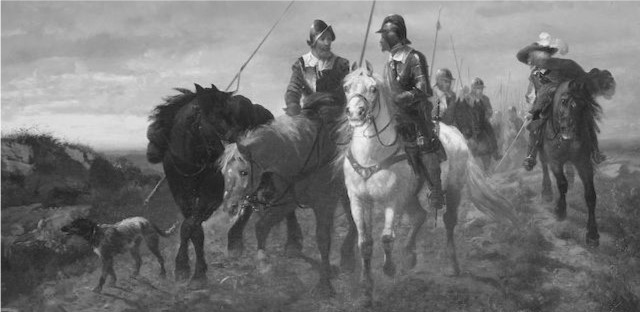
So you may be wondering what in the world does the history of the border clans and reivers have to do with the history of both Windham and America. The border clans and families moved from the “debatable lands,” first to Northern Ireland and then to America. Many came to this area of New Hampshire. Independence Day, might just be a good time to appreciate how much the Scots-Irish influenced the ethos of America. It all comes down to this; the border Scotch held honor above all, loyalty to family above all, and had an ingrained sense of individualism that made them rebel against centralized authority. The men of the borders prized their independence above all things, including the inconvenient laws issued by the “mere kings” of Scotland and England. For the most part they became small “d” democrats supporting the rebellion against King George III and backing presidents like Andrew Jackson who fought the power of the eastern elites.

“In many ways, their culture became American culture. The Scots-Irish (sometimes called the Scotch-Irish) are all around you, even though you probably don’t know it. They are a force that shapes our culture, more in the abstract power of emotion than through the argumentative force of law. In their insistent individualism, they are not likely to put an ethnic label on themselves when they debate societal issues. Some of them don’t even know their ethnic label, and some who do don’t particularly care. They don’t go for group-identity politics any more than they like to join a union. Two hundred years ago the mountains built a fierce and uncomplaining self-reliance into an already hardened people. To them, joining a group and putting themselves at the mercy of someone else’s collective judgment makes as much sense as letting the government take their guns. And nobody is going to get their guns. Quote from “Born Fighting: How the Scots-Irish Shaped America” written by James Webb.

Many fought for the South, but most gained no advantage from slavery and were not a part of the planter class, yet they fought tenaciously for “states rights.” Many more fought for the North. The hero of World War One, Alvin York was a pacifist from the hills of Tennessee, of Scotch-Irish and English extraction. And of course, the hero of the race to the moon, Neil Armstrong, was a direct descendant of the independent spirited reiver clans. It really is sad, that this county is so ignorant of its history, and that American public opinion is so easily swayed by the persuaders. The border reivers and the Scots-Irish immigrants would be appalled if they could see the strong hand that now rules America from above and the dependence on the government that personifies so many American lives. Happy Fourth of July.

Neil Armstrong on the Moon.

Neil Armstrong on the Moon.