Windham Life and Times – March 17, 2016

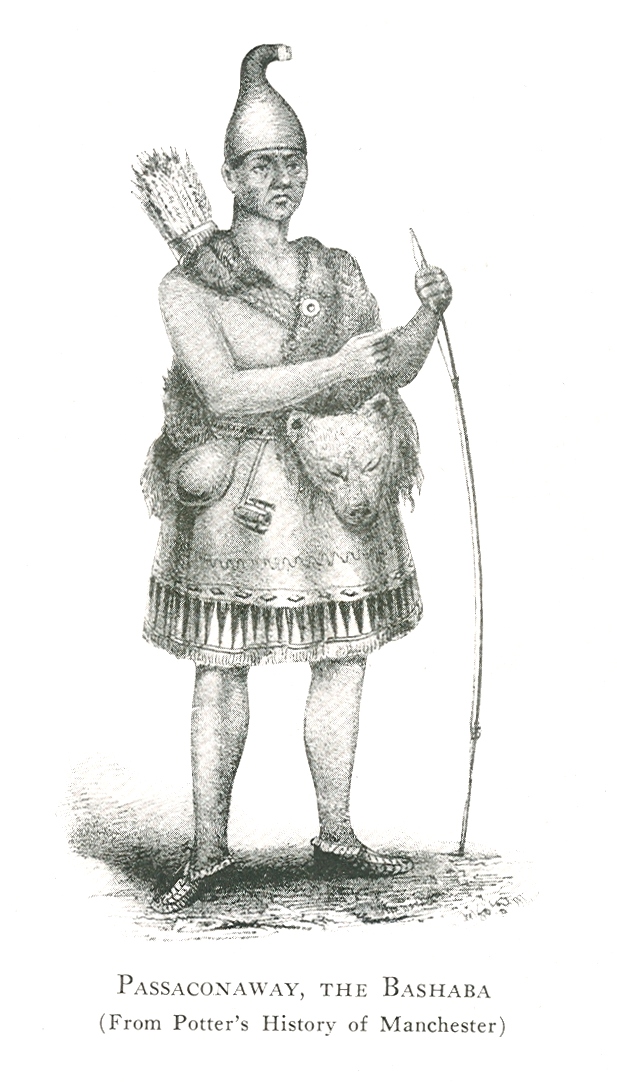
Pasaconoway

PART TWO | ACCOMMODATION WITH THE EUROPEANS | WHEELWRIGHT’S DEED

Imagine that you’re a great chief over a confederacy of Native American tribes. You have lost up to 80% of your people over the past 50 years or so to new and previously unknown diseases. The Europeans keep arriving in increasing numbers, and what was the traditional home of your people is right in the path of the onslaught. You are a shaman with great magical powers, which you have used in an attempt to cure the diseases and repel the Europeans. Nothing has worked, and it is obvious that the Europeans are more powerful than your people in both technology and military might. If this were not bad enough, Native American tribes from the north and west are attacking your people in constant warfare, further threating you and diminishing your numbers. The path that Passaconoway chose toward the end of his life, was an attempt at peaceful coexistence with the Europeans.

The first account of Pasaconoway comes from Thomas Morton, who left America in 1628 and printed the book The New English Canaan, in 1637, in London. In it he gives an account of “Passaconoway and among other curious matters relates the unhappy termination of a marriage between the daughter of Passaconoway and Winneperket, the Sagamon of Saugus. Winneperket and the old Sagoman’s daughter were married, with all the pomp and ceremony becoming their station—of the best blood in the country. Feasting, music, and revelry were the order not only of the day, but of the night, and a chosen band of warriors were sent to accompany the bride to her home, at Saugus, where they were feasted in turn, as became the royal groom. But a sumptuous feast did not make a happy marriage.”

“The young bride, the following spring, desired to visit her father, and Winneperket sent her to her father’s home, with an escort befitting her station. When she wished to return to Saugus, Passaconoway sent a messenger to Winneperket, to send for his wife. This message Winneperket took in high dudgeon, as he thought it insulting to him that Passaconoway, should not return her to him, with a fitting escort. In the beautiful language of Whittier, the Merrimack poet, Winneperket returned for an answer:–

I bore her as becomes a chieftain’s daughter
Up to her home beside the flowing water.
If now, no more for her a mat is found,
Of all which line her father’s wigwam round,
Let Pennacook call out his warrior train.
And send her back with wampum gifts again.
This message enraged Passaconoway, and he refused to send her back.
“Dog of the marsh!” cried Pennacook, “no more
Shall child of mine sit on his wigwam floor.
Go! Let him seek some meaner squaw to spread
The stolen bearskin of his beggar’s bed.
Son of a fish-hawk! Let him dig his clams
For some vile daughter of the Agawams,
Or coward Nipmucks! May his scalp dry black
In Mohawk smoke, before I send her back.”

“And the old Sagamon was as good as his word, for Morton adds that when he left the country, in 1628, she was still living with her father. At this time. Passaconoway was nearly ninety years old, as Gen. Daniel Goodkinkin, who was well acquainted with him, in after years, says he saw him in 1660, when he was about one hundred and twenty years old.”
“On the 17th day of may, 1629, Passaconoway with three subordinate Chiefs, sold the tract of land extending from the Piscataqua to the Merrimack, and from the line in Massachusetts thirty miles into the country, to the Rev. John Wheelright and his associates, for certain stipulated and valuable considerations… While some have pronounced this a forgery, other authentic documents have come to light that show the genuineness of this instrument.”

This transaction was one of importance. It shows that Pasaconoway as early as 1629, was not only chief of the Pennacooks, but that he was a Sagamon at the head of a powerful confederacy, and that this early he had the sagacity to see the superiority of the English, and to wish them as a barrier betwixt his people and their eastern enemies.”
“The deed expressly acknowledges on the part of the chiefs of the Pawtucket, Squamscot and Newichewannock, their being tributary to the Sagamon of the Pennacook; the 7th and last article stipulating that ‘every township within the aforesaid limits or tract of land that hereafter shall be settled, shall pay to Passaconoway our chief sagamore that now is and to his successors forever, if lawfully demanded, one coat of trucking cloth a year.”

“Passaconoway early saw the superiority of the English. And with his usual sagacity he saw the entire hopelessness of the attempts of his people to subdue them. His policy was to make terms of peace with them, and it was in pursuance of this policy that he disposed of his lands to Wheelwright, reserving alone his right to fishing and hunting. It was that he might have the English as protection against his enemies, who since the plague had thinned his people and were becoming a source of terror to them.”

Source: Historian C.E. Potter
Windham Life and Times – March 10,2016

Passaconaway

PART ONE

The Native Americans of the Merrimack Valley

Each and every day we live and travel in a place filled with Native American names, and never think about the people who bequeathed us their heritage.

From the late 1500’s though the arrival of the Europeans in 1620, the Merrimack Valley was a type of Eden to various Native American tribes. It all came to an end, because of inter tribal warfare, European plagues that killed upwards of 80-90% of the native population and the overwhelming numbers of European settlers. During this time “the most powerful tribes of the interior, and probably of New England, north of the Pequots, had their residence in the valley of the Merrimack, upon the productive falls and fertile meadows of that beautiful river.” The Merrimack afforded superior advantages for Indian settlements the most prominent being the rapids and falls that provided abundant fishing grounds. Spears, dip-nets, seines and weirs allowed the Native Americans to easily catch myriads of alewives, shad, and salmon. The woods along the banks were filled with moose, deer, and bears and the ponds, lakes and sources or its tributaries were teeming with water fowl.

“In this beautiful ‘Valley of the Merrimack,’ with all these attractions of fertile planting grounds, and abundance of fish, and hunting grounds of unlimited extent…It was the very paradise of Indian imagination.” The tribes along the Merrimack were the Agawam, Wamesit, or Pawtucket, Nashua, Souhegan, Namaoskeag, Pennacook, and Winnepesaukee. One of the largest settlements was located near the current city of Lowell, Massachusetts. “Wamesit, is derived from Wame (all of whole) and Auke (a place) with the letter “s” thrown in betwixt the two syllables for the sake of sound. The Indian village at this place, undoubtedly received this name from the fact that is was a large village where the Indians collected together. This was literally true in the spring and summer, as the Pawtucket falls, near by, were one of the most noted fishing places in New England, where the Indians from far and near, gathered together in April and May, to catch and dry their year’s stock of shad and salmon. Wamesit was embraced nearly in the present limits of the city of Lowell…The Indians in this neighborhood were sometimes called Pawtuckets, from the falls in the Merrimack, of that name. Pawtucket, means the forks, being derived from the Indian word Pohchatuk (a branch.) Pawtucket seems, however, to have been applied by the English, to all the Indians north of the Merrimack, rather than a particular tribe at the falls of that name.” “The Nashuas occupied the lands upon the Nashua and the intervals upon the Merrimack, opposite and below the mouth of that river. Nashua means the river with the pebbly bottom—” “The Souhegans lived lived upon the Souhegan River, occupying the rich intervals upon both banks of the Merrimack, above and below the mouth of the Souhegan. Souhegan is a contraction of Souheganash, and Indian noun in the plural number meaning worn out lands. These Indians were often called Natacooks or Nacooks, from their occupying ground that was free from trees, or cleared land—Netecook meaning clearing. The Namaoskeags resided at the falls of the Merrimack known by the present name of Amoskeag, in Manchester.” Namaske, Namaoskeag, Naumkeag, and Maimkeak, means the fishing place from Namaos (a fish) and Auke (a place.)

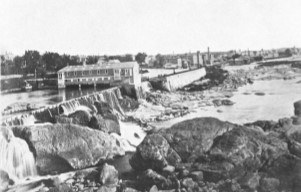
Amoskeag Falls after the native Americans were long gone and industrial development had begun.

Amoskeag Falls after the Native Americans were long gone and industrial development had begun.

The Pennacooks occupied the rich intervals at Pennacook, now embraced by the towns of Bow, Concord, and Boscawen. “They were thus called, from Pennaqui (crooked) and Auke, (place,) the intervals at Concord, which are extensive, being embraced within the fold of the Merrimack, which winds its way along, in a very crooked manner.” The Winnepesaukies occupied the lands in the vicinity of the lake of that name, one of their noted fishing places being at the outlet, now known as the Weirs, the parts of the permanent Indian weirs having remained long after the advent of the whites. “Winnepesaukee is derived from Winne (beautiful) nipe (water) kees (high) and Auke (a place) meaning literally, the beautiful water of the high place.”

“Of these several tribes, the Pennacooks were the most powerful; and either from their superiority, arising from a long residence upon a fertile soil. And hence more civilized; or from having been for a long period under the rule of a wise chief,—and perhaps from both causes united,—had become the head, as it were of a powerful confederacy. It is well known that the Winnepesaukee, Amoskeag, Souhegan, and Nashua tribes, were completely subservient to the Pennacooks; while the Wamesits were so intermarried with them, as to be mainly under their control, acknowledge fealty to Passaconaway, and finally, with the other tribes upon the Merrimack, became merged with the Pennacooks, and ceased to be distinct tribes, in fact or name.”

After the demise of the Native Americans, the rich fishing grounds of the Merrimack fell to the Scotch-Irish and other Europeans until industrial pollution and dams destroyed them.

Source: Historian C.E. Potter, History of Manchester formerly Derryfield

Windham Life and Times – March 3, 2016

Passaconaway

INTRODUCTION

passaconowayPassaconaway is an amazing figure in the history of New Hampshire, and more specifically the Merrimack Valley. Since we are taught the history of the Europeans, I would wager a guess, that less than 1% of the current residents of the area have even heard of him. I know, I know, he lived 350-400 years ago, that’s ancient history and doesn’t have any relevance to contemporary times, right? And he was a Native American after all, but his story is so amazing and compelling that he is a person who is worth the time it takes to remember him. His long and noble life deserves our attention.

Passaconaway is said to have been born between 1550 and 1570, and died somewhere near 1679. He lived to be over 120 years old. So he lived through a time of great change. He grew up in a land that was possessed by the Native Americans, when the Europeans were all but unknown. He saw the coming of the Europeans and pondered upon what it meant for himself and his people. He made peace with the Europeans and cooperated with them, and yet, they double crossed and killed members of his tribe and abused his two sons. His cooperation was not simple surrender, it was a well thought out plan to allow the Europeans to plant themselves as a bulwark against his enemies the Mohawks and other tribes who had been attacking his people in constant warfare. He was part of a community that had seen over 75% of his people die of plague and disease. And in old age, he watched as his world was destroyed by the overwhelming power and numbers of the foreigners. In his great prophecy, he councils his people to live in peace with Europeans, because they are destined to inherit the land and because he knew his own people did not have the power to resist.

Passaconaway is the bastardized English version of the chief’s name. “His name is indicative of his war-like character—-Papisse-conewa, as written by himself, meaning ‘The Child of the Bear,’ being derived from Papoeis (a child) and Kunnaway (a bear.) The name he doubtless received at mature age, according to the custom of the Indians, from his supposed resemblance in courage and bravery in war, to that ferocious and powerful animal.” (Potter’s History of Manchester)

The various European accounts of him say that he was a giant, a genius and possessed magical powers. The fact that accounts say he was a giant and a magician is very interesting, because of the obscure but well documented evidence found in the nineteenth century, in the mounds and burial places of the Native Americans, that giants lived among them. The findings and archeological evidence was suppressed by the Smithsonian Institute and others at the time of their discovery because the existence of giants didn’t fit their paradigm. So maybe, the legend of Passaconaway, his magical powers and intelligence was more truth than fiction and came by way of a “giant” ancestor, whose DNA still coursed through his veins.

Passaconaway was the sagamore or sachem (chief) of note among the Pennacooks and other tribes who lived along and near the Merrimack River in Massachusetts and New Hampshire. Later, he became the “Bashaba” (chief of chiefs) of many diverse tribes whose sachems were subject to him.

Finally, you should appreciate Passaconaway because you owe the very legal claim to your home and land in Windham, to him and the other sachems, who deeded it to the Rev. John Wheelright and his associates, on May 17, 1629. Forty years after his death, when the Scotch-Irish arrived in Londonderry, in 1719, there were only a few Native Americans roaming the area and only slight traces of Native American culture left….their best growing fields and dwelling places having been coveted and appropriated by the Europeans.

Windham Life and Times – February 25, 2016

Magic Lanterns

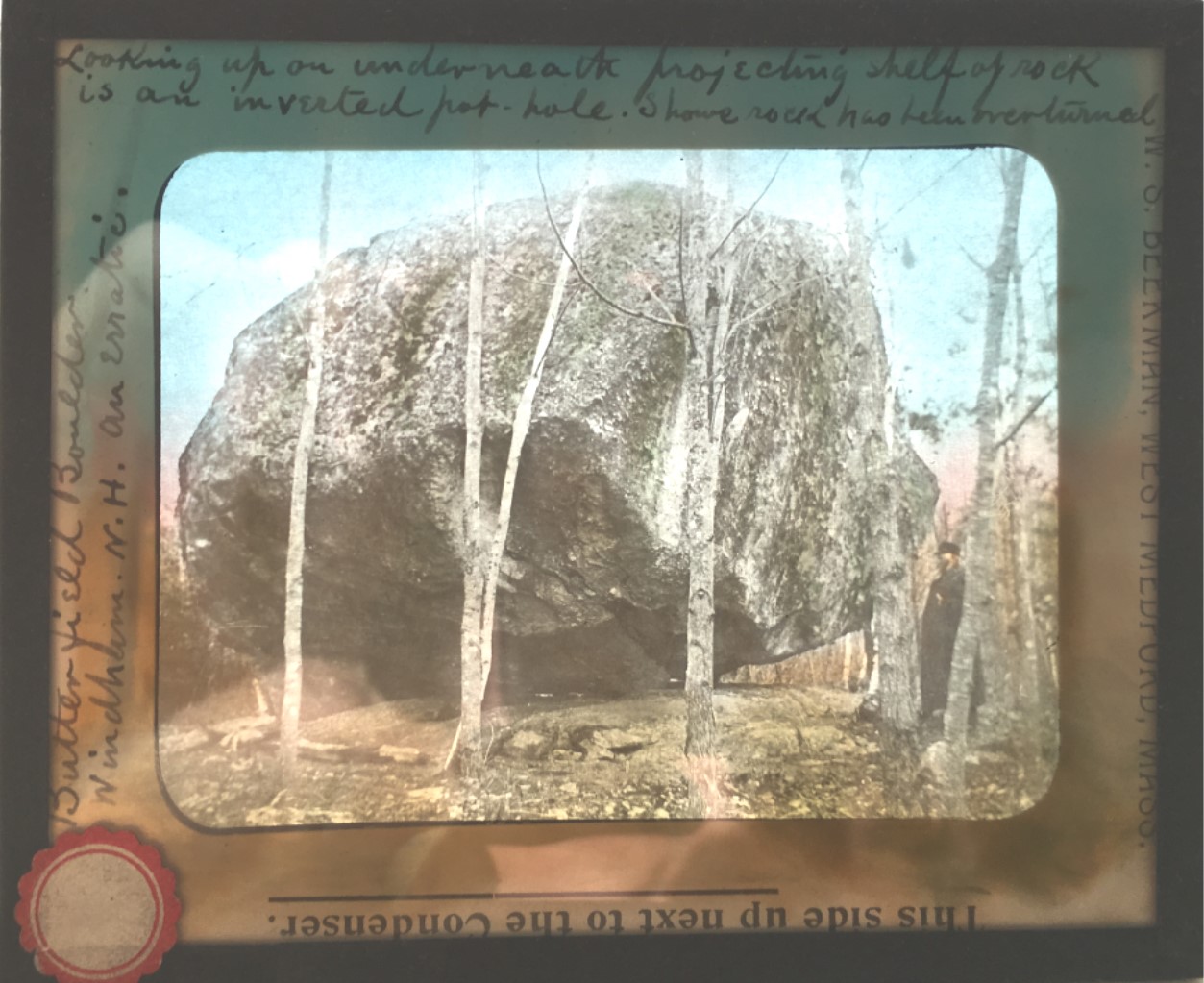
Magic Lantern Slide of Butterfield's Rock in Windham

Magic Lantern Slide of Butterfield’s Rock in Windham

“Imagine yourself back in the Victorian period, say in 1895, just before the birth of the movies.  Suppose you wanted to go out for an impromptu evening’s entertainment.  What would you do? The chances are you’d go to a magic-lantern show, or, as we Americans often called them, a “stereopticon show.”  Magic lantern shows were the combination of projected images, live narration, and live music that the movies came from.  They were incredibly popular 100 years ago…In 1895, there were between 30,000 and 60,000 lantern showmen in the United States, giving between 75,000 and 150,000 performances a year. That means there would have been several shows a week in your county.” (victoriana.com)

“A magic lantern consists of seven functional sections: the lamp, reflector, condensing lens, lens tube, body, base, and smokestack.  The lamp is the sole source of illumination, which often came from burning oil or gas, a burning piece of calcium, or later, electricity.  The reflector reflects the light from the lamp toward the condensing lens, which focuses the light onto the slide being projected.  The lens tube serves to magnify the illuminated slide, so that projected images from 6 to 12 feet wide can be obtained.  The body is often made completely of metal, and houses all of the previous components except the lens tube.  The base lifts the magic lantern above the surface of a table.  This is important because the body will become intensely hot from the illuminating lamp, and the base helps to prevent table burns.  Finally, the smokestack serves to vent the smoke coming from the lamp, so that the smoke doesn’t accumulate inside the lantern and put out the fire.”

butterfield-magic

“Hand-painted or photographic glass slides are inserted horizontally between the condensing lens and lens tube, through metal runners at top and bottom.  A skilled projectionist can move them quickly, and if the slides contain images of progressive motion, the projected image will appear to move.  Some slides can create complex, constantly moving displays, demonstrating that the magic lantern is not simply a still image projector.”