Windham Life and Times – May 27, 2016

Rock Pond

INTRODUCTION

Lucien Caron grilling on Rock Pond with his unhappy nephew Robert.

Lucien Caron grilling on Rock Pond with his unhappy nephew Robert.

Things have changed. It used to be that once Memorial Day hit, there would be released this pent up frenzy of activity, on the waterfront in Windham. Well, OK, there still is, to a degree, but it’s nothing like it was when the summer people were trying to squeeze in as much waterfront frivolity, family gatherings and buzzed activities as possible, with the little time they had to enjoy it. It was a time when summer floated on Budweiser, Schlitz and Narraganset, not craft beer, white wine and martinis. And food, there was always copious amounts of food, all of it bad for you! The smell of roasting meats on the barbecue, ethnic delicacies and home-made deserts wafted over the water.  There were buckets and boxes of Granite State Potato chips that you picked up warm in Salem, on the way to camp. Maybe in the morning your mother would pick out some whoopee pies or other treats from the back of the Cushman baker’s van. Ah, heaven! Family and friends packed the waterfront, chairs in a neat row overlooking the water. Time was spent on the screened porch or the yard, after all there was no air conditioning. You could hear the frivolity and laughter of all of the other people enjoying themselves around the shore of the pond or lake.

I still remember all the great people that rented summer cottages from my grandfather on Cobbett’s Pond. These were rustic affairs, with used furniture and bare stud walls, which had mellowed to a rich, reddish brown and all the cottages had huge screen porches facing the water. People lived on the porches and at night, they glowed with the ambience of a bare yellow light-bulb. There was a mixture of people from Lawrence, northern Massachusetts and Rockingham racetrack.  Horse owners, trainers and hard-working folks who also played hard. It wasn’t golf on the links, it was horseshoes and Bud. I still remember my friend’s Dad, coming home after working long hours as a pipe fitter, taking all of us out on the lake to go water-skiing. A beer in hand, he put up with us, as we asked to go again and again.

Now if you think it was all low brow you’d be mistaken. One of the best summer theaters in New England was located right on Range Road as was a pretty nine hole golf course. In New England, the point was that summer was short, and warm sunny days were few and far between. If you were paying the taxes and expense on a summer ”camp,” that you could use, maybe 3 months a year, you were going to make the most of every minute that you had on the water.

This summer, as the people of the lakes and ponds, lets make a commitment, to pay our respect, to our for-bearers in lakeside living. This year lets “go for the gusto” with non-stop partying, eating, drinking, boating, water-skiing, floating on rafts in the sun, sailing, skinny-dipping, nocturnal boat cruises away from prying eyes, fire-pits, and enjoying family, friends and neighbors. As a tribute to those who floated before us, let’s give it hell, along the shores of Windham’s lakes and ponds! Maybe we should turn off the AC and open the windows, and enjoy the sounds of boats and laughter as they pass in the night. None of us know what tomorrow will bring, a little joy in the small things is good for us all. Stop what you’re doing, stop worrying, crack open a beer and enjoy the moment! This little lecture is as much for me as for anyone else.

Happy Memorial Day

Go forth, grill meat and drink some beer, in memory of our lakeside for-bearers. And get a little too wild while your at it !

Many thanks to Robert Caron for the photographs and stories about his family and uncles Moe and Lucien on Rock Pond, in Windham.


Windham Life and Times – May 20, 2016

Edward Devlin

PART 4 – THE RAKU POTTERY PARTY

Windham May 21, 1974. The Eagle-Tribune.

By Sally Gilman

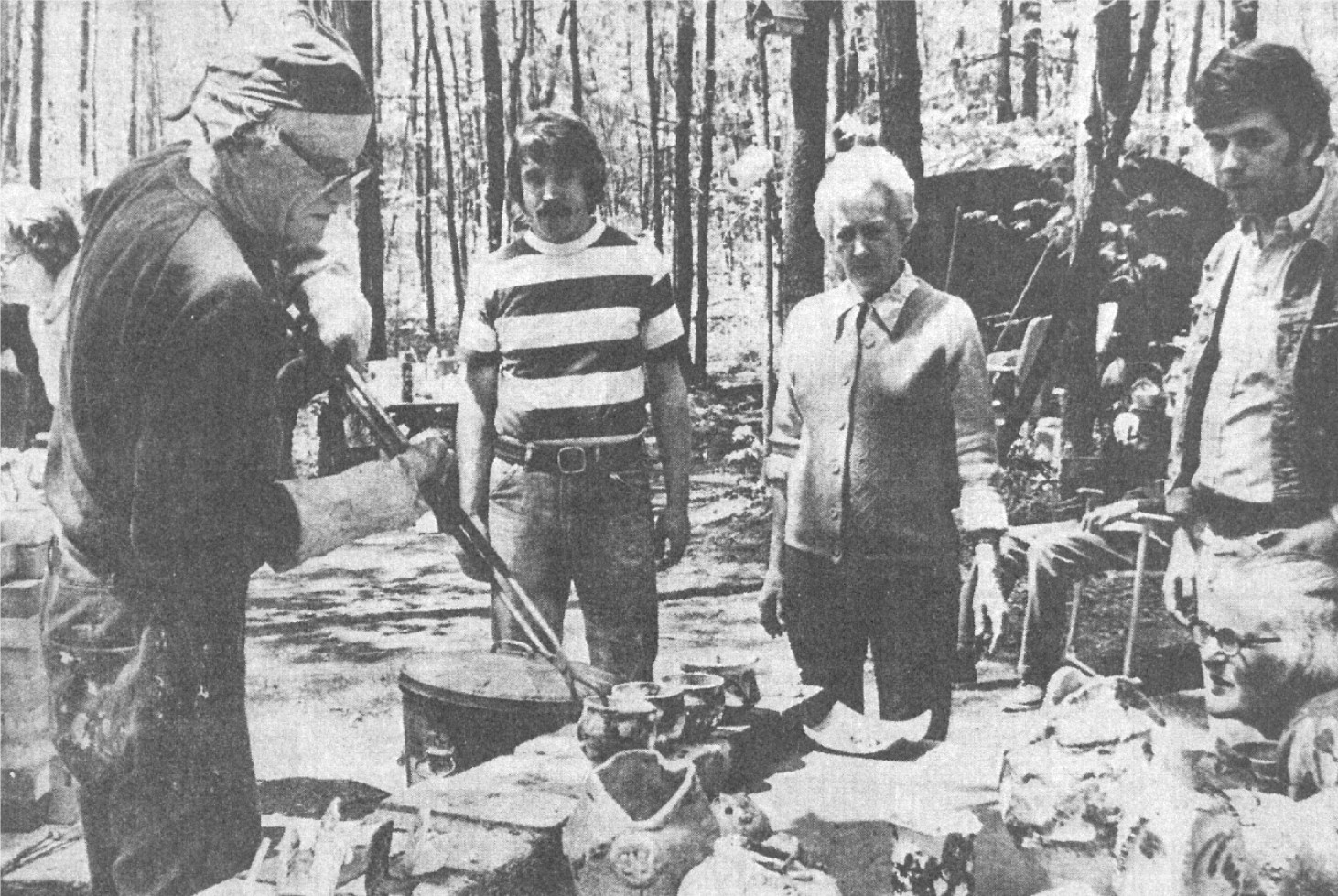
Ed Devlin and Edith Low with Raku pottery pieces.

Ed Devlin and Edith Low with Raku pottery pieces.


“When Edward and Pearl Devlin decided to throw a party for the Windham Arts Association, you could be sure it would be something quite different.”

“Since Devlin is a noted New Hampshire potter, he decided to have all the arts association members over to his studio for a Raku party.”

“Raku pottery had it origin in the tea bowls of the 16th century and the term “Raju” comes from the Chinese character meaning enjoyment, pleasure, contentment and ease.”

“Under the guidance of the Devlins, Raku was the ideal fun project for everyone.”

“Raku emphasizes the accidental and spontaneous and not the unblemished surfaces and sophisticated concepts in pottery.”

“The ground work for the Raku party was laid months ago, when Devlin gave each member of the local group a lump of clay and told them to go home and ‘Create.’ ”

“All sorts of containers, dishes, and plaques were turned out and brought to Saturday’s Raku party.”

“Working outside in old clothes, the members went up to their elbows in cans of glaze mixtures and dribbled paint of all colors over the clay objects, which had already dried and bisque fired by Devlin.”

“After the ‘potters for-a-day’  did their own glazing and decorative work on the pieces they were dried a second time.”

“Devlin using tongs, put the pieces into a glaze fire, leaving them there from 10 minutes to a half hour, depending upon the glaze composition and temperature.”

raku-2

“They were then removed with tongs and allowed to either cool off for subtle reduction effects on the metallic oxides and glazes, the red hot pot was put into a covered vessel containing combustible material. They were also put directly into cold water to freeze the glaze in a molten stage.”

“Devlin supplied everyone with some ‘practice’ pieces before they took on their original creations. The Windham Arts Association was so pleased with the final results, that it is planning to exhibit the Raku work at the Nesmith Library.”


Windham Life and Times – May 13, 2016

Edward Devlin

PART 3 – The Potter’s Craft in His Own Words.

devlin-wheel

     “ ‘Best therapy there is,’ said Edward Devlin as he looked up from his dripping ball of clay on his potter’s wheel. ‘You just work out your frustrations on this ball of mud and before long you are so busy feeling good about what you’ve made and forget about anything else that might have been bothering you. Everybody has an innate desire to make something– to create something that is his own; and nothing is more rewarding than working at something you love.’ ”

These are the words Mr. Devlin used to describe his own work, which he pursues each day in the little studio set back from the road in Windham.”

“ ‘Here you start at the beginning, and get your hands right in the medium. Every-time you make something that is altogether new…People today are more interested in doing what they want to do than what they must do. Young people want an outlet for self-expression, and older people want a chance to relax. They are looking for a gap in the rat race.’ ” Derry News, September 25, 1969.

     “ ‘I like making things with my hands. I like things that have a function and I hope that other people can get as much pleasure in using them as I do in making them.’ he said. ‘Some craftsman like to go on and on about artistic mumbo-jumbo. But I think that whole philosophical thing is a lot of hogwash.’ ”Eagle Tribune

He has had samples of his pottery exhibited in the Cleveland Museum, the Boston museum and Cochran Gallery in Washington D.C. He was an active member of the NH League of Craftsman

He has had samples of his pottery exhibited in the Cleveland Museum, the Boston museum and Cochran Gallery in Washington D.C. He was an active member of the NH League of Craftsman

     “ ‘He admits with a grin that his driveway is filled with things that didn’t turn out the way I wanted them.’ Accidents do happen and sometimes a piece will break…It’s best to know what you’ll find when you open the kiln, but sometimes something unexpected happens that is very nice. No matter what the effect, it’s gratifying to create something beautiful,’ he said.” “ ‘It’s a lucky man who works at what he likes to do best,’ he said, and rubbing his clay covered hands upon his huge apron he went on, ‘like me.’ ””

“Edward Devlin is Windham’s resident potter. Almost anyone in town can direct you to his home…‘These are mostly non-symmetrical pieces—the design motivated by organic growth and plant forms.’ Mr. Devlin said… Pottery can be divided into three general classes: earthenware, stoneware and porcelain. In Mr. Devlin’s studio are many examples of all three classes. But, he works primarily with stoneware, however. “I haven’t been doing too much work on earthenware lately. It involves too much preparing. I like the delicate colors of stoneware—there’s more refinement than in the colors of earthenware,’ he said.” “ ‘Freedom of expression.’ That is how Mr. Devlin sums up his interest in pottery…Sally Gilman, Eagle Tribune, March 18, 1969.


Windham Life and Times – May 6, 2016

Edward Devlin

PART TWO

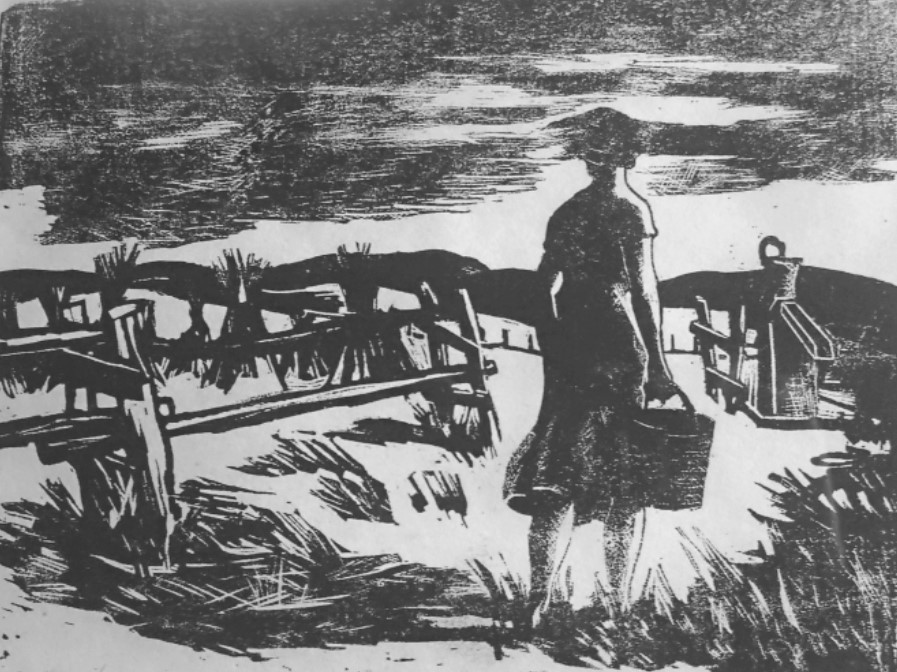
“In the print, Red showed his 19 year old bride walking through the fields in need of water for the strawberry plants. Life so naturally blended with the practical needs of family, that, over time, the gardens expanded, livestock increased, a new farm was bought, and five children were born. Her sole indulgence were flowers, wild and cultivated, where she found beauty after hours of toiling.” On their fiftieth wedding anniversary, Dad nicely summed up their life together when he gently said, ‘Could Not Be Better”. With a wide smile

“In the print, Red showed his 19 year old bride walking through the fields in need of water for the strawberry plants. Life so naturally blended with the practical needs of family, that, over time, the gardens expanded, livestock increased, a new farm was bought, and five children were born. Her sole indulgence were flowers, wild and cultivated, where she found beauty after hours of toiling.” On their fiftieth wedding anniversary, Dad nicely summed up their life together when he gently said, ‘Could Not Be Better”. With a wide smile

We know from Ed Devlin’s own words that “he was never quite satisfied with life in the big city saying ‘I’m a country boy at heart.’ He also was quoted as saying, “New York is just not my bag. It’s too fast a pace for me, the city’s too impersonal.” “And when his friend, George Lloyd called him to help paint the mural for Hamilton Smith Hall, at the University of New Hampshire, Devlin grabbed the offer.  ‘It was a good excuse to get out of New York…I liked New Hampshire so much I decided to stay.’ ”  This was in 1939-40 and the project was a massive mural.

“Artist George Lloyd was on a mission to find a ‘real’ farmer. It was the spring of 1939, and, having been commissioned to paint a mural about agriculture that would cover one entire wall inside Hamilton Smith Hall, he wanted to be sure he could depict a New Hampshire farmer accurately. With UNH agriculture professors as his guide, he soon found his models out in the fields, piecing together a way of life in the aftermath of the Great Depression—much the way he was doing, himself. Lloyd was one of the unemployed artists who had been hired under the auspices of the Federal Art Project branch of the Work Projects Administration, a national program created by U.S. President Franklin D. Roosevelt to provide productive work to some 8.5 million citizens in lieu of unemployment benefits. Coordinated by Manchester artist Omer T. Lassonde, at the time one of the country’s most influential modernist painters. The UNH project included three massive murals, eight feet high and 40 feet wide, in the three main rooms of UNH’s then-library. Lloyd’s ‘agriculture’ mural was to grace the reserve room.” UNH Today. According to the artist’s wife, “this is a mural on farming in New Hampshire, It deals with the four seasons of the year—Spring, Summer, Fall and Winter; and with the four main social institutions around which the farming community is centered—the Home, Town Meeting, School and Church…” UNH Today

“In order to stay in rural New Hampshire, Devlin had to give up his art career. ‘Back in the 40’s there was very little interest in New Hampshire for this sort of thing or with artwork in general. People didn’t have the money to get interested in it.’ He met his wife, Pearl, a native of New Hampshire, and settled down in Nottingham, working a small dairy farm. When their family grew with five children, they bought 100 acres plus in Windham NH.” “He was a farmer for 30 years before he could devote himself to his ‘real work.’ ” “His former art training has given him an artist’s eye for craftsmanship, but he credits farming experience for much of his pottery design. ‘The one thing I have strived for is that a piece not only have a shape, but that shape to have a vitality to it…to live and have appeal,’ he said, ‘It’s a sensitivity of form. My close association with nature, after 30 years of farming helped to develop it’ ”

“But Ed Devlin went back to art work as suddenly as he had left it. Remembering his work with Dedham Pottery where he painted decorations, he remembered an old hankering to learn the potter’s trade.”

“ ‘My daughter was studying pottery at the University of New Hampshire. It restimulated an interest that was in the back of my head,’ he said. ‘I worked with it between farm activities and the more I got into it, the more it interested me.’ ‘As the years went by. This (Windham)  was no longer a farming community. We finally got rid of the cows, then I put all my time into pottery.’ ”