Windham Life and Times – May 24, 2019

Nutfield 300

Burying the Time Capsule in 1969

The burying of the time capsule for the Nutfield Celebration in the summer of 1969, at the MacGregor (Derry) Library, included children representatives from the towns of Derry, Londonderry and Windham. The idea being that they might still be around when it was dug up in 2019. That was an incredible time, the summer of 1969. The United States landed Neil Armstrong on the moon, getting there aboard Apollo 10, Richard Nixon was president, the Viet Nam War raged with the body counts blaring nightly from Walter Cronkite on the television. The first color prime time season on television was in 1966. It was black and white until then. Of course, this meant the war was also broadcast in living or should I say dying color. The 747 flew for the first time, the Beatles performed publicly for the last time and Edward Kennedy roared off the dike bridge on Martha’s Vineyard. The great muscle car the Pontiac Trans Am first appeared, Big Bird, Elmo and PBS made their debut and Charles Manson was loose in the hills above Los Angeles. Woodstock became the youth event of pretty much all time, announcing to the world that the baby boomers were coming of age and ready to dominate American culture. I would soon own a Nehru jacket with a Maltese Cross pendant and a Honda 70 that I loved!  I’m the kid in the middle, at the top of the picture, starring into the hole. You have to wonder what the next 50 years will bring? Are we to have microchips implanted in our brains merging man and machine? Possibly. Its only a few more years of cell phone conditioning away or maybe it will be a return to the stone age instead. So here’s to 2069 and all that lies ahead!


Windham Life and Times – May 17, 2019

Nutfield 300

Tales of “Olde Londonderry” | Wiley’s Book of Nutfield

“Family prayer was regularly observed every morning and every evening in all the rude dwelling of the early settlers, and the Scriptures were devoutly read. If any family omitted these daily acts of devotion, there would immediately be an investigation by the pastor. It is related that Rev. Macgregor was one evening informed that a member of his flock had become neglectful of family worship. He went at once to his house, and finding that the family had retired for the night, called up the man and asked if the report was true. The fact was admitted and the pastor, reproving him sternly for his fault, refused to leave the house until the backslider had knelt and offered up prayer.”

“MUSCULAR CHRISTIANITY is not of recent origin. Rev. James MacGregor was a muscular Christian, as he proved upon more than one occasion. In the summer after the arrival of the first settlers at Nutfield a large party of men came up from Massachusetts, as had been their custom for several years previous, to mow grass on the fine natural meadows. Their coming was not wholly unexpected, but it was supposed they would refrain from their purpose after being told that the Nutfield settlers had a claim to the land and the grass. They laughed to scorn the claims of the settlers, however, and proceeded to carry out their intention. Then Mr. MacGregor, at the head of his parishioners, went out and ordered them off the ground. This angered the leader of the party, who stepped up to the minister and shaking his fist in his face, exclaimed in a threatening voice, alluding to his clerical attire, ‘Nothing saves you sir, but your black coat.’ ‘Well, it shan’t save you, sir,’ retorted Mr. MacGregor, and throwing off his coat, was about to smite him hip and thigh, when the boasting leader, with his party, beat a hasty retreat.”

“GARRISON HOUSES, to which the people could flee when threatened by the Indians, were not as numerous in Nutfield as in most other colonies, for the reason that there was not great need of them. Nevertheless there were a few, the house of Captain James Gregg, near the mill, being a garrison, and also the house of Samuel Barr, now Mr. Thwyng’s. Rev. Macgregor’s dwelling was surrounded by a flanker, which was built by the town, and in West Parish a garrison stood on the spot now occupied by the house of Charles A. Tenney Tradition ascribes the preservation of the colony from attacks of Indians to the influence of Mr. MacGregor with the Marquis de Vaudreuil, the French governor of Canada. It is said that they were classmates at college, that a correspondence was maintained between them, and that at the request of his friend the governor caused means to be used for the protection of the settlement. He was said to have induced the Catholic priests to charge the Indians not to injure any of the Nutfield settlers, as they were different from the English; and to assure them that no bounty would be paid for their scalps, and that, if they killed any of them, their sins would not be forgiven. Another and perhaps more plausible reason for the immunity of the colony from Indian attacks was the fact that the settlers had secured through Colonel Wheelwright a fair and acknowledged Indian title to the lands.”

“PLAIN SPEAKING, even to a clergyman, was the custom among the blunt Scotch settlers of Nutfield. If they had anything to say, they never beat around the bush. It is related of one of the early ministers —tradition has kindly concealed his identity — that after passing a long and laborious day in parochial visits, he rode up toward evening to the house of one of his elders. He had, as a matter of course, been urged at every dwelling to partake of the stimulants which were then considered indispensable, and, between fatigue and the excessive hospitality of his parishioners, he found it difficult to keep himself upright in the saddle. The elder’s keen eye took in the situation. ‘Won’t ye light doun, parson,’ said he ‘and come in and get something to eat? For I perceive ye’ve had enough to drink already!’ ”


Windham Life and Times – May 10, 2019

Nutfield 300

The Elopement of Susan MacGregor | Wiley’s Book of Nutfield

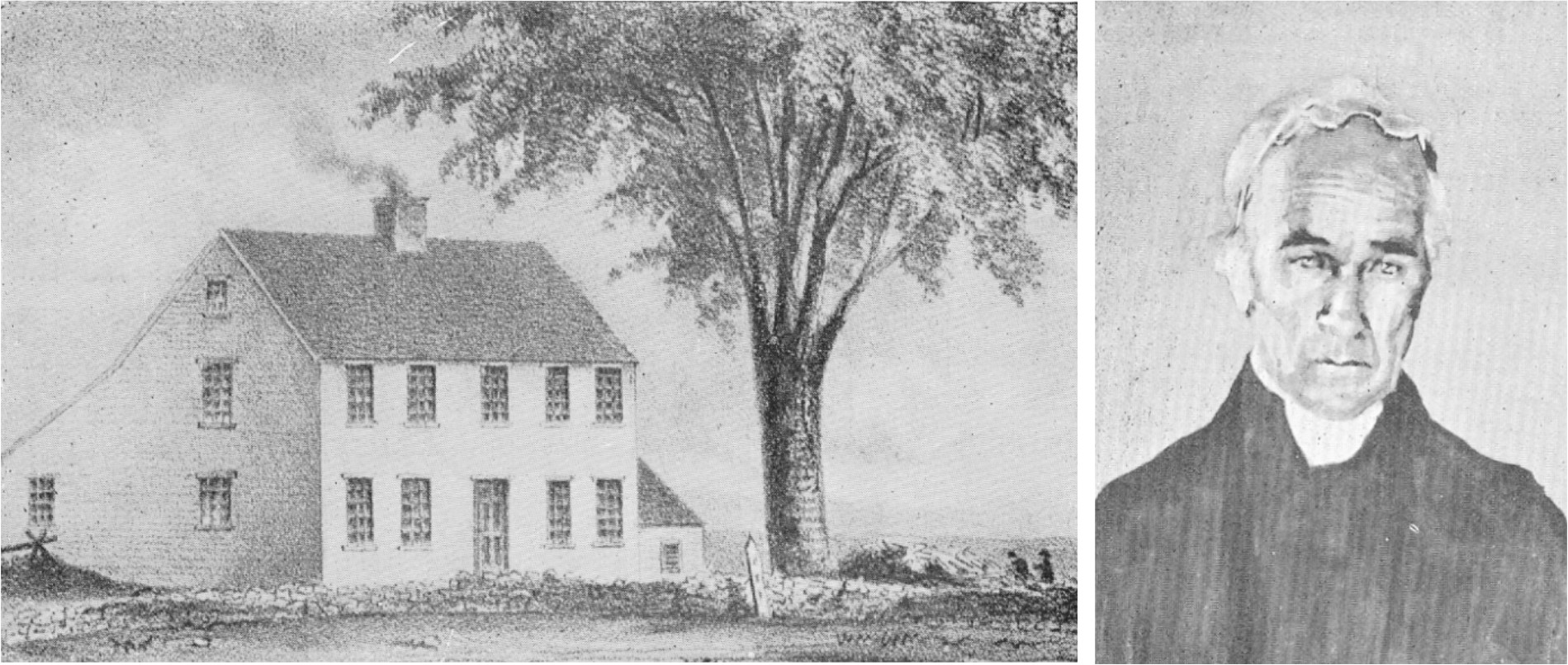
Clockwise: The first framed house in Londonderry built by the Rev. James McGregor. Rev. David MacGregor was the son of the first minister of Londonderry. The McGregor coat of arms. The “auld” gun owned and used by Rev. James McGregor. “ James MacGregor was “the first minister of Londonderry, was born in 1677, and died in 1729. During his brief pastorate of ten years, his influence in town was unbounded in matters temporal as well as spiritual. A gun carried in the famous siege of Derry, (Northern Ireland) in 1688-89, is now in the possession of A.F. Hall, Esq., of Manchester, N.H. Additional interest attaches to it from the fact that Mr. MacGregor always carried it into his pulpit on the Sabbath, well loaded and primed, to be ready in case of sudden attack by the ‘Indian enemy.’ It is well represented by the artist.” Londonderry Celebration June 10, 1869.

      “Mrs. Ballou remembers this elopement story of the MacGregors: Rev. James MacGregor, first pastor of the church in Londonderry, had died and his son, Rev. David was the pastor of the East Parish church. Alexander, another son, lived on some of the MacGregor lands where the Morrisons recently lived, and where the old MacGregor house, the first framed house in Londonderry, was still standing a few years ago. James another brother had a pew in the meeting-house. Susan a daughter of Alexander MacGregor, fell in love with one Burnside, who kept a store in the East Village and was not liked by the Stricter Presbyterians, especially the MacGregors. Susan’s parent opposed the intimacy between her and Burnside, but their mutual affection ripened and failing to secure the consent of her father and mother, Susan determined to elope. The arrangements were quietly made by procuring a license from the Governor, and the time was set. Susan prepared her wardrobe, tied it in a bundle and on the day of the wedding placed it behind the door that opened into the stairway in the front hall. Burnside gathered his friends on horseback, and halting them a few steps from the house, rode up to the front door in great style. Susan caught up her bundle from behind the hall door, and before any of the family knew what was going on, had mounted the horse behind her lover, and the party had started for a minister. Nothing was done to interfere with the wedding, and Mr. and Mrs. Burnside settled down to housekeeping, to the great indignation of the MacGregors, who refused to visit them. Mrs. Burnside, however, sought to overcome their scruples by taking her husband to church the following Sunday. With great assurance she marched up the aisle a little late, followed by her husband, and stopped in front of her uncle James MacGregor’s pew. He instantly opened the pew door and let her in, but seeing Burnside he suddenly closed the door and shut him out. Burnside, however, did not hesitate a moment, and touching the door lightly with his hand, he vaulted over it and sat down next to his wife, to the amazement of the congregation and the mortification of the MacGregors. Such audacity was unbearable and James MacGregor seized the young man by the shoulders and would have pitched him out of the pew but for the timely remonstrance of the scandalized pastor. Stopping in the midst of his sermon, Rev. David McGregor called out: ‘Brother James, do not disturb the house of God!’ This restored order, and the young couple remained together. But the MacGregors did not visit Susan until after the birth of her first child, when it was commonly reported that she was in delicate health and might not live long. Then they relented, and were in a measure reconciled to the marriage. It is said that the issue of this marriage became renowned in the succeeding generations and one of the sons was a general in the Revolutionary war. This Susan MacGregor and James, 2nd, were the only children of Alexander, the son of Rev. James, first pastor of town. Alexander married and settled in Rhode Island, and died after the birth of these two children. His widow married an Allen and remained in Rhode Island, but the two children were brought to Londonderry and raised in the family of James MacGregor, who figures as the uncle in this story.”


Windham Life and Times – May 3, 2019

Nutfield 300

Drawing from Wiley’s Book of Nutfield of the “English Range.”

The  English Range | Wiley’s Book of Nutfield

The influential New Hampshire officials who helped secure the land grant from the Crown for the Scotch-Irish, being of the political class, expected and received their quid pro quo as land grants in Londonderry, in what became known as the English Range.  Again from Wiley’s Book of Nutfield: “Within 12 months after the arrival of the first sixteen families, the population of Nutfield, afterward the incorporated township of Londonderry, numbered several hundred, and simultaneously the allotments of homesteads were made to the proprietors under the charter to the number of one hundred and twenty-four and a half shares, exclusive of large awards in land given to some particularly influential persons who had assisted the immigrants in securing a grant of land. About Seven Thousand Five Hundred acres were laid out in homesteads under the schedule as recorded with the charter, June 1, 1722, and on the same day one thousand eight hundred and fifty-six acres were allowed as rewards for special services to thirteen persons directly connected with the procuring of clear titles to the land. The largest grants of land for special services were made to the officers of the crown, who acted as mediators between the colonists and the king. These loyalists were the Lieutenant Governor of His Majesty’s Province of New Hampshire in New England, and that body of followers commonly designated as the governor’s suite, with colonels and men of military insignia in the service of the king. These persons received grants of land in proportion to the supposed importance of their rank and services, not alone in Nutfield but in various other settlements over a wide area of land not very clearly defined in early records.”

“Without controversy the section of the township which was called the English Range embraced the most pronounced Tory faction, and as Englishmen in sentiment, spirit and religious opinions the settlers there had a profound contempt for the zeal, piety, and learning of the fugitive Covenanters by whose pestiferous preaching the whole of Great Britain was shaken.”

“The series of parallel homesteads that may properly be designated the English Range began at the most easterly corner of Beaver pond and extended in the form of a rectangle whose longer side lay in a due northwest line to a point near Sheild’s upper pond, and the shorter line lay in a due northeast line along the course of the stream above Beaver pond to the limit of the Haverhill False Line, so called by reason of a claim that the people of Haverhill made to the part of town then lying east of the meridional line through that corner of the English Range.…”

“…The English Range embraced a beautiful tract of land, with fine glimpses of Beaver pond from almost ever part, and some of the farms running down to the firm shores were selected for the more noted persons of the community…The following agreement will explain the laying out of some of these lots. It was made at the time when the people of Nutfield had secured a deed of land, on which they settled, from Col. John Wheelwright of Wells, Me.: “These presents witnessed that the Rev. James McGregor and Samuel Graves do in the name of the people of Nutfield and by virtue of being a committee from them agree that the Honorable Governor John Wentworth of Portsmouth and Col Wheelwright of Wells and their heirs forever should have and possess two lots with them in Nutfield lying to the northward of and butting upon Beaver pond, to wit:  Lt.-Gov. Wentworth to have the third and Col. Wheelwright the fourth in order upon the range, together with what second divisions will fall to the said lots throughout the said town, and each of these gentlemen and their heirs to have besides the said lots five hundred acres apiece forever laid out in farms where they shall think fit in said town, Record this 9th day of January, 1720.”

“The governors of the various provinces in New England were generally of good birth and highly respected by the colonies…The resolution passed by the town of Nutfield, in meeting assembled in 1719, is not without interest: The people of Nutfield do acknowledge with gratitude the obligation they are under to the above mentioned gentlemen, particularly to the Honorable Col. John Wentworth, Esq., Lieutenant Governor of New Hampshire. They remember with pleasure that his Honor, on all occasions, shewed a great deal of civility and real kindness to them, being strangers in the country, and cherished small beginnings of their settlement and defended them from the encroachment of violence of such as upon unjust ground would disturb their settlement and always gave them a favorable ear and easy access to the government and procured justice for them…”

“It appears from contemporary evidence that there was scarcely a resident of the English Range in 1719 who was not titled and serving the government in some capacity. Their descendants of the next generation were conspicuous leaders in the French and Indian wars. Very familiar are the names of Colonel Thornton, Colonel Barr, Sir James Leslie, Captain Blair, Ensign Blair, Captain Cargill, Colonel Wainwright, Colonel Wheelwright, and Lieutenant Goffe.”