Windham Life and Times – August 23, 2019

Nutfield 300

Samuel Penhallow’s Indian Wars | Hostilities of 1722

What follows is a description of the Indian attacks that forced many of the early Scotch-Irish settlers to abandon their homes and seek to be resettled in New Hampshire and Pennsylvania. Penhallow continues, “But in the year 1720, they began to be more insolent, and appear’d in greater Bodies; upon which Colonel Walton was ordered with about 200 men to guard the frontiers, and was after appointed with Capt. Moody, Harman, Penhallow, and Wainwright to send to their chiefs for satisfaction for the late hostilities which they had done in killing the cattle, etc. The Indians fearing the event promis’d to pay two hundred skins, and for their fidelity to deliver up four of their young men as hostages. After this they became tolerably quiet, but in the spring grew as insolent as before; especially in Kenebeck, where some time in July they came with ninety canoos to Padishals Island, which lies opposite Arowsick, and sent to speak with Capt. Penhallow (the author’s son), who fearing an intreague, refused. Upon which one hundred and fifty of them went over to him, with whom he held a conference; especially with Monsieur Delechase, and Sabastian Ralle who were Jesuits; Monsieur Croizen from Canada, and St Casten from Penobscot came also along with them, who brought a letter for Governor Shute in behalf of several tribes, importing, that if the English did not remove and quit their land in three weeks, they would burn the houses and kill them as also their cattle. Upon this an additional number of soldiers were sent under the command of Colonel Thaxter and Lieut. Col. Goff; and several gentlemen of the council were also appointed to enquire unto the ground of these tumults, and if possible to renew the pacification;  who accordingly went and sent scouts to call on the Indians, but they slighted the message with derision. Hereupon the soldiers were ordered to continue, and reinforce the garrisons that Winter. But in the summer they renewed their insults, and on the thirteenth of June 1722 about sixty of them in twenty canoos, came and took nine families in Merry meeting Bay most of which they afterwards set at liberty, but sent Mr. Hamilton, Love, Handson, Trescot and Edgar to Canada; who with great difficulty and expense afterwards got clear. They made a descent on St. Georges, where they burnt a sloop, took several prisoners and fought the garrison for some time; and in a month after came a greater body from Penobscot who killed five and engaged the fort twelve days; being very much encouraged by the influence of the friar that was with them. But finding they could make no great impression endeavored to undermine it, and had made a considerable progress therein, till upon the falling of much rain, the trenches caved in, which caused the siege to break up, with the loss of twenty of them in the engagement, as we were afterwards informed. About the same time, Capt. Samuel with five others boarded Lieut. Tilton as he lay at anchor a fishing near Damaris Cove: They pinioned him and his brother, and beat them sorely: But at last one got clear and released the other; who them fell with great fury  upon the Indians, threw one overboard, and mortally wounded two more.”

“Capt.  Savage, Capt. Blin and Mr. Newton, who was at this time were coming from Annapolis, and knew nothing of their ravages, went into Passamaquady for water. They were no sooner ashore, but found themselves hem’d in by a body of Indians, the French basely standing by and suffering it. They wanted to divide the cargo of the sloop among them, and at last sent Capt. Savage on board to procure the ransom. Nut the wind rising, he was forc’d off, and made the best of his way to Boston; Those that were left (After some difficult and expense) were released. Capt. Harmon who was now in Kennebeck, went up the river with a detachment of thirty four men, and seeing some fires, went ashore in the night, where he came upon eleven canoos: The Indians were lying around the fire, and so wearied, by much dancing the day before upon the success they had that they stumbled upon them as they lay asleep. Reports are various as to the number of Indians that were then slain; some say eighteen, others not so many: However they brought away fifteen guns; and at a little distance found the hand of an Englishman laid on the stump of a tree, and his body mangled after a barbarous manner; having his tongue, nose and private parts cut off: They brought away the body and gave it a decent burial. It was found to be the body of Moses Eaton of Salisbury.”

“In this brave attempt of Capt. Harmon, which was effected in ten minutes, we lost not one man, yet at the same time a great body of Indians lay near, who being startled at the noise that was made, arose and fired several guns, but did no damage.”

“The country at this time was in a surprising ferment, and generally disposed to war; but the Governor and Council could not readily come into it, considering the vast expense and effusion of blood that would unavoidably follow: Besides some were not satisfied with the lawfulness of it at this time: for altho’ they believed the Indians to be very criminal in many respects, yet were of the opinion that the English had not so punctually observed the promises made to them of trading-houses for the benefit of commerce and traffick, and for the preventing of frauds and extortions too common in the private dealings of the English with them. But the grand abuse to them is the selling of strong drink to them, which has occasioned much quarreling and sin and the loss of many lives, to the great scandal of Religion, and reproach of the country. His excellency was sensible of the promises that he made them at the Treaty of Pacification; which he failed not to lay before the General Assembly; but he met with so much opposition that nothing could be effected. The firing an armourer at the public charge was also engaged, but nothing done therein; so that the Indians were full of resentments, and thought themselves wronged. Yet all this time they made no application to the government for redress, which they ought to have done by the Articles of Agreement, but broke forth into horrid and cruel outrages, by burning, killing and destroying, At last the Governor by repeated addresses from the people, was obliged to call the council together to concert what was proper to be done, who advised, to the proclaiming an open war. But their not consulting before-hand with other governments was certainly a great oversight; who probably would have come into it, and thereby have helped support the charge, which now lay wholly on Massachusetts and New Hampshire.

“On July 25, 1722, Governor Samuel Shute declared war on the Indians. Later, the General Assembly not finding the former bounty sufficiently encouraging to volunteers, passed an act offering one 100 pounds for Indian scalps to all who supported themselves and 60 pounds to those who were supported by the public.”


Windham Life and Times – August 16, 2019

Nutfield 300

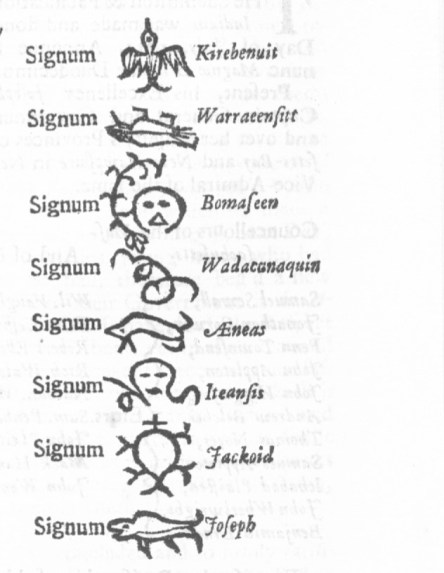
Indian Signatures

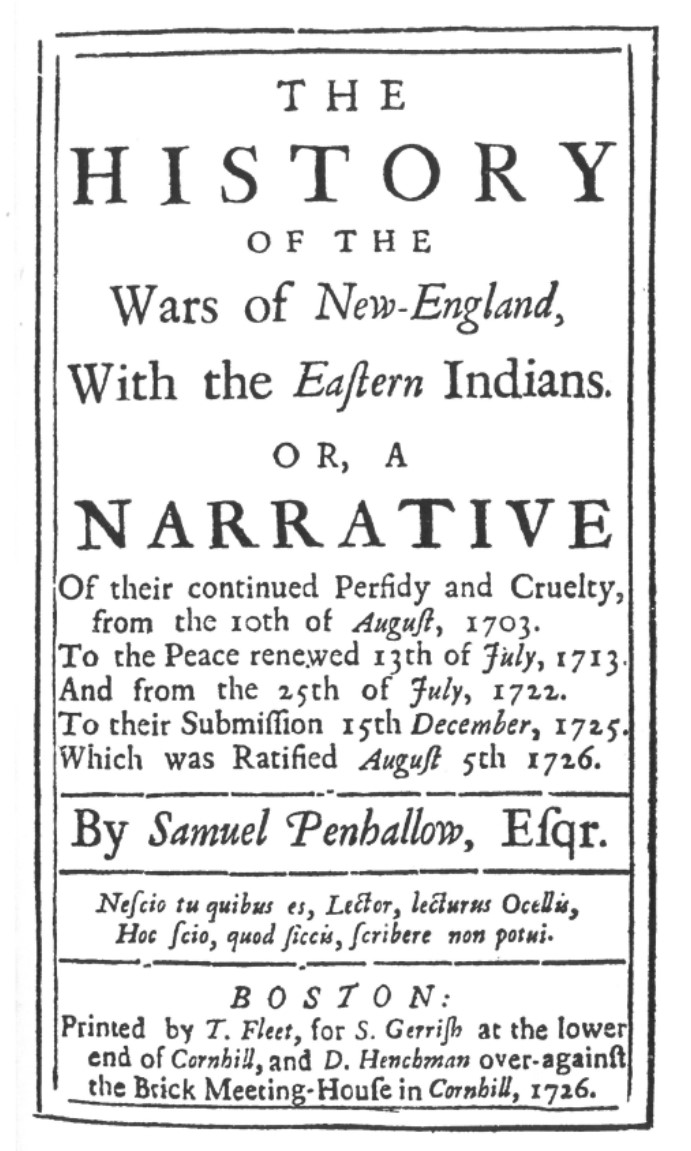
Samuel Penhallow’s Indian Wars |Events up to 1717

Well if you have been paying attention, you will have begun to understand that this was a clash of totally incompatible civilizations, that was dominated by the beliefs and folkways of each, in which both totally misunderstood the other and their actions. And of course as often happens, there was a third party, France, working against an accord because it was not in their interest. This is very similar to today with the western viewpoint of this country as it seeks to interact with the Occidental and Asian cultures with ideas and beliefs that are totally divergent from each other. Queen Anne’s War ended in 1704 with a peace treaty duly signed by the Indian Sachems pledging loyalty to the sovereign of England and apologizing for their actions. What follows highlights the prejudices and views of the times from those that lived in the middle of the conflict and saw friends and family members killed and tortured in the most awful manner.
Penhallow states that, “The keeping of a Register of Memorable Occurrences, as it has been the practice of former Ages, so it ought to be continues for the advantage of posterity: And in as much that the Divine Providence has placed me near the Seat of Action, where I have had greater Opportunities than many others of remarking the Cruelty and Perfidy of the Indian Enemy, I thought it my Duty to keep a Record thereof…I might with Orosius very justly entitle this History De miseria hominum, being no other than a Narrative of Tragical Incursions perpetrated by Bloody Pagans, who are Monsters of such Cruelty, that the words of Virgil may not unaptly be apply’d to them…Who are as implacable in their Revenge, as they are terrible in the Execution of it; and will convey it down to the third and fourth Generation. No Courtesy will ever oblige them to gratitude; for their greatest Benefactors have frequently fallen as victims to their fury.”

“…God has made them a terrible Scourge for the punishment of our Sins. And probably that very Sin in neglecting the welfare of their Souls. For we have not expressed the like laudable Care for them, as hath been done in the Southern and Western parts of the country.” (Probably because New England was dominated by the Puritans whose precept of controlling others still plagues American culture to this day.) “But indeed we have rather aimed to advance private Trade, then to instruct them in the Principles of True Religion. This brings to my remembrance a remarkable saying of one of their Chief sachems, whom (a little before the war broke out) I asked, Wherefore it was they were so much bigoted to the French? Considering their Traffick with them was not so advantageous as with the English. He gravely reply’d, That the Friars taught them to Pray, but the English never did.”

Throughout the early eighteenth century Indian attacks continued on New England settlements, even after the peace of Queen Anne’s War. Here we jump ahead to the period just prior to the arrival of the Scotch-Irish in large numbers in New England. The Treaty of Portsmouth was signed in July of 1713, in which the Indian Sachems, swore loyalty to the English sovereign and pledged to keep the peace. Penhallow says, The Peace thus concluded and so firmly ratified, gave matter of Encouragement to the Eastern Inhabitants for re-settling their former Habitations; who were also countenanced and assisted by the Government, even from Cape-Porpas to the Kenebeck River, where several gentlemen who had large tracts of of Land, granted a hundred acres to every one for Encouragement that would go and Settle; supporting a Minister besides (For some time) and employ’d a Sloop at their own Charge for carrying and re-carrying the Inhabitants, with their Stock; which gave so great Encouragement, that several Towns began to be settled, such as Brunswick, Topsham, Augusta, George Town, etc. In which a great many fine Buildings were erected, with several saw-mills.”

“The French Millionaires perceiving the Growth of the Plantations, soon animated the Indians to disrespect them, by insinuating that the Land was theirs and that the English invaded their Properties; which was a vile and wrong Suggestion, for their Conveyance were from the Ancient Sagamores, at least seventy Years before; and the Proprietors did not settle so high up by several Miles as was formerly possessed by their Predecessors…However the Indians could not be satisfied, but so threatened the Inhabitants, that many withdrew, and others were discouraged from going to Settle. Soon after they killed many of their cattle and committed many outrages.” What followed was the congress between the English and Indians at Arowsick in 1717 which was discussed earlier. “After this they drank to the King’s Health and promised allegiance to the Crown of Great Britain; so everything had now the promising Aspect of a lasting peace…” This was the condition of Eastward settlements at the arrival of the Scotch-Irish.

Penhallow follows with this interesting observation, “One thing I cannot here omit; three days after our departure, a number of Indians went a duck hunting, which was a season of the year that the old ones generally shed their Feathers in, and the young are not so well flusht as to be able to fly; they drove them like a flock of Sheep before them into the Creeks, where without either Powder or Shot kill’d at one time four thousand and six hundred; for they followed them so close that they knocked them down with Billets and Paddles, and sold a great number of them to the English for a penny a dozen, which is their practice yearly, tho’ they seldom make so great a Slaughter at once. (So much for the “living in harmony with nature myth.”) But before two years were expired, they again began to insult the Inhabitants, being spur’d on by the Jesuits, which occasioned a scout and fifty or sixty Men to be sent out, who kept them in awe…”

Windham Life and Times – August 9, 2019

Nutfield 300

Samuel Penhallow’s Indian Wars– Introduction

Almost as soon as the conference between the English and the Indians ended at Arrowsick, attacks against settlers began. Penhallow’s Indian Wars was first printed in 1726. The author was a high placed British government official, who knew first hand accounts of events. In the introduction to the 1924 edition, Edward Wheelock says, “To the New England colonists the depredations of his Indian neighbors were of literally vital interest. The pioneer in the new settlements de-forested his land, tilled his fields, gathered his harvest and, on the Lord’s Day, walked to his meeting-house, at all times armed with his flint-lock for self defense against the native he had armed at a sinister profit with musket, powder and lead. When at last, Anglo-Saxon determination had conquered and the Indians were eliminated from the problem of pioneer existence, the growing generation of New England boys and girls read into the fragments the ‘Narratives,’ ‘Captivities’ and ‘Histories’ of those of their forebears who providently had escaped the enemy, or who had been redeemed after ‘captivation’ had lived to print the tale.” (More on this later with the stories of Jamie Cochran and John Dinsmoor, Indian captives.)

“Never before the colonization of America had the English come into continued and intimate contact with the savages and in the contest for supremacy that followed, they were but poorly prepared with their incomprehension of primitive society and their ill-conceived policies of fanatical proselytism. On the other hand the Indian of the Atlantic coast had experienced little in his acquaintance with the early explorers, English and others, that had prejudiced him favorably toward white men. These had kidnapped him to exhibit him as a curiosity in Europe or to sell him into slavery; they had shot him in little else than wantonness for petty thievery. When colonization began and the Indian himself had furnished the valuable food plant (corn) without which permanent settlements at that time would probably have failed, he saw his own planting places overrun by cattle, his game driven away, his fisheries ruined by mills and mill-dams, his people destroyed by firearms, diseases, vices, fire-water, indeed by the very religion of the whites. He was human. Naturally enough, before he was overwhelmed, he devastated outlying settlements and decimated the colonists; during the half century preceding the publication of this History, more than eight thousand New England settlers lost their lives and few families there were who mourned no relative or friend. In such a community the interest of Indian affairs was predominant…A specific instance of this interest is seen in the practice of making Indian affairs the chief topic in the published sermon— the newspaper of the day… Aside from all this, Penhallow’s Indian Wars seems to have been predestined to become a scarce book, Its author a public man and perhaps the best known officer of New Hampshire…Samuel Penhallow was born in St. Mahon, Cornwall, England, July 2, 1665. In his youth he was a student in the school of the silenced dissenting minister, Charles Morton at Newington-Green,  and with Morton, in 1686, he came to New England.” He was admitted to Harvard that same year.

“He next moved to Portsmouth, New Hampshire, where he began a prosperous career in business and political life. Here he married a wealthy heiress, Mary, the daughter of President Cutt, part of whose patrimony was valuable land in Portsmouth. He accumulated what in those times was described as a great estate, but many details of his life have been lost owing in part to the destruction of his diary in the great fire of 1802. He was elected Speaker of the House, August 7, 1699, and held office for three years. From 1702 to the time of his death, he was an influential member of the Royal Council, holding concurrently the offices of Treasurer of the Province and or Recorder of Deeds. As Councilor he won popular applause through his controversy with Lieut. Governor George Vaughan. At that time he was suspended by Vaughan, who was soon himself removed from office by Samuel Shute, the Colonial Governor of Massachusetts and New Hampshire. Penhallow resumed his place by virtue of his office, took part in the ratification of the treaties with the Indians, of which he has given us a description in this history. He was appointed to the Superior Court of Judicature in 1714; of this Court he was Chief-Justice when he died December 2, 1726.”

“He is said to have lived in a style superior to that of his fellow townsman in his brick house at the head of the pier, entertaining every stranger of distinction. His biographer thus describes him as ‘given to hospitality,’ wherefore, the following Order, found in the Provincial Papers of New Hampshire may be of interest bearing as it does upon the amenities of official life two centuries ago. This direct us that:“Mr. Treasurer Penhallow take care to provide for the Gentleman Commissioners…who are going to Casco fort to the Eastward (Maine) to publish the Articles of Ratification of peace with the Indians, with all such provisions, wines, Liquors and other necessaries as may be proper…” [July 14, 1713.] “Of thirteen children, one son, Captain John Penhallow was an early proprietor of Phipsburg (Georgetown,) Maine, Governor of Arrowsick and a prominent officer of the militia under Col. Thomas Westbrook…Our author’s prominence in official business life must have stimulated his attention to the Indian affairs of his time and the resulting familiarity with his subject is perhaps his strongest claim to authority as a writer of this book.”


Windham Life and Times – August 2, 2019

Nutfield 300

“Bulwark Against The Indians”

The French and Indians in Maine | Father Rale

The New England Indian Wars in three volumes by Herbert Milton Sylvester, details conditions in Maine just prior to the arrival of the Scotch-Irish.  Keep in mind the British-centric views of the author “It is time now to come nearer what was to be the scene of the warlike activities two years later at Merrymeeting Bay, where nine families of English settlers were butchered without warning; as Bourne says, a larger number of people than even Kennebunk could boast of at that time. The old territory of Acadia, to the French, was comprised of the country east of the Penobscot, including New Brunswick and the coast of Nova Scotia. Acadia to the English extended as far north as the St. Lawrence; but this was not to be settled without a quarrel. Besides this, the French claimed the Kennebec River to be the boundary of their possessions in Maine. It was a natural highway — as Arnold demonstrated — to Quebec. Not far above the Ticonic Falls on the Kennebec was the Norridgewock settlement, which comprised one of the three great Abenake families in Maine; the Tarratines, on the Penobscot, and the Sokoki, on the Saco, being the other two. The Abenake on the Kennebec were closely allied to the French interest…And further, by Captain Bennett: ‘The bearer can further tell your Grace of the disposition of the French inhabitants of this province, and of the conduct of their missionary priests, who instills hatred into both Indians and French against the English.’ ” It was here that Sebastian Rale established a mission, but the exact date of his coming is not given. He was here sometime, however, before 1697, possibly as early as 1693. His contemporaries were Bigot, on the Kennebec, and Thury at St. Famille (Pentagoet), on the Penobscot. A writer on the Abenaki gives a lucid account of this  “Above the village, at the head of the rapids of the Kennebec, was a chapel dedicated to the most holy virgin, in which her image in relief demanded the prayers of the savages as they passed upward to the chase; and below, where the waters rested on their quiet level, another chapel stood, dedicated to the guardian angel of the tribe. The women contended with a holy emulation in the embellishment of their sanctuary by all the finery they possessed, and the chapels and the church were illumined by brilliant lights from the wax of the bayberries gathered upon the islands of the sea. Forty youths in cassocks and surplices officiated in performing the solemn functions around the altar. Such was the machinery of the holy office among the rude people of Nanrantsouak; and multitudinous processions, symbolical images, paintings, and mysterious rites were combined to catch the fancy and arrest the eye of the savage neophytes. Every day was introduced by the performance of mass, and the evening was ushered in by prayer in their native tongue, in which their zeal was excited by the chanting and recitation in which they took part, while the frequent exhortations of the father allowed no distraction of their attention, no suspicion of their piety, and no backslidings in their faith. Dictator of the consciences of his flock, where no envious rival, no jealous competitor, no labors and the place where his life-work was carried on. He was of French extraction, born (1657) in French Compte. He engaged in the American missions (1689) when he was thirty-two years old. He was with the Canadian Abenake two years. Two more years were devoted to the Illinois Indians, after which he came to Norridgewock, where he was to spend the remainder of his days, which were fated to be terminated by an English bullet.”

“Undoubtedly, of all the eastern tribes, the Noridgewocks were the most thoroughly embittered against the English. They had been among the most aggressive in the preceding years of war along the frontier, and possibly they had suffered most at the hands of their white adversaries. There were paramount reasons, nevertheless, why they should remain at peace with their English neighbors, however irritating such association might be. The English had inspired them with a wholesome respect for their fighting-qualities;…”

“The settlers, however, had little or no use for the savage. They knew the latter best for his treachery and unsparing cruelty. By the Peace of Portsmouth the savage was barred from intercourse with the English except at the truck-house. There were those of the settlers, too, whose attitude was not only intentionally insulting, but openly aggressive. Added to these evidences of unfriendliness were the constant encroachments of the English upon Indian territory; they planted a fort or a blockhouse wherever a settlement had taken root. These were regarded by the Indians as a menace to their liberty. There was reason for their apprehension, which, judiciously encouraged by Rale, was giving birth to an ominous resentment. ”In 1716 Samuel Shute succeeded Dudley as governor. In 1717 he came down to Arrowsic to attend a council which had been called at Georgetown. Here he met the delegates from the various Abenake tribes…Hither they came in a flotilla of canoes. The English were at Georgetown, while the savages had set up their wigwams on an adjacent island. The council convened August 9, 1717. The deliberations ran into the following afternoon. Wiwurna, the orator of the Norridgewocks, was the spokesman for his race… Shute was no less indifferent to the savage etiquette observed upon such occasions, and was inclined to be overbearing if not dictatorial. The savages, objecting to the English building so many forts, were answered by the governor that he should build forts wherever they occurred to him as necessary. At this impolitic declaration the savages abruptly left the conference to go to their wigwams across the stream, where Rale was awaiting the outcome of the convention.”

“Rale was the ruling spirit of the Norridgewocks on this occasion, as he had been on others, having attended them down river. Upon the savages reporting to him Shute’s decision, he wrote the latter a letter of inquiry as to the origin of the English title to the lands the latter assumed to occupy, which communication Shute refused to entertain. Shute had not mended matters; yet so anxious were the savages to keep on friendly terms with the English, that as the governor was embarking on his return voyage to Boston the next morning they made apology for their apparent rudeness of the preceding afternoon and requested the return of a flag left behind, which had been given to them by the English. Shute acceded to their request, and a new spokesman intervened, who gave the governor a belt of wampum, with a request that the English use the lands as they pleased. With some promises on the part of Shute as to the establishment of trading-houses, and a gunsmith for their convenience, the pledge of Portsmouth was solemnly renewed. Rale declared this last compact void, and some caustic correspondence ensued between the priest and the Massachusetts governor, all of which hastened matters to a crisis…”