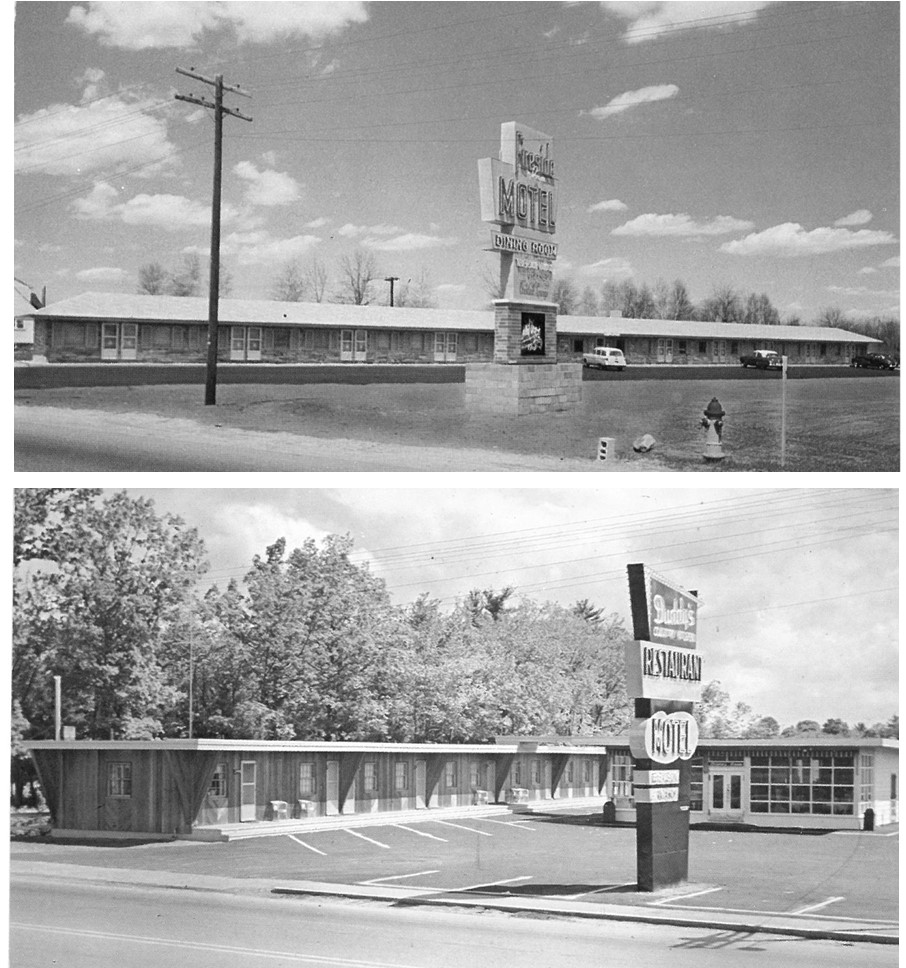
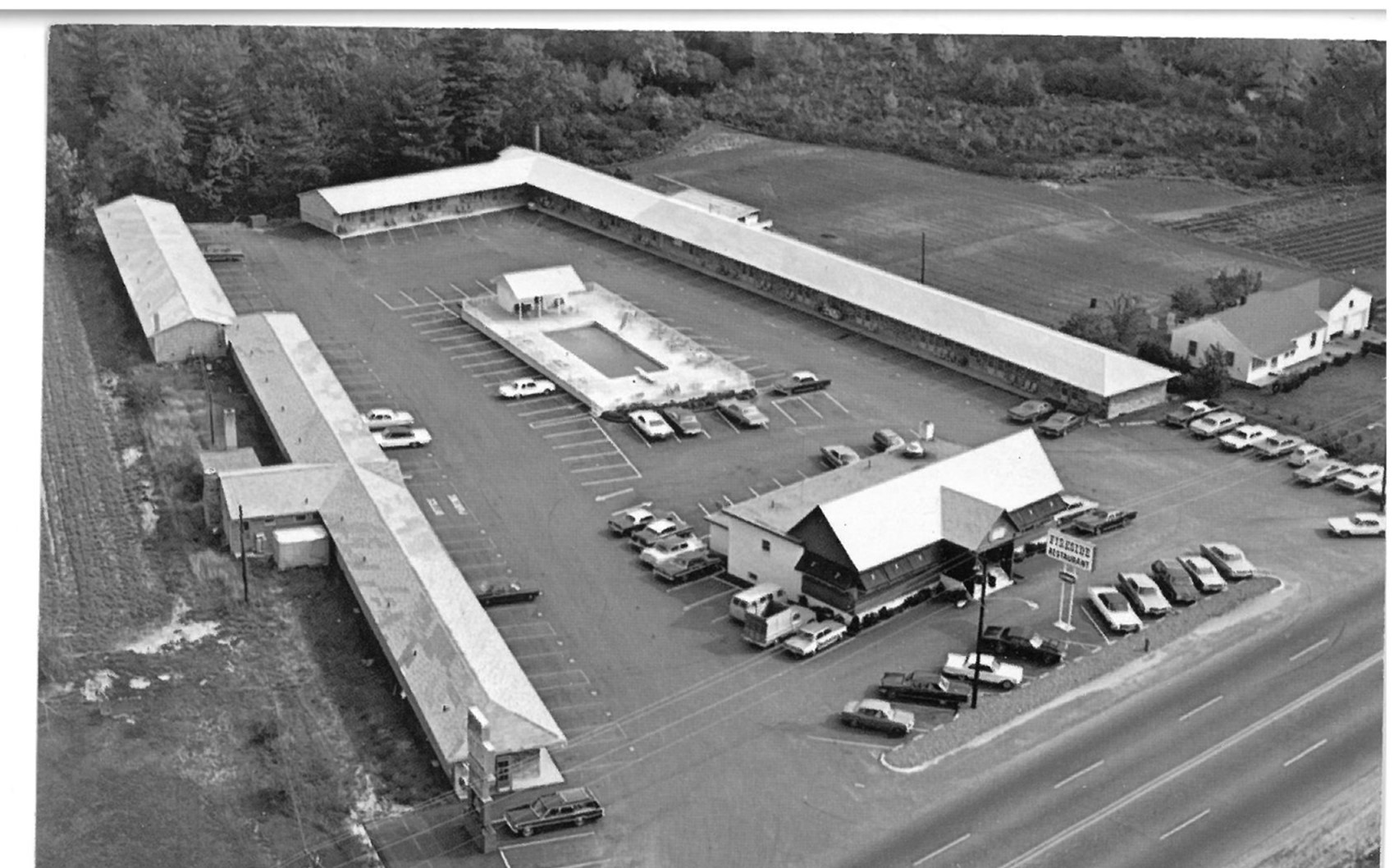
The Fireside Inn Motel was the largest on Route 28 and was owned by Saul Rubenstein who had a cottage on Cobbett’s Pond. It had 56 units. Swimming Pool and was fully air conditioned. It was built before Interstate 93 and bills itself as the “Gateway to the White Mountains.”
Duddy’s Motel was located in Salem Depot. I remember it being called “The Turf.” “The better motel of New Hampshire. We cater to nice people. Walking distance to famous Rockingham Race Track.
The large photograph above shows the Methodist-Episcopal Church in North Salem NH. According to “At the Edge of Megalopolis,” This church was constructed about 1836 as a one story building and was raised to two stories in 1864, so the local village would have a meeting-place. This churched burned on December 2, 1909. “…almost immediately, plans for rebuilding were made, and gifts large and small, came in, and with the added help of Edward F. Searles of Methuen, the building was completed and the first service was held Christmas Day, 1911. George Thom, descendant of one of and old Scots-Irish family, was paid $6,145.87 for its construction.
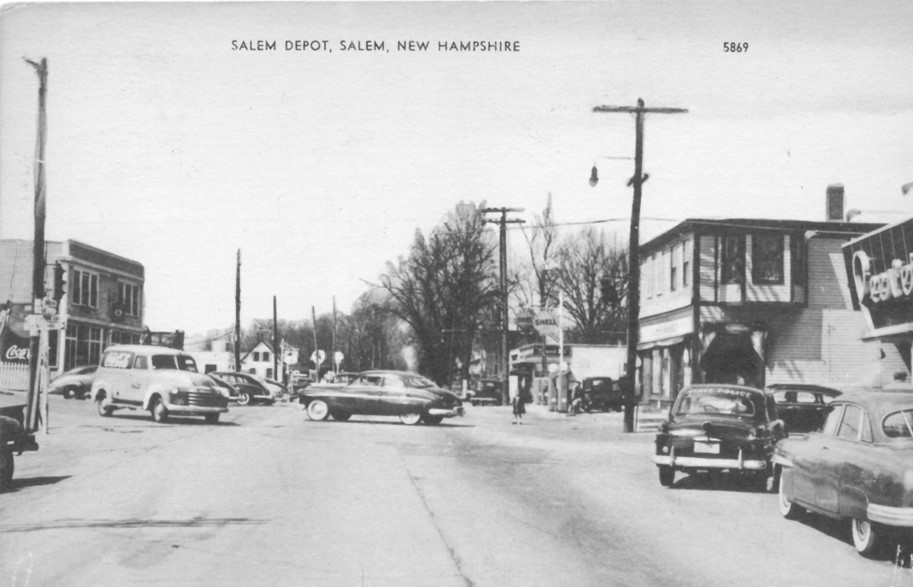
The end of the commuter rail and the trolley service saw the rise of automobile traffic in the Depot. Peever’s Drug store was a local institution that once stood where the Salem Co-Operative Bank is located today. That’s odd, do you see the little girl standing in the middle of the street and “State Police” on right?
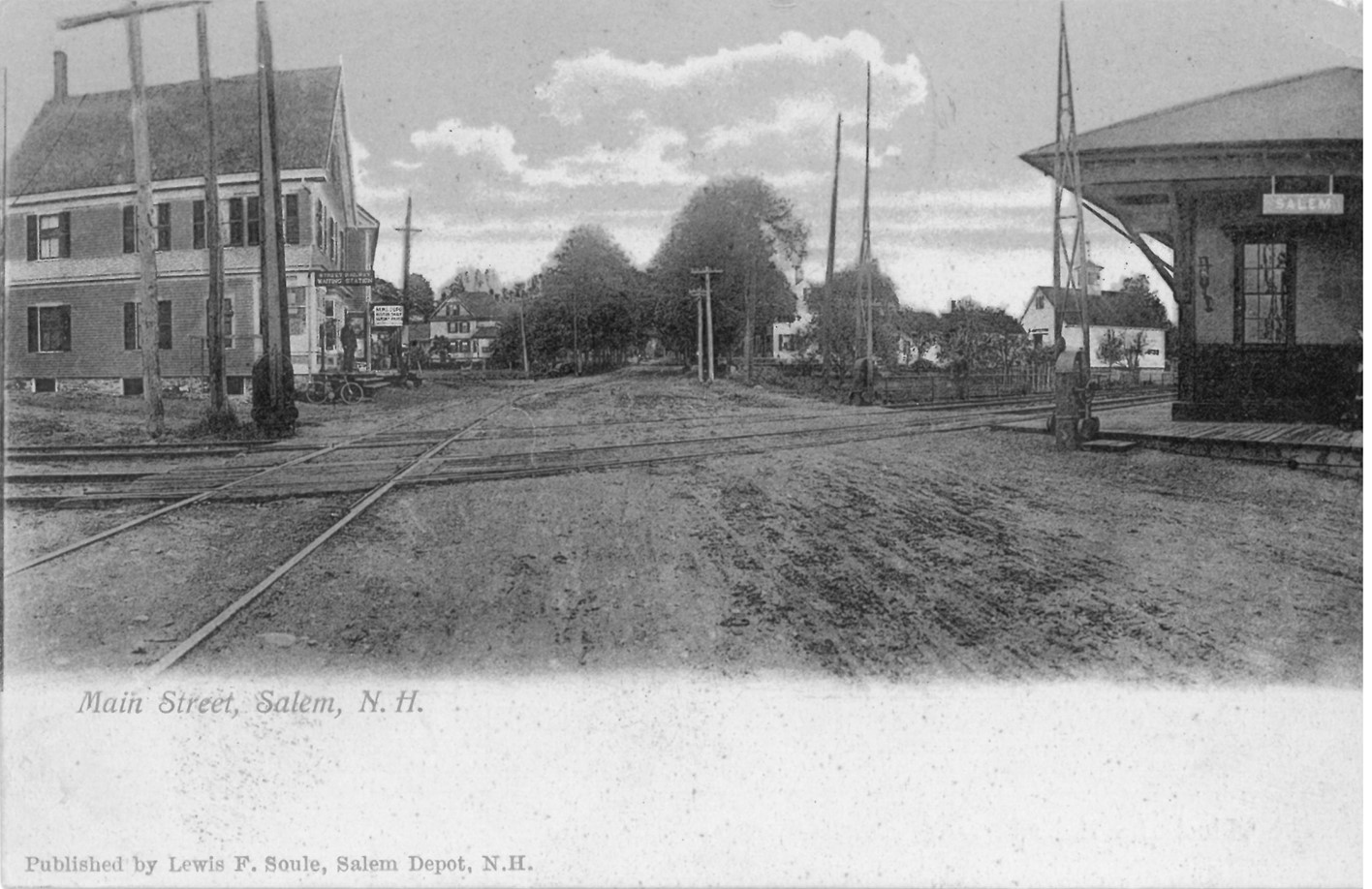
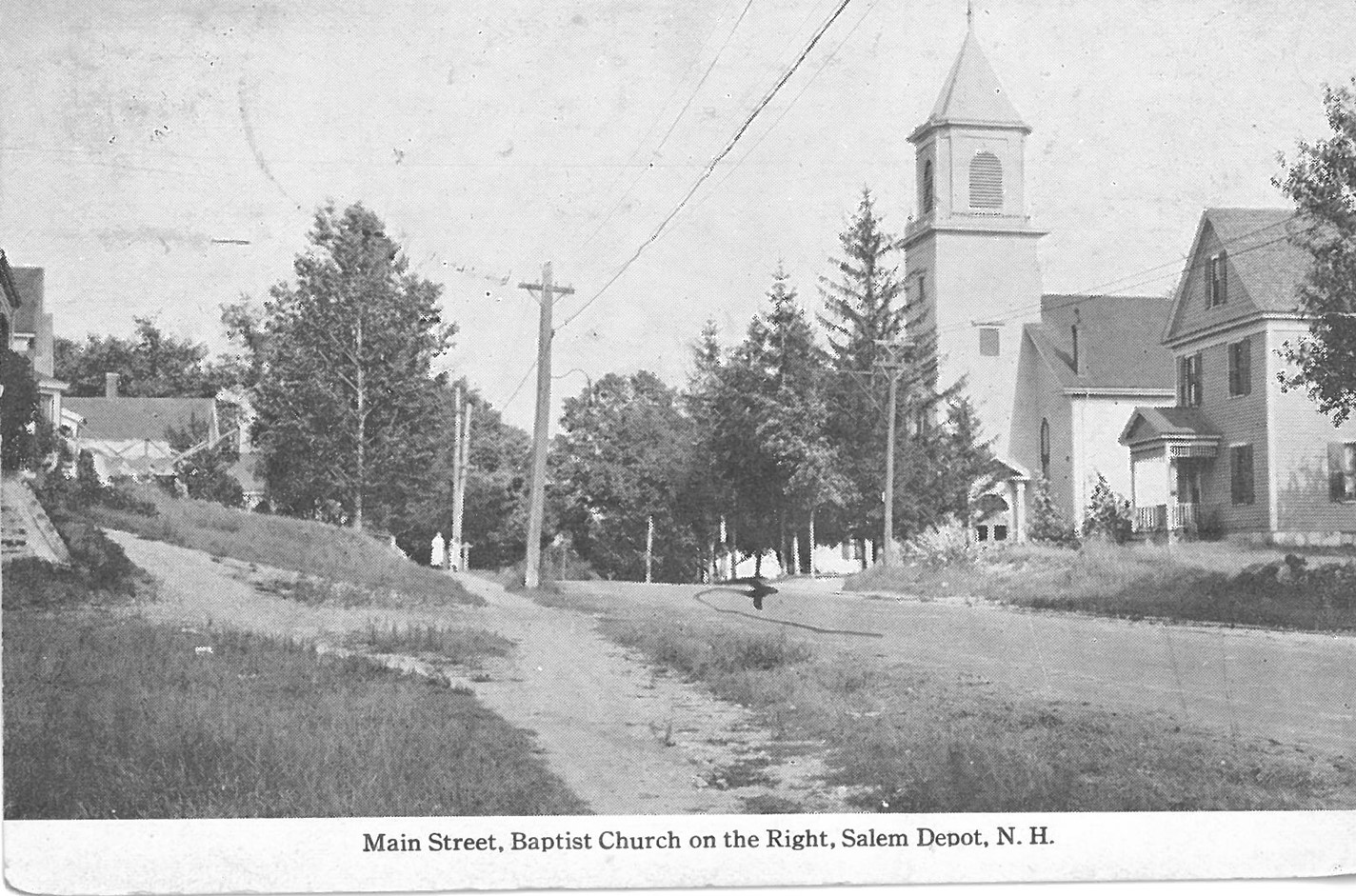
These photos show the Depot on Salem to the West and East of Broadway. The photo above shows the B&M Railroad Station. The tracks running down the street were for the trolley line which ran through Salem. The First Baptist Church which has been torn down can be seen in the photograph below.
When the B&M Railroad was Still Running Passenger Rail Service
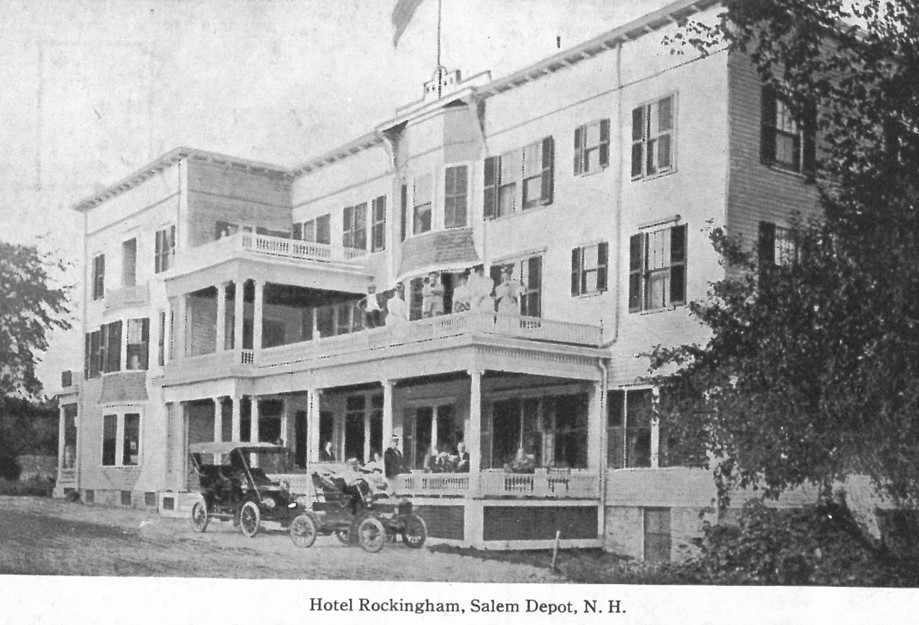
Most of us from Windham spend a lot of time in Salem, and over the past several months, Salem Depot has undergone many changes as part of the Tuscan Village “improvements.” This old Swallow postcard shows the area when passenger rail was still in service on the B&M line. The roof of station, which has recently been restored, can be seen behind the rai cars. The Rockingham Hotel is shown on the right of the photo. I used to get my hair-cut as a child, in one of the store fronts there. You can also see many passengers departing the recently arrived train.
The Play “Anastasia” performed at Windham Playhouse in 1956, with Everett Austin, second from left, playing Prince Bounine. Photo Courtesy of the Hartford Athenium.
Arthur Everett “Chick” Austin Jr. Buried in the Cemetery on the Hill.
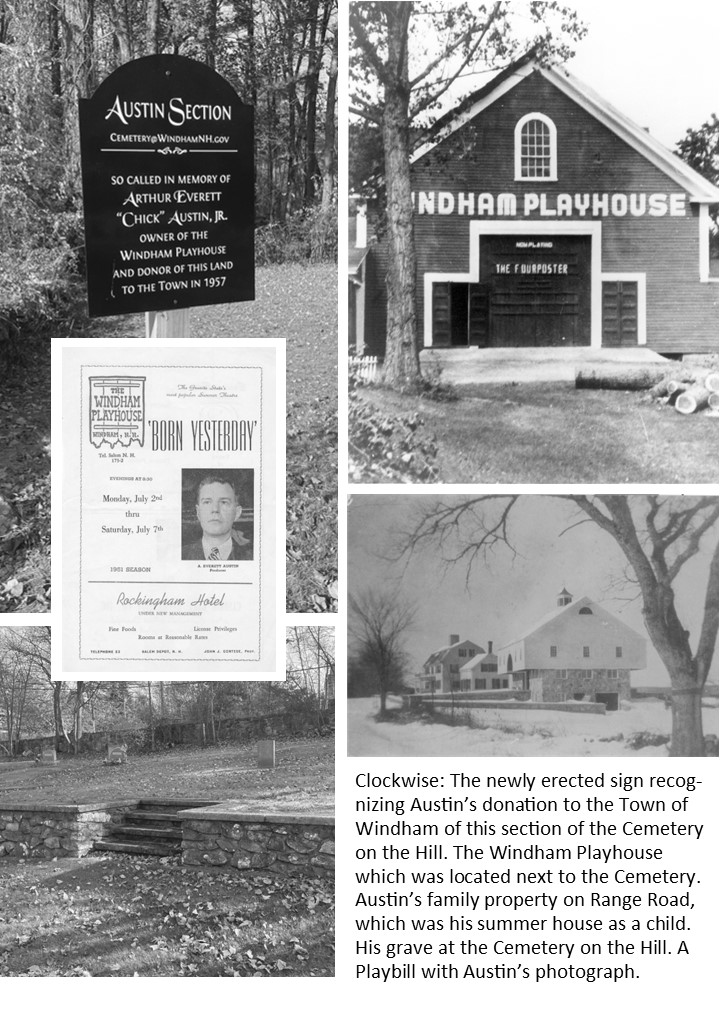
The Cemetery Trustees have recently installed a sign on the Cemetery on the Hill, recognizing the donation of the “Austin Section” by A. Everett “Chick” Austin, Jr.
We learn more about this donation from Austin’s biography, “Magician of the Modern…,” by Eugene Gaddis, Chapter Eighteen; “In June Chick returned to Windham with Jim Hellyar, relieved to step back into the roles of theater producer and actor. Walking back and forth in Rose Crucius’s kitchen every morning, helping himself to whatever she was baking as it came out of the oven, sipping coffee or the eggnog she made to ease his persistent cough, Chick outlined his grandiose schemes for his theater and his future career. Often she and Herb would hear him say, almost to himself, “I just need a million…’ ”
“The 1956 season was sophisticated and up to date. Among the eight plays were The Rainmaker…, Tea and Sympathy…, and Anastasia…in which Chick played Prince Bounine. Marble Fireplaces and French doors appeared on stage in the barn, and his mother’s pictures and antiques once again began migrating down to the Playhouse. By now, Chick’s loyal and eager audience was well established . Attendance was high, and he would have the money to spend on his European holiday.”
“Chick was only fifty-five, but was feeling old. Although he did not seem to be seriously ill, he talked to Rose and Herb Crucius about his death, a subject he always avoided. Once at a party in Sarasota, (where he was the Director of the Ringling Museum.) when the discussion turned to wills, Chick announced, in front of Helen and Jim, that he did not have a will and never would have a will. ‘When I go,’ he added ‘you’re all going to have to fight over it.’ ‘With that’ said Jim, ‘we all had another martini.’ ” But that summer, he gave a parcel of land between the Playhouse and the old cemetery in the town of Windham, reserving a large plot near Range Road for himself, Helen and the children. Which he intended to enclose in a wrought-iron fence fifty feet square. When Sally visited the Playhouse, she found he had sketched monuments for each of their graves and had tacked them up in the box office. They were all Egyptian obelisks.” Chick Austin did travel to France that summer and while there purchased a 1956 Rolls Royce Silver Cloud…Chick Austin died on March 29, 1957. “On the morning after the funeral, through steady rain, the hearse, followed by Helen and the children and a few friends, took Chick back to Windham. Herb Crucius had helped dig the grave in the plot of land that Chick had given the town the previous summer. It was on a little rise, just inside the stone wall along Range Road. The red barn with the huge letters WINDHAM PLAYHOUSE, could be seen through the bare trees. It was three o’clock when the burial service began…” You can learn more about the incredible life of A. Everett Austin in his biography, Magician of the Modern, Chick Austin and the Transformation of the arts in America” by Eugene R. Gaddis.
So growing up, Windham was a small town, and there were only a few full time firemen. The force was supplemented by volunteers. You have to remember this was a time before cell phones and internet. Instead, there was a fire-horn, and it would blare if a fire was called in, a sign that the volunteers should head to the fire station. If I remember right, they used to write the address of the fire on a chalk board at the station. I remember going there as a kid and seeing it. Often though, with so little to do in a small town, when we would hear the horn blowing, our family would decide to pile in the car and go to the fire to watch. I can remember following the trail of water leaking from the tankers, in order to find the route to the fire. The station and addition were built thought the efforts of volunteers.





 Windham NH History