The Battle of Fort Ticonderoga – 1775

Capturing the Cannons at Fort Ticonderoga

    If you grew up in New England, one of your family road trips was likely to Vermont and New York, to see Fort Ticonderoga, and to explore the Ausable Chasm after ferrying across Lake Champlain.

    “The capture of Fort Ticonderoga was the first offensive victory for American forces in the Revolutionary War. It secured the strategic passageway north to Canada and netted the patriots an important cache of artillery.”

     “Ethan Allen and his Green Mountain Boys, together with Benedict Arnold, surprised and overtook a small British garrison at the fort, acquiring valuable weapons for the Continental Army. Arnold took command of Ticonderoga until he was relieved in June 1775.”

     “Located at the confluence of Lake Champlain and Lake George, Fort Ticonderoga controlled access north and south between Albany and Montreal. This made it a critical battlefield of the French and Indian War. Begun by the French as Fort Carillon in 1755, it was the launching point for the Marquis de Montcalm’s famous siege of Fort William Henry in 1757. The British attacked Montcalm’s French troops outside Fort Carillon on July 8, 1758, and the resulting battle was one of the largest of the war, and the bloodiest battle fought in North America until the Civil War. The fort was finally captured by the British in 1759.”

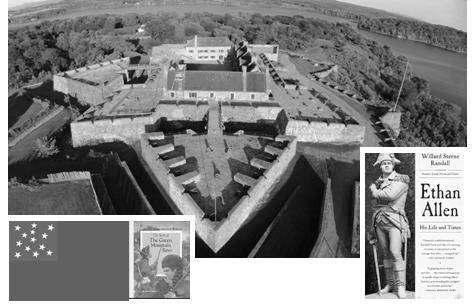
     “During the American War for Independence, several engagements were fought at the five-pointed star-shaped Fort Ticonderoga. The most famous of these occurred on May 10, 1775, when Ethan Allen and his band of Green Mountain Boys, accompanied by Benedict Arnold, who held a commission from Massachusetts, silently rowed across Lake Champlain from present-day Vermont and stormed the fort in a swift, late-night sneak attack.” 

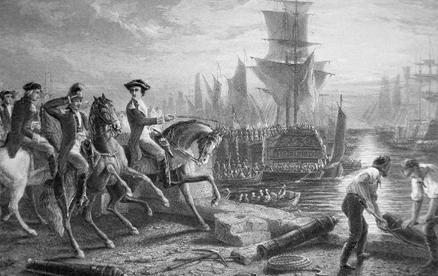
     “Months later, George Washington, commander of the Continental Army, sent one of his officers, Colonel Henry Knox, to gather the artillery left at Ticonderoga and bring it to Boston. Knox organized the transfer of the heavy guns over frozen rivers and the snow-covered Berkshire Mountains of western Massachusetts. Mounted on Dorchester Heights, the guns from Ticonderoga compelled the British to evacuate the city of Boston in March of 1776.”

   “The capture of Fort Ticonderoga was the first offensive victory for American forces in the Revolutionary War. It secured the strategic passageway north to Canada and netted the patriots an important cache of artillery. n 1775, Fort Ticonderoga is garrisoned by a small detachment of about 50 men and has fallen into disrepair, but its value—both for its location and the arms it houses—is well known. Patriot Benedict Arnold persuades the Massachusetts provisional government to give him a commission to command a secret mission to capture the fort. But Arnold soon learns that Ethan Allen and the Green Mountain Boys are already on their way north towardward Ticonderoga with the same intention. Arnold is warned that although Allen has no official sanction for his planned attack, his loyal men are unlikely to take orders from anyone else. Arnold feels that he should lead the expedition based on his formal authorization to act from the Massachusetts government. He and Allen come to an agreement about sharing command, despite the objections of some of Allen’s men. Ultimately, their force includes about 100 of Ethan Allen’s Green Mountain Boys and 50 other men recruited throughout Connecticut and Massachusetts.”

    “By 11:30 p.m. on May 9, the men are ready to cross the lake from what is now Vermont to Ticonderoga. The small boats do not arrive until 1:30 a.m. and they cannot accommodate the entire force. Eighty-three of the Green Mountain Boys make the first crossing with Arnold and Allen. As dawn approaches, Allen and Arnold, worried about losing the element of surprise, decide to attack with the men at hand.

American victory. Ethan Allen and his Green Mountain Boys, together with Benedict Arnold, surprised and overtook a small British garrison at the fort, acquiring valuable weapons for the Continental Army. Arnold took command of Ticonderoga until he was relieved in June 1775.”

https://www.battlefields.org/learn/revolutionary-war/battles/fort-ticonderoga-1775

George Washington Arrives at Bunker Hill

    “George Washington arrived at the Second Continental Congress in Philadelphia on May 9, 1775. Immediately he was placed on several committees that handled military preparedness in the colonies. Washington had a respected military reputation based on his time serving in the French and Indian War, lending him respectability and a certain level of expertise. One of Washington’s first acts included designing a buff and blue colored uniform sewn by an indentured servant at Mount Vernon named Andrew Judge; Washington wore it throughout his time in Philadelphia.”

     “The selection of a commander of the militia forces gathering outside Boston after the battles of Lexington and Concord constituted an important priority for the Congress. The New England forces lacked guns, ammunition, training, and most importantly leadership. Several New England congressmen believed that their officers should command the army surrounding Boston. Others thought that an outsider in command would truly make the militia a “Continental” army. Washington commanded a loyal following among many of his fellow delegates. Those unfamiliar with his politics and reputation sounded out the Virginia delegation for information.”

     “ ‘A need for unity and common cause among the colonies motivated delegates to consider Washington. An army drawn from all of the colonies with a Virginia commander would make the Massachusetts cause a struggle shared by the entire continent. Washington’s unanimous choice signified the beginning of a process to create a national military force.’ Washington’s selection made sense for several reasons. To make the rebellion a truly continental endeavor, the participation of Virginia—the wealthiest and most populous colony—was essential. Congress sought a commander with direct combat experience, and few had more than Washington. At forty-three, he was vigorous and young enough to survive the long campaigns of a protracted conflict. Lastly, Washington’s fellow Virginians convinced many congressmen of his singular determination to the patriot cause.

Politically, Washington was a moderate revolutionary; a sober leader determined to defend colonial rights. Washington’s presence also helped his cause; several contemporaries described his appearance as majestic. Benjamin Rush explained that, ‘He has so much martial dignity in his deportment that you distinguish him to be a general and a soldier from among ten thousand people.’ ”In his statements after his appointment, Washington pledged obedience to the civilian authorities in Congress. He declined a salary, asking only that he be reimbursed for expenses he accrued during the conflict. In his acceptance speech of June 16, Washington sounded the appropriate chords of humility in stating, ‘I am truly sensible of the high Honor done me in this Appointment… I do not think myself equal to the Command I am honored with.’ In private letters, Washington thought himself unworthy of the monumental task he faced.”

     “Encountering Patrick Henry after the vote, Washington’s eyes filled with tears as he told his fellow Virginian “Remember Mr. Henry, what I now tell you: from the day I enter upon the command of the American armies, I date my fall, and the ruin of my reputation.” Before speeding to Boston, Washington purchased several texts on organizing and leading large armies.” James MacDonald, Ph.D. Northwestern State University.  https://www.mountvernon.org/library/digitalhistory/digital-encyclopedia/article/appointment-as-commander-in-chief

The Siege of Boston

Letters Written Home to Windham from Bunker Hill  |  Part 2
 

      “Among the Windham men at Great Island, near Portsmouth, in fall of 1775, was Robert Dinsmoor, the “Rustic Bard.” The names of the rest not known. Windham had eleven men in the Continental army in December, 1775.* Soldiers enlisted for short terms of service, which accounts for the different number of men Windham had in the field at different times during the year. This account of General Stark’s prompt action was never before in print. The paymaster had neglected Stark’s men, and they were suffering for want of money. He sent a squad of men, arrested the paymaster, brought him to Medford, where his men were encamped, and showed him their suffering condition. This was done to relieve himself of blame from his men.”

     “During the siege of Boston, on the 1st of December, 1775, General Sullivan, of New Hampshire, who was in command of the troops at ” Winter Hill,” in Charlestown, sent an urgent message to the New Hampshire authorities for more troops to take the places of the Connecticut troops, who refused to tarry longer, as their time of service had expired. The government answered the call, and Dec. 2, commissions were sent to various men in the different towns to enlist men for short terms of service. James Gilmore, of Windham, was commissioned as captain, Dec. 2, with Samuel Kelley, of Salem, first lieutenant, and David Gordon, of Pelham, as second lieutenant. Eleven Windham men were in this company.”

    “We introduce a letter in possession of the author, from one of our men at the siege of Boston.”

LETTER OF JOHN MORISON TO HIS FATHER.

“Cambridge Jan. 9, 1775. Lieut. Samuel Morison.

Honored Father. — * * * Yesterday morning Samuel [his brother] went on Gen. Washington’s guard, and our camp was as still as usual till a little before sunset there was a stir for volunteers to go over the mill dam to Bunker Hill to burn 16 or 17 houses which the regulars used, and there were men enough before dark turned out volunteers and we were ordered to lay on our arms ready to turn out at the shortest notice but Capt. Gilmore, Isaac Cochran and myself went down about the rising of the moon and got to our end of the dam, but the party that went on was  almost to the other end and so we staid about ten minutes. When the first matches were lighted and in a few minutes, there was light in every house, and then firing began from Bunker Hill at the houses with small arms in abundance and the balls went through the houses very fast. They shot some cannon towards the ploughed hill and some to the eastward of Cable Hill;  I suppose some 20 in all, yet through the blessing of God we cant hear of one of our men amissing. There were nine or ten of the houses soon consumed, three or four are yet standing, and in one of them which was burnt they took five Regulars and one of their wives. They were sat down to take a game of cards and drink some punch, not knowing their danger, but in two or three hours their game was in Gen. Washington’s guard house while Samuel was on guard.” John Morison.”

     “Captain Gilmore and his men remained with General Sullivan on Winter Hill till March 17, 1776, when the British evacuated the city, and they were discharged. John Morison, Samuel Morison, and Isaac Cochran were in his company. Robert Dinsmoor, “Rustic Bard,” was there; his uncle Robert Dinsmoor was there ; and while the latter was wheeling a wheelbarrow load of dirt, a cannon-ball struck and split open an apple-tree by his side, but did not harm him. Abram Planet or Plunket; Hadley and Thomas Gregg ; this latter was probably lieutenant of the company which was under the command of Captain Runnells, or Reynolds, of Londonderry. This company was at Medford in December, 1775, and remained till the latter part of January, 1776, when their term of enlistment is supposed to have expired, but at the urgent request of General Sullivan, most of the company re-enlisted for twelve days, among whom was the ” Rustic Bard.”
 

The Siege of Boston

George Washington’s First Battle in the Revolutionary War

    I have included this historical summary of the Siege of Boston by Mary Stockwell, Ph.D from the George Washington Presidential Library. This will give the background to the letters home from Windham residents who were part of the engagement. I will publish those letters next week including ones from Robert Dinsmoor and John Morrion.

     “The Siege of Boston was George Washington’s first campaign as Commander-in-Chief of the Continental Army. Disdain for British troops stationed in North America to enforce royal policies grew among colonists, especially in cities such as Boston. Subsequently, the British occupied Boston at the outbreak of the American Revolution, and eventually 11,000 British troops were stationed there. American forces undertook the Siege of Boston to force out the British from April 1775 to March of 1776, when the British evacuated the city.”  

     “Militias contained the British to Boston in April 19, 1775 following the battles at Lexington and Concord. Freeing Boston of British control was an early priority in the war, as it was a critical port and ideological American stronghold. However, Americans faced early defeat attempting to advance towards the city in the Battle of Bunker Hill on June 17, 1775. Understanding the need for more competent military leadership, the Continental Congress elected Washington as Commander-in-Chief of the Continental Army, and he was bound for Boston to continue to the siege.”

     “Quickly, Washington was charged with forming military companies into an army and directing the siege of Boston. Knowing that he would be away for many months, Washington wrote to his wife, Martha Washington, “I shall feel no pain from the toil or the danger of the campaign,” he confessed. With the future of the Revolution uncertain, Washington worried that Virginia’s Governor Lord Dunmore would attack Mount Vernon and even imprison his wife while he was fortified outside of Boston.

     “Upon arriving in Cambridge in early July, Washington proposed an attack on Boston. However, his officers were against it as the British were still receiving supplies by sea. They urged Washington to wait until the waters around Boston were frozen.”

     “Washington shifted his priorities, and instead sent an army to Quebec who ultimately failed in their invasion. He also ordered Henry Knox to march to Fort Ticonderoga and bring back the post’s artillery. Knox returned to Cambridge in January 1776 with fifty-nine cannons to assist in future efforts to capture the city. Throughout the winter, Washington contained the British under the leadership of General Thomas Gage to the confounds of Boston.

     Washington desired to “bring the Enemy out of Boston” with a nearby attack in Dorchester Heights that would restrict British usage of the greater harbor. On the evening of March 4, 1776, Washington directed his men to take the cannon retrieved from Fort Ticonderoga up Dorchester Heights south of the city. In a more assertive turn, Washington also ordered his troops in Cambridge to fire on the British. Despite a strong British defensive, the Americans held their position in Dorchester Heights.”
     “General William Howe sent troops up Dorchester Heights to undermine the American fortification, but a snowstorm prevented the assault. Fearing a brutal bombardment at their advance, he decided to leave Boston.   On March 17, 1776, known afterward as “Evacuation Day,” 11,000 British soldiers and hundreds of Loyalists left the city by boat, leaving significant amounts of artillery. his victory was crucial in preventing the British control of a major port in which to receive supplies and troops. Additionally, the victory boosted morale for American independence.” Washington marched into Boston on March 18, but there was little time for rejoicing. He rightly suspected that the British turn their attention to New York City. In the summer of 1776, Washington prepared to launch the New York Campaign as the British moved to occupy another critical port city.” Mary Stockwell, Ph.D., revised by Zoie Horecny, Ph.D., 15 April 2025

https://www.mountvernon.org/library/digitalhistory/digital-encyclopedia/article/siege-of-boston

The Battle of Bunker Hill

    “The day after George Washington’s appointment to command the Continental Army, the American and British forces engaged in one of the bloodiest battles of the Revolutionary War. Washington was still in Philadelphia preparing for his journey to Boston, when the armies of General Artemas Ward and General Thomas Gage engaged in the Battle of Bunker Hill.”  

    “The American force outside of Boston grew in size and strength in the weeks following the Battle of Lexington and Concord. Militiamen from Connecticut, New Hampshire, Rhode Island, and what would later become the state of Vermont streamed into the vicinity of Boston. While the quality of the American soldiers was questionable at best, their sheer numbers troubled Gage. Flush with reinforcements and new subordinates, Gage met with three officers who played key roles in the war in North America and all whom failed time and again to quell the rebellion. Gage held a council of war with Gens. William Howe, Henry Clinton, and John Burgoyne. The problem that lay before them was that the Americans assumed a position on a peninsula of land (the Charlestown Peninsula) bordered by the Mystic and Charles Rivers, and that was only accessible to the British via an amphibious landing. After debate among the Americans, it was decided that they would fortify two of the three high points on the west side of the peninsula—Bunker and Breed’s Hills. As Breed’s Hill sat closer to the British (and at an elevation about 40 feet lower in height) the Americans chose to fortify Breed’s Hill first followed by Bunker Hill. Gage and his subordinates debated the situation, with Clinton advocating for a landing in the rear of the Rebels where they could smash them from their rear and isolate them on the peninsula. Howe advocated for a direct assault. The King’s soldiers would attack the unsecure Rebel left and outflank the enemy from their position. Howe’s proposal won the day.   The Rebels did not play to the British tune. General John Stark from New Hampshire recognized that the left flank was exposed along the south bank of the Mystic River. He and his men assembled a makeshift split-rail barricade to blunt any flanking action employed by the British.”  

    “On the sultry afternoon of June 17, 1775, Gage and his commanders ordered British regulars and grenadiers to be transported across Boston Harbor and disembarked in lower Charlestown. Howe led King George’s troops in the assault, but the situation had changed since the officer advocated his plan. The American left was not open and flanking column of eleven companies of light infantry were stopped cold as the made their way along the narrow beach. A second attempt was made to dislodge the fence defenders in concert with a frontal assault on the main redoubt atop the hill. This attack, too, failed. A third attack against the American fortifications atop Breed’s Hill finally carried the day for the British. Once again marching head on into musket fire, British tenacity and a lack of ammunition on American side finally carried the day for Gage and Howe.  Henry Clinton declared it was “A dear bought victory, another such would have ruined us.” British losses amounted to roughly one-third of the men engaged. Within weeks Washington arrived to assume command of his army, and undertake siege operations. For now, Patriot forces held the advantage in New England.”  https://www.battlefields.org/learn/maps/bunker-hill-june-17-1775

The Battle of Bunker Hill

The Background in Windham | Part 1

“Fifteen  days  after  this  meeting,  on  the 17th  of  June,  1775,  was fought  the  battle  of  Bunker  Hill,  and  Charlestown  was  laid  in ashes.  The Battle of Bunker Hill, fought on June 17, 1775, was a crucial early battle of the American Revolutionary War. While the British won the battle, they suffered heavy casualties, demonstrating the strong colonial resistance. The battle, fought primarily on Breed’s Hill (though misnamed after Bunker Hill), saw the British forces ultimately driving the American militia from the hill, but at a high cost.” 

     “The  Provincials  had  met  the  trained,  disciplined  troops of  England,  and  had  not  found  them  invincible.  With  electrical speed  the  story  of  the  battle  went  through  the  land.  The  cannonading during  the  battle  had  been  heard  in  Windham;  her  sons had  mingled  in  the  deadly  fray,  and  some  of  them  had  sealed their  devotion  to  American  liberty,  by  offering  themselves  as  a sacrifice upon  its  altar.  Tradition  says  that  five  of  her  sons  were  slain,  but  the  names  of  only  one  has  come  down  to  us,  namely, Thomas  Collins,  who  died  on  Winter  Hill. In  Capt.  Elisha  Woodbury’s  company,  Colonel  Stark’s  regiment, of  Salem,  were  John  Kincaid  and  William  Duty,  who enlisted  April  23  to  Aug.  1,  1775.”

    “In  Capt.  John  Marcy’s  company  was  Joseph  Park. John  Jameson  was  not  in  the  battle,  but  enlisted  in  Captain Woodbury’s  company,  July  10,  1775. John  Montgomery  of  the  centre  of  the  town  was  in  the  battle. John  Simpson  and  William  Simpson  were  in  the  fight  in  this company.  John  Simpson  had  a  part  of  his  hand  shot  away  by  a cannon  ball.  This  fact  was  attested  to  by  Dr.  Isaac  Thom,  of Windham,  and  he  was  placed  upon  the  invalid  list,  and  received half  pay  from  Jan.  1,  1776,  to  Sept.  12,  1786,  inclusive,  to  the

amount  of  £127.”

CASULTIES AND LOSSES

     John  Simpson,  lost  a  gun,  value  £1.  10s.

     Ephraim  Kyle,  1  gun  and  bayonet,  £2.  2s.

     Thomas  Collins,  killed,  lost  1  gun,  £2,  8s.

     “In  Capt.  George  Reid’s  company  from  Londonderry,  which marched  to  Medford  and  joined  the  American  forces,  and  were  in the  Bunker  Hill  fight,  are  the  following  men  from  Windham:  — Lieut.  Abraham  Reid. Allen  Hopkins.  Thomas  Wilson. Alexander  Brown.  John  Hopkins.  William  Clyde. James  Gilmore.  Ebenezer  Mcllvain. David  Gregg. This  list  is  as  it  stood  July  28,  1775. In  Capt.  Hugh  Maxwell’s  company,  in  10th  regiment  Continental army, commanded  by  Col.  William  Prescott,  were  Arthur  Darrah  and  William  Darrah,  of  Windham.”    “I  shall  give  of  the  Windham  soldiers  in  the  Revolution. Men in service  eight  months,  and  were    probably   serving  for   Londonderry and were  in  the  battle  of  Bunker  Hill…The  record  of  these  men,  and  many  others  from  New  Hampshire towns,  can  be  found  on  the  ”  Coat  Rolls,”  and  other  muster  rolls  in  the  office  of  the  Secretary  of  State  of  Massachusetts,  at Boston. The  “Coat  Roll”  were  so  called  from  the  fact  that  the  men were,  at  the  end  of  their  term  of  service,  each  to  receive  a  coat as  a  bounty.  By  a  resolve  passed  by  the  Legislature  of  Massachusetts, June  29,  1775,  13,000  coats  were  ordered  for  this  purpose, and  vouchers  for  them  are  on  file  in  the  State  Department of  Massachusetts.”

     “The  news  of  the  attack  at  Bunker  Hill  reached  Windham  in the  night,  and  in  the  morning  the  people  assembled,  and  assistance of  men  and  provisions  was  instantly  dispatched  for  the place  of  hostilities,  the  men  setting  out  on  foot,  and  others  following on  horseback,  with  needful  provisions. “

    “At  the  time  of  the  battle,  some  of  the  Windham  men  rallied to  aid  the forces  in  the  field.  They  left  their  homes  hurriedly, and  reached  Andover  before  Alexander  Park,  one  of  the  men, noticed  that  he  had  left  his  powder-horn  at  Windham.  The  battle was  over,  and  they  returned  to  their  homes.  Two  days  after the  battle,  the  selectmen  gave  their  townsmen  a  three  days’  notice to  tarry  after  the  sermon  on  Thursday,  the  twenty-second  day  of June.”

     “The  twenty-second  day  of  June,  1775,  was  a  notable  day  in the  history  of  the  town,  one  long  to  be  remembered,  and  of  which the  successors  of those  humble  worshippers  and  sturdy  men  who gathered  together  in  the  little  church  on  Cemetery  Hill  may  well be  proud.  After  the  preparatory  exercises  for  the  sacred  observances of  the  following  Sabbath,  the  worthy  men  of Windham convened  and  consulted  together  for  the  general  good.  There was  no  unseemly  haste  or  unmanly  fear,  but  with  calm  heroism and  self-reliant  spirits  they  met  the  momentous  issues  of  the  hour. Religion  and  patriotism  were  thus  harmoniously  blended,  and  a fitting  precedent  established  for  succeeding  generations.  At  this meeting,  James  Betton,  Esq.,  was  chosen  a  “Delegate  to  Represent this  Parish  at  the  Congress  at  Exeter  at  their  Next  sitting.”

     “Voted to  let  the  Constables  warrant  Stand  as  they  are  with the  words  His  Majesty’s  Name  in  them  until  we  Have  the  advice of  the  Provincial  Congress.”

Voted,  to  add  — John  Dinsmoor,  Nehemiah  Hadley, James  Gilmore,  William  Campbell, to  the  Committee  of  Inspection  for  Windham. So  closed  the  second  town-meeting  after  the  commencement  of the  bloody  drama  of  the  Revolution” 

The Windham Guards

The Militias- The Power Behind the Revolution Part 5

The Second Amendment: “A well regulated Militia, being necessary to the security of a free State, the right of the people to keep and bear Arms, shall not be infringed.” Why was this right and duty placed into the United States Constitution? It’s rather obvious that the new country of America realized that they owed their independence from the British to the militias that had been set up to fight the Indians and the French, and which had allowed them to settle a disputed frontier. In other words, if there had not been well organized militias in the 1700’s, America never could have wrested its independence from the powerful British Empire. Its ironic that in more recent times, a well organized, local rebel force, is what allowed the Vietnamese to defeat America in Southeast Asia and local rebel forces defeated both the Russians and Americans in Afghanistan. An effective rebel force, could wreak havoc on a rouge government throughout the heartland of America even today, although those Directed Energy Weapons and Blackhawk helicopters of the U.S. government, make a  terrifying prospect for those in rebellion.

     In Windham, militias continued after the Revolution. Based on birth dates and when people moved into Windham, the “Windham Guards” were active during the early 1800’s.

From Morrison’s History of Windham. Theodore Dinsmoor was born in Windham in 1798. “He was square build, compact in bone and muscle…; He could outrun, out jump and outwrestle the whole town…The ease and grace with which he would beat any competitor, took away all sting and mortification from the vanquished and instead of a sullen foe, he became a fast friend, and as proud of the honor of having contended with him in a trialof strength and skill as most boys would have been in coming out victorious…He was a most skillful drummer…That was in the days of the glorious pomp and circumstances of the training and regimental muster of the New Hampshire Militia, before the military spirit kindled by the War of 1812, had died out, and the militia degenerated into that laughing-stock of the world which characterized its condition in most of the Northern States, at the breaking out of the rebellion in 1861.”
 

The Revolution Comes to Windham

When Leviathan Attacks its Own People | Part 4

The reaction to the battle at Lexington and Concord was swift because most of the colonist had been expecting the conflict and many relished the fight with England. It is said that in America at the time, opinion was divided into thirds. One third were loyalist to the Crown, one third were revolutionaries and one third were trying to be neutral. The Scots-Irish in Windham, were by in large revolutionaries, because of having been abused by the Crown and the London merchants in Northern Ireland.

       Leonard Morrison says in his History of Windham that the militias knew about the battle at Lexington and Concord by the early afternoon of the day of the attack. Speaking of the attack Morrison says, “ The ride was successful, the precautions for secrecy by the British failed, the brave yeomanry rallied, made their first stand in defense of American liberty, and the British troops retired to Boston. The soil of Concord became sacred ground, consecrated forever more to American liberty, for there the first blood of the revolution was shed.”

     “ ‘The die was cast.’ Men no longer hesitated; the time for argument had ceased, and the supreme moment for vigorous, prolonged and glorious action was upon the American people. The news of the advance of the British spread with amazing rapidity. Swift couriers rode through the country to rouse the minute-men. The news reached Windham probably the forenoon of April 19, by mounted express, who rode through the town to arouse the minute-men and the public generally. Passing rapidly from house to house, he shouted ‘The regulars are coming! The regulars are coming!’ and was gone.” Can you imagine how the residents of Windham felt at that moment when war arrived at their very doorstep?

     “One of the couriers rode up to the house of William Dinsmoor, the father of the elder Gov. Samuel Dinsmoor…” “It was a cry of defiance, and not of fear; A voice in the darkness, a rap on the door, And a word that shall echo forever more.”

     “Captain Joseph Clyde, who commanded the company of minute-men in town, was plowing in his field when the tidings reached him. He left his plowshare in the mould, and started immediately to head his company, each man having been notified. The women —wives, mothers, and sisters of the soldiers — went to work and immediately cooked a large amount of food, and sent it to the front for the men. One of Captain Clyde’s brothers loaded his horse quite heavily with provisions which his mother had cooked and followed after the company.”

     The muster roll of this company cannot be found, and it is not known how far this company went nor the length of their service, not the names of the men. It is not improbable that they met the New Hampshire militia near Boston, as Captain’ Clyde’s pay-roll to Cambridge, for the services of his men, was 35 pounds, 8 cents.

     “Men from town were enlisted in the service immediately after the ‘Alarm’ April 23, 1775. James Caldwell, Samuel Caldwell, John Caldwell, and Nathaniel Burrows.”

     “The first allusion to the political difficulties of the times, found upon the town records, was May 25, 1775,— ‘five weeks’ after the Battle of Lexington, when James Betton and John Morrison, selectmen, called a meeting of the town for June 2. On that date, Lieut. Samuel Morrison was chosen to preside, and it was ‘Voted,’ To send one delegate to ye congress at this time, and John Dinsmoor was chosen to that end. ‘Voted’ that our delegate, John Dinsmoor, shall use his best endeavors to procure some powder for the town, either our proportion of the province store, or procure it anywhere else with money.”

     “The Committee of Inspection, 1775, was essentially the war counsel for the town. It consisted of George Davidson, Peter Merrill, Samuel Morrison, Robert Hemphill, Joseph Smith, John Dinsmoor, James Gilmore, Nehemiah Hadley and William Campbell.”

     “So ended the first town-meeting after the commencement of the great conflict which would deprive England of thirteen of her provinces to a proud and independent nation, and institute a new form of government in the earth, which should revolutionize the political ideas and institutions of men. Fifteen days after this meeting, on the 17th of June, 1775,was fought the battle of Bunker Hill, and Charlestown was laid in ruin.”

      There is an interesting side-note about “loyalist” chimneys in New England which today refers to “white-painted chimneys, sometimes with a black cap, that were said to be a signal of loyalty to the British Crown during the American Revolution.  These chimneys are often found on older houses, particularly along the New England coast. While the “loyalist chimney” theory is popular, it’s important to note that the symbolism of white chimneys is complex and open to interpretation Some propose that white chimneys were also associated with the Underground Railroad, signaling homes that were safe havens for escaping slaves. In the 1800s, white chimneys may have also been associated with abolitionists or homes that were part of the Underground Railroad. The “loyalist chimney” theory is not universally accepted, and there’s ongoing debate about the true meaning and intent of these white-painted chimneys. Some scholars suggest that the “loyalist chimney” theory may have emerged as a popular folk tradition or legend rather than a well-documented historical fact.”

Battle of Lexington and Concord

Windham Life and Times April 18, 2025

     April 19, 1775: “The Battles of Lexington and Concord were the first major military campaign of the American Revolutionary War, resulting in an American victory and outpouring of militia support for the anti-British cause. The battles were fought on April 19, 1775, in Middlesex County in the colonial era Province of Massachusetts Bay, within the tow of Lexington, Concord, Lincoln, Menotomy (present-day Arlington), and Cambridge. They marked the outbreak of armed conflict between the Kingdom of Great Britain and Patriot militias from America’s Thirteen Colonies.”

    “In late 1774, Colonial leaders adopted the Suffolk Resolves in resistance to the alterations made to the Massachusetts colonial government by the British parliament following the Boston Tea Party. (funny how it all started over tariffs). The colonial assembly responded by forming a Patriot provisional government known as the Massachusetts Provincial Congress and calling for local militias to train for possible hostilities. The Colonial government effectively controlled the colony outside of British-controlled Boston. In response, the British government in February 1775 declared Massachusetts to be in a state of rebellion.”

     “About 700 British Army regulars in Boston, under Lieutenant Colonel Francis Smith, were given secret orders to capture and destroy Colonial military supplies reportedly stored by the Massachusetts militia at Concord.  Through effective intelligence gathering, Patriot leaders had received word weeks before the expedition that their supplies might be at risk and had moved most of them to other locations. On the night before the battle, warning of the British expedition had been rapidly sent from Boston to militias in the area by several riders, including Paul Revere and Samuel Prescott, with information about British plans. The initial mode of the Army’s arrival by water was signaled from the Old North Church in Boston to Charlestown using lanterns to communicate “one if by land, two if by sea”.  The first shots were fired just as the sun was rising at Lexington. Eight militiamen were killed, including Ensign Robert Munroe, their third in command. The British suffered only one casualty. The militia was outnumbered and fell back, and the regulars proceeded on to Concord, where they broke apart into companies to search for the supplies. At the North Bridge in Concord, approximately 400 militiamen engaged 100 regulars from three companies of the King’s troops at about 11:00 am, resulting in casualties on both sides. The outnumbered regulars fell back from the bridge and rejoined the main body of British forces in Concord.

The British forces began their return march to Boston after completing their search for military supplies, and more militiamen continued to arrive from the neighboring towns. Gunfire erupted again between the two sides and continued throughout the day as the regulars marched back towards Boston. Upon returning to Lexington, Lt. Col. Smith’s expedition was rescued by reinforcements under Brigadier General Earl Percy. The combined force of about 1,700 men marched back to Boston under heavy fire in a tactical withdrawal and eventually reached the safety of Charlestown. The accumulated militias then blockaded the narrow land accesses to Charlestown and Boston, starting the siege of Boston.”

     What does this bit of history teach us? First, if you are a colonial power, like Great Britain in America or America in Viet Nam; on a long enough timeline, if you can’t subdue and control the countryside, you will remain trapped in the cities and lose the war. One other point. In the American colonies, the British government relied on the American militias to fight the French and the Indians. The British government didn’t have the military strength to control “their” frontier so they relied on the colonists who they allowed to arm and who were thereby totally familiar with the land and strategies of warfare.

    News of the Battle at Lexington and Concord reached Windham by curriers on the afternoon of the battle.

Tariffs (Taxes) Lead to War in Colonial America

Windham in the Revolution: Part 1

“The Boston Tea Party was a seminal American political and mercantile protest on December 16, 1773…Its ironic that tariffs are on the front pages in America at the same time as the 250 Celebration. The tea party was initiated by Sons of Liberty in Boston in colonial Massachusetts, one of the original Thirteen Colonies in British America, it escalated hostilities between Britain and American Patriots, who opposed British colonial mercantile and governing practices. Less than two years later, on April 19, 1775, the Battles of Lexington and Concord, also in Massachusetts, launched the eight-year American Revolutionary War between the British and the Thirteen Colonies, which ultimately prevailed, securing their independence and the establishment of the sovereign United States of America.

The target of the Boston Tea Party was the British implementation of the Tea Act of May 10, 1773, which allowed the East India Company to sell tea from China in the colonies without paying taxes apart from those imposed by the Townshend Acts. The Sons of Liberty strongly opposed the Townshend Act taxes, which they saw as a violation of their rights as Englishmen to “no taxation without representation.

Disguised as Native Americans the night of December 16, 1773, Sons of Liberty activists boarded the Dartmouth, a British ship that had docked in Boston carrying a major shipment of East India Company tea, and set about throwing 342 chests of the tea into Boston Harbor. The British government considered the protest an act of treason and responded harshly. Nine days later, on December 25, at the Philadelphia Tea Party, American patriots similarly protested the arrival of a British tea shipment, which arrived aboard the British ship Polly. While the Philadelphia patriot activists did not destroy the tea, they sent the ship back to England without unloading it.”

     “Parliament responded in 1774 with the Intolerable Acts, or Coercive Acts, which, among other provisions, ended local self-government in Massachusetts and closed Boston’s commerce. Colonists throughout the Thirteen Colonies responded to the Intolerable Acts with additional acts of protest, and by convening the First Continental Congress in Philadelphia, which petitioned the British monarch for repeal of the acts and coordinated colonial resistance to them, culminating in the October 1774 Continental Association.”

    “In addition to proving one of the most influential events of the American Revolution, the Boston Tea Party has proved an enduring historical symbol. In the 21st century, drawing inspiration from the symbolism of the Boston Tea Party in 1773, the Tea Party movement drew its name from it and has frequently cited the principles associated with it and the broader American Revolution as inspirational and guiding principles.” Wikipedia