Windham Life and Times – February 18, 2016

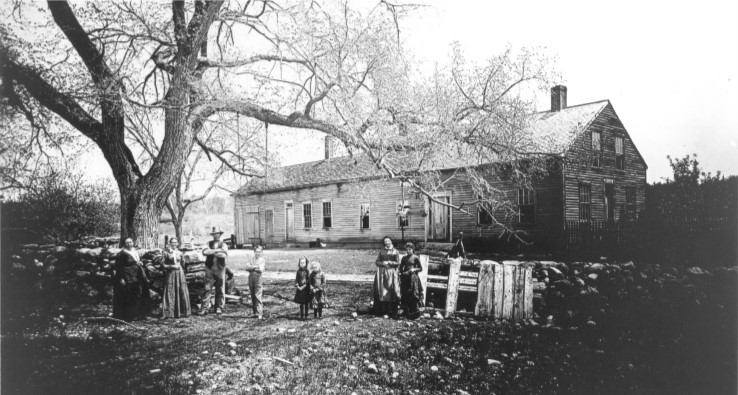
Butterfield’s Rock

Butterfield's Rock Windham NH

Butterfield’s Rock Windham NH

Origin of the Name

100 YEAR AGO IN WINDHAM

“WINDHAM FEBRUARY 14.— “The popular clamor for preparedness appears to be about one-third genuine scare over the hallucination that Germany is coming over to gobble us up, one-third attempt to make political capital by discrediting the present administration, and one-third desire to stimulate certain lines of business for selfish pecuniary reasons.” (So the military industrial complex celebrates 100 years.)

“We couldn’t help being amused at two contiguous items in a recent paper, the first stating that a jury had awarded a man damages of $1900 for the loss of some fingers in a machine, while the second stated that another man was awarded $275 by a jury in the same court for the loss of his wife, who had been enticed to leave him and take up her abode with another fellow.”

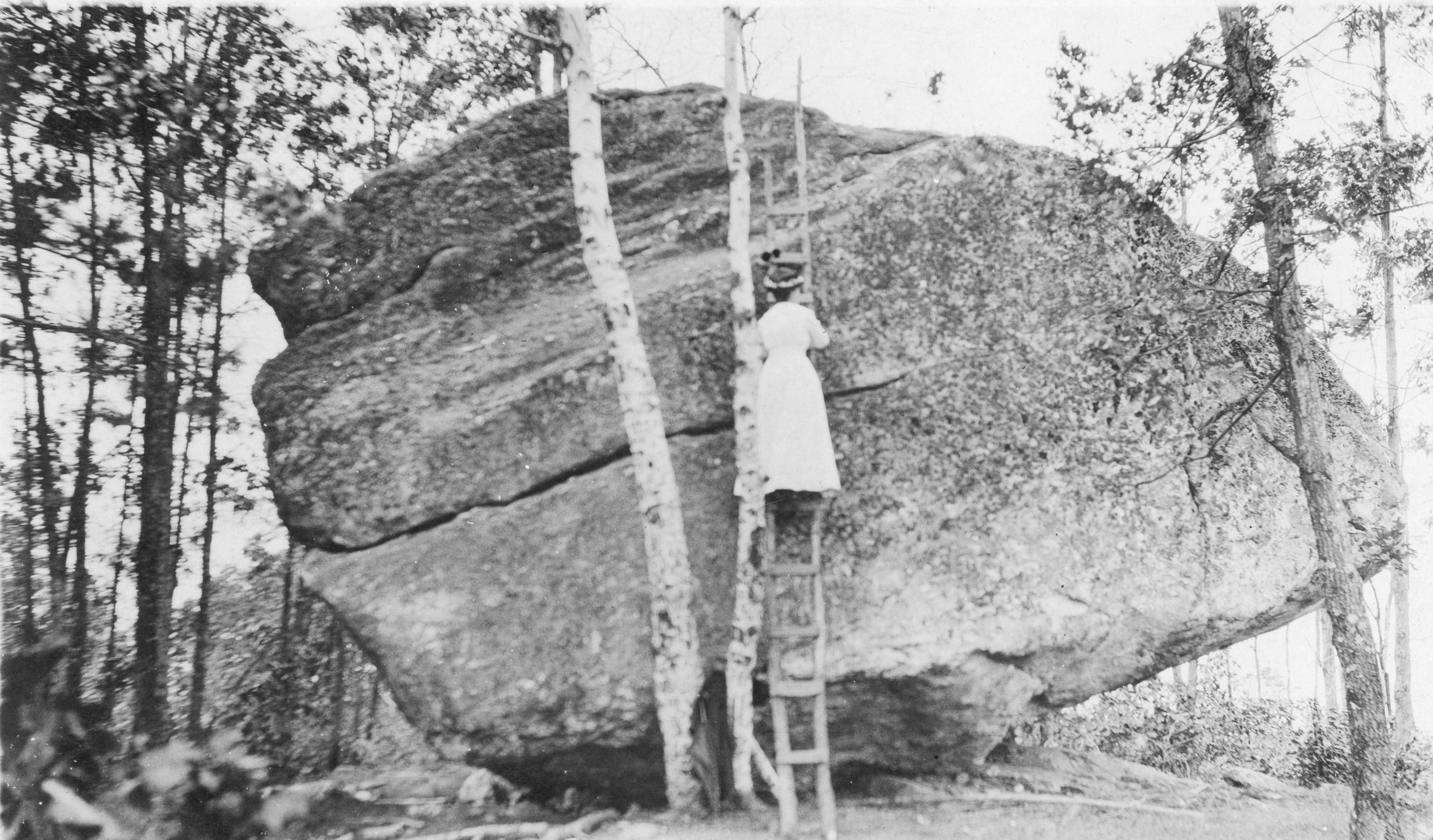
“Butterfield’s rock, one of the natural curiosities and noted landmarks of the town, has been known by that name for nearly two hundred years. (300 years now.) In the Londonderry Proprietors’ Records under the date October 29, 1723, occurs this record: ‘Laid out by order of the town a farm Given in the Charter to Mr. David Cargill Junior containing one hundred acres of land lying and being to the south west of the rock called Butterfield’s rock.’ It apparently took its name from a Jonathan Butterfield, of Chelmsford, to whom there was laid out one hundred acres of land , June 8, 1721. This land, however, was not near the rock, as it was west of Beaver brook. August 30, 1728, he again received ninety-eight acres, but its location is not clear. Morrison’s History of Windham says that Butterfield owned land in Londonderry, perhaps including the rock, before the coming of the Londonderry settlers in 1719. When Dracut, first settled in 1664, was incorporated in 1701, its bounds included the south part of what is now Windham, and the settlers of Dracut and Chelmsford used to pasture their cattle in the wild lands and meadows here. They burned the woods in the south part of town to improve the pasturage. The northeast corner of Dracut as first laid out, was apparently near Spear hill, east of the southern end of Cobbett’s pond. From there the line ran northwest four miles to the Dunstable line near Beaver brook somewhere in the region of West Windham, from there running south by the Dunstable line about four miles to near Jeremy hill in Pelham. The bounds of Londonderry when incorporated in 1722 overlapped this Dracut line, and it was not until 1741 that the line between Massachusetts and New Hampshire was definitely settled, substantially as at present. Windham was set off from Londonderry in 1742. There is an old path, still usable running through the woods from near Butterfield’s rock southwest to near E.A. Haskell’s which has always been called the ‘Dracut road.’ It would be interesting to know more than we do of the early days to which these old names carry us back.”

GOULDINGS BROOK: In doing research for this article, in the History of Dracut, I came across the following interesting information about early place names which were known before the Windham was settled by the Scotch-Irish. “In 1682, the Negus grant was purchased by Peter Goulding of Boston, who sold it the same year but, very singularly, the tributary of Beaver Brook still retains the name of Goulding’s brook, sometime corrupted to ‘Golden.’ …the grant covered the land between the two brooks at their junction, and extended nearly to the Moody Hobb’s farm on the road from Pelham Center to Windham…”

Some additional information about early place names in Windham include the following: “With the exception of he small grants to Caldicot and Negus, the latter called Goulding farm, all of the territory north of the tracts described was reserved land and was laid out in lots. They were usually located with reference to certain natural features such as Goulding’s Pond, Goulding’s Brook, Ledge of Rock’s Pond and Distracted Meadows. The latter were partly in the Gage Hill district and partly over the Windham line. Goulding’s Pond is in Windham and is called Cobbett’s Pond. It is one of the sources of Goulding’s brook which flows into Beaver brook near Pelham center. Ledge of Rock’s Pond has been called Goulding’s but is now Simpson Pond. “ (And now Moeckel Pond.) “ Morrison says the, “brook is call Golden or Golding’s Brook, tradition says, is so called from the fact that that an ox by that name died upon its banks at an early date. This was at the time when Chelmsford and Dracut people used to turn their cattle into the neighborhood in spring to get fresh grass and to browse during the summer. They also set forests on fire to kill the wood, so that the grass would grow more luxuriantly, and in early days the hills in that part of town were black with the burned and dead trees caused by these devastating fires. A Mr. Golding (Goulding) owned land in the vicinity. This undoubtedly gave it its name.” It also appears that there was a Deer Jump on the banks of the Merrimack River as well as on Moeckel Pond in Windham.

As for Butterfield’s Rock, it is no doubt named for Benjamin Butterfield or one of his descendants. Benjamin was one of the first settlers of Chelmsford, MA., in 1653. He would have likely turned his cattle out in wilderness that is now Windham.
 

Windham Life and Times – February 11, 2016

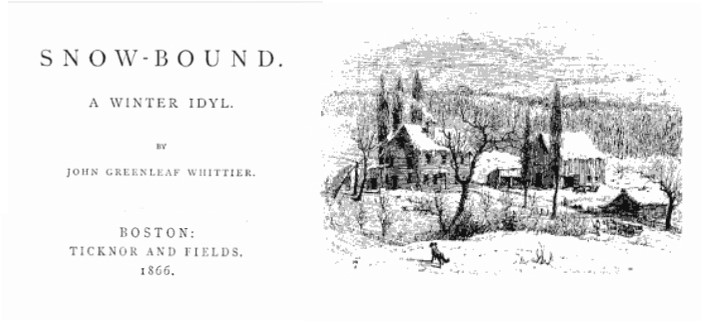
Snow-Bound

A WINTER IDYL

Images of the Embracing Intimacy of Snow and the Power of Fire.

snowbound     “WINDHAM FEBURARY 14.—Winter certainly took another flight… Yesterday was the day to read “Snowbound,” again—or do you know it by heart?” W.S. Harris, The Exeter Newsletter.

I didn’t know Snowbound at all, so while the snow was falling today, I read this poem written by John Greenleaf Whittier in 1865. In it, a snowstorm brings normal daily activity to a halt, allowing time to ponder the larger realities of life. Whittier eulogizes his family and the rural past. Written in the context of the destruction of the Civil War and the changes being brought about by the industrial revolution it was a popular success. The full poem runs for 747 lines and can be read at the Poetry Foundation-Snowbound.

…For such a world and such a night
Most fitting that unwarming light,
Which only seemed where’er it fell
To make the coldness visible.
Shut in from all the world without,
We sat the clean-winged hearth about.
Content to let the north-wind roar
In baffled rage at pane and door,
While the red logs before us beat
The frost-line back with tropic heat;
And ever, when a louder blast
Shook beam and rafter as it passed,
The merrier up its roaring draught
The great throat of the chimney laughed.
The house-dog on his paws outspread
Laid to the fire his drowsy head,
The cat’s dark silhouette on the wall.
A couchant tiger’s seemed to fall;
And, for the winter fireside meet,
Between the andirons’ straddling feet,
The mug of cider simmered slow,
The apples sputtered in a row,
And, close at hand, the basket stood
With nuts from brown October’s wood.
What matter how the night behaved?
What matter how the north-wind raved?
Blow high, blow low, not all its snow
Could quench our hearth-fire’s ruddy glow.
O Time and Change! – with hair as gray
As was my sire’s that winter day,
How strange it seems, with so much gone
Of life and love, to still live on!…

Found in Whittier’s introduction to Snowbound is a poem by Emerson and a quote illustrating the ancient spirituality of fire.

“As the Spirits of Darkness be stronger in the dark, so Good Spirits, which be Angels of Light, are augmented not only by the Divine light of the Sun, but also by our common Wood Fire: and as the Celestial Fire drives away dark spirits, so also this our Fire of Wood doth the same.” — Cor. Agrippa, Occult Philosophy, Book I.ch. v.

The Snowstorm (in part) by Ralph Waldo Emerson

Announced by all the trumpets of the sky,
Arrives the snow, and, driving o’er the fields,
Seems nowhere to alight: the whited air
Hides hills and woods, the river and the heaven,
And veils the farm-house at the garden’s end.
The sled and traveller stopped, the courier’s feet
Delayed, all friends shut out, the housemates sit
Around the radiant fireplace, enclosed
In a tumultuous privacy of Storm.’

This is all in a round about way bringing us to the principle of spirituality that is found in the essence of fire. Who hasn’t sat transfixed in front of the flames of a fire losing all trace of time. “Fire is one of the four classical elements in ancient Greek philosophy and science. It was commonly associated with the qualities of energy, assertiveness, and passion. In one Greek myth, Prometheus stole fire from the gods to protect the otherwise helpless humans, but was punished for this charity.

St John of the Cross, the Spanish mystic, In Dark Night of the Soul, uses a beautiful depiction of fire to illustrate the path to spiritual Oneness with God. Essentially, we begin as green wood, with which it is very difficult to start the spiritual flame, so the fire often goes out, having to be restarted many times before a self sustaining fire can be established. Eventually, the  fire burns brighter and hotter as we become one with God. Of course, the wood can never become the flame, but it can become totally subsumed within it. That’s the hope offered by the saint.

The 3,500 year Zoroastrian religion has fire as a central symbol. In ancient times, when Zoroastrians built no temples, possessed no religious imagery and had no books on the teachings of the faith, light served as the focus of their religious practices. Fire (athra / atarsh / atash) was a means of producing light. When using a flame, a source of light, as the focus while contemplating the spiritual aspects of one’s life, the symbolisms carried by the fire and the light it produced, conveyed some of the essential principles of the faith. For instance, carrying a fire into a dark place dispels the darkness giving us the metaphor of the light of wisdom banishing the darkness of ignorance. From wisdom are derived the principles of justice and order. The temporal fire was also the symbol of the cosmic fire of creation, a fire that continues to pervade every element of creation. In this sense, fire takes on a much broader meaning than a flame, a meaning we discuss below. Light and fire were also essential elements for sustaining life…Zarathushtra makes reference to the mainyu athra – the spiritual fire – as one that illuminates the path of asha. The universal laws of asha govern and bring order to the spiritual and material existences. Asha is available, through individual choice, to bring order to human thoughts, words and deeds. As an ethical choice, asha principled, honest, beneficent, ordered, lawful living.” HeritageInstitute.com

Enough said about this radical personification of snow and fire, its time to head home and start a blaze of my own. And to remember the more down to earth words of Robert Dinsmoor, Windham’s own “Rustic Bard”:

“And at my door a pile of wood, A rousing fire to warm my blood— Blessed sight to see!”

Windham Life and Times – February 4, 2016

Is the “Yankee” an Endangered Species ?

yankee

100 YEARS AGO IN WINDHAM | WILLIAM S. HARRIS

One look around today, and it is pretty obvious that the “Yankee,” with his stoic, sturdy ruggedness and independence, is an endangered species. What is a true “Yankee” you might wonder? Well Judson Hale, editor of Yankee Magazine says that “a Yankee is someone who is either native to New England or perhaps whose ancestors were.” NH Magazine Online in an excellent piece entitled, New Hampshire’s Real Life Yankees says that “Certain traits do exemplify the Yankee character: common sense, dry wit, a deep connection to the natural world and an acceptance of hardship. Yankees either have a penchant for storytelling that may stretch the truth or they’re taciturn.” The article further says, “But a Yankee preserves much more than material goods. The zeal for conservation also includes local culture, whether it’s the mom-and-pop maple syrup operations, the traditional music of the state or how town government is run.” “Hale further states in his book, Inside New England that “though frugality and shrewdness in business dealings are traits characteristic of New Englanders as a whole, I think New Hampshirites are the most frugal of all.” But is it still true? In the past, old time Yankees would debate for hours at town meeting about a 100 dollar expense. Today, the U.S. national debt is 17 trillion dollars. Where is Yankee culture in all of that. It is in this light that I present the Exeter Newsletter column from January 28, 1916, written by William S. Harris about “Thrift.”

‘There is more need to teaching children to save than there is of teaching them to give,’ was a remark made in our Sunday School lately. It was rather a novel idea, but on consideration there appears much truth to it. There are so many things, good and bad, calling for money, that the homely precepts of Benjamin Franklin on economy have been too much forgotten, and the traditional thrift of the New England character has been too much outgrown. Thrift in the poor is a necessary condition of comfort, but in the well-to-do also it is a virtue.”

“We are a nation of spendthrifts, and probably present conditions are making us more so. ‘Easy come, easy go.’ Many a well-to-do American family wastes enough to support a European family in comfort. I have heard a Westerner say that everybody in the West spends up to the full limit of his income.”

“Of course, frugality may degenerate into parsimony and become ridiculous, as in the case of Mrs. C., whose husband owned half the town, who on being solicited for a jar of preserves for a church supper asked, ‘Will I get the jar back?’ But this habit of looking after the small outgoes is one of the foundation stones of prosperity.”

“Reckless personal habits have opened the way to an alarming increase of public debts, of which the end does not appear, although statesmen are sounding the alarm. Governor McCall, of Massachusetts, in his inaugural address dwelt on the increase of his state’s expenditures, seven millions in 1900, thirteen and a half in 1910, and in 1915 almost twenty millions. His words, ‘Public expenses have been mounting with such frightful rapidity as to constitute a menace on our prosperity,’ may well be heeded beyond the limits of his own state…”

“…We get in the habit of depending more and more on the public, the state, the government, to do things things that we formerly did for ourselves. The result is that, forgetful of the fact that the public has no way to create wealth out of nothing, we become careless of expenditures so long as the money comes out of an unseen source—the public. In this way we get half values for the money spent, and debts pile up for posterity to pay interest on.”

A rather dim view of “Yankees,” is presented by the British author Frances Trollope in, Domestic Manners of the Americans, written in 1832. “…I like them extremely well, but I would not wish to have business transactions with them, if I could avoid it, lest, to use their own phrase, ‘they should be too smart for me.’ It is by no means rare to meet elsewhere, in this working-day world of our people who push acuteness to the verge of honesty, and sometimes, perhaps, a little bit beyond; but, I believe, the Yankee is the only one who will be found to boast of doing so. It is by no means easy to give a clear and just idea of a Yankee; if you hear his character from a Virginian, you will believe him a devil: if you listen to it from himself, you might fancy him a god—though a tricky one; Mercury turned righteous and notable. Matthews did very well, as far as ‘I expect,’ ‘I calculate,’ and ‘I guess;’ but this is only the shell; there is an immense deal within, both of sweet and bitter. In acuteness, cautiousness, industry, and perseverance, he resembles the Scotch; in habits of frugal neatness, he resembles the Dutch; in love of lucre he doth greatly resemble the sons of Abraham; but in frank admission, and superlative admiration of all his own peculiarities, he is like nothing on earth but himself.”

So is the final “Yankee” about to draw his last breath? I don’t know, I have to pin my hopes on the Millennials. Maybe a rejection of the rampant indebtedness and materialism foisted upon them by the baby-boomers will turn them into the new Yankees.

For and interesting look at “Modern Yankees” check out the article in NHMagazine.com “New Hampshire’s Real Life Yankees by Lynn Tryba.

Windham Life and Times – January 28, 2016

Christianity and War | William S. Harris

exeter

January 21, 1916. 100 YEARS AGO IN WINDHAM

“A clergyman of some prominence in the state, in an address, after defining Militarism as ‘that policy of government by which the nation trusts in force for the achievement of its ambitions in disregard of the claims of justice, humanity, and international morals,’ apparently indorses this policy by avowing: ‘There is only one way to meet the militarists that history records: that is with his own weapons on the field of battle.’ ”

“From other statements in the same strain, some of which I myself heard the preacher make, I think I do not misapprehend his position and I cannot refrain from recording a protest against such teaching by those called to interpret and apply the principles of religion and to be leaders of public opinion. It is their place to give us not only warning from the past, but inspiration from the future. Those who believe that humanity can and should ‘make progress upward and onward’ need to look ahead as well as back.”

“One hesitates to denounce war to the full extent of his convictions because so many excellent and esteemed men who fought in our Civil war seem to think arguments for peace are a personal reflection on them. Do they realize that the Civil war ended fifty years ago? If our people have made one-half the progress in the moral realm in these fifty years that they have made in material inventions and scientific knowledge, who will say that the causes which produced the Civil was could not now be adjusted without bloodshed?”

“The apologies for militarism appear to amount to something like this: so long as we have to deal with bad men, there is no use for any one to try to be good. The good need not try to make the bad better, but should descend to their level and overpower them with their own evil weapons.”

“We are told that the ‘national honor’ (whatever that that may be) can be vindicated only by giving blow for blow. The noble statements of President Wilson that ‘a nation can be too proud to fight,’ I heard ridiculed in a sermon by the same clergyman referred to. He should have lived a hundred years ago, when a high toned gentleman could not be too proud to fight his personal enemy or friend if differences involving ‘honor’ arose between them. The duel then must decide which was right, and one or the other must be killed to uphold somebody’s honor!”
“The civilized world has outgrown that barbarous foolishness. We even have laws to forbid individuals arming themselves and avenging their disputes. The time is surely ripe for nations to discard that primitive way of settling differences and to speedily find some way worthy of intelligent, not to say moral, beings. Is it not at least an ideal worth working for? Even though the advocates of force have only derision and the cry of ‘mollycoddle’ and ‘poltroon’ for those who believe the Christian world at least, after two thousand years, should be approximating the precepts of its Great Teacher.”

“The attempt is sometimes made to justify war in the present age by an appeal to the Old Testament. If this can be done, certainly other evils, such as human slavery and polygamy, can be so justified, institutions which the Christian consciousness of this age has utterly repudiated, but which never caused one half of the havoc and misery that war caused.”
Again, if the Old Testament had been sufficient for the world’s moral needs, why did Christ come and teach and exemplify a morality far in advance of that which the world had previously known? Christ recounted things which had been allowed ‘by them of old time,’ but, affirmed, ‘I say unto you’— something higher and better.”

“Christianity was not needed to teach men courage or patriotism. The Spartans, centuries before Christ, were as courageous and a s patriotic as any people ever have been or need to be. The ‘new commandment’ or Christianity is love, good-will, brotherhood. There is no place in the teachings, example, or spirit of Christ for the hatreds, selfish ambitions, and jealousies from which wars spring and which wars in turn aggravate. Christianity has made men more willing to suffer, to die if need be, in defense of truth and principle, but we can not believe that the spirit of Christ has ever made a man more inclined to kill or injure his fellow man.”
“We are told that our country’s only safety lies in having an army and navy sufficient to repel any nation that might wish to attack us; especially Germany or Japan, or both together. But why stop at two nations? Looking at history and human nature one can imagine Great Britain, France, Germany, Austria, Russia, Turkey, Spain, Japan, China, and a few more banding themselves together to despoil America! Why assume we can have the privilege of fighting them one or two at a time? If to meet force with force is are only hope, when are we safe? What amount of preparedness will avail?”

“No, our security is in obeying the command of God and of reason ‘ do justly, and to love mercy, and to walk humbly with thy God.’ If as Voltaire said, ‘God is always on the side of the heaviest battalions,’ away with such a God, the ally of cruelty and injustice! He is worse than useless in the evolution of humanity. Shame on so-called Christianity that has nothing better to offer as a principle of action than that might makes right, and force can only be overcome with force. The whole idea is far aside from the teachings of Christ. Even the Old Testament is full of the teaching that righteousness and not superior force is the surest defense of a nation as it is of an individual.”

     Will we resist the call of the modern war-mongers? We really need to get our own house in order before we arrogantly tell the rest of the world how to act. America now seems to muck up everything it touches. Eisenhower, a Republican, warned us about the evils of the “military industrial complex.” We didn’t listen. His successor died at the hands of the “deep state,” the enablers of the military industrial complex, who wanted wars in Cuba and Viet Nam. Politicians, industrialists and bankers win wars and the propaganda methods of Edward Bernays compels us to blindly do their will. “When the truth is found to be lies, And all the joy within you dies…”Jefferson Airplane. “War=Peace. We’ve always been at war with Eastasia.” 1984 Blah, blah, blah…

Windham Life and Times – January 14, 2016

Granite State Grove, Canobie Lake

canobie-1

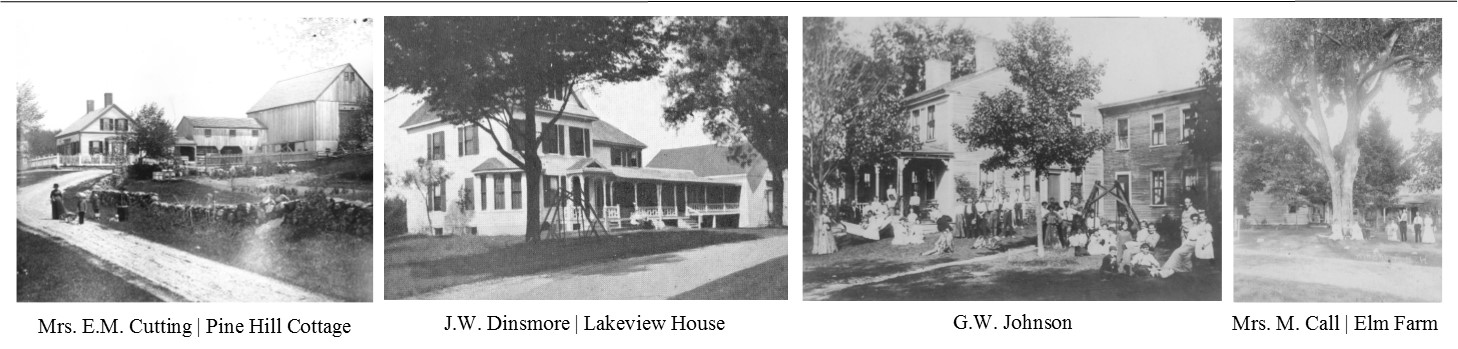
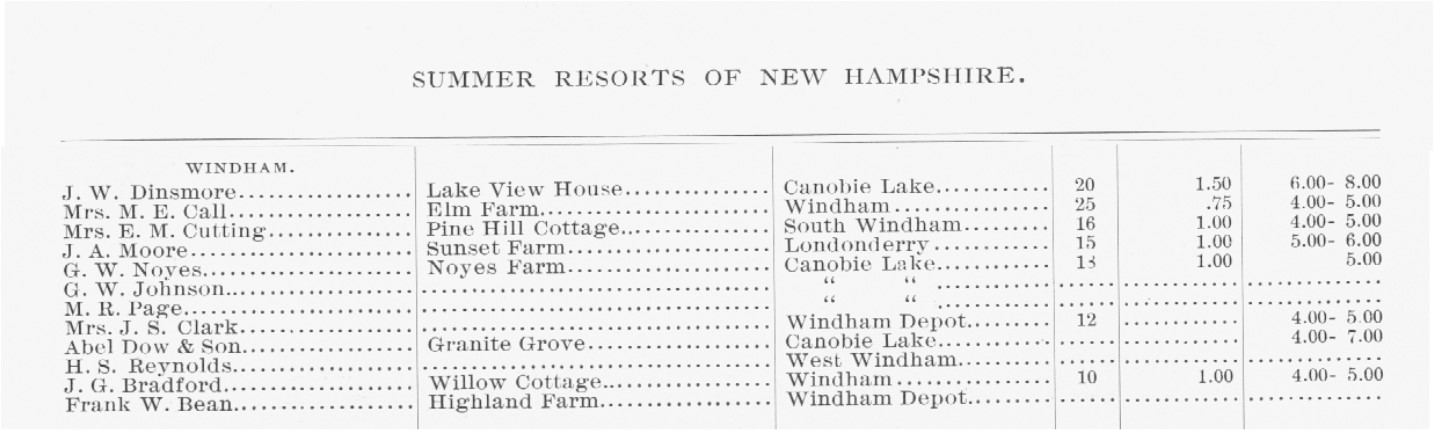
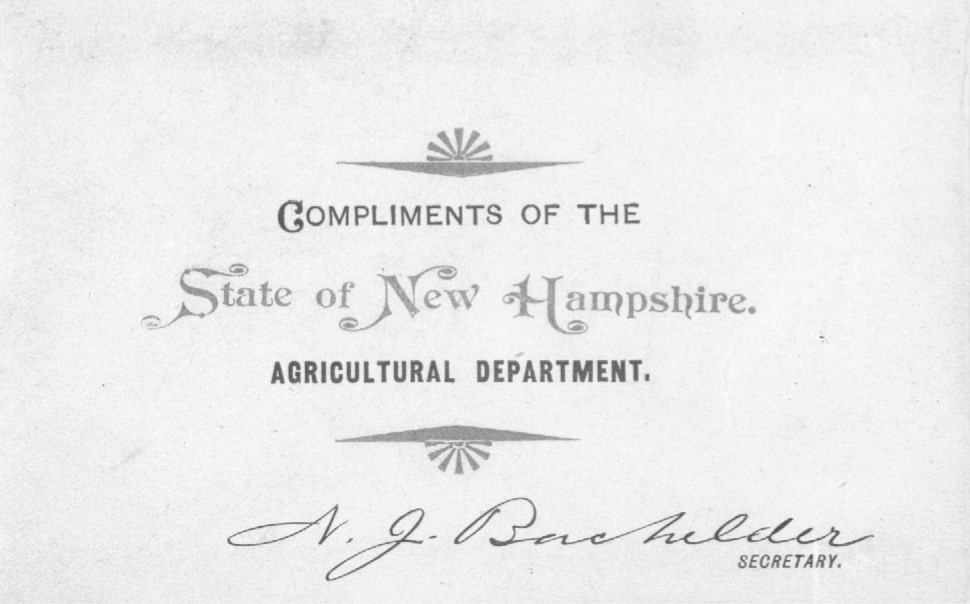
This photograph is from a tourist brochure, produced by the Agriculture Department of the State of New Hampshire. With the abandonment of many farms in New Hampshire in the late 19th Century, N.J. Bachelder took a two prong approach to overcome the problem. First, he encouraged farmers to operate boarding houses on their farms, during the summer months, (the rates of boarding houses could be found in this brochure.) Secondly, he encouraged wealthy and middle class people to purchase New Hampshire farms as summer homes. The Saint Gaudens artist colony in Cornish is a notable success, among others. This photograph shows Canobie Lake in Windham, where Hayes Hart Road is today. At the time, Granite State Grove was operating here. From the brochure: “Within the borders of New Hampshire are thousands of private summer homes varying in quality from rustic cottage to the elegant mansion, and affording ideal rest and recreation. Vacant farms have generally been utilized for this purpose, the buildings being transformed in accordance with the taste and necessities of the purchaser. A list of such farms, with tenantable buildings still for sale, can be obtained by addressing the secretary at Concord.” The brochure was provided to me by Dick Hannon, a long time resident of West Shore Road in Windham.

canobie-2