Windham Life and Times – December 22, 2017

Edward Searles and Angelo
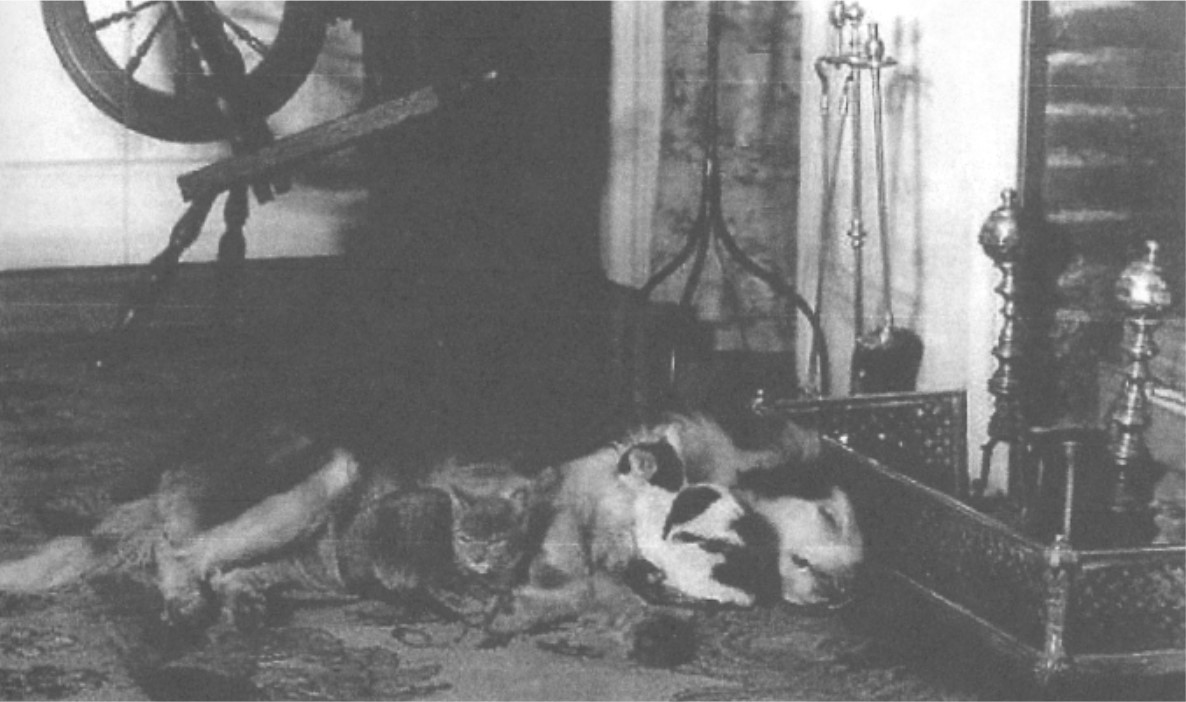
Cats and Dogs in Front of Fireplace at Pine Lodge

The Life and Kindness of Mr. Searles

“Well, Stanton Harcourt was a big place; about two thousand acres. Mr. Searles really loved that castle there; he built it to give himself something to do, but his real home was at Pine Lodge. Up at the castle he would take his stick and use it to show the men how he wanted things done. He always carried a cane. In those days all the gentlemen had walking sticks, and when he wanted something done he would make a plan with his cane, right on the ground, and draw just what he wanted. He would say, ‘You make it like this, here; and do it like that over there!’ He never made the whole design at one time. When the men were finished he would come back and look at it and say it was all right, and make another plan so they could continue. Sometimes it wasn’t the way he thought it would look, or he would think of something better, and he would tell them to take it down and rebuild it a different way. If he was having a wall built and there was a tree in the way he would have the wall built around the tree! He loved beautiful trees! I remember meeting his architect up there, Vaughan; he was a very nice man. He and the old gentleman got along well because both of them were designers, and understood each other. It was Mr. Searles, though, who planned the walls, and changes to other houses that he owned. We used to walk all around his properties in Methuen, and New Hampshire. He enjoyed looking at everything he made; he loved to do that. Mr. Searles never really finished anything he did; he was always changing or adding something. At the castle there was one part that was just a shell. He was going to put a big room there for the organ from Barrington. He was teaching me how to play on the organ at Pine Lodge, and I think that was why, because he told me that the castle would be mine someday. Pine Lodge was never finished either. When I was with him he was talking to an architect in New York, about something for Pine Lodge; that was later after his architect Vaughn had died. I met Vaughn a few times. He was an Englishman, and Mr. Searles loved everything English. The furniture for the castle in New Hampshire came from Barrington and Pine Lodge; they were moving it inside when I was living up there. The old gentleman bought a fireplace from France and had it put in the castle; another fireplace came from Europe and he had the whole thing rebuilt and put in Pine Lodge. Mr. Searles loved the castle, but he loved Pine Lodge most of all because he was born there; right there in the old house. It was really his home.”

“Pine Lodge was full of every kind of treasure you can think of; statues, paintings, and all kinds of beautiful things that came from Europe and Asia…Mr. Searles had his own bedroom in the house there, and Miss Littlefield had another; all the rest was for his art collection. After I started to work for him he arranged for me to have a room in the house also; everyone else, like Art Brown, the butler, lived in other houses on the property. When Arthr Walker, or other men from his businesses came, they stayed at the Red Tavern; that was his guest house. When Mr. Searles was in Methuen people were coming to see him on business. There was a little office there, at Pine Lodge, near the house, where he would meet those businessmen; Walker worked in there too, when he came to town. Mr. Searles and Miss Littlefield had an office in Pine Lodge, that he used for his personal business. Edith Littlefield was his cousin and she ran the house for him because he was always going away on business, or traveling; he loved to travel! She had a big checkbook and paid all the bills, and took care of his correspondence for him. Some people would write to say they knew of someone who needed help; lots of people asked for some kind of help. Miss Littlefield would always reply that they would receive an answer when Mr. Searles returned to town. That would give him time to check if a request was from someone really in need. He owned all kinds of property there, all kinds of houses. One day, when I was at Pine Lodge, a man came to tell him that someone could not pay their rent, and Mr. Searles said to forget about it! Many times he didn’t make any money on his properties. He told me, himself, that he didn’t make enough to pay the taxes on some of his property! He didn’t care; he did that to help out people. Mr. Searles was always doing things like that. He built all kinds of churches, all over. In New Hampshire a church burnt down and I was told that he built one to take its place. I remember him speaking to Miss Littlefield and telling her to make sure that everybody who worked for him was paid all year long. He made sure that they were paid every week, or every month. He had a crew of carpenters, and a crew of stonemasons, and kept them on the payroll even if the weather was bad and they couldn’t work for a few days, or  few weeks! He always had men building walls, or a new addition somewhere. He had lots of men out cutting trees, to clear land and have enough wood for all the fireplaces at Pine Lodge and Stillwater, and the castle in Windham. He would give the extra firewood away to people who couldn’t afford to heat their houses. Lots of poor people were helped out like that, and only he and Miss Littlefield knew of it! In those days you were either rich or poor; you didn’t have the big middle class like you have today.”

“I remember Miss Littlefield well. I would go into her office to talk with her; I would kid with her and make her laugh. She had a sense of humor, and Mr. Searles had a sense of humor too! People didn’t think so, but his friends who knew him well knew that! Dr. Bowker, from Lawrence, was a good friend of his, and he was always coming to Pine Lodge for visits. The old gentleman had lots of close friends; not like what was said in the newspapers; that he didn’t bother with anybody. If anybody said that they really didn’t know him at all. He wasn’t in ‘The Four Hundred’; he didn’t want to be part of ‘Society’. He just wanted his treasures around him and his friends…”
 

Windham Life and Times – December 15, 2017

Edward Searles and Angelo

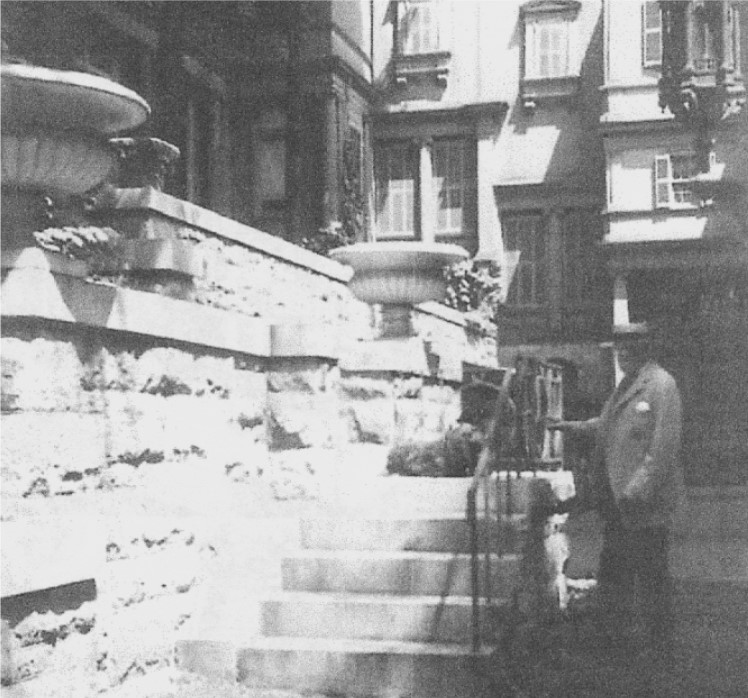
Searles and Junior

TIME SPENT IN WINDHAM AND METHUEN

“I started to work for Mr. Searles in 1915, and Stanton Harcourt was the first place he brought me. We came to Methuen, Mr. Searles and I, and we stayed at the Red Tavern. We didn’t go to Pine Lodge because it was too late, and he didn’t want to bother Miss Littlefield. There were no rooms for guests at Pine Lodge, there were only two bedrooms; the rest was his museum. Carrie Barnes was the manager at the Red Tavern. She ran the place for him, and he sent her a telegram to let her know we would be arriving on a late train and to get rooms ready for us. The next day she fixed breakfast for us, and after that we went up to see the castle.  At that time people were working inside; they still had some woodwork to fix, and the kitchen was not finished yet.  Everything there had to be made in Boston; Vaughan was his architect. After the kitchen was finished he brought in a nice couple to take care of the place for him. He arranged for me to live with the Seavey family. Seavey was in charge of the estate. The place in Windham was called ‘Searles Castle’ or ‘Searles Folly’. I always called it ‘the castle’ myself. We had over two thousand acres there, and at Stillwater we had about one thousand acres! We had our own sheep, and cows, hogs, chickens, and horses; everything we used there. I had a room in the farm house; that was on the road before you go up the hill to the castle. Seavey’s wife would take care of my room and I would have my meals there. I became friends with her daughter, Emma Richter. She was Seavey’s step-daughter, and her husband worked there on the farm. Emma liked me, and she named her daughter after me; ‘Angie’. I’m the girl’s godfather! Whenever I was up there, in Windham, Mr. Searles would come to visit every day to watch them finish the work inside. Later, when the rooms in the castle were ready, he would sometimes stay overnight and go back to Pine Lodge in the morning, but he would come up again later in the day, to see me. Most of the time though he would go back to Pine Lodge for the night. My room in the castle was on the second floor overlooking the lakes; the old gentleman had his room upstairs.

“One of the towers of the castle was unfinished and I had my workshop there. I asked Mr. Searles if I could have a flagpole made for that tower, and he wanted to know why. I said that every English castle has a flagpole on the tower, so I put one up there! I had a crew move a small house from Rockingham Park up to the estate. Mr. Searles owned land at Rockingham Park at that time, so he had the house moved to Windham and I had my shop there. (It’s still there at the base  of the driveway to the castle.) He bought me a boat to use on Canobie Lake. The motor that came with it was not that good so I asked Mr. Searles if he could get me a better one. I heard him tell Arthur Walker to order one. When it came, I went all over the lake in that boat; I had a lot of fun there, and I learned to skate on Canobie Lake. In the winter they used to cut ice on the lakes for the icehouse on the estate. I remember blocks were fourteen inches thick! We put them in the icehouse, and covered them with some kind of straw, to keep it cool; the icehouse was in the shade anyways. In the summer we used the ice up to the castle, and on the farm. We had dogs there; I had three dogs myself! Mr. Searles had a dog named ‘Junior’, that would follow him around Pine Lodge without a leash.”

“Junior”

I first learned to drive in 1915, up in Windham. Mr. Searles had two Studebaker trucks, and I was shown how to drive; up and down the hill. After I learned the old gentleman bought a Studebaker car for me to use, and later his chauffeur gave me a few lessons on the big Pierce-Arrow. When we came back from trips to New York the driver would meet us in Boston, at the train, and take us to Methuen. I was with Mr. Searles, and the driver, when they went down to the Boston showroom to buy another one; in those days Pierce-Arrows were the best cars made in America, those and Packards. The big Pierce-Arrow  was a limousine, with a glass between the driver and the passengers; you could slide the glass to talk to the driver. The newer one he bought that day was a passenger car. He would use that car sometimes, but he never drove himself; he had his chauffeur. I think he bought that smaller car for me because it was the one that I used in Methuen. One day I asked him if I could use it to go visit a friend in Lewiston, Maine, and he said it was all right. On the way I had an accident. In those days they had big water wagons to use on the roads to keep the dust down, and I hit one and damaged the fender on the car. There weren’t body shops back then, so I went to a blacksmith and he did a good job repairing it. When I got back to Methuen, I spoke with Mr. Searles about the accident, and the only thing he was interested to know about was if I had been hurt! All he asked me was, ‘Are you hurt?’ ‘No?’ ‘All right don’t worry about it, as long as your were not hurt.’ That was the way he was. He didn’t care about the car or the money, as long as I was all right”


Windham Life and Times – December 8, 2017

Edward Searles and Angelo

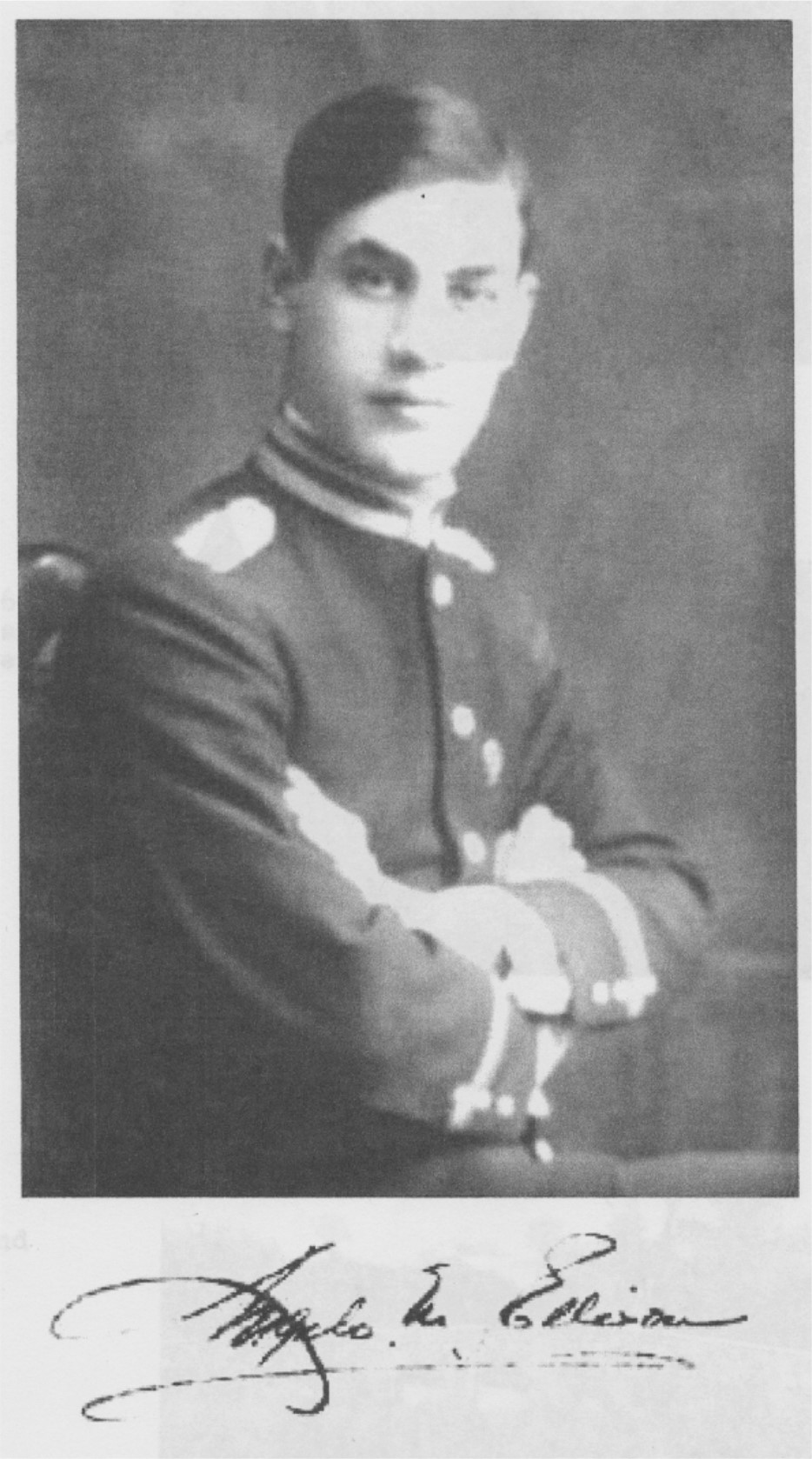
Angelo Ellison in his elevator operators uniform.

THE CHANCE MEETING

Ray Fremmer says of Searles that, “with age came loneliness and even the frequent change of surroundings he effected by going to New York periodically became of little use to enliven his spirits. In 1914, when he was seventy-three, he was in the habit of busying himself as best he could around Methuen for several months by visiting his different property holdings, and then he would go to New York for a week or two. He had an office at 71 Broadway, in the firm of Thomas Hubbard who managed Searles millions. After a few hours at the office he would go to his hotel, the Biltmore, and begin to wonder what was going on in Methuen right about that time. It was obvious, even to the elevator operator at the Biltmore, that Searles was a very lonely man. His name was Angelo M. Ellison, and he remembers to this day that the white-mustached old gentleman never tipped as did some of his other passengers. The lad, Angy as he was called, was somewhat of a loner himself. He had just recently arrived from Greece and although it was easy to adopt a name more easy to pronounce than his real one, it was not so easy to master the English language. This difficulty, together with the necessity of earning a living, made it very hard for him to associate with boys his own age.”

“Usually, Searles greeted the elevator boy with a polite ‘good morning’ or ‘good evening’ each time he entered the elevator. Gradually, however, he began to take a kindly interest in the seventeen year-old boy’s home country, his parents, and his difficulties in mastering a new language. Shortly, in Angy’s own words, ‘He started to tell me a few things about himself’, and asked Angy if he would like to work as his personal companion. Naturally, tired of travelling up and down the Biltmore Hotel all day, every day, Angy accepted the new job at once. In the moths that followed, each time Searles came to New York, he and Angy would go for long walks along Fifth Avenue and occasionally go the Metropolitan Opera House. When Searles went on inspection trips of his holdings, such as the Pittsburg & Shawmut Railroad coal pits, he was always accompanied by Angy. In Philadelphia they stopped to visit Searles’ aunts, the Smith sisters. And back in New York on Sundays they usually went to the Cathedral of Saint John the Devine, the organ of which Searles was quite fond. By this time Searles legal address was the Murray Hill Hotel— rooms 646 and 647; his legal residence as a citizen of the state of New York. He made New York his legal residence to protest the heavy taxes imposed on him by Massachusetts.”

Murray Hill Hotel where Searles had two suites

Angy tells the story of his meeting with Searles this way, “My name was Angelo, and my family name was Eliopoulos. After I came to America I wanted to become part of this country, so I changed my name to Ellison, because I was told that that was the American version. ‘Eli’ comes from the Greek word for the sun god, ‘Helios’, and ‘opoulos’ means son of’; son of the sun! I changed my name to Andrew after the will trial because reporters were trying to take advantage of me, and I was so disappointed in the way it ended that I didn’t want to be bothered anymore. I just wanted to get on with my life.”

“Before I met Mr. Searles, I was working at the Biltmore Hotel. It was across the street from Grand Central Terminal. That hotel and the other one they built on the other side of Grand Central, the Commodore Hotel, all belonged to the New York Central Railroad. All that was built about the same time and was new when I worked there. It was like a city underneath the station; there were all kinds of shops there, and you could enter the hotel from the passenger station underneath. I started as a bellboy, and they advanced me to operate the elevators. The manager told me that I would have a good future there; working for the organization. He was going to give me a better job but I left to work for Mr. Searles; but it wasn’t like work at all. He got to know me and asked if I wanted to work for him as his assistant; to help him when he went on his business trips, or just around town. We would go walking all over town; he liked to look at buildings and talk about architecture. He would like to go to the opera, or the theater; never a movie! We would have dinners at one of the big restaurants, or at a big hotel; The Plaza, or the old Waldorf Astoria on Fifth Avenue or someplace else. He would stop at Tiffany’s, and that is where he bought me a gold watch and later a beautiful ring with a green stone in it!

Windham Life and Times – December 1, 2017

Edward Searles and Angelo

INTRODUCTION

The photograph above of Angelo “Angy” Ellison and Edward Searles sometime around 1917. On the back of the photograph is written the following: International Newsreel Photo. Former elevator boy contests Millionaires will. New York. Photo shows Edward F. Searles, millionaire, seated and Angelo M. Ellison, former elevator boy for whom he is alleged to have shown great regard. The latter is contesting Searles’s will.

Over the next few weeks, I will be presenting information about Edward Searles and his relationship with a young Greek immigrant, Angelo “Angy” Ellison. Ellison changed his name from Eliopoulos soon after arriving in America. In those days, immigrants wanted to assimilate into American culture as soon as possible. The story of young Ellison is a very interesting one and offers rare insight into the life of Edward Searles himself, as well as a glimpse of the goings on at the Castle in Windham. The relationship between Searles and Ellison lasted for over six years. Searles met Ellison when he was seventeen years old and working as an elevator operator at the Biltmore Hotel in New York City. At the time of their chance meeting, Edward Searles would have been seventy-three years old.

The typed manuscripts, from where I have obtained much of the information to be presented, were given to me by Sister Josette, of the Sisters of Mercy. They are The Reminiscences of Andrew “Angy” Ellison transcribed by his friend Robert DeLage in the 1970’s and 80’s. Much of what has previously been known about Ellison, was contained in the sensational accounts of him and his relationship with Searles that can be found in the local and New York newspapers. These reports were written during the battle over the estate with its large real estate holdings, stocks and thirty something million dollars. The people fighting over the estate had various agendas in their portrayal of Searles at the time, just prior to his death, when he abruptly changed his will. Much of the sensational portrayal in the newspapers, was being manipulated by the would-be heirs to influence the outcome of their lawsuits. The real story, while it will never truly be ascertained, appears to be much more benign, especially when explained by Angy Ellison in his own words.

As you will see, it appears that despite his millions, in 1914, Searles was a lonely old man, when he had the chance meeting with the seventeen year old Ellison. His wife, Mary Hopkins Searles, who was the heiress to the vast Mark Hopkins railroad fortune, and twenty-one years older than Searles, had died July 25, 1891. So from his wife’s death until his own in 1920, Edward Searles lived alone, managing his money and indulging his love and fascination with art and architecture.

This vast fortune was tinged with really bad karma. It seems that both Mark Hopkins and Edward Searles intended to leave their millions to their “adopted” sons. Mr. Hopkins intended his money to go to his adopted son Timothy Hopkins and Mr. Searles intended the money to go to Angelo Ellison. In a case of what goes around comes around, it appears that after Searles married Mrs. Hopkins, he used his influence over her to see that Timothy was cut out of the will.  In the case of Timothy Hopkins, there was a court fight over the estate of Mrs. Hopkins Searles. She conveniently changed her will leaving everything to Edward Searles. The will also clearly stated that the omission of her adopted son, Timothy Hopkins, was intentional.  This all created a national sensation and public opinion was on the side of Timothy Hopkins. During the court hearing, Searles was questioned about his life with his wife. He admitted that “he admired her very much from the start and when he married her it was for both her love and money.” At the hearing Attorney Burley pressed the question, “which motive was stronger?” to which Mr. Searles made the intelligent reply of “love.” In the end, the estate was settled by giving Timothy Hopkins over three million dollars of the thirty million dollar estate.

It seems that Searles’s intentions for his adopted “son” Angy were also thwarted. Searles’s will was also changed very close to his death when many thought him  mentally incapable of making such a decision. Arthur T. Walker, Searles’s personal secretary, used his influence to have the will changed, and he inherited the vast Searles fortune. Walker died a few months after the estate trial ended, of a stroke, in front of the grand fireplace at the Windham Castle and the fortune passed to his elderly sisters. One can only imagine Mr. Walker’s last thoughts as he lay dying in grandeur.

SOURCES:

“The Searles Saga”, Sister Martina Flinton, P.M. 1976

“Andrew “Angy” Ellison – The Unheard Witness”, Reminiscences gathered on visits to his home in Bronxville, New York. As told to his friend Robert DeLage. 1979-1987.

“The Life Story of Edward F. Searles” Compiled by Ray Fremmer From the Unabridged Handwritten Manuscript of 1948.

Correspondence from Ray Fremmer, November 28, 1977 to December 31, 1982. Edited and Complied by the recipient. Robert DeLage.