Nutfield 300
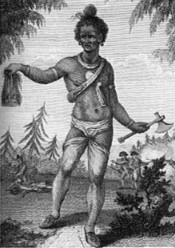
A Maine Indian from the Norridgewock tribe with a scalp.
Jamie Cochran Indian Captive
The first section below is taken from the History of Brunswick, Topsham and Harpswell, Maine, by George Wheeler. The next accounts are from John Gyles and John Wentworth concerning the exploits of James Cochran and are contemporaneous with his captivity by the Eastern Indians. It is important to remember that Cochran was just sixteen years old at the time of his captivity. His mother had a dream that he was killed and scalped by the Indians prior to his being taken. Scalping was practiced by both the Indians who used them as proof in order to receive their bounty from the French and the English, in order to receive their bounty from the government in Massachusetts. Bounties on scalps were quite large, making the practice quite worth the gruesome effort. “This attack upon the settlement at Brunswick is supposed to have been specially in in retaliation for that upon Norridgewock, the preceding year, by Colonel Westbrook.” (He had killed and captured several Indians there and burned the village and church to the ground.)
“No further fighting is known to have occurred in this vicinity until 1725. On April 13th of that year two Indians captured a man belonging to the garrison at Maquoit, named James Cochran, about eighteen years of age. He was on the marshes in pursuit of fowl when he was surprised by two Indians. He was pinioned, taken to the carrying-place, put in a canoe, and carried up to Ten-Mile Falls. There the Indians made their arrangements for the night. A fire was made and supper prepared. Cochran expected all this time he would be killed when the savages met some of their companions, and determined, in consequence, to make his escape, if possible. The second night his bonds were removed and he was placed between the two Indians to sleep. Each of the savages slept with his hatchet under his head and his gun by his side. Cochran feigned sleep, while in reality he watched every movement. As soon as he found his captors asleep he rose up. This movement awakened one of them, who, seeing their prisoner suffering from cold and endeavoring to warm himself went to sleep again. When all was again quiet, Cochran took the hatchet from under the head of the one who had waked, and killed him instantly. He killed the other as he was getting up. He then scalped them both, took both, took their guns and hatchets, and went down the river in great haste, fearing lest he should meet their companions. In fording the river on the way, he lost a gun and one of the scalps. When he arrived opposite the fort, he shouted, and a boat was sent across for him. He narrated his adventure to Captain Gyles, and some men were sent up river, who found the bodies of the dead Indians, and also their canoe which they brought back. He was rewarded for his bravery and promoted in rank.
Letter from Co John Wentworth.
Fre. Portsmouth April 21th, 1725.
“Yesterday was with me a young man, who is a Soulder in Your Servis by Cocharain An Ireish lad, Two Indians Took him at Maquoite and carried him up Abroscogen river a Day & a halfe Journy. The Second Night, this Cocharam (sic. Cochran) found The Indians fast asleep, went around em feeling for a hatchet, at length found one with which he Dispachrd em boath & has brought away there Scalps, but makes the Story more Manly, this Cocharam lost one of his Scalps in his March home so that when he came to Our Garrison he got three men more of his minde and went up to the place which they Judge Neer forty Miles from Mequoite, and there found the Indians as he had Saide, So they Took Another part of his Scalp and brings with, I Sent them Down Yesterday in Order to get a passage to Boston, where I hope You will See him this Evening. It was a Manly Action and doubt not but You will reward Accordingly, but in these cases our hands are Tied up, which is very greaveious to me. I think Such actions should be bountifully rewarded, it would Animate our Captives and put em upon Desperate attempts which would Discourage our Enemies…”
May it Pleas your Honour,
April 15, 1725. This Day a soldiar taken from Maquaitt Made his Escape to this Garrison, who informs me yet he was taken by two Indians ye 13 Currant, one spake good English & asked him many questions Particuler Concarning myself & this fort, he being well acquainted & told him he kil’d Moses Eaton & a negro & an English Man at Black Point, & he tould him yet six Indians wear now gon towards falmouth to kill & take, and yet our Gentlemen Commitionars wear Return’d from Canaday and yet ye Indians wear Resolved for war, & yet many Indians & Mohewks would be Down this summer to Destroy ye English & their Cattle, and now their wear 50 or 60 Indians with a friar at Narangawock, & several Indians at a Village up this River (Part of his Discours I take to be french Aier, tho My humble opinion is as I mention in my mean Lines to your Honour, December 12: 1724 Date) the second night after ye Presonar was taken, ye about said 2 Indians after hunting & killing several beauer & authers* in ye Evening they being tir’d, then, Camp* about 15 or 20 mile up this River above our fort, and when found on sleep, ye youth James Cochron ye Prisonar Rise & nockt them bouth in ye head, & took of their sculpt, one he brought to this Garrison, ye other Lost by yr way, and a fm gun in a small River Palling over. I adis’d ye Presonar to give a full accompt of to ye Colenel by ye furst — he being now much tired, I have also Rate again to ye Cololonel of affears since ye Presonar Came in, I thought also to send to Captian Heath for Men, to go up & secure ye Canew & anthers. Left with ye Corps of, but it being Difucult sending to Ritchmond, I thought it Proper to mustar a few hands of my Little number & from maquaitt, to Prevent ye anther Indians getting ye Plunder. April 18th this Day our People Went up ye River to Vew ye Indians Corps & bring of ye Plunder, and if any further Discovery.
April 17″‘, then Return’d, but no furthir Discoury; they brought of ye anther gun hatchets, knives & stone; ye Canew brought ye auther sculp, skins etc. in all to ye Value of 6 or 8 Pounds. I have often Prayed for a Reinforcement of men to this Garrison to scout & ambush this River & anther Places Which Depending on anthers for it. I now renew my humble Request for your Honours feauer to this Garrison.
Fort George.
April 16th 1725.
I am your honours, Most Dutyfull servant John Gyles.


 Windham NH History