Windham Life and Times – March 15, 2019

Gilbert Alexander Farm

Gilbert Alexander Farm North Lowell Road, Windham

Gilbert Alexander built this house about 1835 on a portion of the original Nesmith farm. His son Charles owned the property when this photograph was taken. The house still stands on North Lowell Road and was for many years the residence of the Low family. (Baldwin Coolidge No. 258-A; courtesy of SPNEA

Windham Life and Times – March 1, 2019

Benjamin Thompson- Lord Rumford

The Rumford Fireplace

When Lord Rumford was not chasing skirts, he put his brilliant mind to work solving practical problems in the world. This was a common attribute of many of the  settlers of America in the 18th century and brings to mind other “Renaissance men” such as Benjamin Franklin and Thomas Jefferson.  If you have lived in New England for awhile, you have probably heard of the “Rumford” fireplace, but might not have understood why it was such an advance in woodburning technology.

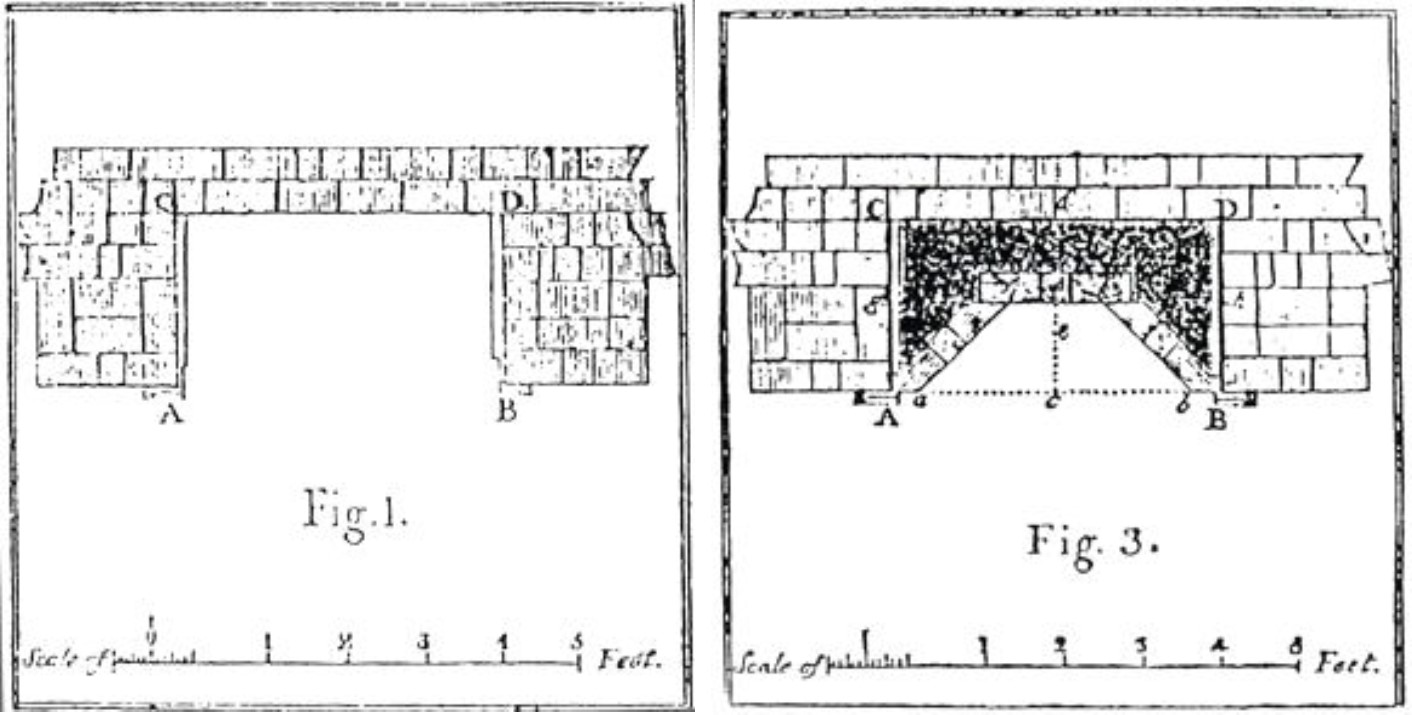
A plan of a traditional fireplace next to the Rumford design.

“Rumford applied his knowledge of heat to the improvement of fireplaces in the 1790s. He made them smaller and shallower with widely angled covings so they would radiate better. And he streamlined the throat, or in his words “rounded off the breast” so as to “remove those local hindrances which forcibly prevent the smoke from following its natural tendency to go up the chimney…” Rumford wrote two papers detailing his improvements on fireplaces in 1796 and 1798. He was well known and widely read in his lifetime and almost immediately in the 1790s his “Rumford fireplace” became state-of-the-art worldwide. Subsequent testing of Rumford’s designs has shown that their efficiency would qualify them as clean-burning stoves.” The Rumford fireplace created a sensation in London when he introduced the idea of restricting the chimney opening to increase the up draught. He and his workers changed fireplaces by inserting bricks into the hearth to make the side walls angled, and they added a choke to the chimney to create a circulation of air inside the chimney. In the unmodified chimney, smoke rises up the chimney propelled only by buoyancy…Thompson became a celebrity when news of his success became widespread. In an age when fires were the principal source of heat, this simple alteration in the design of fireplaces was copied widely… Rumford fireplaces were common from 1796, when Count Rumford first wrote about them, until about 1850. Jefferson had them built at Monticello, and Thoreau listed them among the modern conveniences that everyone took for granted.” Wikipedia

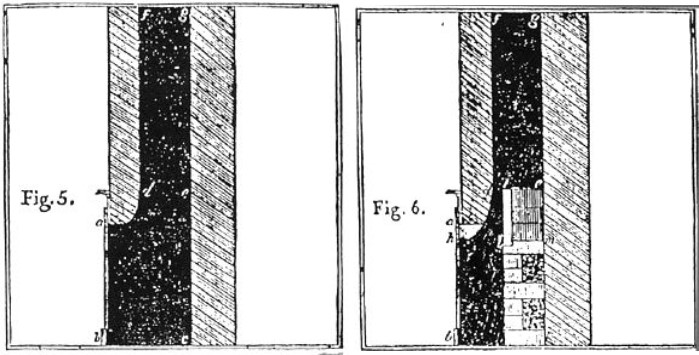
A cross section of a traditional fireplace next to the Rumford design.

“The work for which Rumford is perhaps best known today is his energy-efficient design for fireplaces. His essay “Chimney Fireplaces, with Proposals for Improving them to Save Fuel; to Render Dwelling-houses more Comfortable and Salubrious, and Effectually to prevent Chimneys from Smoking” was first published in 1796, in the Bibliotheque Britannique in Geneva, and in volume I of his Essays, Political, Economical and Philosophical, published in London. An American edition of the Essays was published in 1798…A Rumford-design fireplace in the South Square Room…Thomas Jefferson owned volume I (Boston, 1798) and volume II (1799) of the three-volume American edition of Rumford’s Essays. However, it seems that Jefferson was familiar with Rumford’s designs well before 1798. Jefferson’s remodeling notes for Monticello, begun in November of 1796, contain sketches and notes for ‘Count Rumford’s fire places in the square rooms;’ ….By 1798 Rumford was already complaining that masons took short cuts and ‘neglected to round the breast,’ and his second essay on fireplaces published in that year was written primarily to address these faults. Once again he re-emphasized the importance of keeping the ‘back perfectly straight’ and of ‘rounding the breast.’” (The Collected Works of Count Rumford; Harvard Press; 1969; vol. 2.) Jim Buckley, rumford.com


Windham Life and Times -January 25, 2019

Harvesting Ice in 1944 in Windham NH

ice-markewicz

Harvesting ice on Castle Hill Road in Windham NH

I was sad to hear that one of Windham’s long time residents had passed away recently. Mary Glance was very kind to me, in providing photographs of her family’s farm on Castle Hill Road for my book. I thought with the sub-freezing temperatures it was appropriate to show a ice harvesting scene from the Markewich farm from 1944. The men sport a great L.L. Bean look. Ice harvesting was an important part of rural life. The farmers harvested ice to keep their milk cold until it could be delivered. Ice was harvested on Cobbett’s Pond and Canobie Lake and there were ice houses along the shore of both lakes. Even after the advent of electric refrigerators, many camps on the lakes and ponds still used ice. For those of you who are interested, they have an ice harvesting day, using the old ice harvesting machinery every winter on Squam Lake. https://www.squamlakes.org/news/annual-ice-harvest-squaw-cove Also found something else that was interesting. The public can rent canoes and kayaks from the Squam Lake Association Center, 534 US Route 3, Holderness, NH. …No not in the winter! Every year, there are fewer and fewer “old-timers” left… you know who you are

Windham Life and Times – January 18, 2019

Windham and the Summit

Part 6– Conclusion

Mattie Clarke was one of those independent woman who grew up in Windham in the nineteenth century and flourished both locally and in the wider world. Woman like Mary Bradish Titcomb, Margaret Hughes Berry, Julia Baker and many others. Mattie Clark had a demanding career both on the Summit of Mount Washington and in Ormond, Florida. Any many very successful men trusted her and sought her out for her managerial skills. She used those skills and improvised a flourishing hotel in the rustic “Tip-Top House,” after the first Summit House burned in 1908. She was there again to manage the New Summit House when it opened in 1915.

Mattie Clark’s Gravestone on the Cemetery on the Plain, Windham NH.

Not only did Mattie Smith have and interesting career but she also invested her money well, no doubt gaining insight from the many leading businessmen she dealt with and served as guests. “She was on her way north from Ormond, Florida in 1933 when sickness overtook her while in the Buttonswood Beach section of  Warwick, Rhode Island and she died at 81.”

Tim Lewis in his research provided information regarding her will. “Clarke bequeathed her farm in Windham; a cottage on Orchard Lane in Ormond Beach known as the “Coacoochee Cottage;” stock from American Telephone and Telegraph, Swift and Co., Libby; Liberty Loan Bonds; Over $11-thousand dollars to friends; a thousand dollars to both the Ormond Union Church and the Colored Library of  Ormond, the latter to be invested to provide money for purchasing books. Two thousand dollars to the Windham Cemetery to be invested for perpetual care of the family plot. The Windham Library, Presbyterian Church, the New Hampshire Orphans Home in Franklin, the White Orphans Asylum in Jacksonville, Florida and the Nashua Protestant Home for Aged Women all received money from Miss Clarke.”

A path in Santa Lucia Plantation, Ormond Beach, where Mattie Clarke owned her cottage.


Windham Life and Times – January 11, 2018

WINDHAM AND THE SUMMIT

The Armstrong Homestead on Londonderry Road, was adjacent to the Clarke Farm.


Eugene Armstrong

Eugene Armstrong was I believe, a cousin of  Mattie Clarke, her mother being Deborah Armstrong. The Armstrong and the Clarke families lived on adjoining farms on Londonderry Road, in Windham. You may notice that I have changed the spelling of Clarke by adding an “e” to the end as carved on the family gravestone, not as spelled in Morrison’s History of Windham which eliminated the “e.”

Eugene Armstrong owned the store at Windham Depot for a number of years. In an Exeter Newsletter column written by William Harris . October 1, 1915, it says, “Eugene C. True of Derry, has bought of Eugene W. Armstrong the store, property and business at the Depot which the latter has conducted for a few years past. It is the stand formerly for a long period occupied by the late Edwin N. Stickney. Mr. True has been employed for some years in the furniture store of L.H. Pillsbury & Son, in Derry and is highly spoken of by those who know him.”

We also learn in The News-Letter, in November of 1912 that, “Fred S. Webster, Republican, was chosen representative by 60 votes to 41 for Eugene W. Armstrong, Democrat. Not known to me, was that Eugene Armstrong was also an engineer on the Cog Railway on Mount Washington. He was born in Windham on December 23, 1865. Tim “Jitney Jr.” Lewis says that he worked on Mount Washington from 1885 through 1908. “Eugene Armstrong is noted as a Mount Washington Railway engineer in 1907. ‘Engine No. 4 of the Mount Washington Railway, which has been in the shops at the Base for repairs, came up with freight on Saturday (August 17, 1907) for its trial trip and was put in regular service the same night, in charge of Engineer Armstrong.’ ” He was 12 years younger than his neighbor (cousin) Mattie Clarke. He worked twenty-four summers on the Mount Washington Railway and spent six winters working for Anderson and Price at the Ormond Hotel in Florida. He purchased the store in the Depot in 1910. He passed away on August 24, 1925 in Windham.

…Still looking for photographs of Mattie Clarke and Eugene Armstrong for Tim Lewis.


Windham Life and Times – December 28, 2018

Windham and the Summit

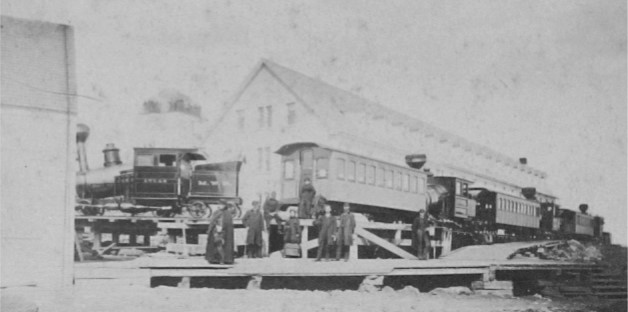
Passengers arrive on the Cog Railway at the Summit House

Part 3 – Mattie Clark Remembered in Windham

In spite of spending most of her grown life travelling between Ormond Florida and the Summit of Mount Washington, Mattie Clark remained connected to Windham throughout her life. She grew up here on her  parents farm here and her exploits were written about by Will Harris in the Exeter Newsletter.

WINDHAM, August 25, 1899: “Miss Mattie A. Clark of this town holds the responsible position of manager and housekeeper of the Summit House on Mount Washington. Among the Clouds thus speaks of her in a recent issue: ‘Miss Mattie A. Clark, who first became connected with the Summit House in 1884, and who has so successfully managed it for several years past, is the manager this year, and that is saying quite enough to assure the Summit visitors of first class treatment. Both here and in Ormond Florida, where she is superintending housekeeper, Miss Clark has the most enviable reputation, and is known as one of the most capable woman hotel managers in the country.’ ”

October 11, 1900: “Miss Mattie A. Clark, the efficient manager of the Summit House on Mt Washington, is at home to remain until December, when she goes to Florida for the winter season at the Hotel Ormond where she is housekeeper.”

WINDHAM, April 21, 1903: “Mrs. Deborah E. Clark, 77 years of age, had a paralytic shock some days ago, and remains quite feeble. Her daughter, Miss Mattie B. Clark, well known as a hotel manager at the White Mountains and in Florida, came home from Florida as soon as the news of her mother’s illness reached her.”

July 8th, 1903 Clarke Funeral:

“For the first time in many years Miss Mattie A. Clarke has failed to be in attendance at the opening of  the Summit House to greet the visitors to whom she is so pleasantly known. After returning from Ormond, Fla., in the spring, Miss Clarke was detained at the bedside of  her mother, Mrs. Deborah Elizabeth Clarke, who after many weeks of  suffering died on Monday, July 6, aged 77 years. The funeral was held Wednesday at her late home at Windham Depot, N.H.  Mrs. Clarke was a bright and lovable woman, of  a most kind and motherly disposition. Besides Miss Clarke, her only other child was a son, who died in the Civil War. Her whole life was spent in Windham, and the family homestead was a welcome resting place for the daughter in the intervals between her summers on Mount Washington and her winters in Florida. Miss Clarke has the sympathy of her many friends, who hope in a few days to welcome her back to the Summit.” Among the Clouds

     Season Opening Notes: “The Mount Washington Railway, which sent its first train to the Summit this year the week of  June 15th, retains in its service nearly the entire personnel of  last season’s employees….An old guest at the Summit House will note but few changes here this season. The same homelike atmosphere pervades the whole establishment, and that the former excellence of  its service will be maintained this year is assured by the presence of  so many of  the heads of  departments of  long continued service. Miss Mattie A. Clarke, whose attention to visitors makes them to feel that they are personal guests, is still manager of  the house, with Mr. A. Frank Curtis as clerk. The cuisine will be prepared by Mr. A. J. Miller, the accomplished chef  of  1904, and Mrs. George Howland. Mrs. Myron Browley assists at the souvenir stand, Mr. Maurice J. Dineen is in charge of  the telegraph and post office, Mr. Park Horan of  the wine room, and Mr. Mark A. Davis of  Middlebury, Vt., fills the position of  head waiter, and James Powers, watchman. Nor should mention be omitted of  John Tice, bellman, who for several years has been an alert messenger upon the arrival of  each train…All in all, each and every details of  the hotel management has already received such careful attention that it is difficult to realize only a few days have intervened since the arrival of  the first train to the Summit, and that so much could be accomplished against such great odds of  location and climate.”

– Among the Clouds – Thu, Jul 13, 1905


Windham Life and Times – December 21, 2018

Windham and the Summit

A June Snowstorm Brings Christmas to the Summit. Among the Clouds, July 13, 1905.

Part 2 – June Christmas

Summit House Opens: “The formal opening of  every hotel is an important date in its calendar, and often the management endeavor to introduce some special attraction for the pleasure of  those guests first to arrive. Mount Washington – always zealous of  its individuality, this season outdid itself.”

“The Summit House was ‘opened,’ Monday, June 26th. The morning was rainy and dense clouds obscured the slightest vision of  the outside world. There was wisdom in this arrangement, for it was not the scenery but the completeness of  the hotel that was to be made manifest that day. The thermometer, which registered 46 in the morning, having heard a student waiter reciting “What is so rare as a day in June” was not forgetful of  its part of  the program and toward noon settled slowly to 38, and at 4 o’clock gave a decided novelty by sinking below the freezing point. Immediately the torrents of  rain became a driving snow storm, and throughout the night and Tuesday and until late Wednesday (6/29) Mount Washington was in the clutches of  a winter tempest, at time the roaring of  the wind and the beating of  ice and hail against the summit House was almost deafening. But within all was good cheer and comfort. “Dolly” the boiler was never more faithful, and steam whizzed through the pipes assuredly and without cessation, while the huge coal stores performed nobly the extra service required of  them. But those were days to be remembered, and the few guests who braved the mountain will not soon forget their experiences. After all, it is not the weather that decides the amount of  pleasure to be had in a visit to Mount Washington. ‘For the dissatisfied man all life is unsatisfactory, and for one that is contented the world is full of comforts, and for the cheerful man even the easterly wind is musical in the window crevices.’ ”

—Among the Clouds – Thu, Jul 13, 1905
“A June Christmas Tree: ‘On Wednesday evening, June 28th, the Summit House colony indulged in festivities unique in the history of  Mount Washington. The platforms that morning covered with snow and the whole cone of  the mountain glistening with frost work and ice suggested midwinter rather than a rare June day. Someone remarked that ‘it would be proper to observe Christmas.’ The idea was a popular one and immediately following breakfast preparations were continued throughout the day for an unusual festival. The manager of  the hotel, Miss Mattie A. Clarke, ordered a fir tree brought up from the Base, which through the kindness of  the Mount Pleasant House was later made attractive by many festoons of  pop corn. Then came the search for gifts. There were about thirty-five employees of  the Summit House and Mount Washington Railway to be remembered. Trunks, boxes, even coat pockets were divested of  their treasures and by nightfall the tree was overloaded with offerings. Nearly 150 presents were ready for distribution. What they may have lacked in value was made up in quantity. About 8 o’clock the parlor doors were opened. Mr. John Tice presided at the piano and a merry company was soon seated. Hardly had an exchange of  greetings been made when Mount Washington’s Santa Claus, Mr. Ed Colter, costumed in a style to make St. Nick himself  envious appeared on the scene to the  delight of  everyone save Leon (the Summit dog), whose association with the genial gentleman had heretofore been confined to an almanac interpretation of  seasons. Among the Clouds at this date not having commended an issue, one of  the staff  presented the initial number of  a possible evening addition for midwinter circulation “Among the Snow Flakes.” Next Santa ably assisted by Mark Lee, distributed the presents, a description of  which would be impossible. Then followed an excellent musical program, including solos by Mr. Chandler and Mr. Horan, and a chorus selected from the company. While the storm was furious, and together with the freezing temperature made all without wild and terrible, this little Summit House party – warm and comfortable, were living the sentiment of  Dr. Van Dyke ‘and best of  all along the way is friendship and mirth.’ ” —Among the Clouds July 13, 1905

Remember, we’re looking for a photograph of Mattie Clark for Tim Lewis. Does anyone know of one?