West of Baker Farm…Did Mr. Horne Photograph the Old Simpson Road
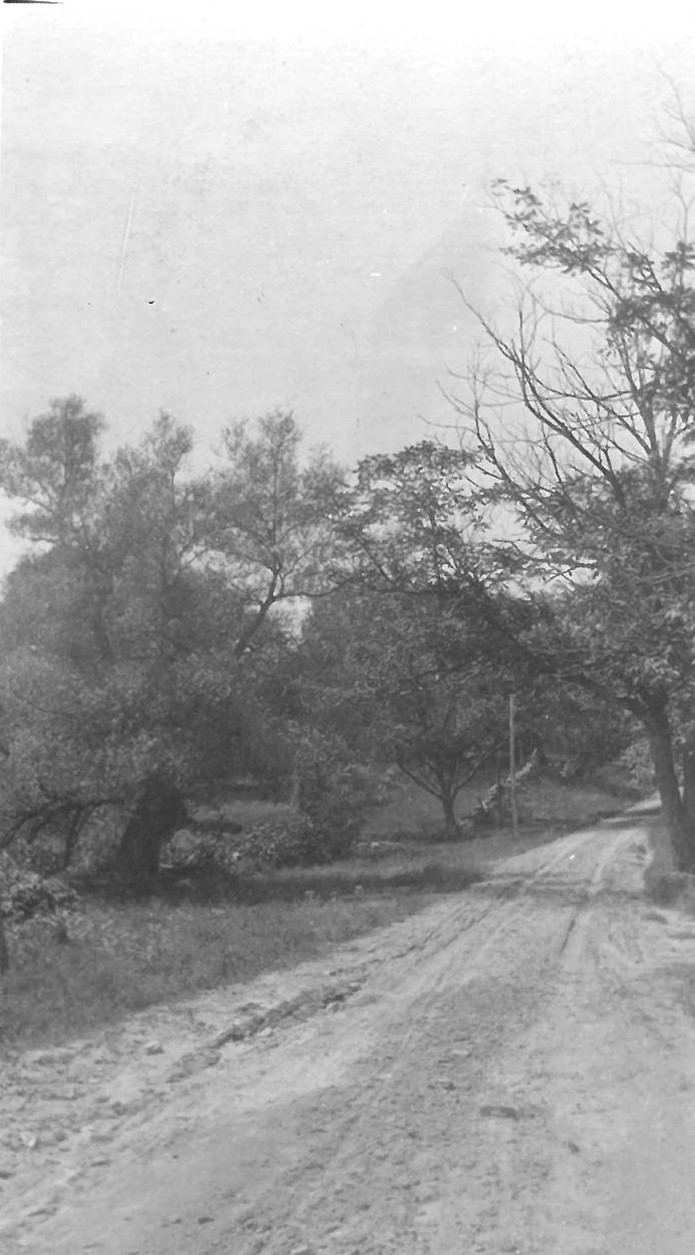
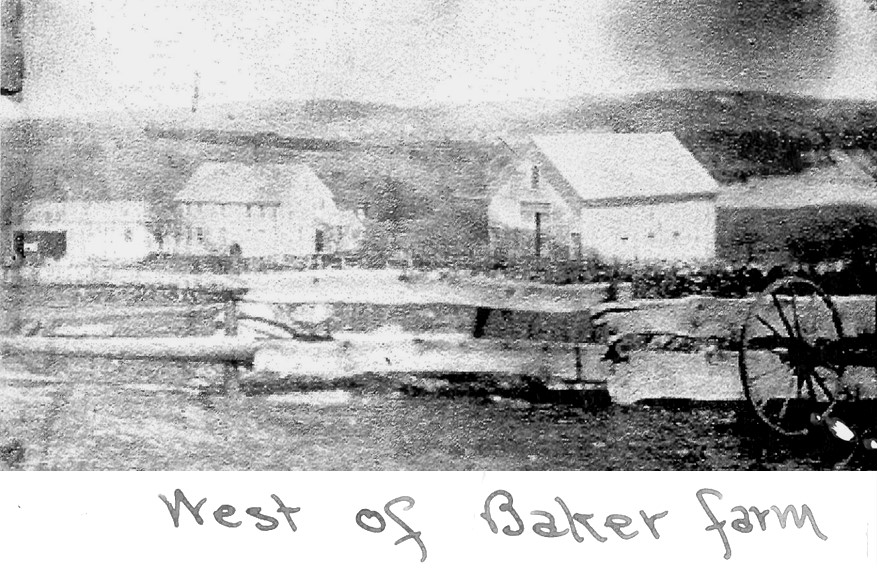
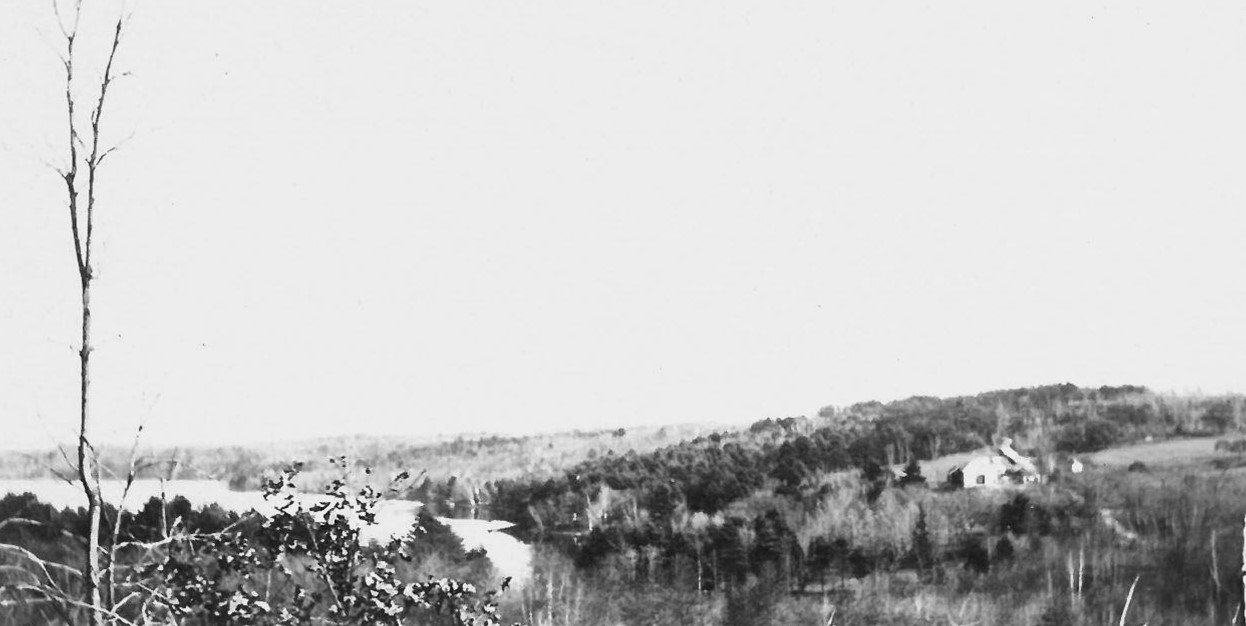
So I was writing a few weeks back about the old Simpson Road in Windham. I think I’ve stumbled across a photograph taken by Herbert Horne of Simpson Road, early in the twentieth century. It is on the right and hand written on it was “West of Baker Farm.” The Baker Farm was owned by Julia Baker, who operated a boarding house there. It was located on the West end of the Range overlooking Cobbett’s Pond where Baker Road is today. Sorry for the poor quality photos of the farm, they’re all I have.
Bank Swallows-Winged Acrobats flying over a Lake or Pond near you.
So I have been really impressed this year by the numbers of swallows flying over Cobbett’s Pond. In early Spring, there were groups near the hundreds darting, dropping and rising over the water. I’ve never seen so many. The best time to spot them is at dusk and dawn. So on Monday night, I was standing on my wall near the shore admiring a pod of three sparrows, performing their acrobatics. Suddenly, they came following the shore, in a tight formation, inches from each other, and flew just past my face as if they knew I was watching them. My wife, a natural born skeptic, thinks this is just a quaint tale that I fabricated, but they really did soar past me, up close and personal and it was incredible!
Audubon says the following: “The smallest of our swallows, the Bank Swallow is usually seen in flocks flying low over ponds and rivers with quick, fluttery wingbeats. It nests in dense colonies, in holes in dirt or sand banks. Some of these colonies are quite large and a tall cut bank may be pockmarked with several hundred holes. Despite their tiny size, tiny bills and small feet, these swallows generally dig their own nesting burrows, sometimes up to five feet long.”
Also according to Audubon these swallows “migrate north relatively late in spring compared to other swallows. A long distance migrant, wintering in lowlands of South America. In late summer, may gather in huge flocks before southward migration.”
According to the Cornell Lab: The svelte and speedy little Bank Swallow zips through the air with quick twists and buzzy wingbeats. Look for them in chattering nesting colonies dug into the sides of sandy cliffs or banks, or pick them out
of mixed swallow flocks as they catch insects over the water. These birds occur on all the continents except Australia and Antarctica—but in North America their numbers have mysteriously plummeted since 1970, and they are recognized as a Common Bird in Steep Decline.” Well, if Cobbett’s Pond is any indication, they are making a rapid recovery.
· “Bank Swallows are one of the most widely distributed birds in the world. In the Old World, this species is known as the Sand Martin.”
· “Bank Swallows nest in burrows in banks and sandy cliffs. In recent years, they have started to nest in gravel and sand piles in construction sites and freight yards. The small birds dig the burrows themselves, using their feet, wings, and bill.”
· “Male Bank Swallows are able to distinguish heavier, apparently more receptive, female birds in flight and preferentially chase them for mating.”
· “The oldest known Bank Swallow was at least 8 years old when it was recaptured and rereleased at a banding station in Wisconsin
“Look for nesting Bank Swallows in banks and bluffs along rivers and lakes, where they can occur in colonies of up to 2,000 nests. These birds stick to open, wet areas and steer clear of forested habitats. Their harsh, doubled call note is distinctive as they pass overhead. Also, remember that flocks of swallows often contain several species—so linger with big flocks and keep your eyes out for a slightly smaller, brown swallow with quick, fluttery wingbeats—then look for the neat brown band across the chest.”
According to New Hampshire Wildlife: Aerial insectivores (here including nightjars, swifts, flycatchers, and swallows) have recently received increased conservation attention due to significant declines in several species (Hunt 2009, Nebel et al. 2010). Because all species share a common prey base of flying insects, there has been much speculation on a potential common cause for many of the declines. Much current research has been directed toward swifts and swallows in North America, resulting in greater knowledge of potential threats. Swifts and swallows have several ecological characteristics in common. All are highly aerial, and feed entirely on insects captured during sustained flight – often quite high in the air column. Threats identified for the group as a whole include changes in food supply, effects of insecticides on adults or young, loss of nesting locations, climate change. It should be noted that any of these factors could be affecting birds at any point in their annual cycle, and knowledge of their winter ecology is currently largely unknown. Like many aerial insectivores, populations of Bank Swallow are in strong decline. Based on BBS (Sauer et al. 2014) data the species has declined at 9.25% annually since 1966 in NH (‐8.46% from 2003‐2013). Regionally, declines are higher in the north (BCR 14: ‐10.59%) than the south (BCR 30: ‐4.09%) (see also Nebel et al. 2010). Repeated Breeding Bird Atlases have documented declines in occupancy of 30‐45% (Cadman et al. 2007, McGowan and Corwin 2008, Renfrew 2013) Sources online.
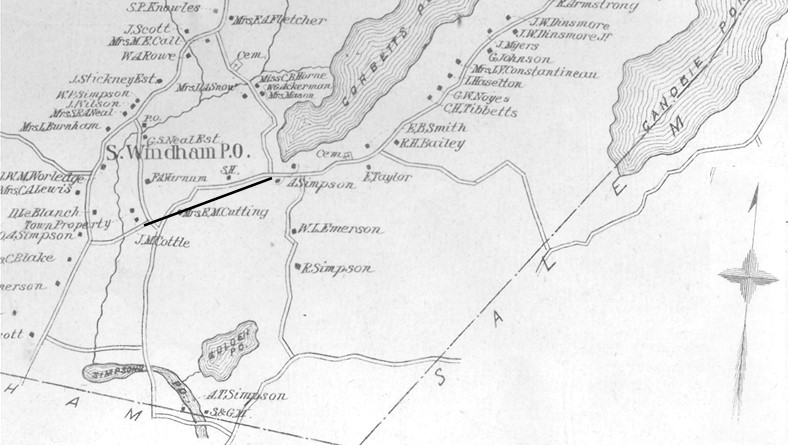
Last week I identified this beautiful farm as the “Cutting Place” on Range Road in Windham. Your intrepid editor at the Windham Independent, Jon Carpenter, kindly corrected my mistaken identification of the road as Range Road. You see, the road that Mrs. Cutting and the boys are walking on could not be Range Road, because it did not exist in this location in the 1880’s. At that time the road that ran by here was actually Simpson Road. It ran from Cobbett’s Pond Road all the way to Simpson’s Mill, on Simpson Pond, which is now known as Moeckel Pond. I love learning new things, (that’s why I used to sit in the back of the classroom, in fifth grade, while the teacher droned on about something, reading the encyclopedia Britannica.) So, there was no Range Road at this location at the time of the photograph. On the 1892 map of Windham you can see Simpson Road, running from Cobbett’s Pond Road, further west than the current 111A and then making a sharp turn to the South toward Simpson Pond and mill.
Simpson Road once ran from what is Cobbett’s Pond Road today to Simpson Mill on the WIndham / Pelham line.
In early Windham history this section of Windham with it’s schoolhouse was known as “the Dock,” for reasons I have not been able to ascertain. Jon Carpenter’s family came to Windham in 1953 and Simpson Road was still in use to be later replaced by a new Range Road built by the state of New Hampshire. It seems that prior to this, Range Road continued along what is now Cobbett’s Pond Road today. This is why Cobbett’s Pond Road is still maintained by the State of New Hampshire.
At the 1962 town meeting, in a rare and unusual secret ballot, Simpson Road was closed to gates and bars, costing the land owners with frontage a ton of money. One of those who lost out was Bob Thorndike, who ironically was a Selectman. He and the Sullivan’s, who owned the farm in the photograph, went to court and sued the town over the road closing. They lost the case, then appealed and lost again. Sadly, there was also an old Cranberry bog, near Golden Brook Road, lost to the construction. Thanks to Jon for all of the information about this area of Windham!
Happy Mother’s Day- The Cutting Farm, Range Road, Windham
The Cutting Farm – Baldwin Coolidge Photograph Courtesy of SPNEA
In this photograph by Baldwin Coolidge, Eva Cutting is shown walking on Range Road with her two boys Charles and John. Eva was the daughter of Samuel W. Simpson who built the house in 1815. This photograph was taken sometime around the 1880’s. It was a spectacular farm. When I was a child it was known as the Sullivan place and the property was rapidly falling into disrepair; then it burnt to the ground. Do something nice for your mother, she put up with a lot, raising the likes of you!
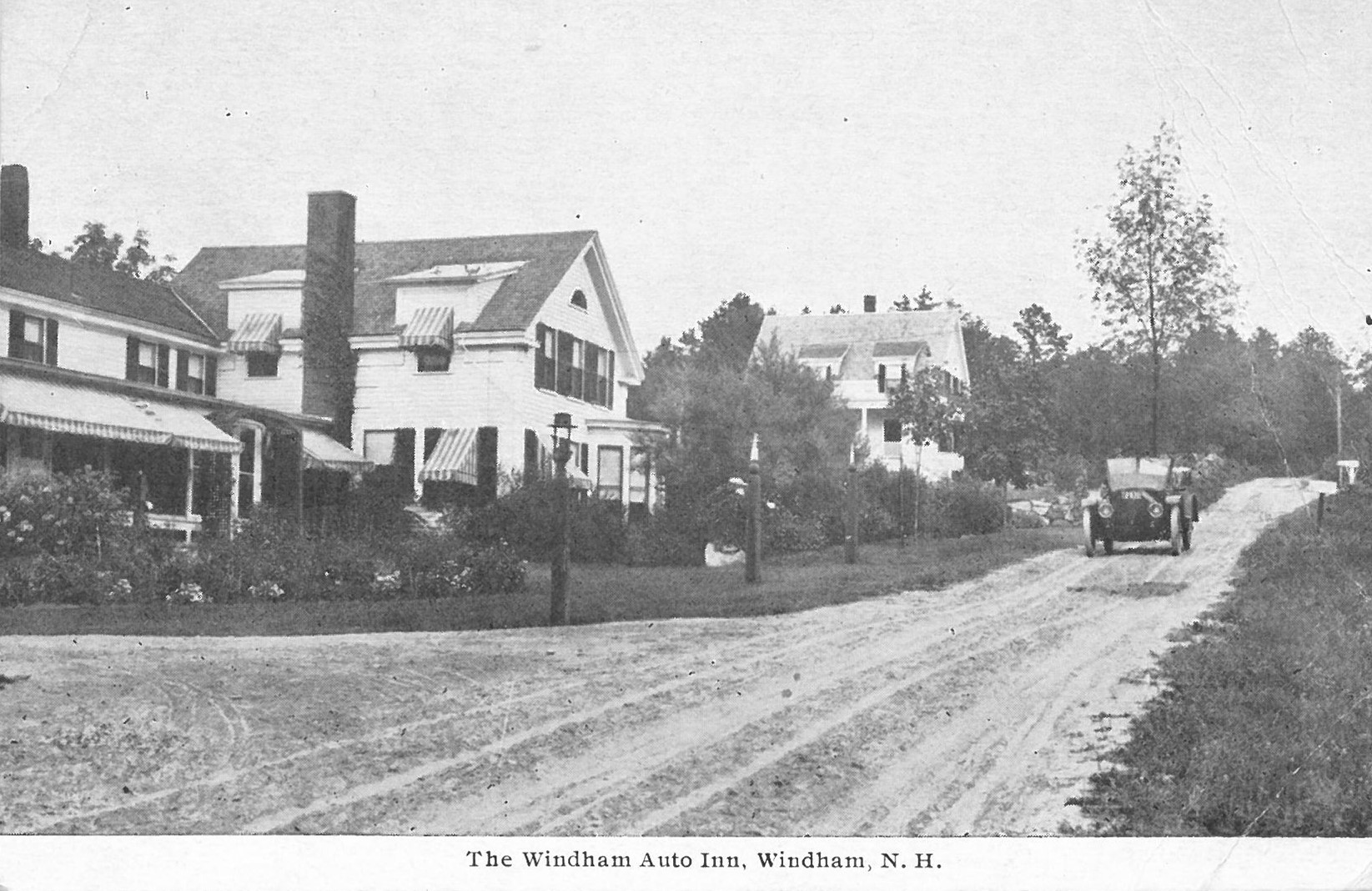
This is one of my favorite scenes from Windham because we all pass by the old “Windham Auto Inn” and the pretty house behind it travelling on Range Road. Rural Oasis says, “By 1924 most of the boardinghouses had closed. Then when the automobile became popular, John V. Mackenzie opened the Windham Auto Inn on Range Road in 1934” (1924?). The inn finally closed in 1947..” From the back of the post card it appears the Windham Auto Inn actually opened much earlier than this since it was dated April 8, 1929. E. Land says, “This is a view of part of the house. We have a very nice room twin beds and private bath. Have been on the go every minute. The food is excellent; and I intend to enjoy the change…” The property is now three condos and the house behind it is still there. What are those posts on the front lawn?
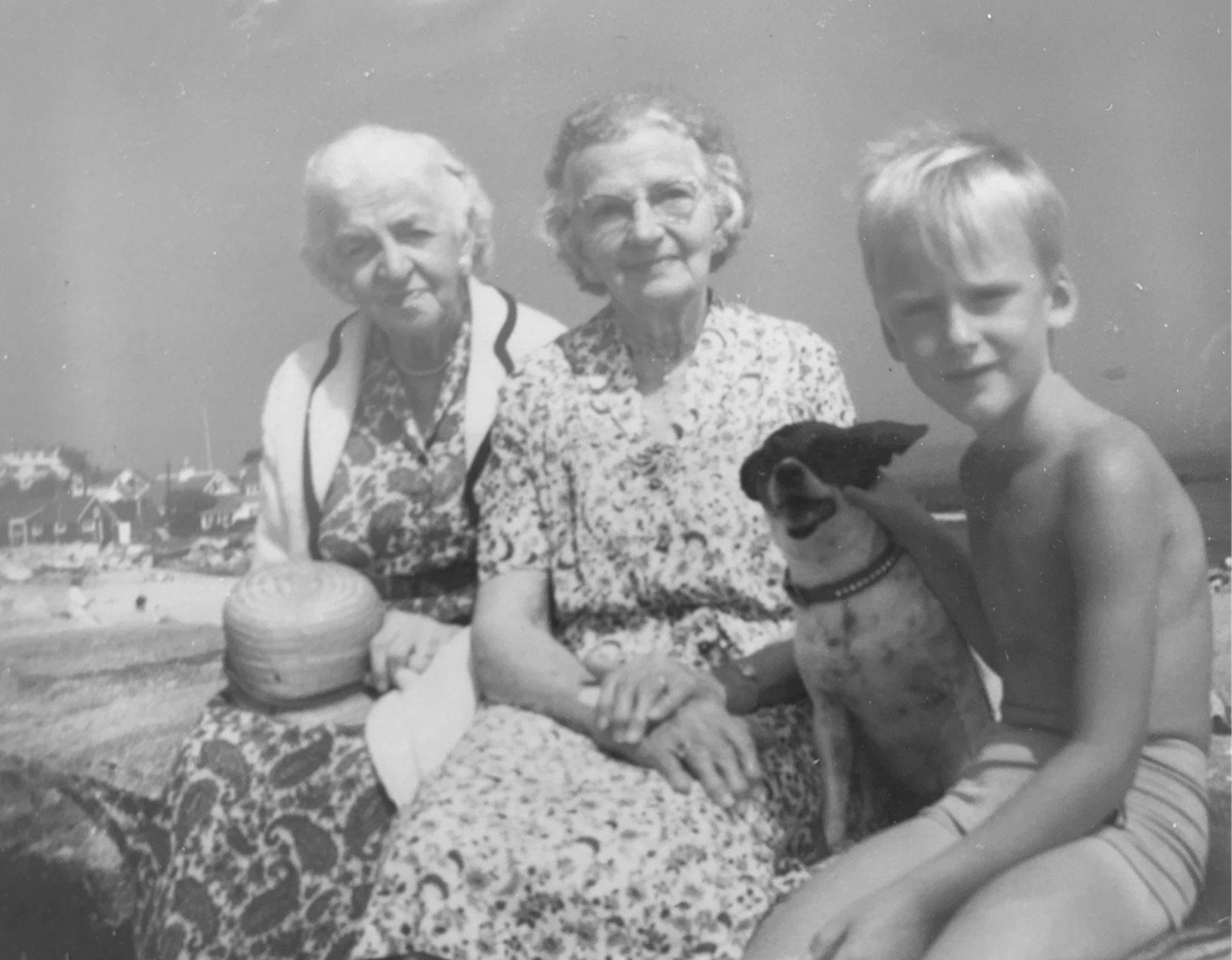
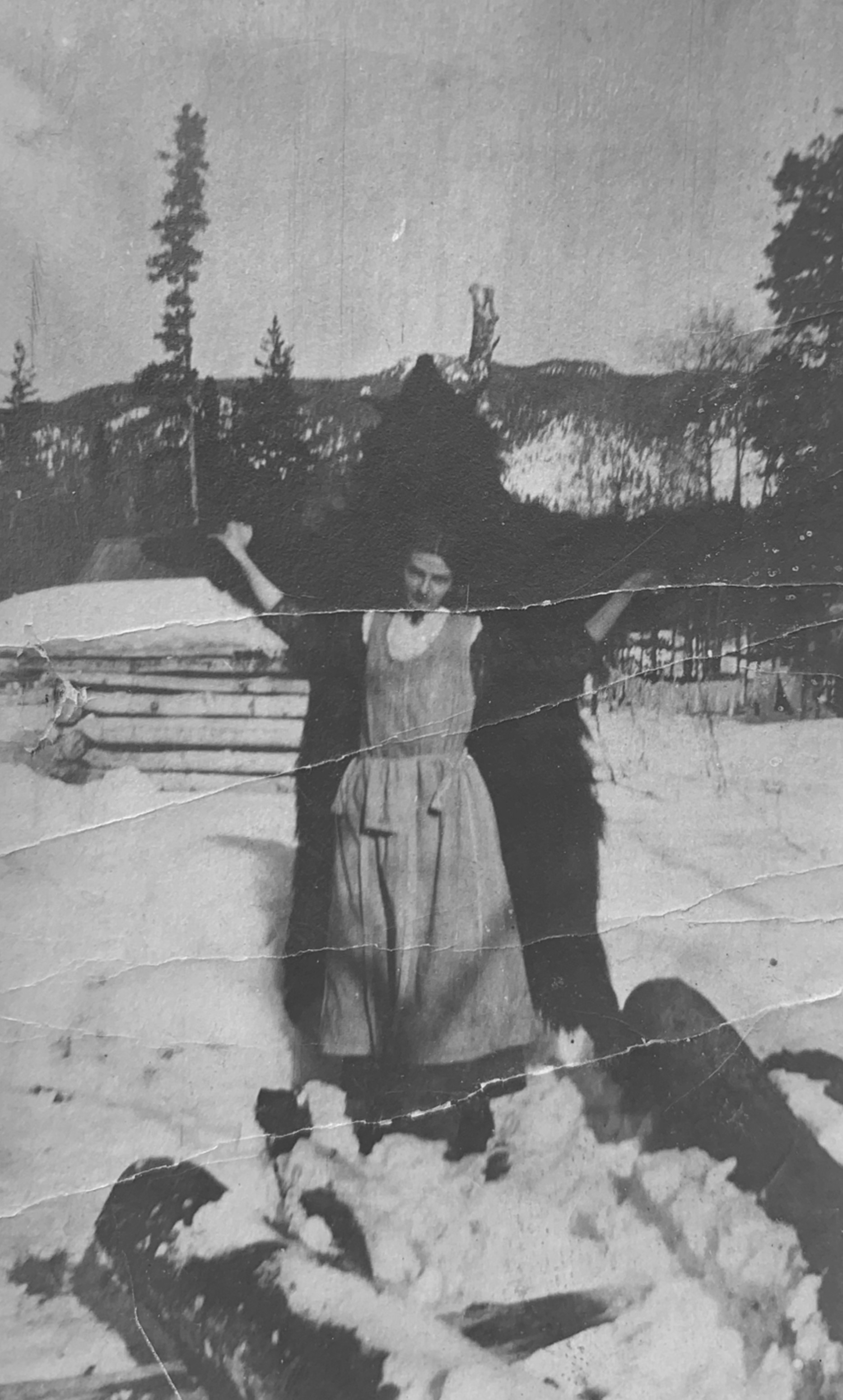
So I loved my grandmother Edith Dinsmore very much, as well as her sidekick sister, my Aunt Anne. That’s us at Hampton Beach with her dog Trixie. Her love for my grandfather must have been pretty deep because it took her from Somerville MA to Pinedale Wyoming. My grandparents lived first in a tent then a small log cabin. After a few years in Wyoming, practicality brought them back to Windham.
My grandmother Edith Dinsmore with a bear skin in Wyoming.
I learned about what a sea-breeze was from her when I was five; the means of ruing a perfectly sunny New England day! One of my grandmother’s and Anne’s favorite treats with breakfast was Baked Honey Brown Sugar Grapefruit. My grandfather would cast aspersions on the concoction, calling it their “Hollywood Breakfast,” as in “there they are again, enjoying their Hollywood breakfast!” They were married for over fifty years so either love or tenacity must have endured in their marriage. THE HOLLYWOOD BREAKFAST: “Have a bubbly sweet start to your day with this simple breakfast recipe that’s both beautiful and delicious:” 2 halved grapefruits; 1 Tbsp melted butter; 2 Tbsp dark brown sugar; 2 Tbsp honey; salt to taste. Preheat oven to 400 degrees. Lightly brush each grapefruit with melted butter. Pour 1/2 Tbsp of honey then sprinkle 1/2 Tbsp of dark sugar over each grapefruit. Don’t spread. Let it melt while baking. 400 degrees for 12-15 minutes. https://simpleseasonal.com/recipes/baked-honey-brown-sugar-grapefruit Need a break from your significant other. Just prepare yourself a “Hollywood Breakfast.”
Deborah Sampson Gannett: Revolutionary War Patriot
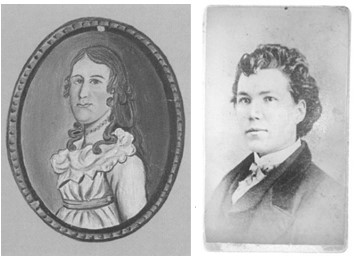
Deborah Sampson Gannett: Revolutionary solider. First female to serve in the U.S. military.
So…I am probably the last person in the world who has not heard of Deborah Sampson Gannett. I’m pretty well read, so imagine my surprise when I discovered the story of a woman from Massachusetts who disguised herself as a man so that she could serve in the Continental Army during the Revolutionary War.
We might never have known about the heroism of Ms. Gannett but for the fact that she petitioned the State of Massachusetts for a military pension. “XXIII. Resolution on the petition of Deborah Gannett, granting her £34 for services rendered in the Continental army. “On the petition of Deborah Gannett, praying for compensation for services performed in the late army of the United States. Whereas, it appears to this Court that the said Deborah Gannett enlisted under the name of Robert Shurtliff in Captain Webb’s company in the 4th Massachusetts Regiment, on May 20th, 1782, and did actually perform the duty of a soldier, in the late army of the United States, to the 23rd day of October, 1783, for which she has received no compensation; and whereas it further appears that the said Deborah Gannett exhibited an extraordinary instance of female heroism, by discharging the duties of a faithful, gallant soldier, and at the same time preserving the virtue and chastity of her sex unsuspected and unblemished, and was discharged from the service with a fair and honorable character therefore, Resolved, That the treasurer of this commonwealth be, and hereby is, directed to issue his note to the said Deborah for the sum of thirty-four pounds, bearing interest from October 23, 1788.” She was the only woman to earn a full military pension for participation in the Revolutionary army.
The Mount Vernon website states that Gannett was “born on December 17, 1760, in Plympton, Massachusetts, Sampson grew up in poverty. Her father abandoned the family when Sampson was five. She was sent to live with relatives until the age of ten, when they could no longer afford to care for her. She was then forced to become an indentured servant to the Thomas family in Middleborough, Massachusetts. As an indentured servant, she was bound to serve the Thomas family until she came of age at eighteen. In exchange for serving them, she was given food, clothing, and shelter. Once she was free, she supported herself by teaching and weaving.” According to Wikipedia; “In early 1782, Sampson wore men’s clothes and joined an Army unit in Middleborough, Massachusetts under the name Timothy Thayer. She collected a bonus and then failed to meet up with her company as scheduled. Inquiries by the company commander revealed that Sampson had been recognized by a local resident at the time she signed her enlistment papers. Her deception uncovered, she repaid the portion of the bonus that she had not spent, but she was not subjected to further punishment by the Army. The Baptist church to which she belonged learned of her actions and withdrew its fellowship, meaning that its members refused to associate with her unless she apologized and asked forgiveness.”
“On May 23, 1782, at the age of twenty-one, Sampson disguised herself (again) as a man named Robert Shurtliff and enlisted in the Continental Army under the Fourth Massachusetts Regiment. She and the other new recruits then marched from Worcester, Massachusetts to West Point, New York. While at West Point, Sampson was chosen to serve as part of the Light Infantry Troops–– the most active troops in the Hudson Valley from 1782 to 1783. To be inducted into the Light Infantry Troops, soldiers had to meet specific requirements. They needed a height of at least 5’5” and had to be physically able to keep a fast and steady marching pace. They were referred to as “light” infantry because they traveled with fewer supplies and took part in small, risky missions and skirmishes.”
“Sampson spent most of her time in the army in the Lower Hudson River Valley Region of New York, which was then known as Neutral Ground. Neutral Ground spanned throughout what is today Westchester County in New York and was termed ‘neutral’ because it sat, unclaimed, between British-held New York City and American-held Northern New York. Neutral Ground was a lawless land filled with both Patriot and Tory raiders who terrorized the local citizenry.” George Washington spent much of his time in the Hudson River Valley just north of Neutral Ground in Newburgh. “Sampson fought in several skirmishes. During her first battle, on July 3, 1782 outside Tarrytown, New York, she took two musket balls in her thigh and sustained a cut on her forehead. She begged her fellow soldiers not to take her to a doctor out of fear her sex would be discovered, but a soldier put her on his horse and took her to a hospital. A doctor treated her head wound, but she left the hospital before he could attend to her leg. She removed one of the balls herself with a penknife and sewing needle, but the other was too deep for her to reach. She carried it in her leg for the rest of her life and her leg never fully healed.” “After the war ended, Sampson returned home and married a farmer, Benjamin Gannett, in 1784. They had three children and adopted a fourth. In 1792, she successfully petitioned the Massachusetts State Legislature for back pay for her service in the army and was awarded 34£. In 1797, she petitioned Congress, claiming disability for the shoulder wound she received during the war. Her petition ultimately failed. However, starting in March 1802, Sampson began a lecture tour of Massachusetts, Rhode Island, and New York.” “Sampson embarked on a year-long tour, delivering lectures about her sensational experiences as a soldier. Sometimes, she would dress in full military regalia during these speeches. But there is reason to suspect that Sampson inflated some of her accomplishments, as the newly unearthed diary makes clear.” “After the lecture tour, Sampson petitioned Congress again. This time, her petition succeeded. On March 11, 1805, she was placed on the pension list for disabled veterans. She continued campaigning Congress for the entirety of the money she was due until she was denied the remainder of her pay on March 31, 1820. Deborah Sampson Gannett died in Sharon, Massachusetts on April 29, 1827, at the age of sixty-six.”
She is one of the earliest examples of a woman serving in the United States Military.” Her headstone in Sharon honors her as “The Female Soldier.”
Jessie Serfilippi The College of Saint Rose https:/www.mountvernon.org/library/digitalhistory/digital-encyclopedia/article/deborah-sampson/
An official record of Deborah Sampson Gannett’s service as “Robert Shirtliff” from May 20, 1782 to Oct 25, 1783 appears in the “Massachusetts Soldiers and Sailors of the Revolutionary War” Volume 14 p.164 series
We know very little about the lives of the African American slaves and free-men that once lived in Windham. We have some idea about Pomp and Jeff, who are buried on the Cemetery on the Hill, because of log-books and journals that record when they were leased out by their owners to do work for other residents of the town. We know what their masters were paid and we know to some degree what they did for work. There is one African-American slave for whom we know quite a bit. Her name was Dinah and her life was outlined in Morrison’s genealogy of the Hemphill family. I looked for more information about her in the Dunstable history but could find nothing. One problem is that so many African American female slaves were named Dinah; the reason why I could not ascertain. Dinah was the daughter of Jacob in the Old Testament and means “judged, avenged or vindicated,” in Latin.
Captain Nathaniel Hemphill: Morrison Says, “He is called captain in town records; he was probably a captain of the training-band. His is one of the most interesting, prolific, and remarkable families of the town.” He was born on May 11, 1737. He married Agnes, the daughter of Robert Park on December 28, 1764. “They were the parents of eighteen children. I believe the largest family ever raised in town.” He was a signer of the Association Test and served as a Selectmen and Moderator for many years. “This good man was a slave-holder. As his family increased, he and his wife saw the necessity of having more household assistance, so they went to Boston and purchased a colored girl named Dinah, paying forty dollars for her, which was probably cheap, and brought her home. She was a faithful friend and servant. She assisted much in taking charge of the children. Seating herself in a chair with a large bowl in her lap, which held the broth or the pudding, with the little ones gathered in a circle around her, she would ladle out to each the appointed share. Dinah was probably freed by the adoption of the state constitution in 1784, but remained for several years after that date with the Hemphills. The good housewife would go to market and purchase articles for the family. On one occasion the articles for each was mentioned, but Dinah’s portion was not alluded to, though it was the intention to procure articles for her. She was deeply grieved to be thus neglected, and exclaimed, “Me nothing! Me nothing!” Mrs. Hemphill went to market, purchased the several articles, and Dinah’s too; but when she returned Dinah had departed, to return no more as a member of the household. She went to Dunstable, found some of her own people, and was married…she possessed and affectionate, confiding, trusting nature. The kind master who had gone down to the grave, the good mistress and dear little ones were not forgotten; and years after she returned and visited the family bringing her own flock of little ones…” Dinah had named her own children after the names of the Hemphill children.
“Mr. Hemphill was an active and strong man, of probity and worth, a wise old man, and possessed in an eminent degree that rarest and most uncommon qualities which we call good common sense. He was cut down in full strength of his vigorous manhood. His death was sudden. He was taken severely ill with lung-fever, and in two to three days it was evident that he must die. As the hour was at hand, he called his wife and large family of children about him. And in an unfinished invocation commended them to the God of the widow and the fatherless, in this his last prayer: ‘Lord, look down in mercy on this little squadron before Thee. Take them into thy heavenly care and protection; make them to remember Thee their Creator in the days of their youth…Lord I can say nothing!’ With this petition in his heart and the
sentence unfinished upon his lips, his soul left the earthly tabernacle, and followed the winged petition to God.” He died Nov. 10, 1796 at 59 years old.
“By the death of her husband, a double share of responsibility and burdens fell upon the widow, but she did not shrink from them. With great mental strength and physical endurance, she managed unaided the affairs of her large family for eighteen years. She had ten daughters, and each had a spinning wheel,—like all their Scotch neighbors. The flax was prepared, and she and her ten daughters in one large room, which also served as the kitchen, spun their linen thread. They would thus work for three months, when the thread would be gathered together . The webs of linen cloth, bleached and whitened, would be arranged and ready for sale, and at two o’clock in the morning, on horseback and alone, Mrs. Hemphill would start for market at Salem, Mass., some thirty or forty miles distant. The children were generally alone during her absence. The journey to market took one day,—one day to trade, and one to return. While at market she would buy the articles for family use, for the succeeding three months, bringing mementos to each, thus adding to the joys of all. In this manner she bore her burdens and managed her family, and prospered. When her daughters were married, each was generously provided for by the mother…”
While Morrison’s story of Dinah and the Hemphill is sympathetic and sentimental in its character, nobody should believe that slavery in New England was benign. One story from the town of Dunstable history will make this point clear: Robert Blood was a slave owner in Dunstable MA. On September 10th, 1756 he sold a five year old slave girl named Dinah to John Abbott of Andover.
Dunstable, September ye 10th, 1756.
“Received of Mr. John Abbott, junior of Andover, Fourteen pounds
Thirteen shillings and Two pence. It being the full value of a Negrow
Garl, Named Dinah, about five years of Age of a Healthy Sound Constitu-
tion, free of any disease of Body and I Do hereby Deliver the Same Garl
to the said Abbott and Promise to Defend him in the Improvement of
her, as his Servant forever. Witness my hand, “
Robert Blood.
John Kendall.
Temple Kendall.. The paper has this indorsement : — Oct. 28, New Stile, 1756.
This day the Within Named Girl was Five years old.”
“Robert Blood lived on the place now occupied by Dexter Butterfield, and many stories are told of his peculiarities. He is said to have called an Indian doctor to prescribe for him in a case of sickness; but fearing lest the medicine might contain poison, he administered it to his negro boy, who died from its effects. The place of his burial is called to this day ” Negro Hill.” (Imagine being so monstrous as to test a possibly poisonous medicine on a little boy.) A sheriff once came into church to arrest Mr. Blood, who, seeing his pursuer, raised his handkerchief to his nose as if it were bleeding, and quietly left the meeting. On being asked’ afterwards why he left the church so suddenly, he said, ” The sons of God came to present themselves before the Lord, and Satan came also among them.” (Job 1, 6.) His wife was a noted swimmer, and frequently swam across the Merrimack River. She was, however, drowned at last, as it is said, among the lily-pads of Massapoag Pond.”
The Thanksgiving Sermon of Rev. Calvin Cutler – 1835
Free speech is a cherished ideal in America. That being said, there are always people in power who find this right inconvenient to their machinations. It was true with the issue of slavery in 1835 and it is true in America today with tech titans and their government allies working in tandem to muzzle free speech. When people start demanding that certain voices be silenced, you can be sure that those shouting the loudest at people to shut up, are the ones dreaming of ways “ of stamping a boot on a human face forever” as George Orwell so eloquently wrote. In America, prior to the Civil War, it was the defenders of the institution of slavery that demanded that the Abolitionists shut up! Today, those same shrill voices are demanding that certain segments of our society do the same; they are telling those they oppose, that they have no right to speak with the same virulence as those defending the evil of slavery in the 1830’s. In Calvin Cutler’s Thanksgiving sermon, he the speaks on the twin evils of slavery and the suppression of free speech.
OUR LIBERTIES IN DANGER, A SERMON PREACHED IN WINDHAM
NEW HAMPSHIRE, ON THE DAY OF ANNUAL THANKSGIVING NOV. 26, 1835
Rev. Calvin Cutler
II COR. 3: 17. Where the Spirit of the Lord is, There is Liberty.
“…Where the spirit of the Lord is, there is liberty: liberty to do the will of God without constraint, freedom of access in prayer, and the full development of all human powers in their proper and lawful exercise. Such is the effect of the gospel on individuals; and when the spirit pervades the whole community, the that community will enjoy just that kind and degree of liberty which is best adapted to promote the happiness of human society and the glory of God.”
I propose first, to inquire into the meaning of liberty; and secondly, to show by what means liberty is infringed and destroyed…”
“If the laws are made to bear with unequal severity on different portions of the community, there is evidently a defect in them; and just as far as there is oppression on one individual, without a counterbalancing safeguard to the whole, the law is unjust…But if without crime a man is oppressed, immured in prison, or bound down to involuntary servitude, his civil liberty is invaded; for it is a curtailment of natural rights, which the good of the community does not require. ‘Civil liberty, therefore is the not being constrained by any law but what conduces on a greater degree to the public welfare.’ It is obvious, also, that in different forms of government there are different degrees of liberty, and that government is the freest where the laws are most equal, and individual liberty is best secured. Or in other words, that government is the best where equal rights are best maintained,”
“An object so desirable, however, cannot be effected, to any great extent, nor for any considerable length of time, except by the restraining and sanctifying influence of the gospel…and all that is needed even now to render this land another Paradise, is for the gospel to pervade the whole community and sanctify every individual. Then there would be ‘no breaking in, nor going out and no complaining in our streets;’ but perfect liberty to do the will of God, and promote the happiness of man…and it is this degeneracy in respect to moral principle, which endangers our liberties as a nation. When the spirit of the Lord is grieved, and the restraining influence of the gospel is resisted, then the civil liberty much be abridged, and public safety endangered.”
Infidelity, in its Protean forms of licentiousness, endangers our liberties, and is liable to destroy our free institutions. This is apparent, for example, in the extensive and profanation of the Sabbath. No nation have ever been able to maintain their liberties without the Sabbath. France tried the experiment, and just as soon as the Sabbath was abolished, the floor-gates of violence were thrown open, anarchy and death spread through the nation. And nothing could restore order but the strong arm of military despotism. And yet, with the fatal experiment before us, our own nation are fast verging to the same vortex, by annihilating the Sabbath…”
Another method by which this licentious, anti-republican spirit shows itself, is the prevalence of Intemperance. When moral principle and sobriety are so far banished from the public mind, that elections of rulers can be carried in may sections by the maddening bowl of intoxication; when it comes to pass that half a million freeman can willingly be enslaved and led on to any desperate act by the influence of intoxicating liquors, and when the very manufactory of drunkenness is encouraged and sustained by the law…”
Another method by which infidelity is striving to thwart the peaceful reign of the gospel, and to destroy the blessings of a free government, is the prevalence of Moral Pollution,—a violation of the seventh commandment,—in breaking down the institution of marriage, and thereby surrendering the cords that bind society together…”
“…Another evil which endangers our liberties, is the existence of Slavery, by which one sixth of the nation is treated as non-entities—denied the privilege of reading the bible—men turned into brutes—human souls made chattels, to be bought and sold, and used for the gratification of irresponsible masters; who, contrary to out Bill of Rights and the first principles of free government, have seized and bound their fellow men in cruel bondage. Well was it said by Mr. Jefferson, that God has no attribute by which he can take sides with such oppression. The spirit of the Lord is not in this system of wrong and outrage upon the inalienable rights, and therefore it cannot stand any longer than God, to show his wrath and make his power known, endures with much long-suffering this flagrant usurpation of his prerogative. When our fathers of New England gave their sanction to a recognition of slavery in the union of States, they seem to have left God as was Israel in Canaan, when the Gibeonites came to them with mouldy loaves of bread and clouted shoes, under the pretense of a long journey. It was then, however, a day of comparative ignorance in respect to the enormity of this evil. But Slavery is a monster so selfish and infernal, and has become so gigantic in stature, that it will not bear to be examined, no suffer its features to be exposed, without gnashing its teeth, and scattering scintillations of wrath form its eye-balls. But here in the nation, with all its deformity—a standing memorial to our shame and hypocrisy. And giving the lie to our Bill of Rights in the face of all the nations on earth. When the nation hold as self-evident truths, ‘that all men are created equal, endowed with certain inalienable rights, among which are life, liberty, and the pursuit of happiness,’ one sixth of this very nation have these inalienable rights wrested from them by violence; they are deprived of liberty and the pursuit of happiness, and subjected to the condition of the brute creation. And what is most appalling, the great majority love to have it so. Yes, the great majority even of the free States, say, by their conduct, to the slave masters, ‘hold on to your victims of cruelty for the present, —we will stand by you and defend you, and keep off the fanatics, who are so visionary and insane as to call slavery a sin, and use arguments to persuade you to let go of your deadly grasp upon the poor innocents.’ Is there no danger that our liberties will be infringed and destroyed, when the nation by their practice give the lie to their profession; when they deal in oppression and uphold the oppressor? Is there no reason for alarm, lest He who hears the cry of the poor and pleads the cause of the oppressed, give the nation up to a reprobate mind to work out their own destruction?”
“I am aware that many suppose we have guaranteed to the South the privilege of trampling on the necks of one sixth of the nation; of treating them as brutes and chattels, and therefore have no right to say anything on the subject. But the fact is, the Constitution does not bind a nation, nor any portion of it, to hold slaves; nor does it bind any portion of the nation to refrain from exposing the enormity of the system. It does not seal our lips from discussion, nor from the free use of the press and mail on this, more than any other subject. We have the same right to discuss and write, and print, on the subject of slavery, as we have on the subject of intemperance, or gambling, or any other evil. The truth is, if slavery with all it abominations were blotted out this day, there need not be a syllable of the Constitution altered. It might remain obsolete, without abridging the freedom of any man. But in that same Constitution the freedom of speech and the press are not only recognized and permitted, but guaranteed to every man in the Union; and this liberty cannot be abridged or taken away without altering the Constitution, and turning it into an instrument of despotism. The Constitution says expressly, that ‘Congress shall make no law respecting an establishment of religion or, prohibiting the free exercise thereof; or abridging the freedom of speech or of the press; or the right of people to peaceably assemble and to petition the government for redress of grievances.’ The Constitution of the several States guaranties the same, those who propose to ferret out and expose untold abominations of slavery, do not ask to have the Constitution changed: and I have often wondered why those who forbid discussion, and would even by violence stop the freedom of the press, do not first demand the Constitution be so altered that no citizen shall be permitted to use his tongue of his pen to effect any reformation whatsoever.”
“Here every man who would put a stop to the discussion of slavery out to begin…But it ought to be known, that no man or body of men have a legal right to abridge the freedom of speech respecting the giant sin of slavery…”
As you continue to read the rest of this sermon on free speech and slavery, reflect just a little on our current time, and how similar the themes are to our own circumstances and the muzzling of our free speech now. It’s truly eerie how history rhymes! The slave-owners, the elites, and the wealthy all wanted the abolitionist movement crushed. They didn’t want anybody discussing the inconvenient truth that it slavery was immoral and inconsistent with the freedoms exposed by the constitution. Their solution, the same with all tyrants, was an attempt to shut down free speech.
“…and this liberty cannot be abridged or taken away without altering the Constitution, and turning it into an instrument of despotism. The Constitution says expressly, that ‘Congress shall make no law respecting an establishment of religion or, prohibiting the free exercise thereof; or abridging the freedom of speech or of the press; or the right of people to peaceably assemble and to petition the government for redress of grievances.’ The Constitution of the several States guaranties the same, Those who propose to ferret out and expose untold abominations of slavery, do not ask to have the Constitution changed: and I have often wondered why those who forbid discussion, and would even by violence stop the freedom of the press, do not first demand the Constitution be so altered that no citizen shall be permitted to use his tongue of his pen to effect any reformation whatsoever.”
“Here every man who would put a stop to the discussion of slavery ought to begin…But it ought to be known, that no man or body of men have a legal right to abridge the freedom of speech respecting the giant sin of slavery, till the bulwark of our liberties be first demolished; and least of all are those men to be accounted true republicans or supporters of free institutions, who would disseminate the false impression that Congress have no authority to abolish slavery in the District of Columbia and the Territories, or that we have no right to petition the government for a redress of grievances.”
“The most fearful indication of the speedy downfall of our free institutions, is the recent adoption of mob-law to prevent the freedom of speech respecting slavery. In this the troubled elements of infidelity, licentiousness, and oppression, are shaken together, and, like the burning lava of a volcano, seem ready to bury our liberties beneath their own ruins. Buy why is this enormity to be so sacredly guarded from all inquiry? Is it past all doubt, that it is right to trample in the dust and traffic in the sinews and souls of two millions and a half of our brethren, in this land of freedom? We have supposed that liberty of speech and free inquiry was our inheritance as a free people. But now we are peremptorily forbid to discuss or expose this system of wickedness. We must be tongue-tied, and not raise a note of remonstrance nor utter a sigh for this abomination, upon penalty of having our dwellings demolished, and our lives exposed to violence.”
“How is it, brethren—are we freemen ourselves, or are we slaves? Are you ready to become the supple menials of the South, and neither speak nor feel only as slave-masters or their agents, the mob, give you leave? Are you ready—are the freemen of the free States ready, to bow their necks under the yoke of tyranny, and be whipped mutes?…But it is said that slavery is a political question, and therefore the moralist and the Christian have no right to meddle with it. Just as though wrong and outrage and cruelty and blood were all right in politics, and no man has a right to expose any abuse or lift his voice of remonstrance to any measure but the unprincipled demagogue and political aspirant. How strange that men of integrity and character can be duped in this manner; and instead of maintaining their rights or pleading the cause of liberty, can turn apologists for a system of oppression and despotism which outrages all the principles of free government, and condemn the propagation of the doctrine that ‘slavery is a sin, and therefore ought to be abandoned.’”
“Those who propagate this doctrine advocate no use of physical force;—we do not wish to legislate for the South;—we do not wish to alter the Constitution, nor do we countenance insurrection among the slaves. But we do wish for the privilege of using moral means to persuade the slave-masters to let go their hold upon the necks of their brethren, or at least to persuade the free States to wash their hands from this pollution and crime, by the abolition of slavery and the slave trade in the District of Columbia. We claim the constitutional right of thinking and discussing and writing, on this subject as well as any other;—and we shall never relinquish this right so long as we are freemen in a free country.
“The great contest between liberty and despotism in this country has fallen upon the Abolition Question. On this alter our liberties seem about to be immolated. And now it is at every man’s option whether to cast his influence into the scale of liberty or of lawless oppression. If you put down freedom of speech and of the press on this subject, then you put it down on every other. Every man, either in high station or low, in the ranks of the political demagogues or in the church of God, who frowns upon liberty of speech and would muzzle the press, is tying his own tongue, and preparing fetters of brass for his own feet. Every citizen is called to chose, between resisting the exorbitant demands of slave-owners on the one hand, and bowing his neck to the iron yoke of despotism on the other. There is no constitutional law to prevent any man from talking, writing, and publishing, on this or any other subject.
“On this point the exasperated southerners and their apologists are lame. What can be done to take away the liberty of speech from abolitionists? Can they be put to silence by argument? Why is not this expedient tried? Evidently for the reason, that the oppressor and his advocate know discussion will tend to the downfall of slavery. It cannot survive free discussion, and therefore we must be gagged. The most summary way of doing this has been supposed to be to create a general sentiment against all discussion, public meetings and condemnatory resolutions. These give countenance to mobs, who carry out in practice and character the anti-republican sentiments of the resolutions. If proof of this were needed, I might point to the Capital of our own State, where inflammatory resolutions were passed one night to put down free discussion, followed by a mob the next night for the same object. See also the same course of things in Boston, ‘the cradle of liberty,’ in Utica, and in many other places, Are our liberties in no danger when resort if had to brute force to deprive citizens of their lawful privileges? When this modern Vandalism is set on foot and countenanced by men of influence and character, and when even good men can apologize for such acts of violence, by laying the blame on those who are the innocent occasion of them? ‘We are opposed to mobs,’ say some of the sapient editors, ‘but then the abolitionists are so imprudent and fanatical, that they provoke the public indignation, and they must take the consequences. If they would keep still they would not be molested.’ How magnanimous! How republican! What greater countenance could the most savage banditti ask of any man than this? …This is letting lose the ‘dogs of war’ upon every man who uses moral means to redress grievances or reform abuses. To find this lawless, time-serving policy advocated in the nineteenth century—in this republican America, by even religious periodicals, shows our liberties to be on the brink of a precipice.. But it is said the abolitionist are so unpopular and offensive that they ought to be put down. That they are unpopular and offensive is admitted; but were not laws made for the very purpose of protecting the rights and privileges of those who are unpopular and offensive?”
A popular man does not need the protection of law. No one will molest his rights. But when public sentiment turns against him, then he needs protection, and every good citizen ought the supremacy of the laws for his protection. Those who are now trimming their sails to the wind of popular favor, and feel themselves safe, ought to bear in mid that the wind may suddenly shift, and unless they now support the supremacy of laws for the protection of the unpopular, they may yet fall into the tender mercies of an infuriated mob. And above all the ought the poor and laboring man of this country to be jealous of their rights, and maintain their liberty of speech. If these be taken from them, they will have no alternative but to swear silence under their rich task-masters. It is lamentable to see many of this class duped and led on by interested and unprincipled demagogues to trample in the dust and destroy their own most precious privileges. Is there any prospect of preserving the Union by the combined energies of infidelity, avarice and lust to lay the abolitionists on the alter of burnt sacrifice? Will it appease the wrath of heaven? Is the spirit of the Lord in the whirlwind of popular fury which is now sweeping over our country? It is despotism of the meanest character. Better be under the Autocrat of Russia or the Emperor of Austria, than lie at the popular fury in a republican land, without the protection of law. But suppose the reign of anarchy should succeed for a time, and by intimidation or the offering of ten thousand human hecatombs on the alter of despotism, the cause of Abolition should be crushed. Would it continue to slumber? Must not the question come up? Must not the nation meet it, with all its perplexing and exciting difficulties? It surely must come sooner r later; the nation must canvass it, and put it away by deep repentance and humiliation. God is against this system of cruelty; —conscience, humanity, the love of liberty and patriotism, is against it. Discussion cannot be suppressed.; the press cannot be muzzled. Our of an abundance of the heart the mouth will speak. God himself will plead the cause of the oppressed. The tempest of human passion may gather and blacken and lower; the thunders of the South may utter their voices, and the North may mutter their response, but inquiry and discussion will go on, till our land is freed from licentiousness, oppression and cruelty.”
“Where the spirit of the Lord is, there is liberty: liberty to ‘sigh and cry for the abominations of the land’—to plead the cause of the oppressed—to ‘remember those who are in bonds as bound with them’—liberty to pray for out country, and to use moral means for her salvation. And if this liberty can be enjoyed only under threats of prisons, or at the burning stake, then be it so. God will raise up helpers to such a cause.”
Is it not time to remonstrate and to give the alarm, when our constitution is trampled in the dust,—when a premium is set upon the scalps of its citizens because their opinions are offensive to tyrants and oppressors;—when burglary, abduction and assassination are encouraged, and when rulers even cease to be a terror to evil doers? Where are out liberties— our safety? Shall we therefore harden out hearts and hold out peace? Who can tell whether we have come to the kingdom for such a time as this? If we together hold our peace, deliverance will come from another quarter, while we perish with the workers of iniquity. If God be with us, we will pray for out country; we will expose her sins; we will defend discussion and free inquiry. Nor will we envy the responsibility of those editor and ministers of religion, from whatever motive they act, who strive to suppress free inquiry and to keep the people ignorant of their dangers and duties, in the present solemn crisis of the nation. While this nation is approaching the whirlpool— while the wind howls, the ocean heaves, and her frail bark is already broken by the violence of the waves, it becomes every man to apprize himself of her danger—and not only be at his post, but to look to Him in humble prayer, who can guide her through the storm to the haven of riotousness and peace…”
“…This is the subject of devout gratitude, and this is our confidence while we live in this world of wrongs and wickedness, ‘God is our refuge and strength, a very special help in trouble.’ We know he will bring good out of evil, order out of confusion, and cause the wrath of man to praise him…The gospel will prevail to restore to all men their inalienable rights, and to protect the enjoyment of liberty…. ‘The triumphing of the wicked is short.’ While therefore we rejoice this day in the bounties of the year, let us especially rejoice in the future but certain triumph of truth over error, and liberty over all that molests and or destroys the rights of men…Let every man reflect on the guilt and provocations of this nation; let him review the gross impositions and cruel injustices practiced against the aborigines of this country; our hypocritical professions of liberty, while one sixth of the population are in cruel bondage… Let the wicked rage and the people imagine a vain thing, but we rejoice in the Lord, and praise him for his long suffering and patience towards our beloved country…”
The Underground Railroad by Charles T. Webber 1893
Black History in New England
The Abolitionists | Anti-Slavery Societies | Underground Railroad.
Quakers, protestant clergyman, individual abolitionists, and free blacks all worked together and provided assistance and support to the African-Americans traveling on the Underground Railroad from the South, through New England and into Canada. They defied and broke the laws of the federal government, which supported the institution of slavery, in order to assist the self-emancipated blacks. Opinion was divided in New England and many parishes broke apart over disagreements over slavery. The federal government and its power and reach supported the southern slave owners in working to capture and return escaped slaves. In fact, the federal government and the powerful elites who supported slavery, worked to clamp down on freedom of speech by maligning and arresting those people in the United States who were advocating for the end of slavery. You see, at the time, cotton was the biggest export of the United States, closely followed by sugar and tobacco. All were run with slave labor and produced huge profits for the planters and the government.
Underground Railroad in New England – Courtesy New England Antiquarian Society
Wilbur Siebert, in his book about the Underground Railroad in Massachusetts says, “Anti-Slavery Societies were being formed throughout Massachusetts one hundred and eighteen towns and cities having one or more of them by the year 1837.” Windham formed its Anti-Slavery society in April 8, 1834. Morrison says, “William Lloyd Garrison, the apostle of this crusade, started a paper called the Liberator Jan, 1, 1831 and advocated immediate and unconditional emancipation of the slaves in the country. He gave his first talk in Boston MA., at the Park Street Church, July 4, 1829. It caused intense excitement. ‘Benjamin Chase the historian of Chester said, ‘Ecclesiastical bodies passed resolutions denouncing abolition and, and religious newspapers and theological quarterlies published long and labored articles defending slavery from the bible.’ George Thompson, the celebrated English champion of human rights, was mobbed in Concord, N.H., Oct. 21, 1835, and about five thousand gentlemen of wealth and influence turned out in a mob and quelled a meeting of the Female Antislavery Society in Boston. Politicians and clergymen vied with each other in their devotion to slavery, and in an effort to squelch the emancipation movement.”
Morrison continues, “An American Anti-Slavery Society was formed, ‘The Liberator’ found its way to Windham, and Deacon Jonathan Cochran and others were its readers before 1834. They became convinced of the monstrous wickedness of human slavery, and never ceased their opposition to the same…” The Anti-Slavery Society was founded in Windham on the early date of April 8, 1834, which was an auxiliary to the National Anti-Slavery Society. The object of the society was, “by all means sanctioned by law, humanity and religion, to effect the abolution of slavery in the United States…”
One interesting account of how the self-emancipated were transported is told about Israel How Brown, who…”had a market wagon, with high sides and a false bottom on which he placed straw for his passengers. The wagon was then filled with garden produce for the Fitchburg market. He started on his trip of twenty-three miles at three o’clock in the a.m., and was only once delayed by officers of the law. They discovered nothing however, for they did not require him to unload. Mr. Brown is credited with having transported more than a hundred refugees.”
The Underground Railroad had five major routes out of Massachusetts. One route out of Boston, went to Medford, “where their were friends of the runaway. Thence it extended to Woburn and finally crossed the Merrimac east of Lowell to Dracut or ‘Black North…’” Black North was a settlement of African-Americans in Dracut MA., “not far from the New Hampshire boundary.” “A large community of emancipated slaves of wealthy landowners settled here early in the eighteenth century. According to Fred Coburn, the historian of Chelmsford and Lowell, this settlement afforded shelter to the escaped slaves who passed that way. Their next stops were at Pelham and Windham, both in New Hampshire, the former being but four miles north of Dracut and the latter an equal distance farther on.” Another branch ran from Woburn to Reading, northeastward, which was on the main line to Andover, South Lawrence, and across to North Salem, New Hampshire.”
“Straight up the ‘pike’ two miles north of Andover Hill was the thriving manufacturing center of Frye Village, now Shawsheen Model Village of the American Woolen Company. There William Poor and his sons had a flourishing wagon factory, Elijah Hussey, a sawmill, and William C. Donald an ink factory. Being pronounced abolitionists, these men had separated from South Church and organized the Free Christian Church in 1846. The Donalds, Poors, Fryes, John Dover and John and Peter Smith—all members of the new church—contributed generously to the fund for fugitive slaves. William C. Donald, Elijah Hussey, Joseph W, Poor, and perhaps others could be counted on to speed the black wayfarers on their journey. When Mr. Poor heard a gentle rap on his door or other subdued sign in the night, he dressed quickly, went out, harnessed his mare Nellie into a covered wagon and started out…” with his African-American passengers, most probably headed for North Salem, New Hampshire. “On the top of a hill at that place were several large excavations, lined and covered with slabs of stone, which had furnished retreat for the neighboring inhabitants when the Indians were on the war path, but which now afforded refuge to fugitive slaves. Mr. Poor was always back in time for breakfast.”
So which Windham resident or residents sheltered self-emancipated slaves? The most like candidates are one or all of the following: Rev. Calvin Cutler, Jerimiah Morrison, Deacon David Campbell, and Deacon Jonathan Cochran, whom Morrison says, “those who were the most active leaders in the movement.” Among the Anti-Slavery Society members in Windham besides those mentioned above, were Rev. Samuel Harris, Deacon Jacob Harris, Deacon Theodore Dinsmoor, Deacon Samuel Anderson, Giles Merrill, Dr. Daniel L Simpson, David Campbell, 2d, John Hills, J.A. Burnham, Stephen Fessenden, and many others.”
The emancipated slaves might have stayed in New England were it not for the Fugitive Slave Act passed in 1851. The numbers of runaways remained in New England in comparative peace and contentment until the enactment of the Fugitive Slave Law of 1850 sent them in a mad rush to Canada.” “runaways were being brought into New Bedford at least as early as 1819…” By 1851 the African-American inhabitants of New Bedford numbered between six and seven hundred.
“Rev. Hiram K. Wilson, a Worcester man, went to the region of Ontario on the east side of Detroit River as a missionary among the fugitive slaves, and in the winter of 1856 took a census of them, He reported their number at 35,000. By 1860 it was reported their number had increased by 10,000, which was probably too low an estimate.” “Those aiding fugitives were also liable to prosecution and heavy penalties…The Anti-Slavery enterprise from south to the North, of the slave population continued to pour in a swelling flood, in spite of the masters. The love of freedom proved to be stronger than the fear of death, and ‘dangers in the most frightful shapes’ had been dared to achieve liberty. This was one of the triumphs of the Abolitionists…”
Next week, A fiery anti-slavery sermon and impassioned Defense of the cherished American civil right of freedom of speech.





 Windham NH History