Windham Life and Times – February 23, 2018

Windham Deserters in the Civil War

As somebody who has never donned the uniform or faced the fire of an enemy in battle, I make no judgment one way or another about the large number of deserters among the rolls of Windham men who fought in the Civil War. However, the number of deserters in Morrison’s History of Windham was quite astonishing to me. This led me to want to find out more about desertion during the War of Rebellion.

   Come to find out, the problem of desertion was widespread among both the southern and northern troops.  Mark A. Weitz in Desertion, Cowardice and Punishment says, “…the two sides put about three million men in the field during the course of the four-year conflict. Historians concede that exact numbers are unattainable, but estimates of total Confederates under arms is between 800,000 and 1,200,000. The Union army is estimated to have been slightly over 2 million men. Drawn from every corner of America, both armies were overwhelmingly volunteer forces comprised of men unfamiliar with war and the rigors of military life. Thus, in addition to the logistical challenges of training and equipping these armies, military and civilian officials faced the challenge of keeping the army intact, and throughout the war desertion posed a problem for both sides.”

“Defined as leaving the military with the intent not to return, desertion differs from cowardice. Cowardice in the civil war was defined as deserting in the face of the enemy. While deserters numbered in the hundreds of thousands, deserting in the face of the enemy was far less common a crime, or at least not as prominent in the records that survive…To be sure, the image of Henry Fleming fleeing the battlefield in Stephen Crane’s Red Badge of Courage, had its basis in historical fact and undoubtedly occurred …Desertion proved a far more difficult problem for both sides. Official figures show slightly over 103,000 Confederate soldiers and over 200,000

WINDHAM DESERTERS

     Thomas Crook, bounty $175. 3 years; Mustered Dec. 23, 1863; ‘Not officially accounted for.’

     John Inshaw, substitute, Co. I, 3 years, mustered in August 23, 1864; deserted at Petersburg Va., October 10, 1864; regained from desertion Jan. 11, 1865; discharged sentence of G.C.M. March 24, 1865.

     James Brown, bounty $175, 3 years, mustered in Dec. 22, 1863; supposed to have deserted en route to regiment.

     Asa Bean, bounty $200, 3 years, Co. C, mustered in Sept. 19, 1862; deserted at Aquia Creek, Va., Feb. 7, 1863.

George W. Coburn, bounty $200, 3 years; mustered in Sept. 19, 1862; wounded Dec. 13, 1862; deserted Feb. 9, 1863; apprehended Sept. 13, 1864; returned to Co. January 18, 1865; sentenced by G.C.M. to forfeit all pay and allowances due, to make good time lost by desertion, and to forfeit ten dollars per month of monthly pay for 18 months; transferred to 2nd N.H. Vols., June 21, 1865.

Reuben O. Phillips, bounty $200, Co. C. 3 years; mustered  in Sept. 19, 1863; deserted at Aquia Creek, Va., Feb. 7, 1863.

Timothy Norris, bounty $200, Co. G, mustered in Oct. 18, 1862; deserted.

Union soldiers deserted, with some estimates as high as 280,000… Men deserted for a variety of reasons, many of which were common to both sides. The rigors or military life, poor food, inadequate clothing, homesickness, and concern for loved ones at home all drove men to desert… Many soldiers saw their enlistment as contractual in nature and any perception that the government was not living up to its end of the bargain justified their departure. This reliance on the government’s promise as a reason to desert would prove particularly troublesome for the Confederacy where soldiers believed their commitment to fight was based in part on the promise that their families would be taken care of in their absence.

“…Desertion from the Union army began early in the war and continued to some degree throughout the conflict. Early enlistments were for three months, and volunteers flocked to the cause believing the rebellion would be suppressed in short order. When it became clear that subduing the Confederacy would be a much more arduous task, particularly in light of Union defeats in July, August, and October of 1861, the patriotic fervor that drove enlistment in the first months of the war began to wane and with it the commitment of some men to the cause. However, one aspect of enlistment unique to the Union army clearly contributed to desertion and appealed to men who never intended to remain in the service. The Union paid bounties, or enlistment bonuses for new recruits, often as much as $300.00. Men enlisted, collected their bounty, and then deserted. Thereafter, a deserter re-enlisted under a different name and at a different place, collected another bounty, and then deserted again. The Union Army paid privates an average salary of $13 per month. A $300 bounty amounted to almost twice a private’s annual salary and a man willing to test the bounty system
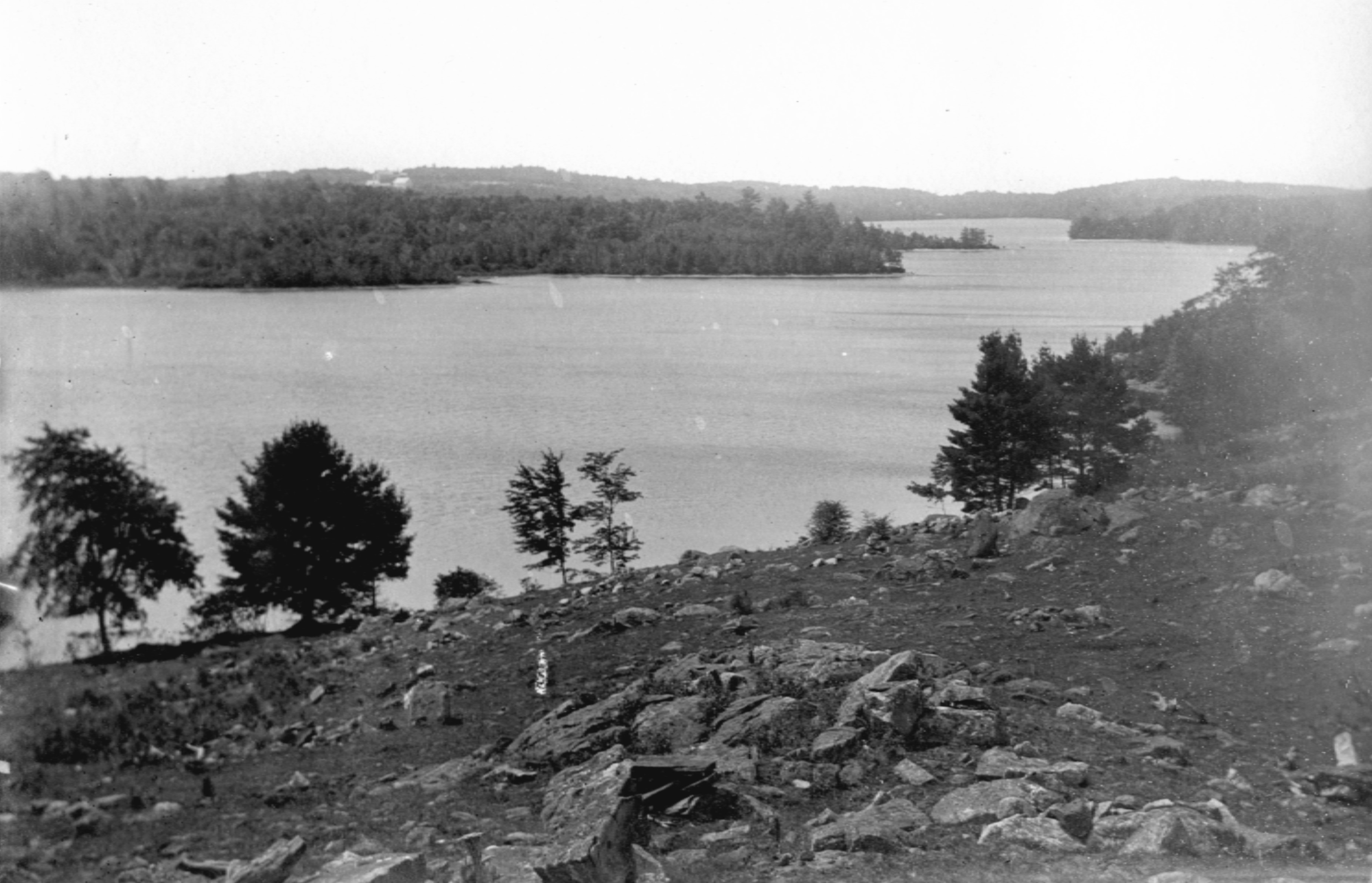
Windham Life and Times – February 9, 2018

This is a page out of the William Austin scrapbook showing Dinsmore Hill with its view of Cobbett’s Pond. I believe Mrs. Austin was picking blackberries along the stone wall. In the left hand photograph one of the Austin children has climbed a pine tree to take in the view.

—WINDHAM—

“I used to roam to Windham

    Beyond the Dinsmore farm;

The roving road to Windham

    Has much of simple charm;

It angles up among the hills,

    And there’s a little singing stream

That carols near at hand.”

“Now, I am far from Windham;

    It’s ways are drifted deep,

The yards that herded cattle,

    The snug folds for its sheep;

I would not climb it’s hill tops

    While bleak the norther blows,

But I’ll be fain to wander there

    Amid the cheery snows.”

“For oh the trees of Windham,

    Their blossoms are so white;

They haunt the mind with beauty,

    They thrill it with delight;

Though from the hills of Windham

    I still be far away,

In visions I will visit them

    About the break of May!”

“Here’s something cut from newspapers, which I changed the name within to fit the old days—-

From the scrapbook of Mrs. John Cochran

Windham Life and Times – February 2, 2018

Edward Searles and Angelo

Conclusion

So the story of Edward Searles (the Old Gentleman) and Angy Ellison comes to an end leaving more questions than answers.  The letters certainly show affection between the two but also seem a bit eccentric to modern readers.  The letters make it obvious why Angy felt so strongly that is was Searles intention to “adopt” him as his son. After all, Searles was signing his letters as “Dad.” You can fully understand how in Angy’s mind it would have logically follow that he would inherit a large share of Searles estate upon his death.

During the will trials, Victor Searle’s attorneys sought to use the relationship between Angy and Searles. In a special report to the New York Times on October 14, 1920 the following is disclosed to discredit the mental capacity of Searles to change his will: “In the opening fight of the Probate Court here before Judge White today for a jury trial in the $25,000,000 will contest involving the estate of Edward F. Searles, late of Methuen, Sherman L. Whipple, counsel for Albert Victor Searles, nephew of the testator, charged that Mr. Searles, when he made his will, was in a mental state and physical decay, and the victim of a plot having for its object the keeping of the vast estate from the party Mr. Searles intended should be the beneficiary.”

“Mr. Whipple dwelt at length upon the alleged affection of Mr. Searles for a young Greek lad, Angelo Ellison, who had been in his employ some six years, and said that a friend had said that Mr. Searles had intended young Ellison should receive the estate, but was dissuaded by Arthur T. Walker, chief beneficiary under the will, on the grounds that it would not do to leave such a vast estate to a poor Greek boy because of the public criticism. It was asserted that Mr. Searles was persuaded that the same object could be gained by leaving the money to some one ‘who could pass it along to Angelo.’ ”

“Counsel declared that young Ellison had disappeared and that had reason to believe the boy was now being paid by the proponent. He declared that the relations between Mr. Searles and the boy were more those of father and son than employer and servant.”

“Young Greek Treated Like Son: ‘We have letters from young Ellison to Mr. Searles couched in terms of the most endearing affection,’ said Mr. Whipple, who added that some of these letters began with ‘Dear Dad,’ ‘Darling Daddy,’ and ‘Dear Old Gray Boy,’ He said he could not find that Ellison was ever paid a salary, but that Mr. Searles gave him money as a father might have done.”

“Mr. Whipple said that Mr. Walker knew of Mr. Searle’s fondness for Angelo and that one of the letters purporting to be from the young Greek to Mr. Searles was in the handwriting of Mr. Walker, and was evidently written by Mr. Walker for Angelo as Angelo was not highly educated and probably asked Mr. Walker to write it for him.

‘Searles,’ said Mr. Whipple, ‘had pictures of young Ellison in his sleeping room and had been seen sitting before these pictures in an attitude or worship.’ Counsel said there was no question that the chief thing in the latter part of Mr. Searle’s life was his affection for this boy, and that there was evidence he intended to adopt him, but that someone, ‘we think we know who,’ (Walker) dissuaded him….”

“Mr. Whipple described the trip taken across the continent by Mr. Searles with young Ellison. Some time after this trip, said Mr. Whipple, young Angelo went to Greece to see his mother. Angelo returned to this country this spring and after seeing Mr. Searles, returned to Methuen. After the millionaire  fell ill, said Mr. Whipple, Angelo was permitted to see him once and then sent to the Searles Estate in Windham, N.H., and did not see Mr. Searles again during the latter’s life.”

What is interesting is that the counsel for Victor Searles was using the argument that Angelo Ellison was the intended heir in order to get a settlement for his client. Whatever the case, Walker settled with Searles out of court. While a settlement doesn’t prove guilt it seems to me that there was something to the story. It is said that Victor Searles had his bequest under the will changed from $250,000 to over $2,000,000.  Ellison claimed that Victor Searles was an alcoholic and a drug addict and not a nice man. Events would bear this out. In October of 1921, he was divorced from his wife Etta who received $140,000. He was also said to have been blackmailed out of $50,000 after being trapped with a woman in a Back Bay apartment. He was also reported to have settled for $1,000,000 an alienation suit in having committed adultery with Mary Johnson of Portsmouth N.H.

As for Angelo Ellison, who was most likely the intended heir for much of Searle’s millions, he ended up with just $10,000. He also went to court to contest the will but lost. Andrew “Angy” Ellison in his later life was consigned to the loss saying that the money would have probably ruined his life.