Windham Life and Times – June 19, 2020

Windham Mid-Century Modern

The New Hampshire Sweepstakes

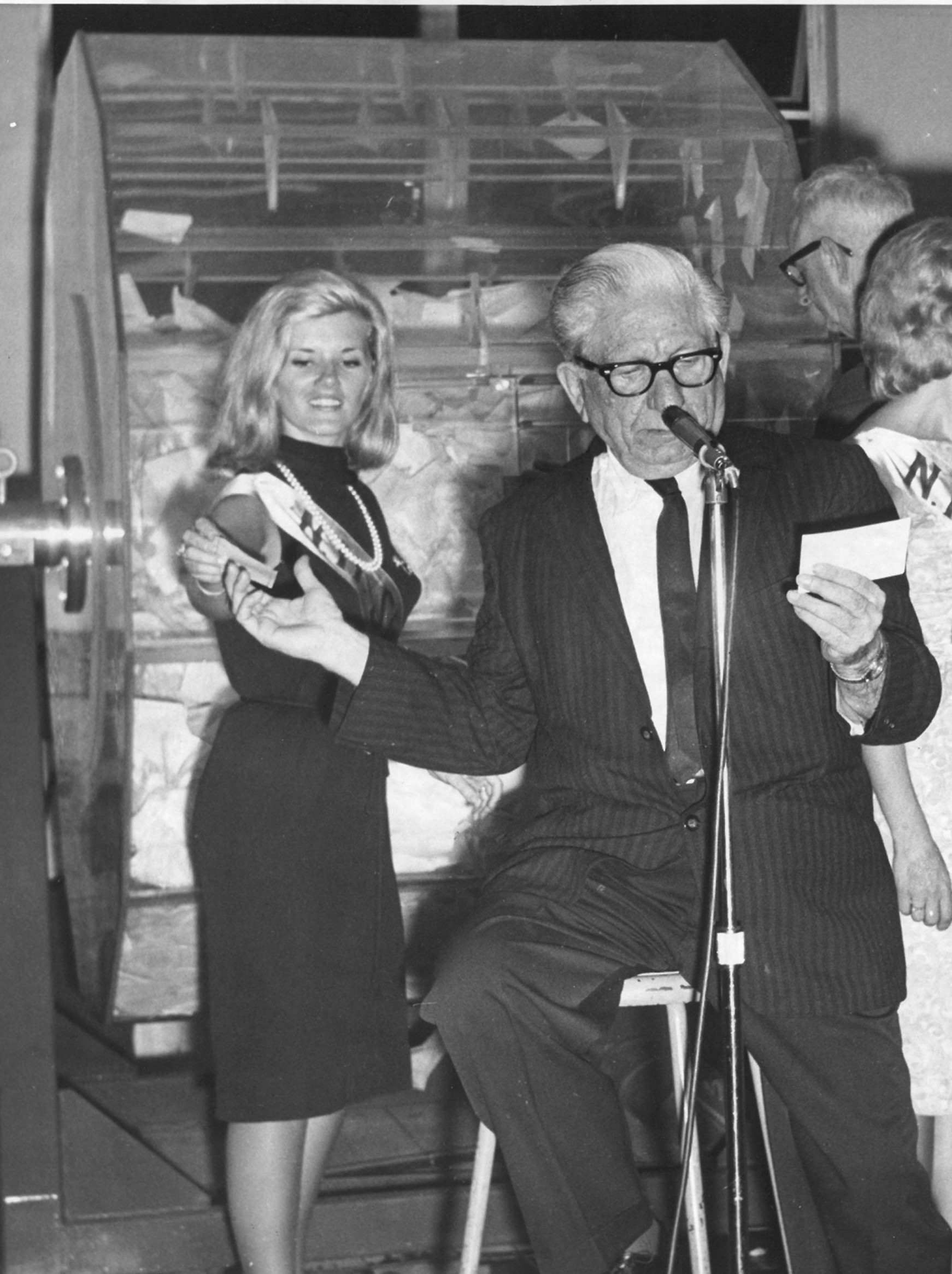
ABOVE: Salem N.H.— State police of New Hampshire flank the large drums containing the first-in-the-nation sweepstakes tickets, as they arrive at Rockingham park in Salem from drawing on July 15th.

RIGHT:  Second Sweepstakes Drawing— Judy Morrison of Dover, N.H., hands tickets to Dave Rubinstein at the second drawing of the New Hampshire Sweepstakes at Rockingham Park, in Salem, N.H., July 29. The New Hampshire Sweepstakes is the country’s first legal lottery since the Louisiana lottery closed in 1894. Winning tickets are guaranteed a minimum $200 to $300. They will win more if their horses enter the September race. The payoff will crest at $100,000 for tickets held on the winning horse. A third drawing will be held in early September.

     If you are interested in the subject there is a great book titled, “American Sweepstakes” by Kevin Flynn. It tells the story of “how one small state bucked the church, the feds, and the mob to usher in the lottery age.”


Windham Life and Times – June 12, 2020

Windham Mid-Century Modern

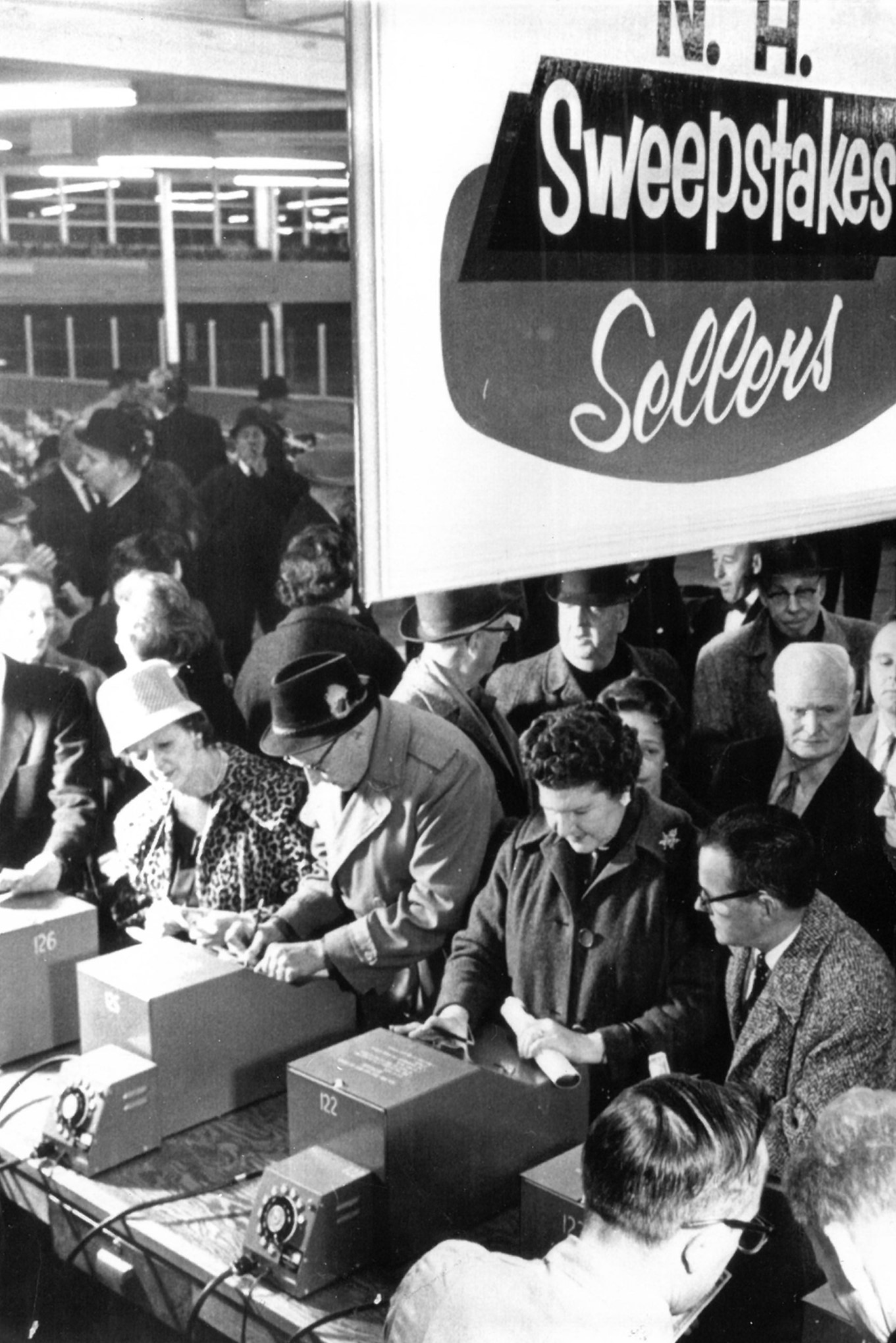
Photograph above- March 12, 1964: “New Hampshire Sweepstakes…people line up at ticket dispensing machines at Rockingham Park, where the nation’s first legal lottery of the 20th Century, the New Hampshire Sweepstakes commenced on March 12th.”

New Hampshire Sweepstakes – How the Game was Played

“Sweeps tickets went on sale March 12, 1964, at Rockingham Park. In a ceremony of much fanfare, Ed Powers sold the first $3 ticket to Governor King: #0000001. He held the slip high — the first legally purchased lottery ticket in the modern age — and the gathered crowd exploded into cheers. Then the rest of the sales windows opened and a crush of dreamers kept clerks working until one hour after the track was supposed to close.”

The genius behind the New Hampshire Sweeps was Ed Powers, who was a former FBI agent who had cracked the 3 million dollar Brinks heist. Powers was hired as the Executive director of the New Hampshire Sweepstakes because of his “unimpeachable reputation”  which quelled fears of “mob infiltration.”

“The major obstacles to a sweepstakes were federal rules prohibiting lottery material from the mail and laws against transporting gambling paraphernalia (like tickets) across state lines. Also, the Justice Department had publicly announced its fear a lottery would attract racketeers who would infiltrate and corrupt the operation. In secret meetings with the DOJ, King’s staff determined operating a lottery within New Hampshire would be permissible. But the FBI would take action if tickets crossed the border — an inevitability nearly impossible to prevent (and greatly encouraged).”

How did Powers and the state of New Hampshire get around the obstacle of federal restrictions? Easy! The Sweepstakes created a loophole by providing a carbon copy of the ticket to the people who bought them. The actual ticket remained in New Hampshire so never ran afoul of federal laws against crossing state lines. This opened the way for people from New Jersey, New York and Massachusetts to purchase tickets without breaking federal laws. The Sweeps were genius in another way. They promoted tourism in New Hampshire. Since the ticket had to be physically purchased in New Hampshire, people often planned a vacation around purchasing a Sweeps ticket.

So how did it work? Sweepstakes tickets were drawn from a giant drum. The winners then were matched with horses that ran in the Sweepstakes race at Rockingham Park. “In July, a pair of beauty queens pulled names from a rotating 2,400-pound Plexiglas drum and matched each one with one of the 332 horses hoping for a position in the race. For every $1 million in tickets sold, another batch of players and stallions would be drawn. In the end, there were six people whose fortunes rode on each horse. Among those selected to win prizes both large and small were an 8-year-old boy, a recently deceased immigrant, an office pool from New England Telephone and someone who signed the slip ‘Old Man Sunshine.’ ” So the six ticket holders who were matched with the winning horse, each won $100,000.

If you are interested in the subject there is a great book titled, “American Sweepstakes” by Kevin Flynn. It tells the story of “how one small state bucked the church, the feds, and the mob to usher in the lottery age.”


Windham Life and Times – June 5, 2020

Windham Mid-Century Modern

April 30, 1964. Gov. John W. King of New Hampshire as he prepared to sign into law today a bill making his state the first in 70 years to sanction a sweepstakes. King , 44, signed the bill over the opposition of Protestant clergyman and other Citizens of the Granite State

The New Hampshire Sweepstakes | Lotteries in America

The investors in the first permanent colony in the Untied States, Virginia, were granted permission to hold a lottery in order to help raise money in 1612. “In 1616, the company sent people on the road to sell tickets in “instant” lotteries outside of the capital. In these small-scale games, people could find out if they won a prize immediately after buying a ticket, similarly to scratch-and-win lotteries today. “To put an incorruptible face on the drawings, they made sure that a child drew the lots from the drums,” writes Matthew Sweeney in The Lottery Wars. These “instant” games were a huge success. Over the next four years, they brought in an estimated £29,000—nearly £8 million today…” “I am of the Company of Virginia, but I hear these lotteries do beggar [impoverish] every country they come into. Let Virginia lose rather than England.’ Public criticism of the lottery grew louder and the King eventually shut down the lotteries.”

Michael Troy at Unlearned History has a detailed account of lotteries in America for anybody who is interested. According to Troy, “Massachusetts Colony held its first lottery in 1745. “The Colony planned to sell 25,000 tickets at a cost of 30s (£1.5) per ticket.  The lottery would be overseen by a Board of Directors made up of leading figures in the colony: Samuel Watts, John Quincy, James Bowdoin, Robert Hale and Thomas Hutchinson…The total amount collected from the sale of all tickets was £37,500.  Prizes ranged from two top awards of £1250, to 5250 awards of £3,15s (about double your money-back). There were a total of 5422 awards, meaning your chances of winning something was about 25%.  To total amount awarded as prizes was £37,500.  But wait, you may ask yourself.  If total tickets sales was £37,500 and total award money was £37,500, how did they make money? The answer is with taxes.  Each award came with a 20% tax, meaning the winner only received 80% of the award amount.  Total collections from taxes would be £7,500, minus the costs of running the lottery.”  Lotteries were used to help fiancé the Revolutionary War, provide extra money for state governments and to fund the establishment of colleges such as Harvard.

“Then, in the 1830’s public opinion began to turn against lotteries. Several lottery scams helped turn public opinion against gambling.  Traditional religious opposition to gambling, combined with social reform movements that saw the cost of gambling with no real societal benefit caused many leaders to decide it was a harm to society that needed to be abolished. In 1833, Pennsylvania, Massachusetts and New York banned all lotteries.  Other States soon followed.  By 1860, only three states still permitted lotteries: Delaware, Missouri, and Kentucky. Although it was illegal, many enterprises sold lottery tickets for these States throughout the country. After the Civil War, a federal law made it illegal to use the US mail to distribute lottery tickets….But the reconstruction years were hard times.  In 1868, the Louisiana legislature was desperate for money.  Its notoriously corrupt legislature made a deal with a criminal syndicate from New York to create a State lottery with a 25 year charter, and establishing the syndicate as the sole lottery provider. The Louisiana Lottery became wildly popular throughout the country, despite restrictions on using US mail.  About 90% of its revenues came from out of state sales.  Louisiana soon became the only legal lottery in the US.  Finally in 1895, Congress barred any transmission of lottery tickets across State lines by any means. With out of state sales becoming impossible, the Louisiana lottery was abolished. With the death of the Louisiana Lottery, all States had outlawed lotteries…For nearly three generations, Americans would not have any options to play the lottery legally anywhere in the US.”

“While legal lotteries disappeared, gamblers turned to organized crime for their lottery fix.  The “numbers racket” grew increasingly popular in many cities.  Most of these operated much like the daily lotteries run by States today.  A random three digit number would give a pay out, usually of 600 to 1…Other Americans turned abroad.  The Irish sweepstakes began in 1930.  It derived most of its revenue from US purchases. The importation and sale of such tickets in the US was illegal.  Nevertheless, the Irish Sweepstakes became wildly popular for many years.”  Everything changed in 1964 when the Sweepstakes was legalized in New Hampshire.

http://unlearnedhistory.blogspot.com/2016/01/america-built-by-lottery.html

https://www.history.com/news/13-colonies-funding-lottery

Windham Life and Times-May 29, 2020

Windham: Mid-Century Modern
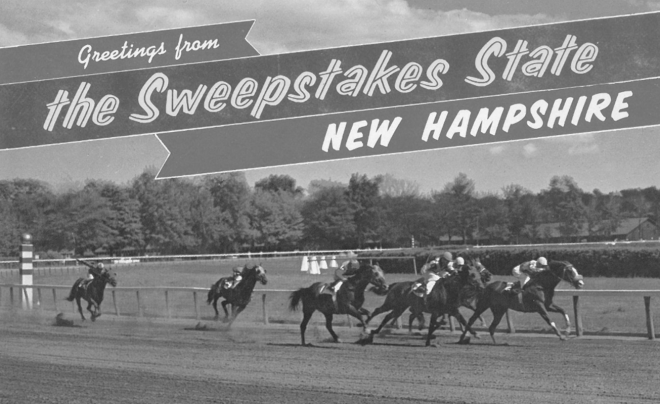
New Hampshire First in the Nation…Lottery.

Oh how far New Hampshire has fallen from it’s long held “Live Free or Die” roots. The story of the New Hampshire Sweepstakes is a fascinating journey into the workings of a state with no sales or income taxes, in need of revenue sources, and how it was seen by many politicians in Concord as a lesser evil to institute a lottery than introduce broad based tax measures.  And even if it meant going up against all of the power and regulatory power  of the federal government.

On April 30, 1964, Governor John W. King, a democrat, signed into law a bill making New Hampshire the first state in 70 years to sanction a sweepstakes.

According to the New Hampshire Lottery Commission: “State Representative Larry Pickett of Keene saw a sweepstakes as a viable and voluntary method of raising money for education. Between 1953 and 1963, Pickett proposed a Sweepstakes bill five times, finally succeeding in getting it passed in 1963. On April 30 of that year, Governor John King signed the bill.

There was opposition to the “Sweepstakes.” It was an interesting tight-rope walk since it was seen as fine for the state to sell booze, but gambling was somehow a moral menace. A February 28, 1964 editorial from the Derry News states, “Throughout New Hampshire the Committee of One Hundred has met with surprising support in its campaign to get a ‘no’ vote against the sweepstakes ballot question on Town Meeting day, March 10… Even Salem, with backing of the very top management at Rockingham race track, has organized a local committee to get out the ‘no’ vote for sweepstakes in that town. This is not surprising  for there are many, many people in New Hampshire who have a very uneasy-feeling about supporting a lottery scheme as a means of financing the cost of state government”

“Let it be understood that a vote against the sweepstakes in not a vote against the governor, nor the legislature, nor the law of the state. In fact, the legislators specifically made it mandatory that the voters have a chance to vote on the issue in every town in New Hampshire before the sweepstakes is finally accepted or rejected as a taxing scheme…We urge the people of Derry to vote against the sweepstakes on Town Meeting Day…The sweepstakes can’t begin to fill the gap. Let’s scrap this costly tax gimmick and put our minds to the business of coming up with an effective and more efficient tax program. Sooner or later we are going to have to face it. If the sweepstakes is killed in New Hampshire on balloting day March 10, the air will be cleared so that a sound taxing program can be developed. It cannot come until we lay this half-measure scheme to rest…” (Needless to say, this seems a very odd way to build support for a sweepstakes no vote…vote no so we can pass a sales or income tax, which the state still has not seen fit to pass.)

William Loeb, the publisher of the Manchester Union Lear backed the sweepstakes; we assume because of his opposition to broad based taxes. “And now the publisher of the Manchester Union Leader isn’t so sure that he has completely sold the majority of the people in the state, despite his repeated statements that an overwhelming number of people support the sweeps. In an impassioned front page editorial last week, the out-of-state publisher strongly urged those in favor of the sweeps to get out and vote.”

Again from the Derry News, “Delores Bridges Joins Bass In Denouncing Sweepstakes. Effective opposition to the New Hampshire Sweepstakes went into high gear this week with the mailing of 20,000 copies of a four page broadside that brought the names of additional citizens to public attention. ‘Considered’ the official publication of the Committee of One Hundred that seeks repeal of the sweepstakes, took to newspaper tabloid form this week with page one headlines that highlighted the opposition of Mrs. Styles Bridges, widow of the former United States Senator, and former congressman Perkins Bass of Peterborough. Mrs. Bridges is quoted from a newspaper interview in Manchester two weeks ago in which she cited the sweepstakes as further evidence of the ‘moral decay’ of our society. She says in the interview that there is no evidence to convince her that the majority of New Hampshire residents approve the sweepstakes… The publication draws heavily on a recent study conducted in Nevada that shows the impact of legalized gambling has made in that state. Officials of the Committee of One Hundred cite the high incidence of crime—in Nevada and insist this can be an expected end for New Hampshire if the sweepstakes be approved at the March 10th primary.”

“Mrs. Rodney Ellis chairman of the Education Committee of the New Hampshire Farm Bureau released the following statement…Enactment of a Sweepstakes Lottery as a means of financing education is as stupid as it is inconsistent…Present state income used for education is derived from such uncertain sources as tobacco and liquor sales and racing. Adding a sweepstakes only increases its unreliability…vote no on the referendum March 10, 1964. Then we can settle on a sound, equitable tax as a firm foundation for present and future education in New Hampshire.”

“New Hampshire cities and towns voted by special ballot, with 198 of the state’s 211 communities voting in favor of starting a lottery. On March 12, 1964, two days after the vote, Sweepstakes tickets went on sale – and the benefits to New Hampshire schools began.”