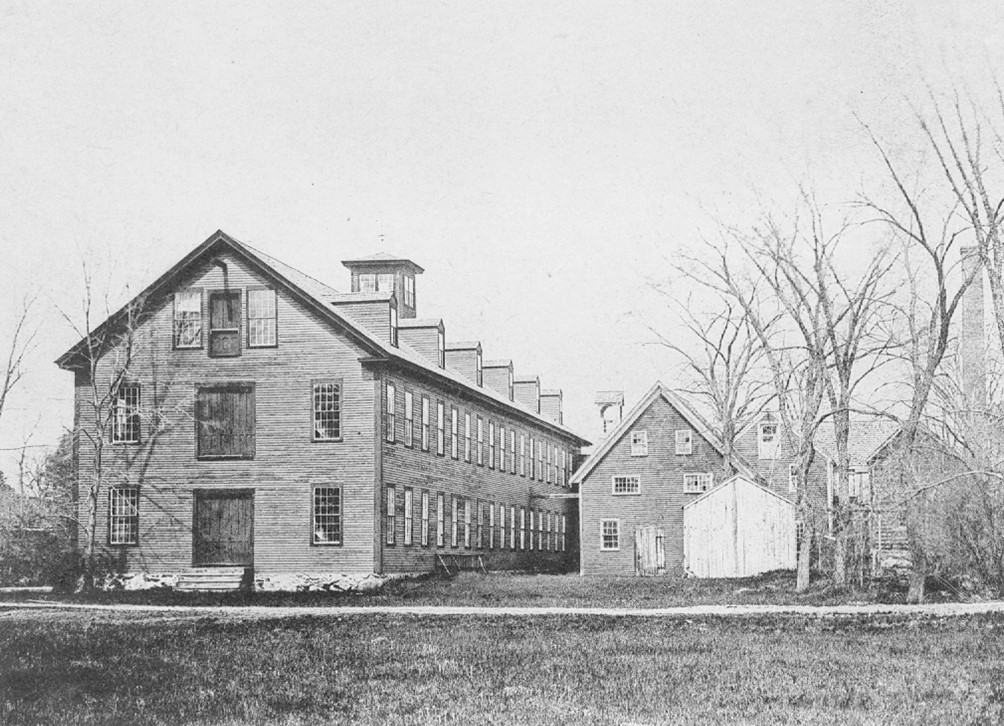
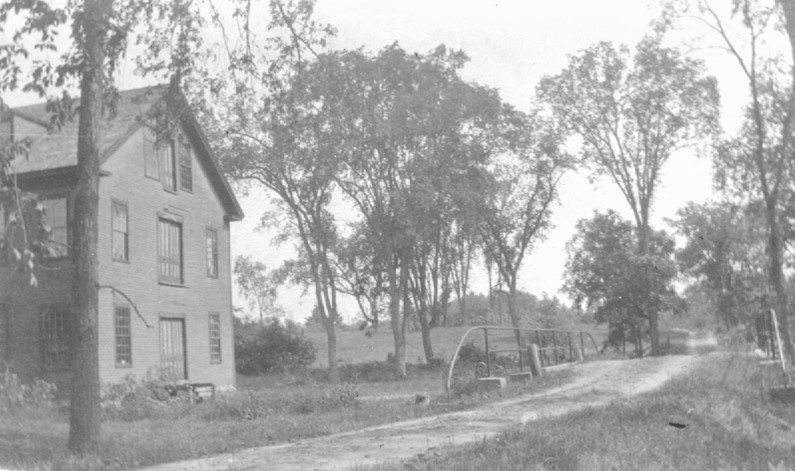
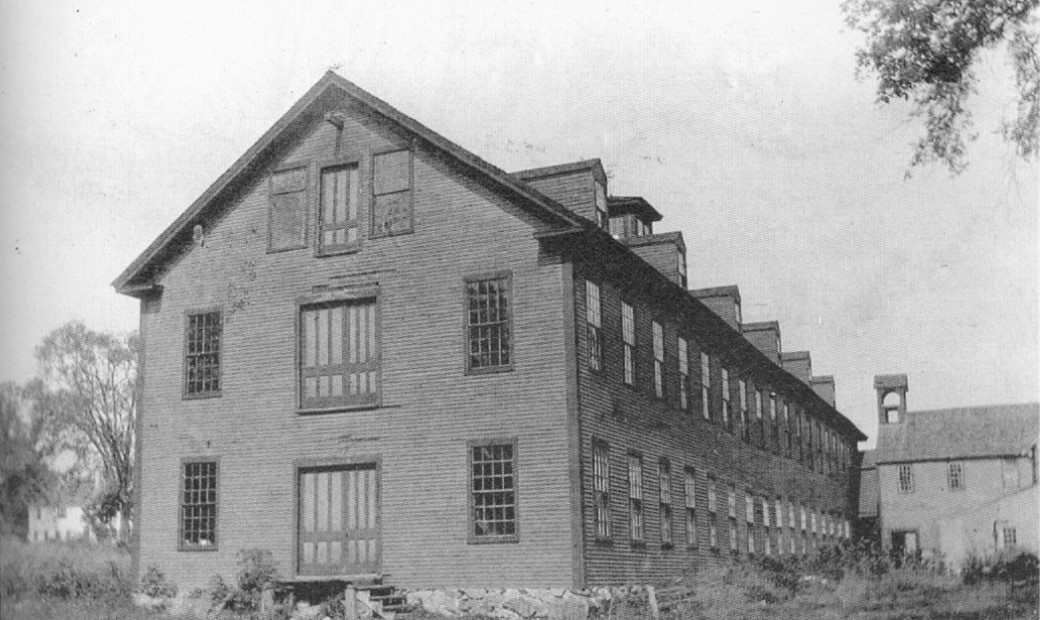
The mill on Golden Brook was powered by rights to, if I remember correctly, the top fifteen feet of water in Cobbett’s Pond. Morrison says, “The first grant of right to use the water’s of Cobbett’s Pond was to Samuel Senter for a grist mill. The first mill ever erected there was built by Alexander Wilson, a short distance above the head of the mill pond. This he sold to Samuel Senter in 1790, who built a grist and saw mill near the present site, and carried on business till his death, Feb. 11, 1833. Isaac Senter, about 1833, sold the mill to the father of Stephen Fessenden, of Boston. The latter with his family, came to town about this time, and soon made changes to the surroundings. A saw-mill and grist-mill were then there. He built a shingle and clapboard mill, then a building for Carding rolls, which was enlarged for the manufacture of twilled flannel and frocking. This business he carried on until his death, May 10, 1868. In 1871 the town voted not to increase the valuation of his property for purposes of taxation for seven years, in consequence of any additional buildings he might erect, etc. In 1871, he built the present commodious building.” According to Rural Oasis Neal manufactured cloth at the mill and used both water and steam power until the 1890s. At the time the dam on Golden Brook, which furnished power to the mill, gave way and was not rebuilt because transportation by horse drawn wagons over four miles to the railroad at Windham Depot have proven too expensive. Edwin Stickney acquired title to the property through a mortgage foreclosure and on January 18, 1900 he sold to the Gould Brothers who manufactured Witch Hazel products. Even today, with the buildings long gone, and the hum of machinery long silent, it is a beautiful and interesting spot.
Golden Brook RoadMr. Whipple one of the mill managers with two unidentified women.
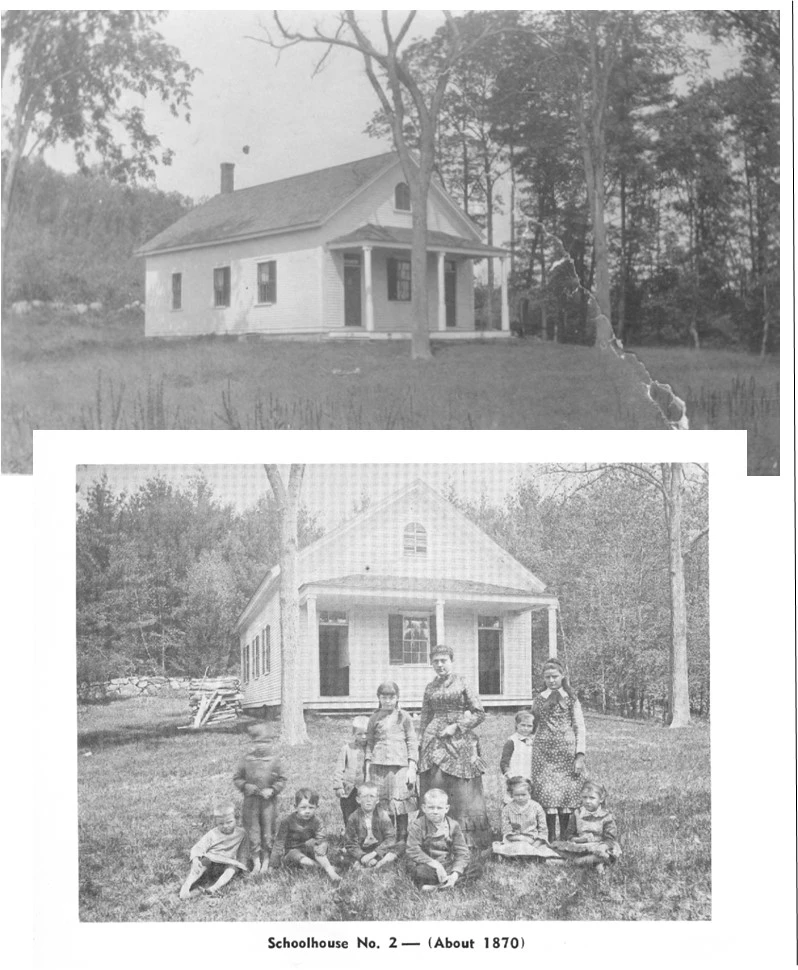
In the early days in Windham, each district has their own one room school-house. The south side of Windham was District No. 2. The school-house was located on what is now Range Road, on a hillside, between Cobbett’s Pond and Golden Brook Road. The school pictured was the fourth building to serve the district known as “the Row” in early times. James W. Smith, a native of the district was architect and builder. The cost was $1,400. The Rev. Loren Thayer dedicated the building on December 8, 1853, and the town sold the building to William and Gertrude Hazlett in the 1940’s after the construction of the first Center School.
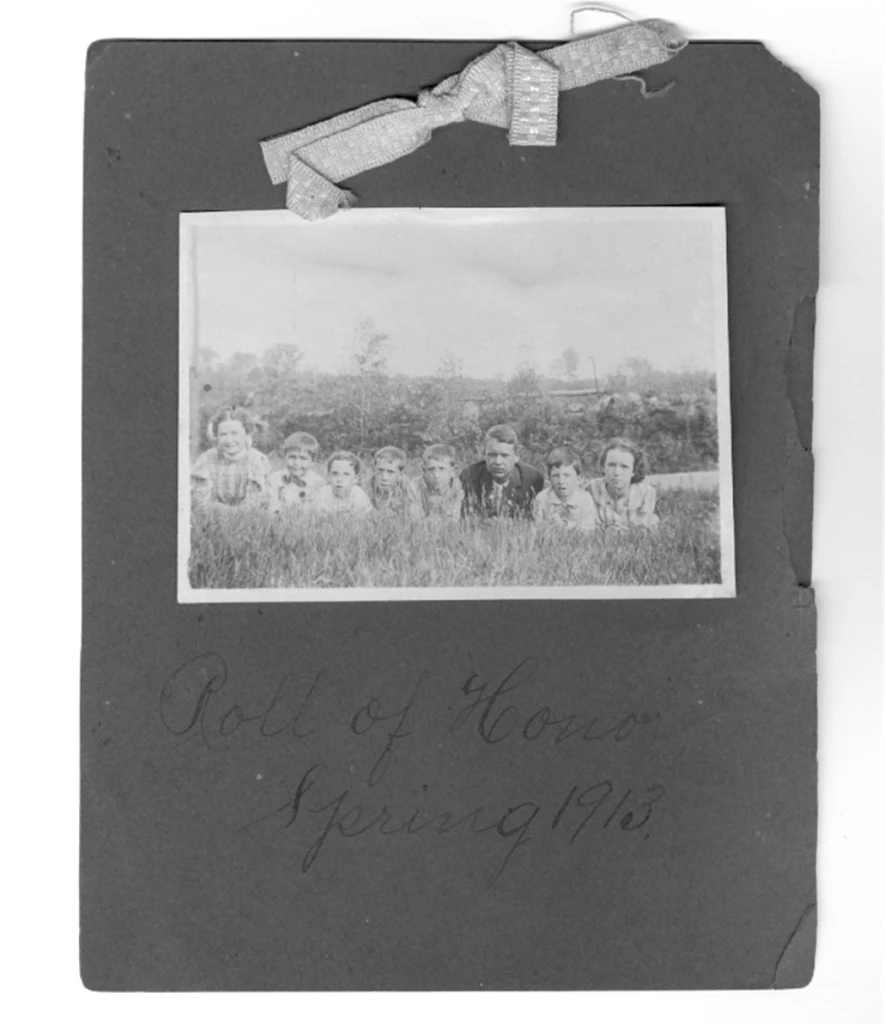
The hand-made award shown to the left was a “Roll of Honor” for the Spring of 1913. The Roll of Honor was for the students at the Number 2 District which was the one room school-house that once stood on a knoll, on Range Road, between Cobbett’s Pond Road and Golden Brook Road. The photograph above was taken right around the same date and the photograph has noted that the Number 2 School was also know as the “Elm Grove” School.
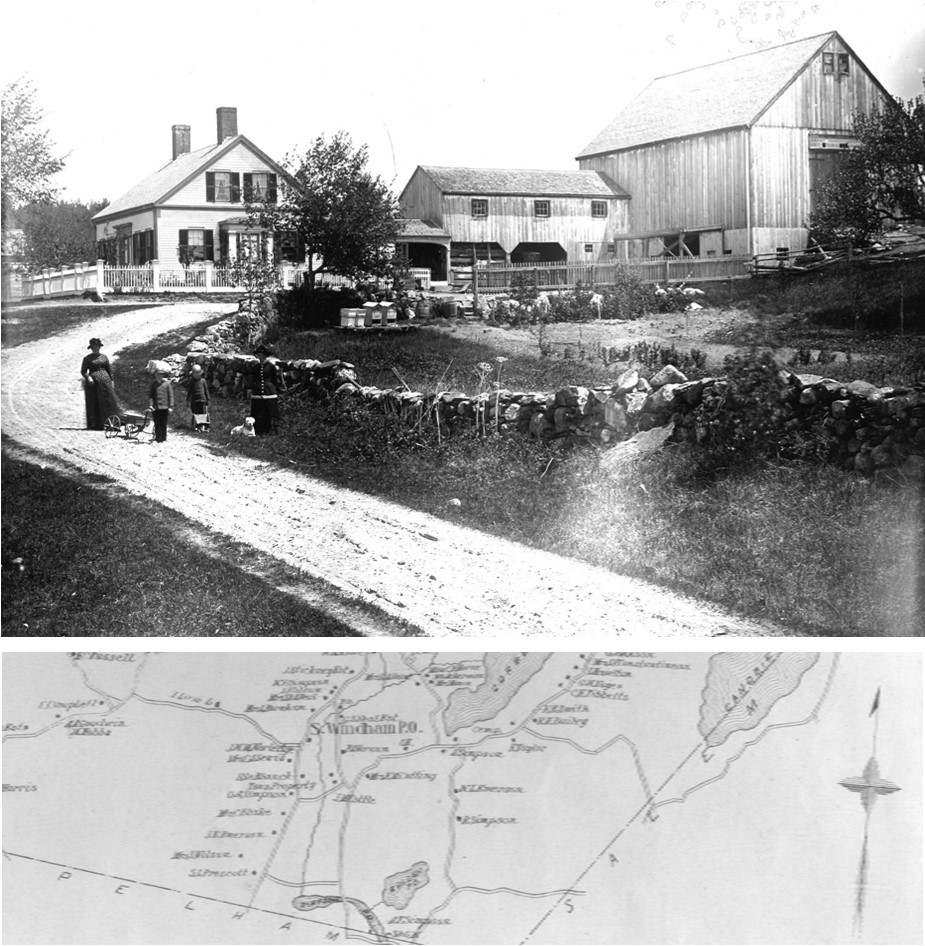
This farm was established and built by Samuel Simpson in about 1815. Samuel Wilson Simpson was the son of William Simpson who was born on February 5, 1748. He owned and lived upon a farm east of T.W. Simpson’s mill; his house stood in a field, a few rods west of the present highway; the old cellar still remains. There he lived until the death of his first wife, when in 1786 he sold the place to Cole, which was soon bought by George Simpson, of Greenland. He then moved to the farm now owned by Eva Cutting, and built the house demolished by S.W. Simpson. He lived there until about 1825, when he moved to a small place now owned by Alfred Lewis. He was killed by falling from a load of wood, October 15, 1830. He was married three times with sixteen children; Mrs. Ruth Dow, who died July 16, 1786 aged 38; married second, widow Grizzell Wilson who died August 23, 1810 aged 60 years upon her farm now Mrs. Cutting’s; married third June 11, 1811, Sarah Morgan, and occupied the Morgan homestead till his death; she died September 1837, 80 years old.
“Samuel W. Simpson was born November 14, 1787; he died August 15, 1873. He was unmarried. He owned and occupied the farm now occupied by Eva (Simpson) Cutting, in District No. 2, but was never married. He was often in office, served as collector of taxes, was treasurer in 1840, selectman in 1832, ‘33, ‘34, ‘34, ‘36, ‘37, ‘38 and representative in 1839, ‘40 and ‘57; was much interested in the schools in Windham and in 1852 he gave District No. 2 a school fund of $1,000; later he gave two other school districts $500 each, having raised an equal amount for a permanent school fund. He was a Selectman at the time of the purchase and establishment of the poor farm, where indigent people were sent to live. He lived to an advanced age, and died in Windham August 15, 1873 aged 85 years, 9 moths and 1 day.”
Eva (Simpson) Cutting was the daughter of John William Simpson. She married Walter P. Cutting who was born in Boston November 10, 1852. She had John W. born November 22, 1874; Charles W, born March 20, 1876 (died in infancy) and Frederick G. born December 25, 1877; and Albert R, born January 24, 1879, (died in infancy). This was a beautiful farm. Baldwin Coolidge took the photograph about 1886 based on the age of the Cutting children.
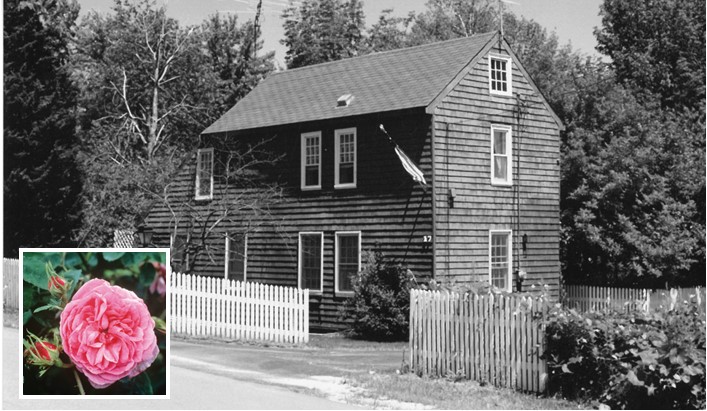
This antique colonial located on the corner of Marblehead and Copp’s Hill Road was built by John Emerson in 1820. It is the last of the old family homes still standing, that were located in south Windham on Marblehead Road. It’s interesting that it was occupied by the Emerson family until 1957.
Morrison says, “Michael Emerson, came from England in 1652, and settled in Haverhill, Mass. He was a commander of one of the garrison houses, and in 1691, he with others repulsed an attack of Indians made upon him. He was the father of fifteenchildren, and from him most, if not all, of the Emersons in this section descended. His oldest daughter , Hannah, married Thomas Duston, of heroic memory.” (Hannah Dustin was taken captive by the Indians in 1657. She had just given birth and the Indians killed here newborn baby. She and three others escaped by scalping 10 Indians. They were paid 50 pounds for the scalps by the General Assembly of Massachusetts) She was heroic, and her name became historic on account of her bravery and endurance, the story of which is familiar to all.” “John, his grandson was the father of Peter, who was born in Haverhill in 1732. The latter served several years in the French and Indian was, and was in Braddock’s defeat. While in Pennsylvania he married Mary Stanton; returned to Haverhill, where they had twelve children, five sons and seven daughters. He came to Windham in 1784, and settled where Isaac Emerson now lives, having bought the farm of the first settler, Abram Annis.”
“John’s son Isaac married Margaret Dunlap of Bedford. He was the only member of his father’s large family who remained in Windham. He owned as resided on the ancestral acres till about one year before his death; he bought March 1828, of William Davidson, the farm upon which James Emerson lives. He was the ancestor of the Emersons of Windham. Born in Haverhill in 1772; came to town in 1774; married Margaret Dunlap of Bedford in 1793; died 1811. When his wife came from her father’s house in Bedford, to her new home, where Isaac Emerson now lives, in Windham, she brought as a memorial of her early residence, some red rose bushes, that in their blooming season they might gladden the home; and yearly they bloom in the garden, and their fragrance fills the air; but the hands which planted and tended them, nearly a century ago, have long since gone back to dust.”
Their son John D. was born July 16, 1797. He married Betsey Corliss January 24, 1824. “He lived upon the farm now occupied by his son Isaac Emerson. He enjoyed his farmer’s life. In politics he was a democrat; but never let his party predilections influence him much in town affairs or in choices of town officers. He was Selectman in 1843. On the nineteenth day of January, 1871, at a special town meeting of the town, called to see if the citizens would accept the bequest of Col. Thomas Nesmith, for the establishment of the Nesmith Library, under conditions imposed, some felt unfavorable towards the project, as it would entail a slight yearly expense on the town. Not so felt Mr. Emerson; with his great public spirit, he was earnestly in favor of the establishment of the library, and was willing to give freely of his substance, that those of the rising generation, and of all future generations in town, might have the inestimable benefits of a free public library, something which he had never enjoyed. After the acceptance of the gift, he promptly made the motion, that the town appropriate a proper sum in preparing the library room and cases for the reception of books, which motion was readily passed. Let this recorded act stand as a memorial to him. He was a good citizen and an upright man. He died October 5, 1872. Mrs. Emerson was a true farmed wife; had an intense love of out-door life, and her happiest hours were spent caring for her bees and flowers. She lived to the good old age of and died at 84 years.”
Their son Isaac, who was born December 13, 1825 lived upon the home farm. He inherited a strong love for fruits and flowers, and became a successful fruit grower. He covered his farm with orchards of apple and peach trees., from which he realized great profits during the war (The Civil War). His farm was reckoned at the time the second in the county for its fruit crops. He was Selectman in 1860 and 61; representative in 1862 (but deprived of his seat by the House), ‘63,’64. In politics a Republican. He married December 13, 1853, Lucetta Reed of Lowell, Mass. She died April 11, 1871, He married his second wife, Mrs. Jane (Bagger) Brown. They had three children including William L. who carried on the farm.
William Emerson had a long tenure as the town treasurer from 1919 until 1935. He also realized the opportunity to be found in land on Cobbett’s Pond, He developed many parcels into camp lots. William Emerson “is the only known person who had his funeral held from the chapel at “Searles School.” The service was performed by Rev. Lester Evans, with Thomas Waterhouse at the organ and a choir from the Presbyterian Church. Its interesting that the descendant of John Emerson, Bessie, who also lived in the property after she inherited it from her father in 1940, was “well-known for her long and faithful service as the Windham librarian.
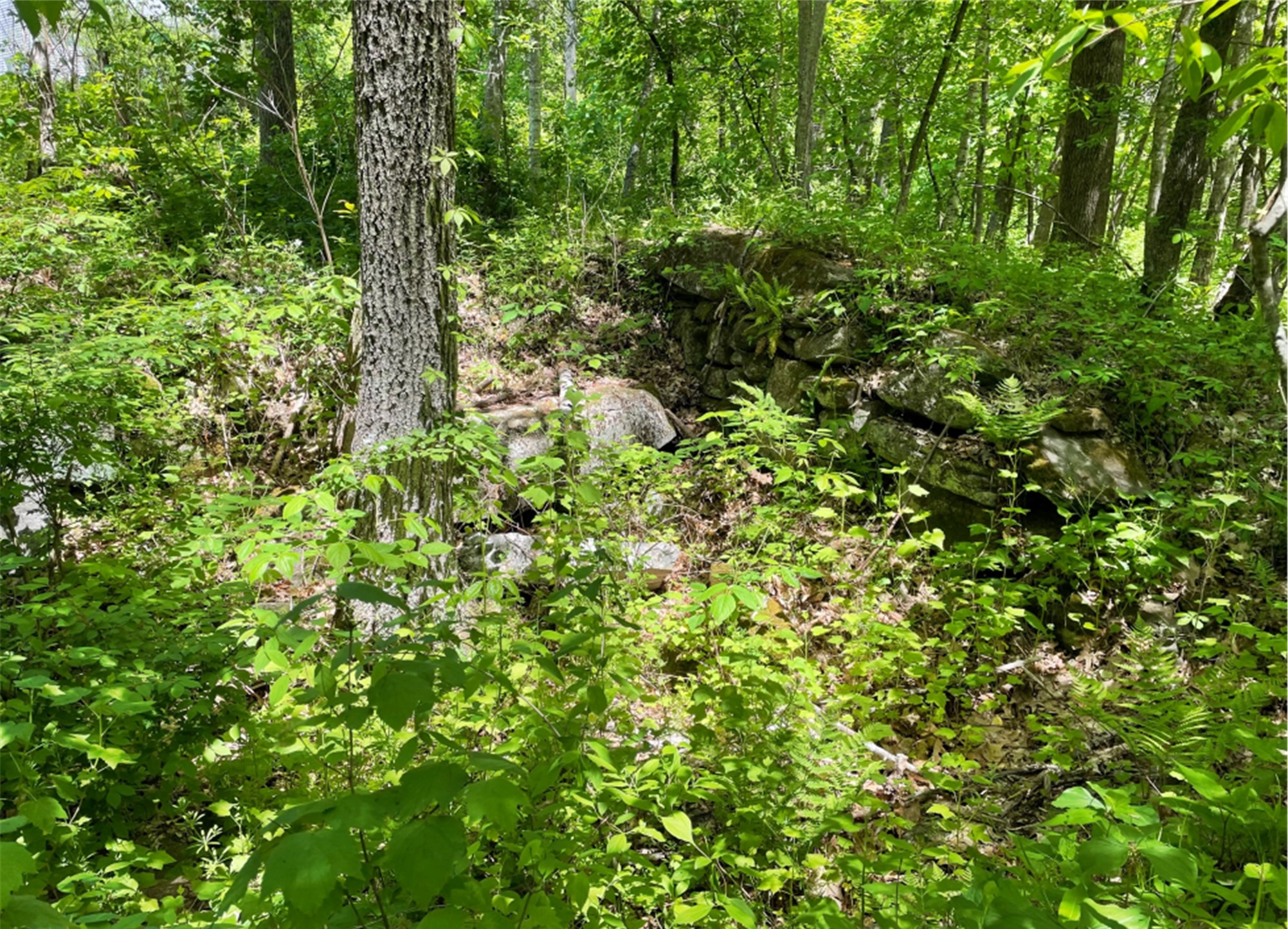
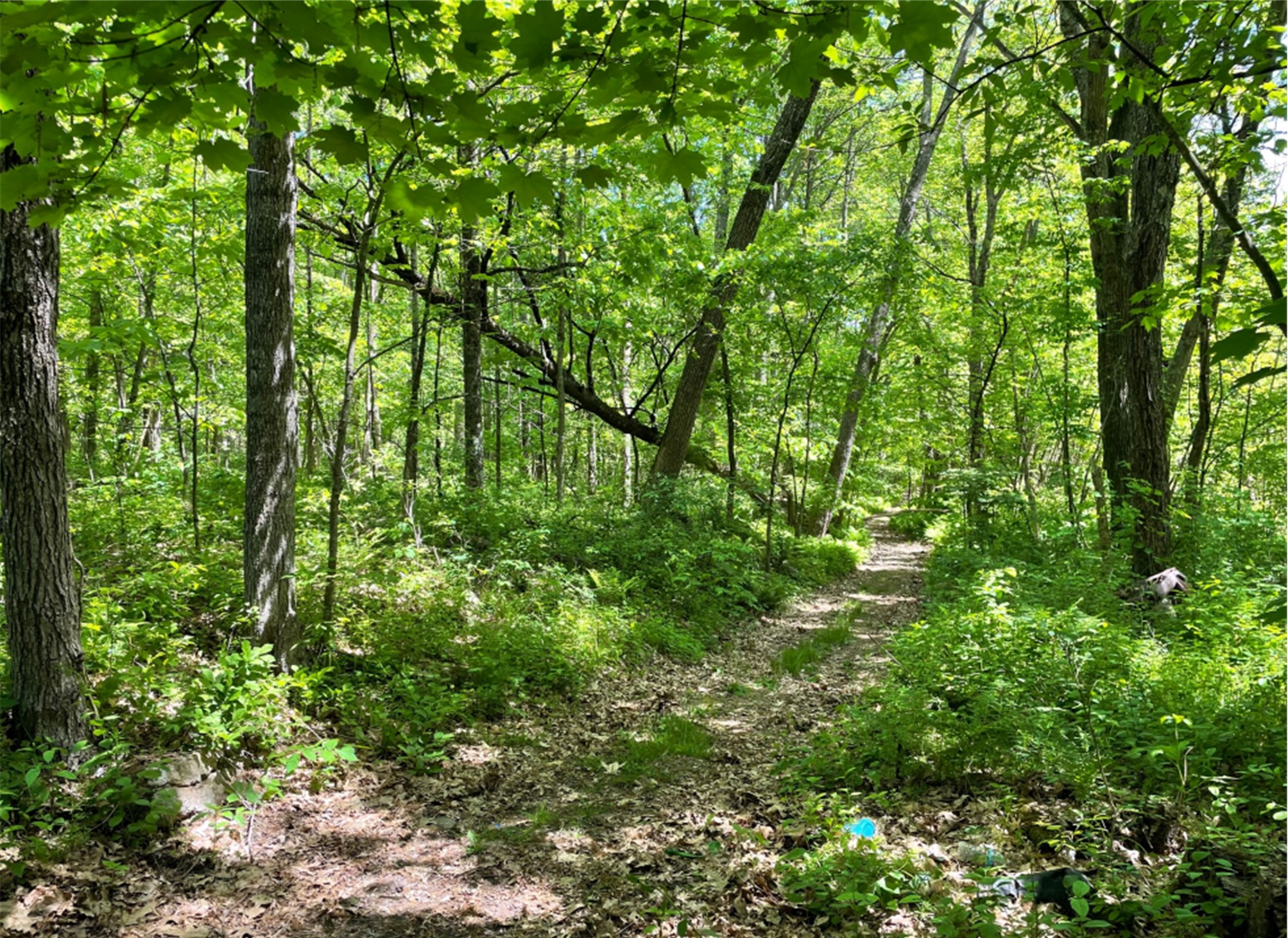
The Corliss Cellar on Marblehead RoadThe Road to Salem NH
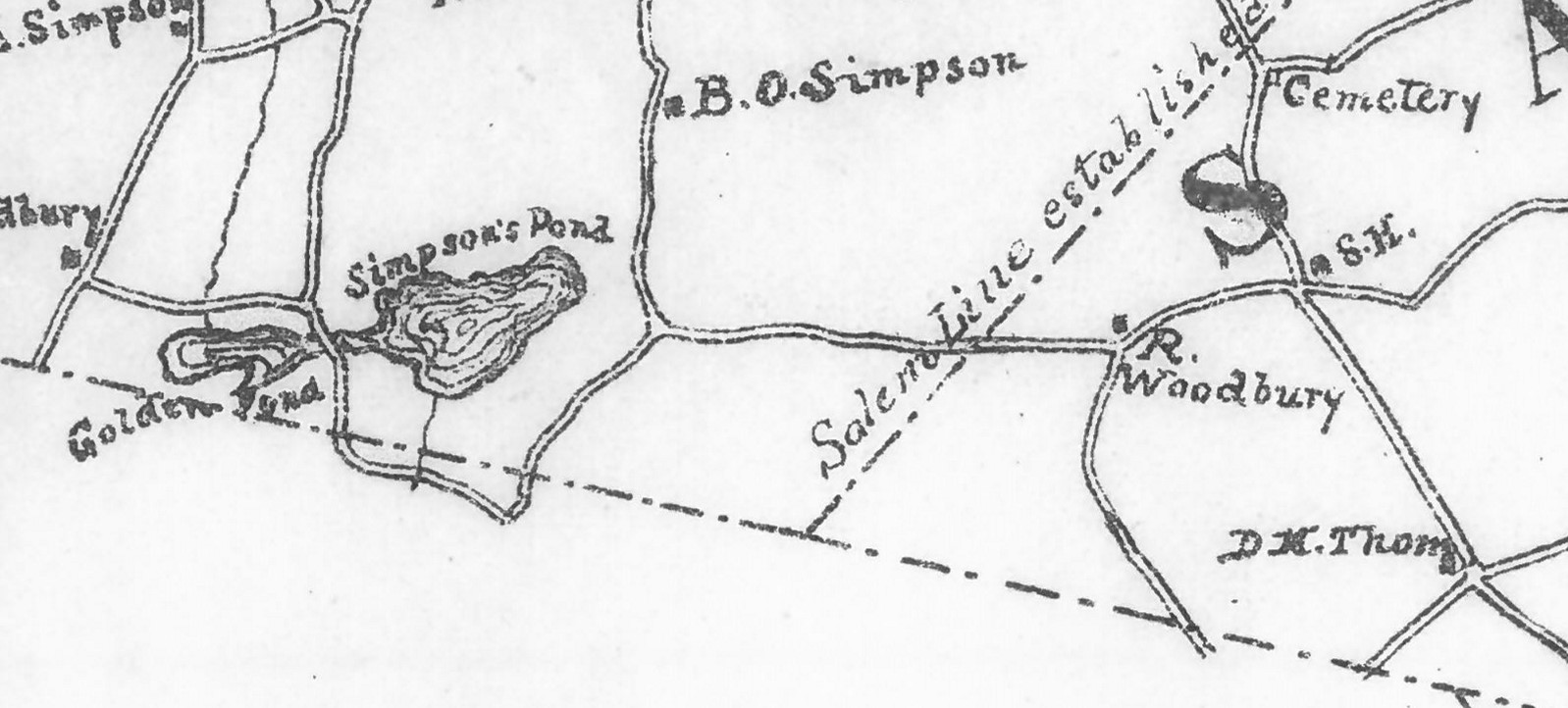
Morrison says the following about the Corliss family of Windham: “One of the earliest , but now forsaken, homesteads in Windham was situated at the junction of two roads, one leading from Simpson’s mill to Salem, the other leading from the cemetery on the hill to that town. Only a few things mark the spot where for two generations large families of children grew up and passed out into the activities of life. The cellar remains and the well from which arose ‘the old oaken bucket’ is still there, and a few large stones where the barn stood; this is all.”
George Corliss, the founder of the family, was born about 1617; came from Devonshire, England, in 1639 he settled in Newbury, MA; soon removed the Haverhill, where he died in 1686. He married Joanna Davis, Oct. 26, 1645, a sister of Thomas Davis, of Marlborough, England. They had ten children—
John Corliss was born in Haverhill on March 4, 1686; married Ruth Haynes and had 14 children together. His seventh child, Joseph, married 1746, Mary Emerson, and they had seven children one of whom was Joseph, the founder of the Windham branch. “Joseph was born November 29, 1747; married about 1767 Miriam Emerson. He was the ancestor of the Windham Corlisses. Leaving his life and child in Haverhill, he came to then wilds of Windham, to make himself a home. He had already earned one hundred dollars by peddling linen thread for the Londonderry settlers. With this he bought of one Thompson, who lived at the corner, one hundred acres of land with a small house. His family joined him. He built a large house, which remained there until 1840 when it was moved to Lowell, MA. His wife dying, leavening nine children, he married Betsey Utinox, daughter of Francis and a descendant of Huguenots. Her father left France for England, where he married Mary Lee, descendant of Harry Lee, who Walter Scott made historic. He and his wife and son sailed for America. Betsey the daughter, was born on the voyage. On their arrival the father and son died; the young mother followed, but on her deathbed she remembered the dear old faith of her fathers; had her child christened and left in charge of a god-mother, who used to buy her thread and linen of the Londonderry settlers. She thought it would be a fine thing to have her young charge sent among these good people and learn to spin and weave, and be brought up in their quiet industry; so the little waif drifted into the family of Mr. Gregg, of Londonderry; was catechized by Rev. David MacGregor. She seldom realized that she had no kith or kin in all the wide world. Having learned the weaver’s trade, she went among the settlers and wove for them when needed. After a time she drifted into the town of Windham, and was brought under the influence of the saintly Williams.” (The Rev. Simon Williams who was the head of Williams Academy in Windham).
‘There’s a divinity that shapes our ends,
Rough hew them how we will.’
“In those days there was a law, that every transient person should be warned out of town by the constable; so that if a person ever needed public aid, the county, and not the town, would be responsible. Joseph Corliss was constable, and it became his duty to perform the disagreeable task. He found Betsey Utinox, the young, friendless French girl, weaving at the house of his mother-in-law, dressed in her red dress, for she was French in all her ways. The stern constable read her the dreadful law, with the penalties affixed, to which she was liable, if she did not leave town within the stated number of days, With frightened eyes she listened, and for once in her life the loneliness of her homeless and friendless condition burst in upon her mind with overpowering might, and the floodgates of her soul were broken down. They soothed her by saying that the law was a mere form. She never forgot that scene, and in her old age would relate it with fire and indignation shining in her faded eyes. It was an event too, that the constable, Joseph Corliss, never forgot, for when, years afterwards, his wife died, he was glad to ask her to be a mother to his motherless children, and by her presence to brighten his home and life.”
This is about the only romantic incident I have found in this early settlement, and that scene is worthy of a painter to sketch upon enduring canvas, or for Whittier to weave into verse immortal.”
The funny thing is that Mr. Corliss may never have met Betsey Utinox except that fate would play its hand in his being forced to become a constable in Windham. Morrison says, on “August 29, 1780— Joseph Corliss was chosen constable at the annual meeting, in 1780, and refused to accept. At an adjourned meeting he gave his reasons, and the town refused to excuse him from serving. The minister rates were assessed and he declined to collect. The matter was brought before the town, and the selectmen were authorized to prosecute said Corliss for his not paying the Rev. Simon Williams agreeable to his warrant according to law.” It is recounted again that “In 1780, Joseph Corliss was a constable, and in the discharge of his official duties warned out of town an attractive, young French girl, who subsequently became his wife…Its funny that thing he did not wish to do; becoming a constable, led to his meeting Betsey Utinox.
Mr. Corliss by his second wife had five children. (In case you’ve lost count, John Corliss had 19 children by his two wives.) He left this farm to his son Solomon and bought a farm near the school-house in District No. 7. The house stood some thirty rods south of the school-house, and the old cellar is still there. On this farm he lived till his death in 1820. Solomon married Annis Houghten of Haverhill and lived upon the farm until 1820 when he removed to Bath, Maine.
Joseph Corliss was revolutionary war veteran who fought through much of the war; “a member of the first military company formed in Windham by Captain James Gilmore.” He was also part of Colonel Matthew Thornton’s regiment.
From about 1807 through 1819 Joseph Corliss was licensed by the selectmen to be a “taverner or public innkeeper” which he conducted “near T.W. Simpson’s mill.
The Joseph Corliss cellar of his first house is “at the corner of the road leading from Windham to the Richard Woodbury farm in Salem.


 Windham NH History