Boston & Maine Right of Ways in the 1920’s and 30’s. Windham Junction.
When Windham had Railroads
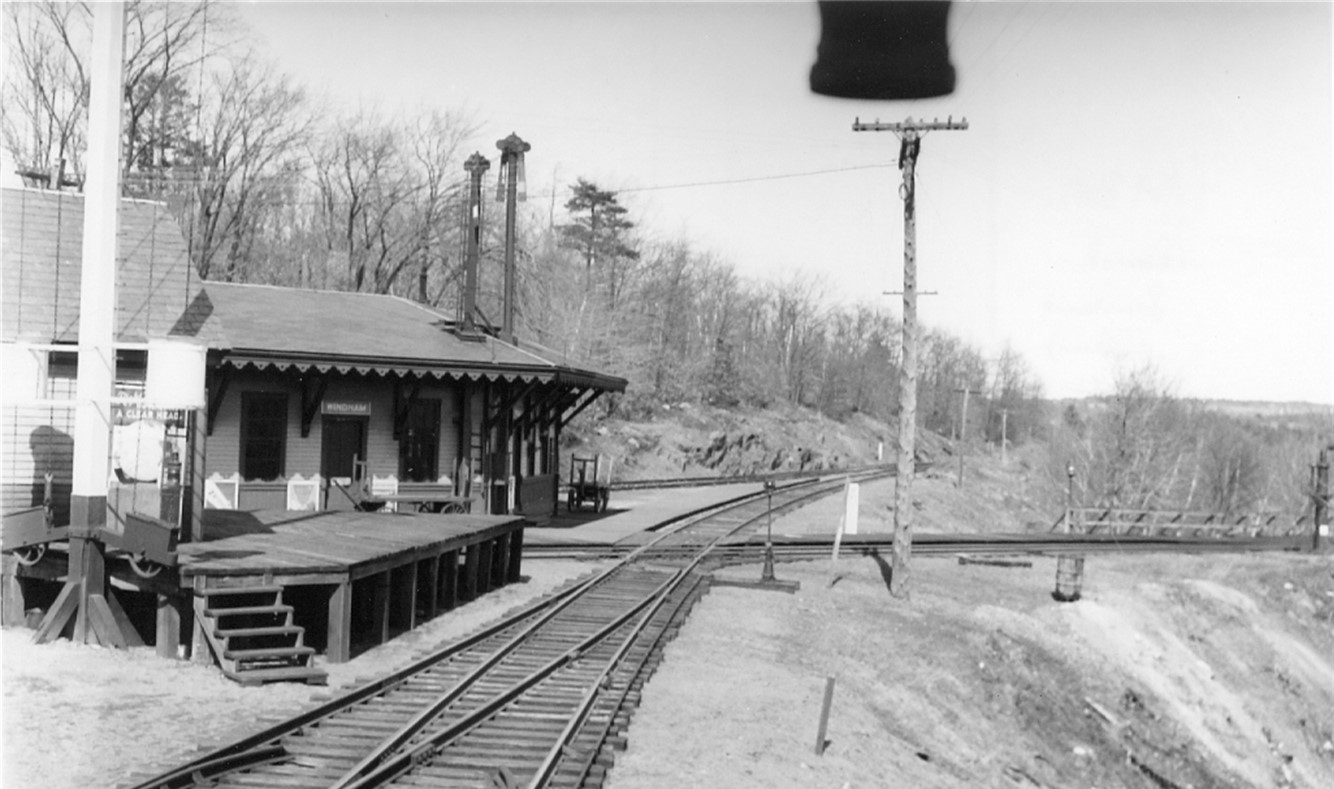
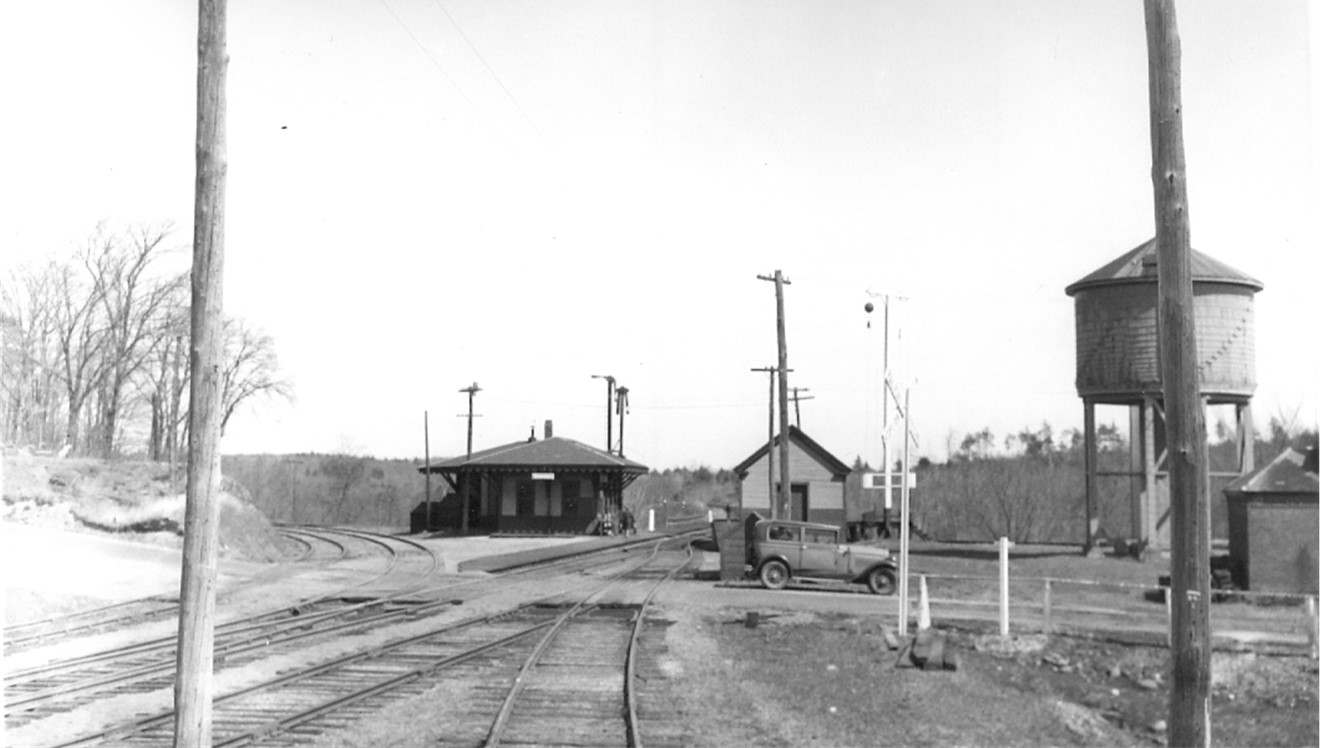
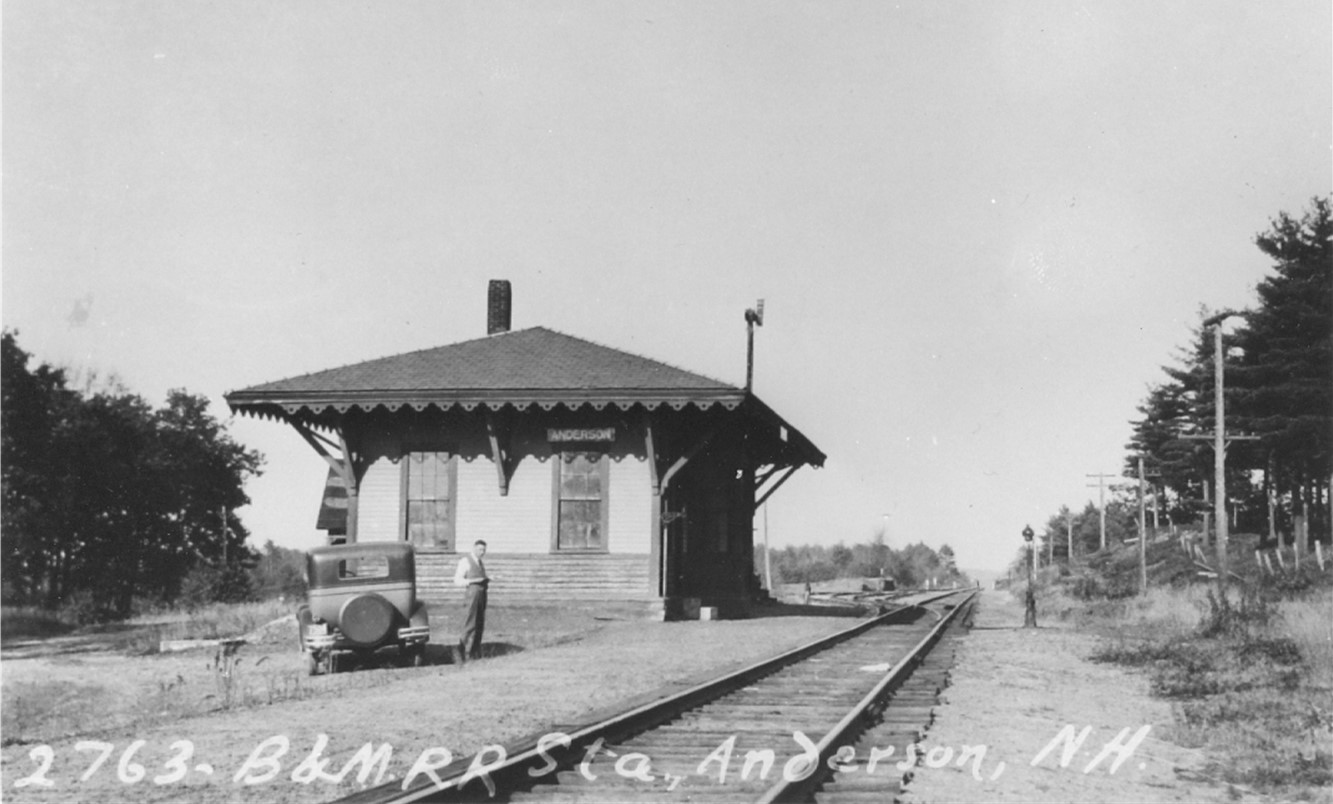
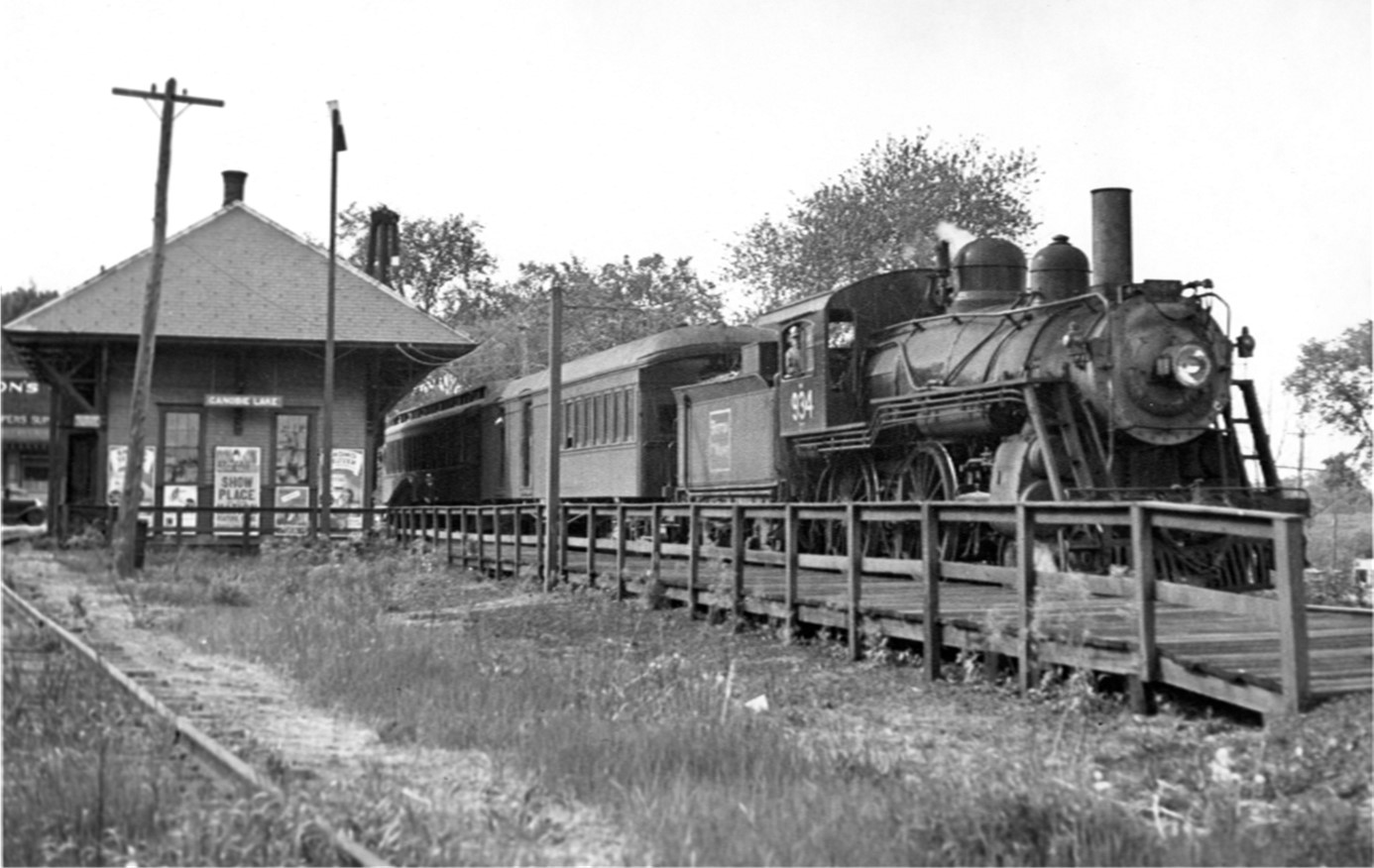
These interesting photographs show the railroad system in Windham just before the discontinuance of passenger rail service by the B&M Railroad in the 1930’s. If you’ve walked on the Windham rail trail you will recognize the top two photographs of Windham Junction. Below left is the station in West Windham which became Anderson Station. It was a originally a station house for the Nashua and Rochester Railroad, which crossed the Boston and Maine Railroad at Windham Junction. Bottom right is Canobie Lake Station. The nemesis that slew the railroads is pictured in the form of the automobile being used by the surveyor for the Boston and Maine Railroad.
Crossing of the B&M and former Nashua and Rochester RailroadWest Windham Station was renamed Anderson to prevent accidents caused by the”2″ Windham StationsCanobie Lake Station on the Windham-Salem town line.
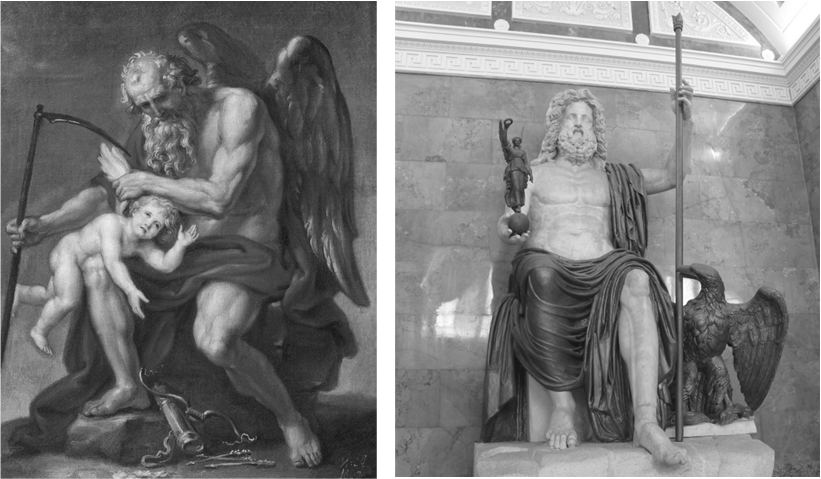
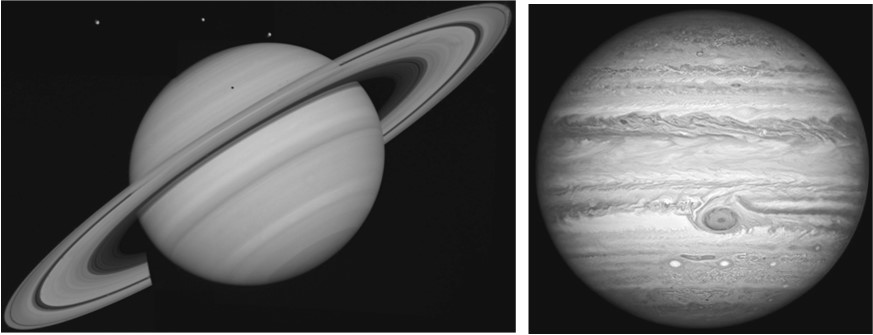
Jupiter and Saturn. Saturn is shown with his sickle eating his child is the basis of the grim reaper. Notice how he appears more of a “fallen angel or watcher rather than a God. That is because he was a Watcher who brought forth the Titans, the Giants of old. Jupiter with eagle & lightning who overthrew Saturn. He represents the new age which will dawn at zero degree Aquarius on 12-21-2020. Their planet namesakes with meet to confront each other again in the night sky of 12-21-20. They are pole opposites in terms of their natures as reflected in the inversion of 12 and 21 in the date of the conjunction.
The Great Convergence of Jupiter and Saturn 122120
Well, to be honest, I’m always on the look out for bad juju and maleficent forces heading our way. It’s a bad habit I picked up when I was very young, when people like Hal Lindsey, and other fear mongering “pseudo-prophets” were running loose during the 1970’s saying the “End Times” were right around the corner. By now you have heard the buzz about “The Great Conjunction of Saturn and Jupiter” on the Winter Solstice, December 21, 2020. It is truly an incredible portent in the night sky which will have the appearance of Saturn and Jupiter merging as one. These two giant planets will be leaving Capricorn, the goat, the SNL Church Lady’s foil; the symbol for the Maleficent One himself and dawn in Aquarius. The conjunction will take place at 0 degree Aquarius. Is this the same dawning of Aquarius made famous by the Fifth Dimension in March of 1969? Maybe this is a good sign? “A common position expressed by many astrologers sees the Age of Aquarius as that time when humanity takes control of the Earth and its own destiny as its rightful heritage, with the destiny of humanity being the revelation of truth and the expansion of consciousness, (transhumanism?) and that some people will experience mental enlightenment in advance of others and therefore be recognized as the new leaders in the world.” Wikipedia. ( I wonder what will happen to the laggards?)
This is the description from EarthSky.org: “Jupiter and Saturn are closing in on their great conjunction on the day of the solstice, December 21, 2020. At their closest, they’ll be only 0.1 degrees apart. They’re already amazing! Start watching them now. Astronomers use the word conjunction to describe meetings of planets and other objects on our sky’s dome. They use the term great conjunction to describe meetings of the two biggest worlds in our solar system, mighty Jupiter and the glorious ringed planet Saturn. The next great conjunction of Jupiter and Saturn will be on the day of the solstice: December 21, 2020. Jupiter-Saturn conjunctions happen every 20 years; the last one was in the year 2000. But these conjunctions aren’t all created equal. The 2020 great conjunction of Jupiter and Saturn will be the closest since 1623 and the closest observable since 1226! On December 21, 2020, Jupiter and Saturn will be only 0.1 degree apart. Some say the pair will look like an “elongated star” on that date.”
“You’d have to go all the way back to just before dawn on March 4, 1226, to see a closer alignment between these objects visible in the night sky,” Patrick Hartigan, an astronomer at Rice University, explained in a statement last month. There’s still another holiday connection at work here, beyond a simple coincidence of timing. Some astronomers, dating back to Johannes Kepler in the 17th century, have conjectured that the Star of Bethlehem that guided the three wise men to Jesus Christ’s birthplace in the Bible was a conjunction like the one set to appear later this month — although likely one involving different planets. Saturn and Jupiter began appearing close to each other this past summer, but this spectacle of proximity will be clearest beginning in mid-December. Look for them low in the southwest in the hour after sunset. And on December 21st, the two giant planets will appear just a tenth of a degree apart — that’s about the thickness of a dime held at arm’s length!” NASA explained earlier this month.” NPR.com
“So Saturn (Cronus) in Greco-Roman mythology was the son of Uranus and Gaea. He lead his brothers and sisters, “the Titans,” in rebellion against their father who Saturn had castrated and killed. Saturn then became the king of the gods and married the Titan Rhea. Saturn was a ‘jealous god” and he especially feared and hated his children. In order to prevent them from doing what he had done to his own father, he ate his children as soon as they were born. Saturn (Cronos) is usually pictured with a sickle in his hand and often represents time and death.
Astrological Saturn has always been associated with the law. “Gnostics have identified Saturn with the God of Early Scripture, whom they regarded as a tyrannical father, obsessed with rigid enforcement of the law. There is a symbolic link between Saturn…through the use of Saturday; Saturn’s Day…” Saturn’s function is contraction, which gives Saturn (called since ancient times “The Greater Malefic”) (causing or capable of causing harm or destruction, especially by supernatural means), a somewhat polarized role against Jupiter (called “The Greater Benefic”) (beneficent or kindly), in astrology. In Vedic astrology Saturn and Jupiter are considered natural neutrals, but under closer relations become enemies….Similarly, Saturn is considered cold (slow) and dry (separate) whereas Jupiter is considered warm (speedy) and moist (inclusive). Where there is light Saturn brings darkness, where there is heat Saturn brings cold, where there is joy Saturn brings sadness, where there is life Saturn brings death, where there is luck Saturn brings misfortune (and sometimes heavy consequences for bad judgment or mistakes), where there is unity Saturn brings isolation, where there is knowledge Saturn brings fear, where there is hope Saturn brings skepticism and stalling. However these effects are not always negative. Saturn’s properties of contraction and “crystallization” are said to create solidness in the world and give lasting form to everything physical and principle…”
“In ancient Roman religion and myth, Jupiter or Jove was the king of the gods, and the god of sky and thunder. He is the equivalent of Zeus in the Greek pantheon. Saturn swallowed his children Neptune, Pluto, Ceres, Juno and Vesta. When Ops realized that she was pregnant with Jupiter, she had the baby secretly and moved to Crete, giving a stone wrapped in baby clothes to Saturn for him to eat.Saturn believed he had eaten Jupiter but Jupiter was saved. After Jupiter was raised by his mother, his destiny was to overthrow, Saturn, as revenge for all he had done to his brothers and sisters in the past. When Jupiter grew up, he made Saturn vomit up all of the children he had swallowed. All the brothers and sisters joined forces and overthrew Saturn. Then, with the help of the Cyclopes and the Hundred-handed Giants, they declared war on Saturn and the other Titans. Jupiter finally defeated the Titans and they were imprisoned in Tartarus. Jupiter and his brothers divided the universe into three parts, Jupiter obtaining the heavens, Neptune the sea and Pluto the underworld. This is how Jupiter became the king of the gods.” What will the conjunction of Jupiter and Saturn portend for Earth? Probably nothing, but we’ll soon find out!
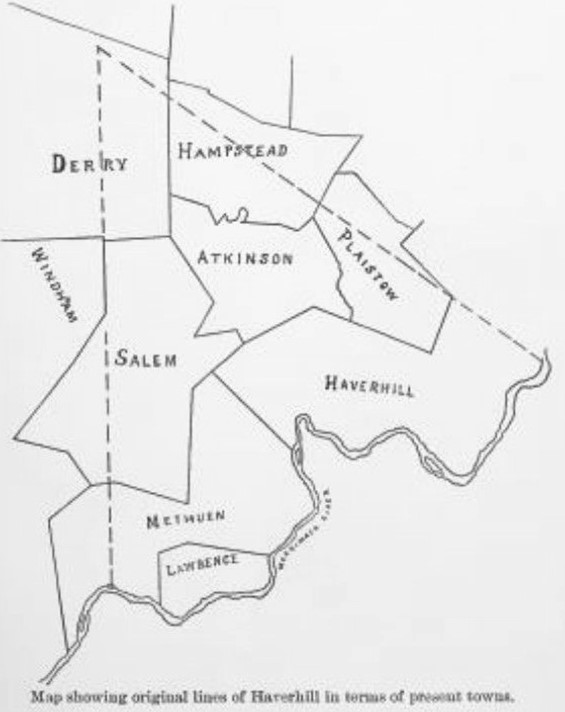
“The location of the Haverhill west boundary is quite perplexing as that of the Dracut north line. G.W. Chase in hist History of Haverhill (1861) devotes much space to the subject, but yet he does not locate the line with any definiteness. Edgar Gilbert in his History of Salem, (1907) on pages 37 and 51 makes it coincident with the old Londonderry line, of which the present boundary of Windham from the Derry line to Hitty Titty Pond is a part, although on page 117 of the same book he shows the Haverhill line as farther west than Londonderry, as it undoubtedly was.”
“We are to remember, first, that this line was intended for and considered a north and south line, and second, that, as laid down on any modern map, it would run a number of degrees west of north. The General Court of 1640 granted the right for a plantation at Pentucket (Haverhill), but did not assign any bounds. Two years later the settlers procured from the Indians a deed to a tract extending eight miles west from Little River, six miles east from the same point, and six north….There is no definite record of the boundaries of the town being laid out until 1666, although as early as 1650 the General Court appointed a committee for the purpose and in 1660 the Court summoned the town ‘to shew a reason why they have marked bound trees at so great a distance from their towne vp Meremacke River, & also to give an account of the bounds of theire towne & upon what right they lay clajme to so long a tract of land.’ ” You have to give those settlers credit as you see the attitude of “go big or go home,” on full display again!
“In 1662, when the grant to Rev. Thomas Cobbet, of Ipswich, Mass., was surveyed, it was described (Massachusetts Colony Records, vol. 4, part 2, p.78) as being located to the westward ‘from a swampe that joynes upon the Hauerill bounds.’ This swamp is believed to be the low ground near the present Searles schoolhouse in this town. In 1669, when Rev. John Higginson, of Salem, Mass., had a grant laid out adjoining Mr. Cobbet’s (ibid., p. 441), a certain tree on the latter’s line was stated to be ‘the aunttient bound marke of Haurills perpendicular ljne.’ In the same description ‘a great pond, formerly called Hauerill Bound Pond’ (later known as Policy Pond and now Canobie Lake) is also mentioned in such a way as to leave no doubt that at some time previous to Mr. Cobbet’s grant the west line of Haverhill had been in some way fixed as to touch this pond and in all probability to cross a portion of it….However, the description of Mr. Higginson’s tract makes it clear that it lay between the pond and the Haverhill line as recognized at that date, 1669, so that we conclude that the line as fixed by the surveyors of 1666 ran wholly east of the pond, but probably not far from it.”
“The interesting record (Higginson’s grant) is in part as follows” ‘The ffarme conteineth seven hundred acres or thereabouts, bounded vpon the east with Hauerill lyne, **** & bounded vpon the south by the land of Mr. Atkinson, to a great pond, formerly called Hauerill Bound pond, & is bounded with a heape of stones & trench at the southeast corner of the pond next to Mr. Atkinson; & is bounded by said pond vpon the west vntill it cometh cleare of the ponds east end, & then rangeth westward by the side of the sajd pond, to the land of Jerimiah Belchar on the west, vntill it comes to the land of Mr. Cobbet, there being **** a white oake tree, marked next to Mr. Cobbet, which white oake was the auntient (ancient) bound marke of Haurills perpendicular line, & thence raingeth east cleere of Mr. Cobbet, & bounded by upon Mr. Cobbets vpon the west, to a stooping white oak tree marked with T C & I H; from thence running northerly to a black oake tree, marked on the north side of a brook, commonly called the western most branch of the Spicket River; **** & from thence it rangeth easterly *** vntil it comes to the Hauerill ljne.’ “ W.S.H.
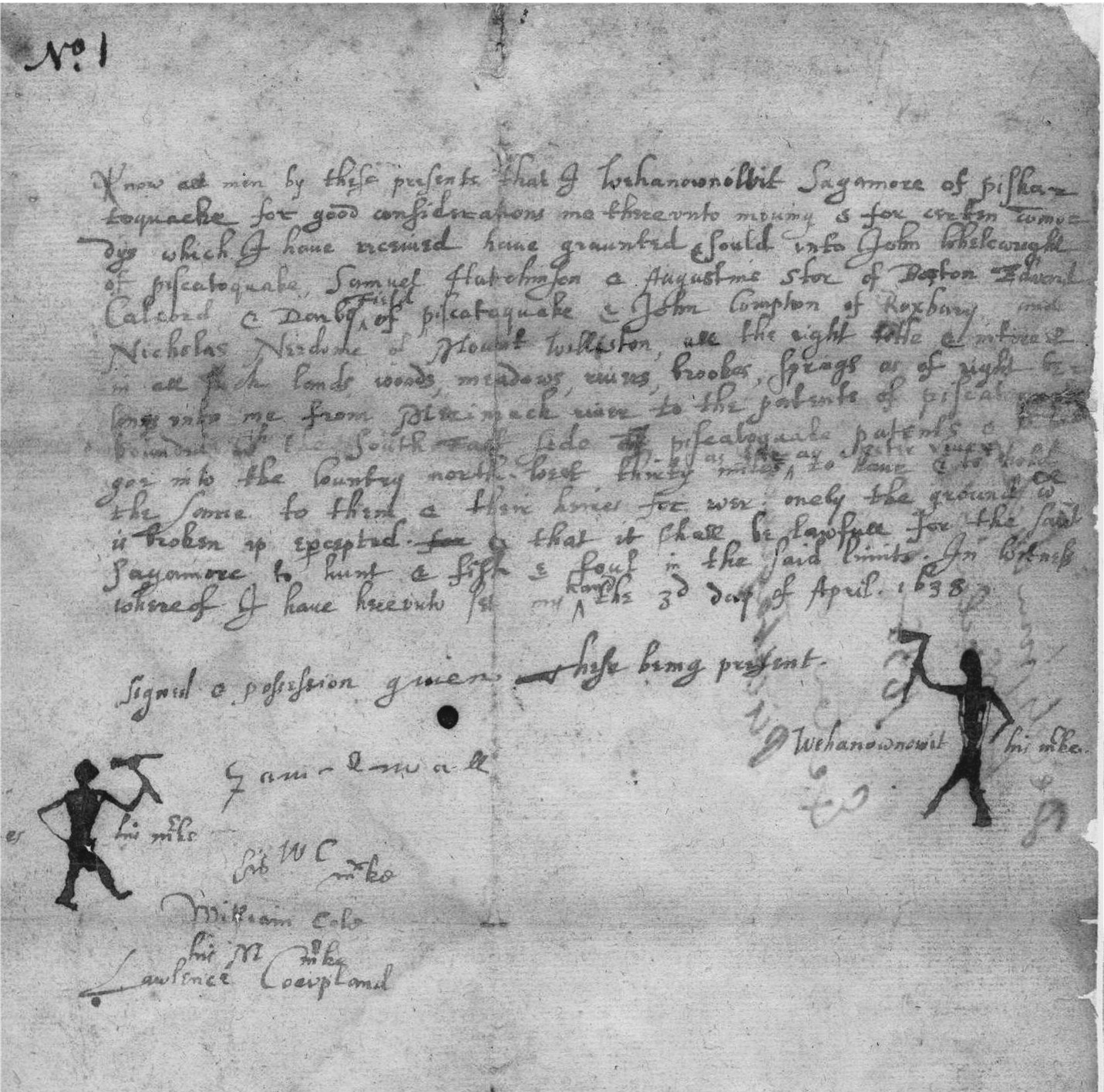
Copy of deed from Sagamore Wehanownowit to John Wheelwright and others of Piscataqua and Boston, April 3, 1638, the original of which is at the Exeter Historical Society. What’s amazing is the English settlers and the Indians actually resided side by side for a number of years. The Selectman passed laws to protect Indian rights and fish weirs.
The Border Dispute – Indian Deeds (V)
The English, being all about the “Rule of Law,” that benefited the English, felt the need to go through the farce of obtaining deeds from the Indians before they settled in the vast areas of New England. They wanted their title in writing, even if the title was spurious, given the fact that the Indians had no concept of private property. The Indian worldview was that no man could ever “own” the earth. While I’m poking fun here, it is also true that English private property rights have made America great. The common man was allowed to own his property in fee simple. This enabled ordinary people in America to thrive by giving them title to the land they labored to improve and on which they lived their lives. It also provided an asset they could pass on to their heirs and the financial means to resist government tyranny.
This is the scrap of paper, signed by a local sachem which gives you title to your property in southern New Hampshire. And it is speculated, that the first Wheelwright deed, previous to this one, was a forgery. What you are looking at is the second Wheelwright deed. All the rights you have to the land under your house derives from this document. In other words, it is the first cause of your chain of title.
According to the New Hampshire Historical Society: “When in November 1637 the Massachusetts General Court forced the Reverend John Wheelwright to leave Boston because of religious differences perceived by leading Puritans as a threat to their authority, he spent the winter, as he described it, “in deep snow in which he might have perished.” NHHS
By spring, he had chosen a location at what is today Exeter for a settlement where he and his followers would be free to practice their religious beliefs. There was no colonial government that could grant them the right to settle there, since the area’s original grantee, John Mason, died in 1635, leaving an heir too young to take charge and no provision for governing the colony. Instead, Wheelwright sought permission to settle from the native inhabitants of the area. On April 3, 1638, the local sagamore (or chief) signed two documents with his mark, deeding a 30-mile-square tract of land to Wheelwright and others, with the exception of the “ground w[hi]ch is broken up” (for planting) and the right to “hunt and fish and foul in the said limites.” (Note that a similar deed from natives to Wheelwright, dated nine years earlier, is generally believed to be fake, though it is known to have existed as early as 1707.) Wehanownowit was the leader of the local native people, known as the Piscataqua. The Puritan minister, Reverend John Wheelwright, emigrated to the Massachusetts Bay Colony in 1636, two years after his sister-in-law Anne Hutchinson followed John Cotton, her minister, to the same location. All three were from Lincolnshire, England, and shared religious beliefs that were questioned by more orthodox religious leaders in Massachusetts. When Wheelwright and Hutchinson were banished from Boston, friends and relatives who had followed them there from England were discouraged by new legislation from staying, and several went to Exeter as well.” Their heresy was belief in “Free Grace Theology.” NHHS
“Although neither of the 1638 deeds gives a location for its signing, it has been assumed that the transaction took place at or near Squamscot Falls at the site soon to become the new settlement. This spot at one of the headwaters of the Piscataqua, where the present-day Exeter River flows into the Squamscot, was a logical place to settle, with its potential for river transportation and trade and its ample water power, lumber, salmon, meadows, and salt marshes. In addition, this area appeared not to be under the control at that point of any larger governing entity. There were already scattered settlers in the area, but Wheelwright is considered the founder of what became Exeter because he established the first church and local government at its site.” NHHS When it comes to Indian deeds, it is a little bit of “go big or go home.” In other words, since the Indians didn’t understand the concept of private property, get them to give you a grant of a huge amount land, thirty miles square, from the Merrimack to the Piscataqua, for a few items of use to them. The Scotch-Irish in the Londonderry area received their land grant from the descendants of Rev. Wheelwright. I’ve heard tell, that after the “Dark Winter” and “Great Reset,” nobody will be allowed to own private property and the earth will be held “in common,” for the benefit of all 6 billion inhabitants. Doesn’t sound like an Indian paradise but more like pure evil.
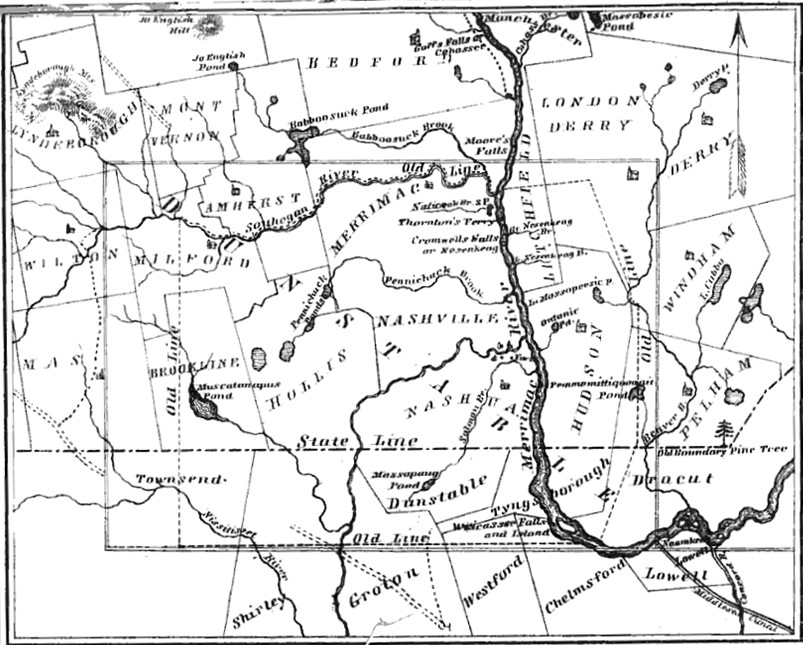
William Harris says that, “When Dunstable was chartered by Massachusetts in 1673, and the boundaries surveyed the next year, the northeast corner was a ‘pine tree marked F standing within sight of Beaver Brook.’ From the corner the line ran a little west of south to near Jeremy’s Hill in Pelham and on to the Merrimack River. This probably cut across what is now Windham.”
“When Dracut was incorporated in February, 1701-2, its eastern boundary was described as running from a point on the Merrimack River ‘due north six miles,’ then by a northwest line, described as four miles long, it ‘closet to the Dunstable line” at the pine tree bound already mentioned, thence following the Dunstable line southward about four miles.”
“This pine tree bound forming the Dunstable-Dracut corner is located by Kimball Webster in his history of Hudson (pp. 145,154) as being on the northward side of Beaver Brook about 112 rods down the brook from the present eastern point of Hudson, and a short distance above the spot where the Worcester, Nashua and Rochester Railroad crosses the brook.”
“In December, 1722, the Dracut selectman perambulated their north line across what had been eleven years before incorporated as Londonderry and which was destined about eight years later to become Windham. They evidently did not intend to give up their claim to a strip of land a mile and a half wide and four miles long, liberal measure, which their original bounds included, and which they would have retained if the king had decided to run the province line straight west from its beginning at the ocean.”
“Morrison’s History of Windham does not mention the fact that the southern part of town formed uncontestably for a score of years (1702 to 1722) a portion of the territory of Dracut, and was claimed by them still longer. The Dracut line crossed some natural features which it is possible to identify, so that it can be quite accurately traced.”
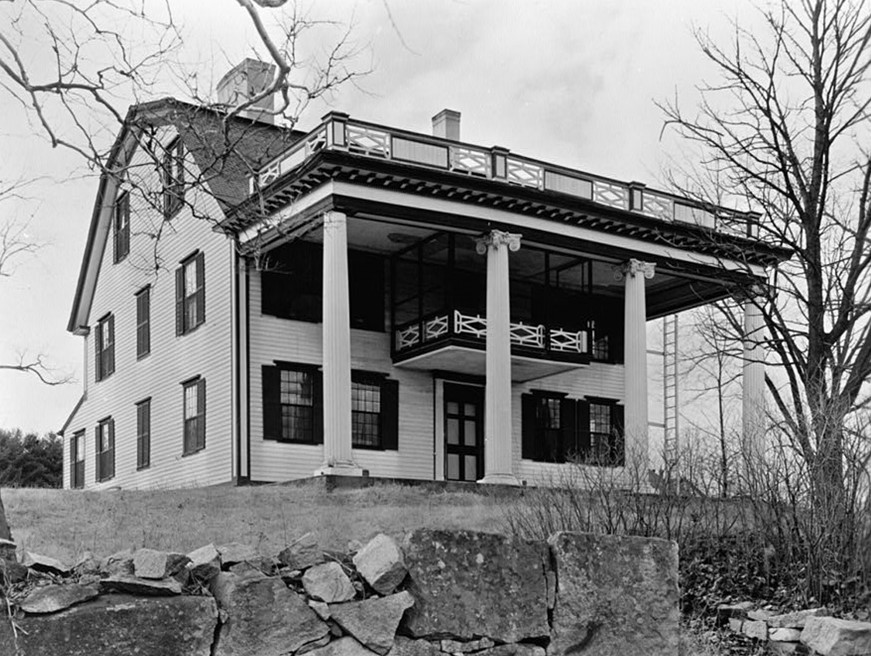
The Tyng Mansion, built before 1675 by Colonel Jonathan Tyng, sat along the western banks of the Merrimack River.
The northeast corner of old Dracut does not appear to have been marked by any special feature, but it is stated by local historians that the present boundary between Dracut and Methuen is a part of the original line, so that by extending it and drawing this old north line of Dracut it is easy to see about where the corner must have been— near Spear Hill and not far west of the south end of Canobie Lake. In a petition of 1742, given in Edgar Gilbert’s History of Salem (p.98) this language is used: ‘So running by said pond (Policy) to the southwest part then by Dracut line,’ etc., indicating that Dracut line came near the end of the pond.”
“The Dracut-Methuen line on any modern map runs a good many degrees west of ‘due north,’ and moreover it is much more than six miles to the supposed corner and it is more than four from there to the Dunstable-Dracut corner. The first fact is explained by supposing that the surveyors of those days ran by the compass needle without making any corrections for declination. There is a record of a survey in 1674, quoted in B. Chase’s History of Chester (p. 11) which says, ‘We ran due northwest according to the compass, not allowing any variations,’ etc. The magnetic declination at present is about 13 degrees west. What it was two hundred years ago I do not know, but all the old lines described as due north and south or east and west vary greatly from these positions when laid down on a modern map.”
“The overrunning of the measure was also a characteristic of the early surveys. Land being abundant and the surface uneven, they did not intend their measure to fall short. There is an intimation in the History of Chester (p.30) that it was customary to allow 11 chains for 10, and Rev. J.G. McMurphy in Early Londonderry Records (Vol. 2, p. XVII) says it was the practice when advancing the chain to place the pin forward as far as one could reach, thus gaining about six feet on every chain-length.”
The record of the perambulation of the Dracut north line in December 1733, is found in the Dracut town records, (vol. 1, p. 285,) its significant features are that proceeding towards the northwest, the line crosses in succession ‘Goldings pond otherwise called Cobets pond,’ south of its outlet; ‘Goldings brook’ the outlet; ‘Drye pond,’ and ‘Tyngs meadow.’ The identification of the last two localities has been the result of considerable study.”




 Windham NH History