Windham Life and Times – December 28, 2018

Windham and the Summit

Passengers arrive on the Cog Railway at the Summit House

Part 3 – Mattie Clark Remembered in Windham

In spite of spending most of her grown life travelling between Ormond Florida and the Summit of Mount Washington, Mattie Clark remained connected to Windham throughout her life. She grew up here on her  parents farm here and her exploits were written about by Will Harris in the Exeter Newsletter.

WINDHAM, August 25, 1899: “Miss Mattie A. Clark of this town holds the responsible position of manager and housekeeper of the Summit House on Mount Washington. Among the Clouds thus speaks of her in a recent issue: ‘Miss Mattie A. Clark, who first became connected with the Summit House in 1884, and who has so successfully managed it for several years past, is the manager this year, and that is saying quite enough to assure the Summit visitors of first class treatment. Both here and in Ormond Florida, where she is superintending housekeeper, Miss Clark has the most enviable reputation, and is known as one of the most capable woman hotel managers in the country.’ ”

October 11, 1900: “Miss Mattie A. Clark, the efficient manager of the Summit House on Mt Washington, is at home to remain until December, when she goes to Florida for the winter season at the Hotel Ormond where she is housekeeper.”

WINDHAM, April 21, 1903: “Mrs. Deborah E. Clark, 77 years of age, had a paralytic shock some days ago, and remains quite feeble. Her daughter, Miss Mattie B. Clark, well known as a hotel manager at the White Mountains and in Florida, came home from Florida as soon as the news of her mother’s illness reached her.”

July 8th, 1903 Clarke Funeral:

“For the first time in many years Miss Mattie A. Clarke has failed to be in attendance at the opening of  the Summit House to greet the visitors to whom she is so pleasantly known. After returning from Ormond, Fla., in the spring, Miss Clarke was detained at the bedside of  her mother, Mrs. Deborah Elizabeth Clarke, who after many weeks of  suffering died on Monday, July 6, aged 77 years. The funeral was held Wednesday at her late home at Windham Depot, N.H.  Mrs. Clarke was a bright and lovable woman, of  a most kind and motherly disposition. Besides Miss Clarke, her only other child was a son, who died in the Civil War. Her whole life was spent in Windham, and the family homestead was a welcome resting place for the daughter in the intervals between her summers on Mount Washington and her winters in Florida. Miss Clarke has the sympathy of her many friends, who hope in a few days to welcome her back to the Summit.” Among the Clouds

     Season Opening Notes: “The Mount Washington Railway, which sent its first train to the Summit this year the week of  June 15th, retains in its service nearly the entire personnel of  last season’s employees….An old guest at the Summit House will note but few changes here this season. The same homelike atmosphere pervades the whole establishment, and that the former excellence of  its service will be maintained this year is assured by the presence of  so many of  the heads of  departments of  long continued service. Miss Mattie A. Clarke, whose attention to visitors makes them to feel that they are personal guests, is still manager of  the house, with Mr. A. Frank Curtis as clerk. The cuisine will be prepared by Mr. A. J. Miller, the accomplished chef  of  1904, and Mrs. George Howland. Mrs. Myron Browley assists at the souvenir stand, Mr. Maurice J. Dineen is in charge of  the telegraph and post office, Mr. Park Horan of  the wine room, and Mr. Mark A. Davis of  Middlebury, Vt., fills the position of  head waiter, and James Powers, watchman. Nor should mention be omitted of  John Tice, bellman, who for several years has been an alert messenger upon the arrival of  each train…All in all, each and every details of  the hotel management has already received such careful attention that it is difficult to realize only a few days have intervened since the arrival of  the first train to the Summit, and that so much could be accomplished against such great odds of  location and climate.”

– Among the Clouds – Thu, Jul 13, 1905


Windham Life and Times – December 21, 2018

Windham and the Summit

A June Snowstorm Brings Christmas to the Summit. Among the Clouds, July 13, 1905.

Part 2 – June Christmas

Summit House Opens: “The formal opening of  every hotel is an important date in its calendar, and often the management endeavor to introduce some special attraction for the pleasure of  those guests first to arrive. Mount Washington – always zealous of  its individuality, this season outdid itself.”

“The Summit House was ‘opened,’ Monday, June 26th. The morning was rainy and dense clouds obscured the slightest vision of  the outside world. There was wisdom in this arrangement, for it was not the scenery but the completeness of  the hotel that was to be made manifest that day. The thermometer, which registered 46 in the morning, having heard a student waiter reciting “What is so rare as a day in June” was not forgetful of  its part of  the program and toward noon settled slowly to 38, and at 4 o’clock gave a decided novelty by sinking below the freezing point. Immediately the torrents of  rain became a driving snow storm, and throughout the night and Tuesday and until late Wednesday (6/29) Mount Washington was in the clutches of  a winter tempest, at time the roaring of  the wind and the beating of  ice and hail against the summit House was almost deafening. But within all was good cheer and comfort. “Dolly” the boiler was never more faithful, and steam whizzed through the pipes assuredly and without cessation, while the huge coal stores performed nobly the extra service required of  them. But those were days to be remembered, and the few guests who braved the mountain will not soon forget their experiences. After all, it is not the weather that decides the amount of  pleasure to be had in a visit to Mount Washington. ‘For the dissatisfied man all life is unsatisfactory, and for one that is contented the world is full of comforts, and for the cheerful man even the easterly wind is musical in the window crevices.’ ”

—Among the Clouds – Thu, Jul 13, 1905

“A June Christmas Tree: ‘On Wednesday evening, June 28th, the Summit House colony indulged in festivities unique in the history of  Mount Washington. The platforms that morning covered with snow and the whole cone of  the mountain glistening with frost work and ice suggested midwinter rather than a rare June day. Someone remarked that ‘it would be proper to observe Christmas.’ The idea was a popular one and immediately following breakfast preparations were continued throughout the day for an unusual festival. The manager of  the hotel, Miss Mattie A. Clarke, ordered a fir tree brought up from the Base, which through the kindness of  the Mount Pleasant House was later made attractive by many festoons of  pop corn. Then came the search for gifts. There were about thirty-five employees of  the Summit House and Mount Washington Railway to be remembered. Trunks, boxes, even coat pockets were divested of  their treasures and by nightfall the tree was overloaded with offerings. Nearly 150 presents were ready for distribution. What they may have lacked in value was made up in quantity. About 8 o’clock the parlor doors were opened. Mr. John Tice presided at the piano and a merry company was soon seated. Hardly had an exchange of  greetings been made when Mount Washington’s Santa Claus, Mr. Ed Colter, costumed in a style to make St. Nick himself  envious appeared on the scene to the  delight of  everyone save Leon (the Summit dog), whose association with the genial gentleman had heretofore been confined to an almanac interpretation of  seasons. Among the Clouds at this date not having commended an issue, one of  the staff  presented the initial number of  a possible evening addition for midwinter circulation “Among the Snow Flakes.” Next Santa ably assisted by Mark Lee, distributed the presents, a description of  which would be impossible. Then followed an excellent musical program, including solos by Mr. Chandler and Mr. Horan, and a chorus selected from the company. While the storm was furious, and together with the freezing temperature made all without wild and terrible, this little Summit House party – warm and comfortable, were living the sentiment of  Dr. Van Dyke ‘and best of  all along the way is friendship and mirth.’ ” —Among the Clouds July 13, 1905

Remember, we’re looking for a photograph of Mattie Clark for Tim Lewis. Does anyone know of one?


Windham Life and Times – December 14, 2018

Windham and the Summit

Mattie Clark Part 1

The “Old” Summit House that Mattie Clark from Windham, managed for many years.

Can you imagine a time when visitors could take the Cog Railway to the summit of Mount Washington, take in all the spectacular scenery and most extreme weather conditions, and enjoy it all while staying in well appointed accommodations there. Such was the world of the Summit House, a popular hotel that graced the summit of Mount Washington from 1873 until it was destroyed by fire in 1908.

For many years, a Windham native, was at the very center of this enterprise and was the popular manager of this well loved landmark. Miss Mattie Clark began working at the Summit House starting in 1884. Prior to that she had worked for the Profile House. When the hotel was destroyed the proprietors began providing accommodations in the rustic, stone, Tip-Top House, with Mattie Clark as manager. Finally, when the New Summit House was built in 1915 she again was put in charge. In the winter, she was employed by the Ormond Hotel in Florida, whose owner credited her with much of its success.

Miss Clark was a remarkable woman for the time; independent, and highly skilled, who died with a very sizable estate.  William Harris in the Exeter Newsletter of August 25, 1899 says, “Miss Mattie A. Clark of this town holds the responsible position of manager and housekeeper of the Summit House on Mount Washington. Among the Clouds thus speaks of her in a recent issue: ‘Miss Mattie A. Clark, who first became connected with the Summit House in 1884, and who has so successfully managed if for several years past, is the manager this year, and that is saying quite enough to assure the Summit visitors of first class treatment. Both here and in Ormand Florida, where she is superintending housekeeper, Miss Clark has made the most enviable reputation, and is known as one of the most capable woman hotel managers in the country.’ ”

My interest in Mattie Clark and Mount Washington was rekindled by Tim Lewis, who has done a remarkable job chronicling the exploits of the men and woman who worked on the Cog Railway, and on and around Mount Washington. He is doing additional research and he recently wrote me because he is looking for a photograph of Mattie Clark, so that he can put a face to the well known name. Much of what is presented here came from his incredibly in depth research.

“Putting a hotel on top of Mount Washington was no easy task. A casual observer would speak of  the Summit House as a three story wooden structure, with accommodations for one hundred and fifty guests. Were he of  an inquiring disposition he would learn that it is built in the most substantial manner possible, of  huge timbers bound by iron bolts, enabling it to withstand the fiercest storms of  winter, that the main building cost $56,599.57, not including freightage; that the lumber and materials, 250 train loads, used in its construction weighed 596 tons; that the thirty-three carpenters employed upon it, handicapped by storms, erected the frame and accomplished its ‘boarding in’ only after many delays – at one time able to work but one-half  day during a storm which lasted nine; that it was first opened to the public in 1873, and numerous other facts of  greater or lesser interest. It is said that transportation facilities are such that 10,000,000 people could breakfast at home and reach the White Mountains before retiring. To you one and all the Among the Clouds sends greetings, urging you to visit Mount Washington and learn for yourselves just what enthusiasm that writer felt who told of  a ‘warmest welcome in an inn.’ ”

Among the Clouds – Sat, Aug 13, 1904

Martha A. “Mattie” Clark was the middle child of  three born February 11, 1852 to Joseph S. and Deborah Armstrong Clark in Windham, New Hampshire. Mattie’s parents were Joseph-Scoby Clark and Deborah Elizabeth Armstrong the daughter of Joseph Armstrong. They lived on the Archibald farm in Windham. Mattie’s only sibling who lived to adulthood was a brother, Burnham who was born October 16, 1849 and who died fighting in the Civil War,  March 22, 1865.

Hopefully someone who reads this may have a photograph of Mattie Clark for Tim Lewis.


Windham Life and Times – November 30, 2018

Just for Fun!

The Derry Fairy

You’ll be glad to know that this is the last time I will be writing about fairies, however, I could not leave the subject without relating the story of the “Derry fairy.” If you’re ever looking for a fun book, check our Weird New England, by Joseph Citro, which is loaded with weird tales of the supernatural and the just plain strange. Before moving on to the Derry fairy, I have to confess about a story of alien abduction that terrified me as a child. This was especially true, since I once observed a UFO, moving straight up into the sky from Sandy’s Bowling Alley parking lot.  In evaluating the story of the Derry fairy, you have to wonder if it was really an alien siting of some kind.

Betty and Barney Hill with their dog Delsey.

Betty and Barney Hill were a couple that claimed they were abducted by aliens while travelling in the White Mountains, on September 20, 1961. Their ordeal was recorded in John Fuller’s best selling book, The Interrupted Journey, Two Lost Hours Aboard a Flying Saucer (1965). Theirs was the first widely reported case of alien abduction in the United States. The Hills lived in Portsmouth NH where he worked for the postal service and she was a social worker.

The Hills were returning from a vacation in Niagara Falls when they saw a bright light in the sky on Route 3 in Twin Mountain, so they stopped the car to take a closer look and to walk their dog. Betty looking through binoculars saw an odd shaped craft with flashing lights. The Hills returned to the road and as they travelled slowly through Franconia Notch near the Old Man of the Mountain they saw that the craft was moving closer. Then it was hovering 80 to 100 feet over the Hill’s 1957 Chevrolet Bel Air causing Barney to stop the car in the middle of the highway.  As they tried to escape, they heard buzzing noises which put them in a altered state of consciousness. They travelled nearly 30 miles but had no recollection of doing so. They made a sudden unplanned turned and their path was blocked by a fiery orb. They arrived at their home around dawn and started to experience odd impulses and sensations. There were shiny concentric circles on the car’s trunk that gave off magnetic pulses. Betty began to have vivid dreams of the encounter where the details of the abduction became known. They also described that they had experienced missing time. Under hypnosis, they remembered the encounter and how they were brought aboard the craft and physically examined by the aliens.

Descriptions of “little green men” date back to the twelfth century in the Green Children of the Woolpit. In 1899, there was a story published in the Atlanta Constitution about a little green skinned alien in a tale called the Green Boy from Hurrah. The first reference of little green men being extraterrestrials is found in the Daily Kennebec Journal in 1910 where they were described as Martians. “Green aliens soon came to commonly portray extraterrestrials and adorned the covers of many of the 1920’s to 1950’s pulp fiction magazines with pictures of Buck Rogers and Flash Gordon battling green monsters.”

This is what we know about the Derry fairy, according to Joseph Citro: “Perhaps the crowned king of ugliness was a bewildering little gargoyle spotted in Derry, New Hampshire on December 15, 1956. A man was harvesting  Christmas trees in the woods when suddenly he looked up and saw something looking back at him silently. Whatever it was stood about two feet tall, and seemed neither human nor animal. Its green skin was wrinkled and looked like the folds of elephant hide. The high dome of his head supported floppy ears comparable to those of a bloodhound. Tiny holes bred into the skull where the nose should be, and its eyes were covered with what appeared to be a protective film. Its arms and legs were short, ending with stump hands and toeless feet” The witness was “Alfred Horne who lived on Berry Road in Derry in the 1940’s and 1950’s. He says he watched the miniature mystery for a good twenty minutes. Then, realizing no one would believe his odd tale, he decided to capture it as proof. When he lunged at the creature, it let out a terrifying screeching that the witness, rather than the beast, ran away in fear.” If you would like to learn more about the Derry fairy, you can watch the 30 minute video produced by GreyStar Paranormal Institute. It features the Derry historian Richard Holmes, as well as, a paranormal investigation in the woods.

So do you think Mr. Horne fabricated the story? Well, in 1981, a creature, almost identical to the one described by Alfred Horne, was spotted by five boys in Arnold Pennsylvania. One of the boys named Chris tried to capture it but it escaped. There was a full police investigation and all of the boys stories and descriptions matched exactly. Fate Magazine, published a story about the incident in May of 1982. It was entitled The Little Green Man Who Got Away.


Windham Life and Times – November 23, 2018

Whittier Homestead Haverhill MA

Well, as I’ve researched this subject, I have felt like I was on Mr. Toad’s Wild Ride, and its appropriate that I now come full circle back to the beginning. John Greenleaf Whittier was a poet and author who lived in the nearby town of Haverhill. He is one of the most important observers of early 19th century New England and it inhabitants. He broke from the Puritan’s ideals, seeing them as dull and gray while exhibiting a grimness of which he had no desire to be associated. He like Thoreau, rejected the emphasis on the pursuit of heaven and saw the incredible richness and beauty of natural world at hand.

It is from Whittier that we have the best glimpse of the Scotch-Irish and their way of life in southern New Hampshire. In fact, his first poem was published in Robert Dinsmoor’s book of poetry. He was also a keen observer of the Native American and saw them as a lost people who once had inhabited the natural Eden of America.  Therefore, it was incredible to find, in his Prose Works, Volume II, a chapter about New England fairies, entitled, Charms and Fairy Faith.


Up the airy mountain,

Down the rushy glen,

We dare not go a hunting

For fear of little men.

Wee folk, good folk,

Trooping all together;

Green jacket, red cap,

Gray cock’s feather.”  ALLINGHAM


“…In our cities and large towns children nowadays pass through the opening acts of life’s marvelous drama with as little manifestation of wonder and surprise as the Indian does through the streets of a civilized city which he has entered for the first time. Yet nature sooner or later vindicates her mysteries; voices from the unseen penetrate the din of civilization….”

“But in the green valley of rural New England there are children yet; boys and girls are still to be found not quite overtaken by the march of the mind. There, too, are huskings, and apple bees, and quilting parties, and huge old fireplaces piled with crackling walnut, flinging its rosy light over happy countenances of youth and scarcely less happy age. If it be true according to Cornelius Agrippa, ‘a wood fire doth drive away dark spirits,’ it is nevertheless, also true that around it the simple superstitions of our ancestors still love to linger; and there the half-sportful, half-serious charms of which I have spoken are oftenest resorted to…”

“Fairy faith is, we may safely say, now dead everywhere,—buried, indeed,—for the mad painter Blake saw the funeral of the last of  the little people, and an irreverent English bishop has sung their requiem. It never had much hold upon the Yankee mind, our superstitions being mostly of the sterner and less poetical kind. The Irish Presbyterians who settled New Hampshire about the year 1720 brought indeed with them, among other strange matters, potatoes and fairies; but while the former took root and flourished among us, the latter died out, after lingering a few years in a very melancholy and disconsolate way, looking back to their green turf dances, moonlight revels, and cheerful nestling around the shealing fires of Ireland. The last that has been heard of them was some forty or fifty years ago in a tavern house in S——, New Hampshire…”

“It is a curious fact that the Indians had some notion of a race of beings corresponding in many respects to the English fairies. Schoolcraft describes them as small creatures in human shape, inhabiting rocks, crags, and romantic dells, and delighting especially in points of land jutting into lakes and rivers and which were covered with pine trees,  (The exact description of the dwelling place of Tsiennetto.) They were called Puckweedjinees, —little vanishers.”

“In a poetical point of view it is regretted that our ancestors did not think it worth their while to hand down to us more of the simple and beautiful traditions and beliefs of the ‘heathen round about’ them. Some hints of them we glean from the writings of the missionary Mayhew and the curious little book of Roger Williams. Especially would one like to know more of that domestic demon, Wetuomanit, who presided over household affairs, assisted the young squaw in her first essay at wigwam-keeping, gave timely note of danger, and kept evil spirits at a distance—a kind of new-world brownie, gentle and useful…”

“Not far from my place of residence are ruins of a mill, in a narrow ravine fringed with trees. Some forty years ago the mill was supposed to be haunted; and horse-shoes, in consequence, were nailed over its doors. One worthy man, whose business lay beyond the mill, was afraid to pass by it alone; and his wife, who was less fearful of supernatural annoyance, used to accompany him. The little old white-coated miller, who there ground corn and wheat for his neighbors, whenever he made a particularly early visit to his mill, used to hear it in full operation,—the water-wheel dashing bravely, and the old rickety building clattering to the jar of stones. Yet the moment his hand touched the latch or his foot the threshold all was hushed save the melancholy drip of water from the dam or the low gurgle of the small stream eddying amidst the willow roots and mossy stones in the ravine below.”

“… The strange facts of natural history, and sweet mysteries of flowers and forests, and hills and waters, will profitably take the place of the fairy lore of the past, and poetry and romance still hold their accustomed seats of the circle of home, without bringing them the evil spirits of credulity and untruth. Truth should be the first lesson of the child and the last aspiration of manhood…”

In an odd coincidence, I had decided to write about Whittier last week, and this weekend I had a need to travel to Newton NH. My navigation took me through an obscure corner of Haverhill, that I’ve never been to before, on the New Hampshire border, and low and behold, there was the Whittier homestead.


Windham Life and Times – November 16, 2018

Fairy Homes

Souterrain, Bushmills, ‘Wee Folks Cove’ – a view of an underground entrance with a boy at the mouth for scale. (Northern Ireland: County Antrim: Bushmills).

Fairy Homes in Northern Ireland Tradition

I found an interesting e-book online available for free with Project Gutenberg titled, Ulster Folklore, written by Elizabeth Andrews in 1913. In it there were many examples of the fairy beliefs in Northern Ireland. It seems that these legends arose out of some distant cultural memory of the people in Scotland and Ireland. “As you will see in the following pages, traditions record several small races in Ulster: the Grogachs, who are closely allied with the fairies, and also to the Scotch and English Brownies; the short Danes, whom I am inclined to identify with the Tuatha de Danann; the Pechts or Picts; and also the small Finns. My belief is that all these, including the fairies, represent primitive races of mankind, and the stories of woman, children, and men being carried off by the fairies, we have a record of warfare, when stealthy raids were made and captives brought to the dark souterrians. These souterrains, or as the country people call them, ‘coves,’ are very numerous. They are underground structures, built of rough stones without mortar, and roofed with large flat slabs.”

“As a rule, although the fairies are regarded as ‘fallen angels,’ they are said to be kind to the poor, and to possess many good qualities. ‘It was better for the land before they went away’ is an expression I have heard more than once… Much of the primitive belief has gathered around the fairy—we have the fairy well and fairy thorn. It is said that fairies can make themselves so small that they can creep through keyholes, and they are generally invisible to ordinary mortals.”

Mrs. Andrews goes on, “We have seen that fairies are believed to inhabit souterrains; they are also said to live in certain hills, and in forts where, so far as known, no underground structures exists. I may mention as an example the large fort on the Shimna River, near Newcastle, where I was told their music was often heard…”

Souterrain, Ballymagreehan, Castlewellan – a view of an underground entrance with a lady beside it. (Location: Northern Ireland: County Down: Castlewellan).

A “Wee Folk Cove?” on Beacon Hill Road in Windham

“The tradition in regard to both Danes and fairies are very similar in different parts of Ireland. In the County Cavan the country people spoke of beautiful music of the fairies and told me of their living in a fort near Lough Oughter. One woman said they were sometimes called Ganelochs, and were about the size of children, and an old man described them as little people about one or two feet high, riding on small horses. A terrible story, showing how the fairies punish their captives, was told to me by and old woman at Armoy, in County Antrim, who vouched for it being ‘candid truth.’ A man’s wife was carried away by fairies; he married again, but one night his first wife met him, told him where she was, and besought him to release her, saying that if he would do so she would leave that part of the country and not trouble him any more. She begged him, however, not to make the attempt unless he was confident he could carry it out, as if he failed she would die a terrible death. He promised to save her, and she told him to watch at midnight, when she would be riding past the house with the fairies; she would put her hand in at the window, and he must grasp it and hold it tight. He did as she bade him, and although the fairies pulled hard, he had nearly saved her, when his second wife saw what was going on, and tore his hand away. The poor woman was dragged off, and across the fields he heard her piercing cries, and saw next morning the drops of blood where the fairies had murdered her.” (Good qualities?)

Stone megalithic structures exist spread across all of New England, one of the most famous being Mystery Hill in Salem. They are very much in the same form and style of construction as found in Ireland. I have a book in my collection entitled, The Ruins of Greater Ireland in New England, by William B. Goodwin. It posits the theory that whatever race built the stone structures in Ireland also built the structures found in New England. It is curious that these structure have such small openings. Certainly when the Scotch-Irish arrived from Northern Ireland they must have recognized them as being the same type structures as they had back home and would ascribe to them the same fairy legends.  The openings are just the right size for the “wee folk.” You might ask me to explain how the giant slabs of granite were put in place by such little people and I would answer, “They were gifted in magic and descended from fallen angels.” Certainly their inheritance included the power to lift such heavy stone slabs.


Windham Life and Times – November 9, 2018

New England Fairies

Native American and Northern Irish Traditions

Maura Dionne’s horseshoe found in her yard in Windham.

So, for all of you folks who think that all of this business about fairies and other supernatural occurrences is nonsense and superstition, listen up. I had a nice note from Maura Dionne who lives near Haskell Pond, right here in Windham. She was in her yard planting spring bulbs. As she turned the soil and dug the holes her shovel hit something metallic, so she continued to dig it up. To her surprise, she found a horseshoe buried there.  While that doesn’t rise to the level of a supernatural occurrence, what happened next does. After she finished planting her bulbs, she went to collect her mail. Maura is not a regular subscriber to the Windham News, she normally reads it in the library. That very day she received a complimentary copy in the mail. She relates that, “as I walked to my mailbox intrigued by my find – I coincidently opened up the Windham Independent to your article.” It was the very issue in which my column discussed the tradition of lucky horseshoes.  The physicists tell us that most of the entire universe that surrounds us is empty space, and that there are multiple universes on which we can possibly travel. If that is true, the visualization of a lucky horse shoe, sent out into the multiverses, could certainly materialize, in a yard in Windham! Just a coincidence or the luck of the Irish?

As most of you know, the settlers of these parts of New Hampshire were the Scotch-Irish. Even today, in Northern Ireland, the belief in fairies runs strong. We learn on FolkloreThurday.com in January of this year that the BBC, in 1952, ran a series about “Northern Ireland’s fascination with the wee folk.”

“Only a few months ago we heard the Independent TD Danny Healy-Rae claiming that the dip in the motorway located in Kerry existed due to the presence of fairy forts disturbing the area.[1] Fairies were frequently blamed in Irish culture for events out of the ordinary or scenarios that were difficult to explain. An interest, curiosity, and belief in the fairies also holds an association with Irish cultural identity. Fairy belief is certainly associated with place and the natural environment. Jane Talbot cites her fascination of tree lore as the inspiration for her book ‘The Faerie Thorn and Other Stories’, basing this on the local fairy thorn tree on the farm where she lives with her husband in Ballymoney.[2] The MAC theatre in Belfast even decided to showcase a play based on Talbot’s book of stories on fairy lore. You may find it curious then that 2017 has actually much in common with the year of 1952. Of course, we have the Irish Folklore Commission collecting oral testimony and the British Broadcasting Corporation dedicated time to the collection of fairy lore in Northern Ireland, leading to a five-part series titled Fairy Faith in 1952.”

A Fairy Thorn tree along a hedge-row in Northern Ireland.

A Fairy Thorn tree in Ballymoney led a local woman to write a book about fairies? That’s interesting! The Dinsmores, lived in Ballymoney and most of the Scotch-Irish, who migrated to America in 1718 lived thereabouts. Did the legend of Tseinetto the fairy originate with the Scotch-Irish in Derry? The BBC program Fairy Faith salvaged the oral testimony of fairy belief surviving in Northern Ireland in the late 1940s and early 1950s. The program’s producer, Sam Hanna Bell, and folklorist, Michael J Murphy, recorded local people recalling their stories of fairy belief.[3] Murphy was the ethnographer who searched for first person testimonials across Northern Ireland and then Bell recorded these afterwards without interfering with scripting and re-recording the participants’ stories. They drew inspiration from the rural areas tracing folk stories and folklife.” So if the BBC felt it important to record for posterity, the fairy beliefs of Northern Ireland, there must have been very heart felt belief or folk memory among the residents there.

In a 2015 story, the BBC reported on the fairy tree in Annacloy, Northern Ireland. “When civil engineers removed a thorn tree blocking a new road between Downpatrick and Ballynahinch, it caused consternation among the residents of Annacloy who believed it to be the home of fairies. In our archive report from 1964, locals talk about the fate that will befall those who have disrespected fairy traditions.” You can find the link to this BBC interview from 1964 on my blog.


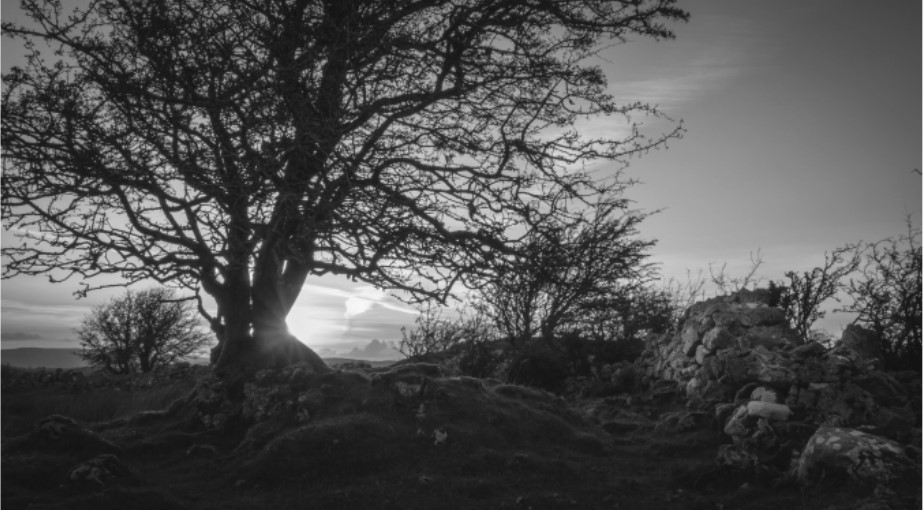
So what exactly is a fairy thorn tree? The site remarkabletrees.org states that, “Throughout the Northern Ireland countryside, there is a special tree – not one tree, but many, – standing alone, unharmed through generations, guarding its special place. It is the Fairy Thorn. Most are hawthorn, the white thorn with its May blossom… Fairy thorns may be associated with archaeological sites, such as the Neolithic chambered graves and wedge tombs. They may stand beside wells and springs, places known to early man and sometimes adopted by Christianity as Church sites or Holy Wells. In some rural sites there may be no apparent built artefact beside a fairy thorn, but the tree may guard a small rise in the ground – a fairy hill, place of entry to the under or other world of the fairy folk…Such special trees have a remarkable power about them. A gnarled thorn, often growing in harsh rocky ground, survivor of wind, weather, grazing, and many generations of man, has its own special strength. Stories still abound of misfortunes visited on those who risked disturbing such trees.”


Windham Life and Times – November 2, 2018

New England Fairies

Native American and Northern Irish Traditions

The fairy version of the story of Tsienneto, raises the question of where this legend, and other legends of New England fairies began. The legend of the fairy “Neto” has two possible origins; the Native Americans and the Scotch-Irish who both have long held traditions about the wee people that inhabit the wood.  Perhaps, the story of “Neto” combines both Native American and Northern Irish traditions.

Frances Jenkins Olcott is a well known children’s author who adapted many Native American legends into a children’s book called, The Red Indian Fairy Book. It was first published in 1917.

How The Fairies Came, is a short children’s story,  based on and old Algonquin legend “Osseo, the Son of the Evening Star” which was published in the book, The Indian Fairy Book, From the Original Legends, written by Cornelius Mathews and published in  1889.

“In the country of the Wabanaki, ten sisters once lived in their father’s lodge. Each was more beautiful than any other maiden in the land, and the youngest was the most beautiful of all.”

“Mandy handsome braves laid their gifts before the lodge door. So nine of the sisters married and went to live with their mothers-in-law. But the youngest refused all suitors, and stayed in her father’s lodge.”

“One day an old man named Osseo came to woo the youngest. His eyes were bright and his thoughts keen and he sang softly before her door. And as the maiden was willing the marriage feast was held.”

“The nine sisters came with their handsome husbands, and they laughed and jeered at the bride, because her husband was so old. But she only said: ‘Wait and see!’ Soon you shall know who has chosen most wisely.”

“After the marriage feast was over, Osseo led his bride toward his lodge in the distant forest. The nine sisters and their husbands went with them along the path. Presently they passed a hollow log. Then Osseo gave a loud call, and leaving the side of his bride, dashed into the log. Immediately he came out the other end, no longer old and wrinkled, but younger and handsomer than the husbands of the nine sisters. He then led the party forward with a step as light as the Reindeer’s.”

“Soon they reached a splendid lodge, and entered it. A delicious feast was spread in wooden dishes, and the sisters and their husbands sat down. ‘The food you see set before you is magic food,’ said Osseo; ‘eat it and receive a gift from the Evening Star, whose lodge this is.’ And as they all ate, sweet music like the voices of birds fell from the Sky. The lodge began to rise in the air. Higher it rose through the trees, and as it did so, it changed into a wonderful cage. Its poles became glittering silver wires, and its covering was of the shining wings of blue, green, and yellow insects.”

“And as the silver cage passed above the tree-tops, the wooden dishes became scarlet shells, and the nine sisters and their husbands were transformed into birds. Some became Bluebirds, others Red Breasted Robins, still others Golden Orioles, and birds with scarlet wings. Immediately they all began to hop about the cage showing their bright feathers and singing songs sweeter than those sung in the woodland.”

“ As for Osseo’s bride, she grew more lovely than ever, so that she shone like a star. Her garments were shimmering green, and in her hair was a silver feather.

“Higher rose the cage until it reached the Evening Star.”

“ ‘Welcome, my son,’ said he to Osseo. ‘Bring in your lovely bride, but hang the cage of colored birds at the door. Because the nine sisters laughed at the bride, they must stay outside.”

“Be careful that you never open the cage, nor let the ray of light from the little Star dwelling near us, fall upon you. For the ray of light is the little Star’s bow and arrow, and if it touches you, your wife and the birds will become enchanted.’ So Osseo hung up the cage of colored birds at the door of the lodge; and he and his wife lived there in happiness.  In time a son was born to them, who was brighter than the starlight. And when he grew older, Osseo made for him a little bow and arrows.”

“One day to please the child who wished to shoot something, Osseo opened the door of the silver cage, and let the colored birds go free, and they flew singing to Earth. The little boy shot an arrow after them, and immediately a ray of light struck Osseo. Then the little boy began to float downward through the Sky. Soon he passed the soft white clouds, and felt gently upon a green island in the middle of a wide blue lake. The colored birds came flying to him with songs of joy.”

“As for the silver cage, it descended after, its glittering insect wings fluttering from its sides. And in it were Osseo and his wife. As the cage touched the green island, it became a shining lodge, and Osseo and his wife, the little boy, and all the colored birds, were changed into bright and joyous Fairies.”

‘And ever since that day, on Summer starlit nights, the little Fairies join hands, and dance around. Their shining lodge may still be seen when the Moon’s beams light the green island. And by night the Indian fisher-boys, on the blue lake, hear the sweet voices of the Fairy dancers.”

Olcott’s book contains other tales about fairies  based on Native American legends. There is a story about the Native American hero, Glooskap and The Summer Fairies, and Leelinau the Fairy Girl.   Osseo, Son of the Evening Star,  was published in The Indian Fairy Book, From the Original Legends, by author Cornelius Mathews, first published in 1889. It is still available in reprint from Amazon and other sources.

“There once lived an Indian in the north who had ten daughters, all of whom grew up to womanhood. They were noted for their beauty, especially Oweenee, the youngest, who was very independent in her way of thinking. She was a great admirer of romantic places, and spent much of her time with the flowers and winds and clouds in the open air. Though the flower were homely, if it was fragrant—though the wind were rough, if it was healthful—and though the cloud were dark, if it embosomed the fruitful rain, she knew how, in spite of appearances, to acknowledge the good qualities concealed from the eye. She paid very little attention to the many handsome young men who came to her father’s lodge for the purpose of seeing her.”

“Her elder sisters were all sought in marriage, and one after the other they went off to dwell in the lodges of their husbands; but Oweenee was deaf to all proposals of the kind. At last she married an old man called Osseo, who was scarcely able to walk, and who was too poor to have things like others. The only property he owned in the world was the walking-staff which he carried in his hand. Though thus poor and homely, Osseo was a devout and good man; faithful in all his duties, and obedient in all things to the Good Spirit. Of course they jeered and laughed at Oweenee on all sides, but she seemed to be quite happy, and said to them, “It is my choice and you will see in the end who has acted the wisest.”

“They made a special mock of the walking-staff, and scarcely an hour in the day passed that they had not some disparaging reference to it. Among themselves they spoke of Osseo of the walking-staff, in derision, as the owner of the big woods, or the great timber-man.”

“True,” said Oweenee, “it is but a simple stick; but as it supports the steps of my husband, it is more precious to me than all the forests of the north.”

“A time came when the sisters, and their husbands, and their parents were all invited to a feast. As the distance was considerable, they doubted whether Osseo, so aged and feeble, would be able to undertake the journey; but in spite of their friendly doubts, he joined them, and set out with a good heart.”

“As they walked along the path they could not  help pitying their young and handsome sister who had such an unsuitable mate. She, however, smiled upon Osseo, and kept with him by the way the same as if he had been the comeliest bridegroom in all the company. Osseo often stopped and gazed upward; but they could perceive nothing in the direction in which he looked, unless it was the faint glimmering of the evening star. They heard him muttering to himself as they went along, and one of the elder sisters caught the words, “Pity me, my father!”

” ‘Poor old man,’ said she; ‘he is talking to his father. What a pity it is that he would not fall and break his neck, that our sister might have a young husband.’ ”

“Presently as they came to a great rock where Osseo had been used to breathe his morning and his evening prayer, the star emitted a brighter ray, which shone directly in his face. Osseo, with a sharp cry, fell trembling to the earth, where the others would have left him, but his good wife raised him up, and he sprang forward on the path, and with steps light as the reindeer he led the party, no longer decrepit and infirm, but a beautiful young man. On turning around to look for his wife, behold she had become changed, at the same moment, into an aged and feeble woman, bent almost double, and walking with the staff which he had cast aside”

“Osseo immediately joined her, and with looks of fondness and the tenderest regard, bestowed on her every endearing attention, and constantly addressed her by the term of ne-ne-moosh-a, or my sweetheart.”

“As they walked along, whenever they were not gazing fondly in each other’s face, they bent their looks on heaven, and a light, as if of far-off stars, was in their eyes.”

“On arriving at the lodge of the hunter with whom they were to feast, they found the banquet ready, and as soon as their entertainer had finished his harangue—in which he told them his feasting was in honor of the Evening or Woman’s Star—they began to partake of the portion dealt out, according to age and character, to each one of the guests. The food was very delicious, and they were all happy but Osseo, who looked at his wife, and then gazed upward, as if he was looking into the substance of the sky. Sounds were soon heard, as if from far-off voices in the air, and they became plainer and plainer, till he could clearly distinguish some of the words.”

“‘My son, my son,’ said the voice; ‘I have seen your afflictions, and pity your wants. I come to call you away from a scene that is stained with blood and tears. The earth is full of sorrows. Wicked spirits, the enemies of mankind, walk abroad, and lie in wait to ensnare the children of the sky. Every night they are lifting their voices to the Power of Evil, and every day they make themselves busy in casting mischief in the hunter’s path. You have long been their victim, but you shall be their victim no more. The spell you were under is broken. Your evil genius is overcome. I have cast him down by my superior strength, and it is this strength I now exert for your happiness. Ascend, my son; ascend into the skies, and partake of the feast I have prepared for you in the stars, and bring with you those you love.’ ”

” ‘The food set before you is enchanted and blessed. Fear not to partake of it. It is endowed with magic power to give immortality to mortals, and to change men to spirits. Your bowls and kettles shall no longer be wood and earth. The one shall become silver, and the other pure gold. They shall shine like fire, and glisten like the most beautiful scarlet. Every female shall also change her state and looks, and no longer be doomed to laborious tasks. She shall put on the beauty of the star-light, and become a shining bird of the air. She shall dance, and not work. She shall sing, and not cry.’ ”

” ‘My beams,’ continued the voice, ‘shine faintly on your lodge, but they have power to transform it into the lightness of the skies, and decorate it with the colors of the clouds. Come, Osseo, my son, and dwell no longer on earth. Think strongly on my words, and look steadfastly at my beams. My power is now at its height. Doubt not, delay not. It is the voice of the Spirit of the Stars that calls you away to happiness and celestial rest.’ ”

“The words were intelligible to Osseo, but his companions thought them some far-off sounds of music, or birds singing in the woods. Very soon the lodge began to shake and tremble, and they felt it rising into the air. It was too late to run out, for they were already as high as the tops of the trees. Osseo looked around him as the lodge passed through the topmost boughs, and behold! their wooden dishes were changed into shells of a scarlet color, the poles of the lodge to glittering rods of silver, and the bark that covered them into the gorgeous wings of insects.”

“A moment more and his brothers and sisters, and their parents and friends, were transformed into birds of various plumage. Some were jays, some partridges and pigeons, and others gay singing birds, who hopped about, displaying their many-colored feathers, and singing songs of cheerful note.”

“But his wife, Oweenee, still kept her earthly garb, and exhibited all the indications of extreme old age. He again cast his eyes in the direction of the clouds, and uttered the peculiar cry which had given him the victory at the rock. In a moment the youth and beauty of his wife returned; her dingy garments assumed the shining appearance of green silk, and her staff was changed into a silver feather.”

“The lodge again shook and trembled, for they were now passing through the uppermost clouds, and they immediately after found themselves in the Evening Star, the residence of Osseo’s father.”

” ‘My son,’ said the old man, ‘hang that cage of birds which you have brought along in your hand at the door, and I will inform you why you and your wife have been sent for.’ Osseo obeyed, and then took his seat in the lodge.”

” ‘Pity was shown to you,’ resumed the King of the Star, ‘on account of the contempt of your wife’s sister, who laughed at her ill fortune, and ridiculed you while you were under the power of that wicked spirit whom you overcame at the rock. That spirit lives in the next lodge, being the small star you see on the left of mine, and he has always felt envious of my family because we had greater power, and especially that we had committed to us the care of the female world. He failed in many attempts to destroy your brothers and sisters-in-law, but succeeded at last in transforming yourself and your wife into decrepid old persons. You must be careful and not let the light of his beams fall on you, while you are here, for therein lies the power of his enchantment. A ray of light is the bow and arrow he uses.’ ”

“Osseo lived happy and contented in the parental lodge, and in due time his wife presented him with a son, who grew up rapidly, and in the very likeness of Osseo himself. He was very quick and ready in learning every thing that was done in his grandfather’s dominions, but he wished also to learn the art of hunting, for he had heard that this was a favorite pursuit below. To gratify him, his father made him a bow and arrows, and he then let the birds out of the cage that he might practice in shooting. In this pastime he soon became expert, and the very first day he brought down a bird; but when he went to pick it up, to his amazement it was a beautiful young woman, with the arrow sticking in her breast. It was one of his younger aunts.”

“The moment her blood fell upon the surface of that pure and spotless planet, the charm was dissolved. The boy immediately found himself sinking, although he was partly upheld by something like wings until he passed through the lower clouds, and he then suddenly dropped upon a high, breezy island in a large lake. He was pleased, on looking up, to see all his aunts and uncles following him in the form of birds, and he soon discovered the silver lodge, with his father and mother, descending, with its waving tassels fluttering like so many insects’ gilded wings. It rested on the loftiest cliffs of the island, and there they fixed their residence. They all resumed their natural shapes, but they were diminished to the size of fairies; and as a mark of homage to the King of the Evening Star, they never failed on every pleasant evening during the summer season to join hands and dance upon the top of the rocks. These rocks were quickly observed by the Indians to be covered, in moonlight evenings, with a larger sort of Ininees, or little men, and were called Mish-in-e-mok-in-ok-ong, or Little Spirits, and the island is named from them to this day.”

“Their shining lodge can be seen in the summer evenings, when the moon beams strongly on the pinnacles of the rocks; and the fishermen who go near those high cliffs at night, have even heard the voices of the happy little dancers. And Osseo and his wife, as fondly attached to each other as ever, always lead the dance.”


Windham Life and Times – October 26, 2018

Hannah Duston and the Fairy

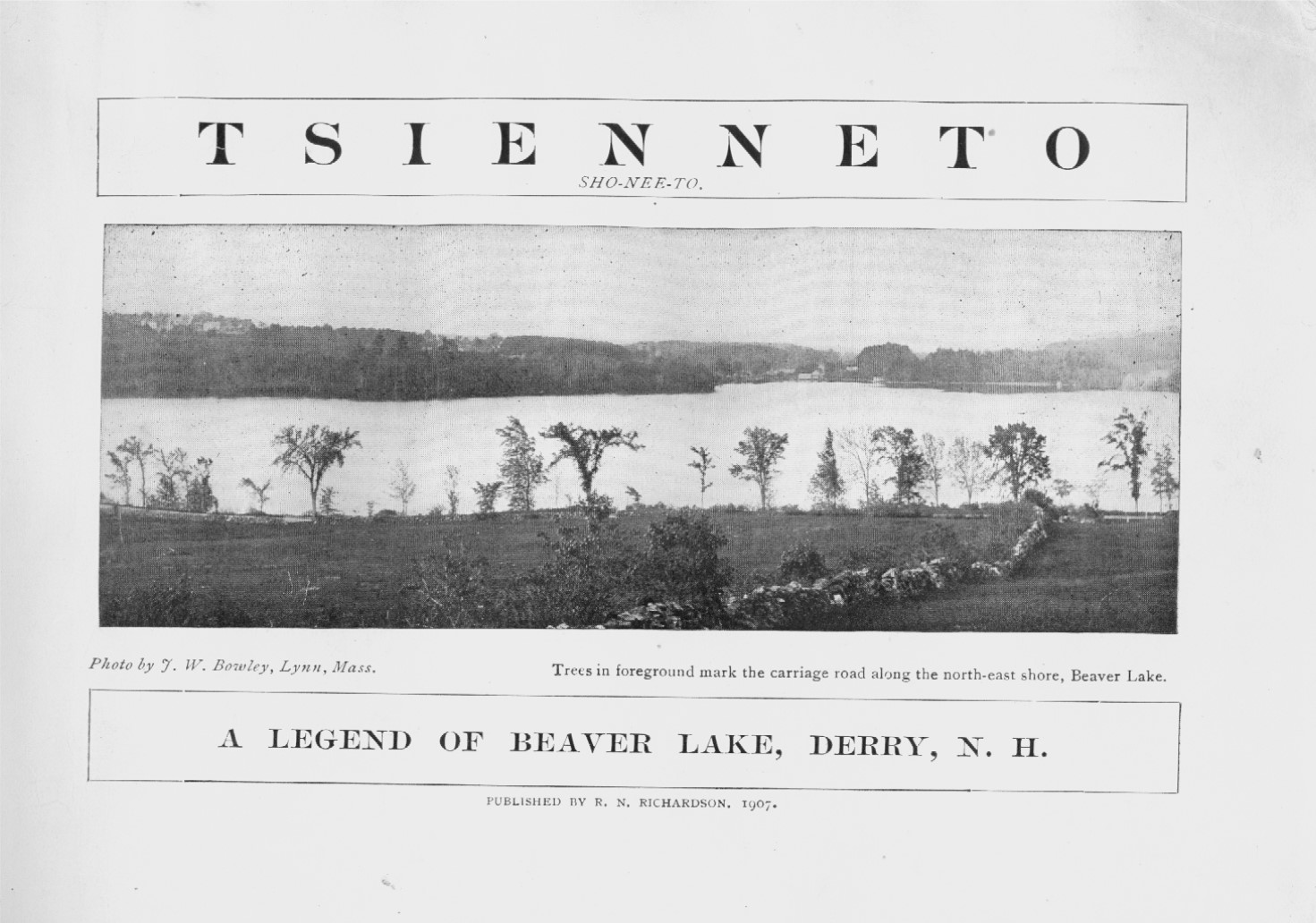
“Tsienneto” booklet contains the legend of the Indian Tsienneto

New Hampshire Folk-Tales and Beyond

So what are we to think about Hannah Duston in the “enlightened” year of 2018. On the one hand she treated indigenous people very terribly (murdering them), and should be loathed for it, but…those indigenous people were alpha males, so they should have been killed anyway, and since it is a tale of woman’s power and strength in the face of calamity, I probably am still allowed to publicly write about her without sending people scurrying to their safe places. On the other hand, people may not like this old folk tale, because it takes the glory from a stoic, powerful, woman and gives the glory to a wood sprite or fairy,  whose magical powers save the day.

First, lets recap the story of Hannah Duston. Stories of New Hampshire under The Indomitable Hannah Dustin says that, “At the beginning of the history of New Hampshire women were important, yet few acquired fame. The first heroine of the state was Hannah Duston (The early spelling of her name), famous throughout the nation because she possessed the courage to kill ten Indians to save her life. Hannah was born in Haverhill, Massachusetts, on December 23, 1657, the daughter of Michael and Hannah (Webster) Emerson. Hannah Webster Emerson distinguished these names long before Daniel Webster and Ralph Waldo Emerson were born.”

“Haverhill was a forested area in 1635, when only a few families were scattered in the south section of the present city…she married Thomas Duston, December 3, 1677, at the time King Philip (an Indian) was killing the English because they were destroying his hunting grounds and food supply.”

“The couple had seven children and Hannah was recovering seven days after baby Martha was born when on the morning of March 15, 1697, Indians were approaching the home. Hannah urged Thomas to save the children. He told the seven to run into the woods toward the garrison house of Onesiphorus Marsh near the bank of the Merrimack River while he mounted his horse and fought the Indians.”

“Meanwhile the Indians killed the baby and captured Mrs. Duston and her nurse, Mrs. Mary Neff, and compelled them to leave the house that was pillaged immediately. (For you Windham folks, Mary Neff was a Corliss, and related to the Corliss family of Windham who occupied one of the earliest homesteads in town.) The March wind must have been cold and the river at flood, yet it is believed that the Indians, with their captives, paddled up the stream to an island at Penacook, New Hampshire. The story is related that while in camp, Hannah cooked a soup that the Indians ate heartily, then they fell soundly asleep. It is believed that Hannah added the roots of a plant possessing soporific (induces sleep) power.”

While the Indians slept soundly, Hannah and a captive boy killed ten Indians with tomahawks, took their scalps, and then the three captives fled down the river in a canoe, safely to Haverhill.” Quite the heroine, but did Hannah have a little magical help?

In The Legend of Tsienneto, The Fairy we learn the following: “Fairy tales also claim their share of mystery among former settlers. Beaver Lake in Nutfield, now Derry, was supposed by the Indians to be the abode of a Fairy Queen named “Tsienneto, abbreviated to Neto in the legend of Hannah Dustin. Seen or unseen by mortals, Neto was able to perform deeds of friendly service to those in distress.”

“When the Indians brought Mrs. Dustin and their other captives from Haverhill, their first-night encampment was on the shore of Beaver Lake where Queen Neto saw and befriended Mrs. Dustin, promising to accompany her unseen by her captors and to supply all her needs.”

“After the party arrived on the island in the Merrimack River near Penacook, Neto cast a spell over the Indians so that they soundly slept while Mrs. Dustin and her boy companion moved about with the Indians tomahawks, killing all their enemies and escaping down river. It was Neto who guided them in safety to their home and family as this good fairy always was known to do, and thus the Scotch-Irish of Derry explain the miraculous escape of Hannah Dustin.”

How this legend arose is a mystery to historians in both Derry and Londonderry, since it was not written down previously to its being published in New Hampshire Folk Tales in 1932.  There was a source for another legend of Tsienneto in a small guidebook published by R.N. Richardson in 1907. However, there is no confirmation in this publication as to the Hannah Duston legend. It instead tells the rather poetic tale of Tsienneto, an Indian prophet, who predicted the demise of the red man as related by a local fairy. “Tsienneto was seized and taken before  a council of Chiefs and great men. There he prophesized that a great misfortune would come to the tribes in the region of the Beaver. ‘A peculiar people,’ he said, ‘with pale-hued faces, shall come from beyond the big water. They will devastate the forests, and dwell unmolested in the places thus desolated. The deer shall leave the near country, the beaver cease their craft in the waters of that region, and your campfires shall be forever out. Yonder isle shall disappear, and fishes prowl where now stands my lodge. In the days of the third forest the deer shall return, but the beaver—never.’ ‘And all the great men assembled were afraid, for they had heard the power of Tsienneto. A sign! A sign! Prove thy power they cried. On the eastern end of the island stood a great pine, large enough for what was called  in the latter days a King’s tree. In the time of Tsienneto it was called the Guardian of the Isle of Great Enchantment.” To prove his power, and the truth of his prophecy, Tsienneto hurled a huge boulder a half mile across the lake and destroyed the tree. With its destruction, the island sank, and the spiritual protection of the tree to the Indians was lost.

So was Tsienneto a wise Native American prophet or a small Native American fairy that protected Hannah Duston? I’ll let you decide for yourselves.