Windham Life and Times – October 28, 2016

Frederick Bessell

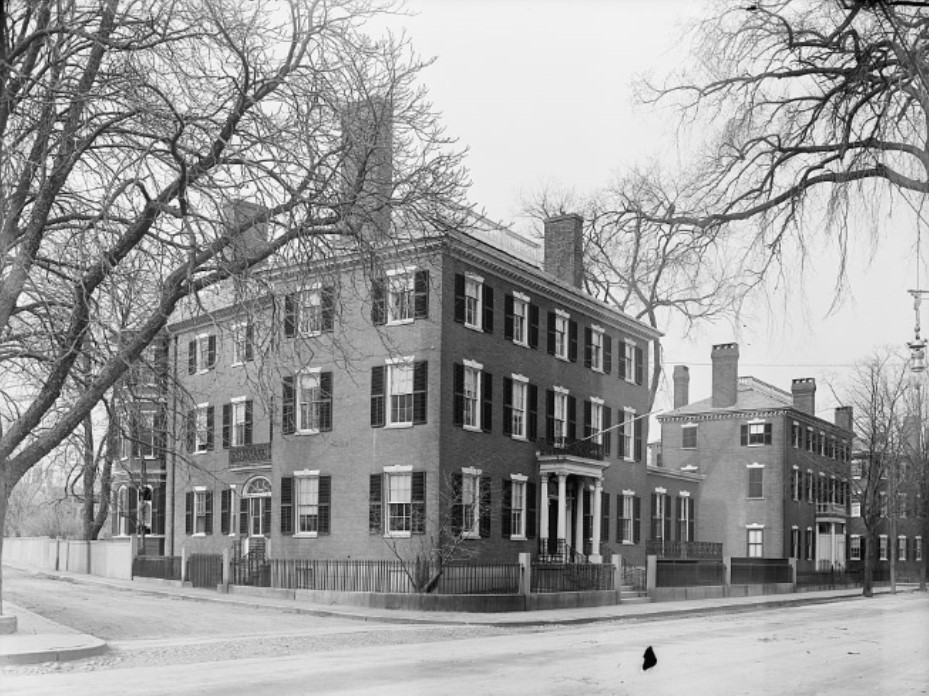
Stephen White mansion in Salem MA. where the Bessell brothers were raised.

Stephen White mansion in Salem MA. where the Bessell brothers were raised.

PART 4: THE BESSELL BROTHERS IN SALEM MASSACHSUETTS

So the three Bessell brothers, “with large trust funds” arrived in Salem Massachusetts with Stephen White on separate ships in 1805 and 1806. Their father also arrived in 1806.  One question I couldn’t answer is if  the boys ever lived with their father while he was alive. It appears that they did not and were rather raised in the Stephen White mansion that was built in 1811.

“After his brother’s death, Stephen White stepped up: he had many new responsibilities, as a Republican politician, principal of an international merchant house, head of two families of young children, and guardian to the three teenage Bessell brothers.”

This period was difficult on the Salem merchant houses because Britain had again risen to dominate international trade, especially in Asia. One profitable line for the Salem merchants was opium. “White continued to send his tall ships to ports all over the world, although specie was scarce. Now he turned to the Mediterranean, where he did a large business in wine and fruits and marble; and he pushed his vessels farther east to Smyrna, in Turkey, to enter the opium trade. Turkish opium was better than that of Bengal, but London had forbidden British carriers to take it to the Orient. Since 1800, however, Boston vessels had been shipping opium to Europe and America, where apothecary shops sold the drug mixed with alcohol as a sedative known as Laudanum.”

Mathias Bessell was employed in Stephen White’s merchant house. In August of 1816 , at seventeen years of age, he sailed to Sumatra on the ship Mary & Eliza as supercargo. A “supercargo” is “the  representative of the ship’s owner on board a merchant ship, responsible for overseeing the cargo and its sale.” So young Bessell was given a great deal of responsibility at a very young age. “Ships sailing under his (Stephen White’s) tricolor house flag represented America in its relationships with the world. He savored the moment, in which foreign trade had at last recovered, thanks to lucrative coffee and pepper voyages; and White’s success were multiplied throughout the town. America had a hunger for these commodities, as did Europe, and somehow, despite many competitors, the demand still exceeded supply.”

“When he sought a new partner, he turned to his brother-in-law, Franklin H. Story, now twenty-one. who entered the White brothers employ in 1809 or so alongside the Bessell brothers. By the age of eighteen, in1813, he had been signing company documents and serving as a member of Stephen’s militia company. (is this how Frederick Bessell became acquainted with Major Dudley?) In 1817, Stephen made him co-owner of a brand-new brig, christened with his name, Franklin.”

Stephen White completed the outfitting of his fifth vessel, the 251 ton brig Franklin, with new rigging and several additional cannon, to use on the pirates of the eastern seas. She would be commanded by Stephen’s older brother, the gallant Captain John White, forty, assisted by captain’s clerk Frederick Bessell, twenty, bound for Sumatra to Vietnam in Conchin China, a place not visited by a Salem vessel in sixteen years.” So here we have  the another mention of our Frederick Bessell of “Bissell’s Camp” notoriety. What is amazing in reading the accounts is how young the captains and crews of many of these ship were.
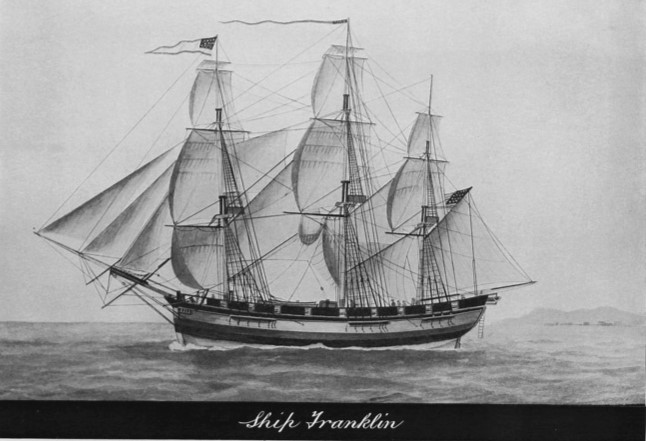
The brig Franklin on which Frederick Bessel was captain's clerk when it visited Saigon, Vietnam.

The brig Franklin on which Frederick Bessel was captain’s clerk when it visited Saigon, Vietnam.

“In a light rain of an April afternoon, Stephen White and the Bessell brothers, his former wards and current associates, walked from Washington Square down to Derby Street, past the big distillery and the warehouses and workshops and out to the dock of White’s Lower Wharf. One block from the ship yard where she had been built, Stephen’s Mary & Eliza waited, refitted and ready to begin her twelfth voyage to the Orient. Mathias Bessell, twenty-two, was supercargo, and Charles, twenty-three, was captain’s clerk. Their brother Frederick, was still at sea as clerk to Captain John White in the Franklin…Coming into the family when Stephen was sixteen, Charles and Mathias were more like his younger brothers, essential members of the clan. White’s affection, confidence and privilege had produced a pair of tall, smart young American gentleman. Mathias, in particular, consciously aimed for a life of personal virtue and honor and integrity in his dealings as a merchant.”  Next Week, The tragic deaths of his older brothers Mathias and  Charles Bessell, may have been the reason a depressed Frederick Bessell sought solitude, solace and a place to numb the pain at “Bissell’s Camp” in Windham.

All quotes in this section are from “Death of an Empire,” by Robert Booth. Also see, Captain John White’s book, A History of a Voyage to the China Sea, written in 1823, which talks about the incredible voyage and Frederick Bessell being in Saigon Vietnam.

 

Windham Life and Times – October 21, 2016

Frederick Bessell

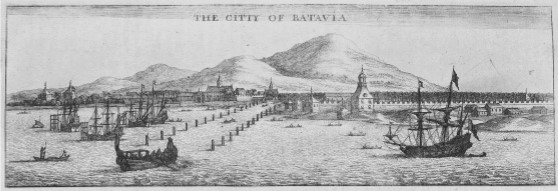
Batavia (Jakarta) on the island of Java Indonesia was the headquarters of the Dutch East India Company and was founded in 1619. It features magnificent homes of wealthy Dutch merchants.

Batavia (Jakarta) on the island of Java Indonesia was the headquarters of the Dutch East India Company and was founded in 1619. It featured magnificent homes of wealthy Dutch merchants.

PART 3: FRANZ BESSELL IN SUMATRA AND HIS ARRIVAL WITH HIS SON IN AMERICA

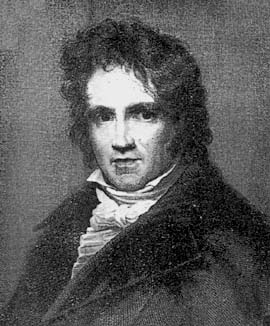
Frederick Bessel, the astronomer.

Frederick Bessel, the astronomer.

Franz Bessell was born in Minden, Westphalia in Germany. His father was a civil servant and his family was very large. His brother was Frederick Bessel, the  famous astronomer and mathematician who was the first person to determine reliable values for the distance from the sun to another star by the method of paralix. A special type of mathematical functions were named Bessel functions after his death.

Franz Bessell’s obituary from the diary of William Bentley, D.D. the pastor of the East Church in Salem Massachusetts reads as follows: “Last night died in Beverly, F.L.A. Bessell Esq. aged 55. He had lived 22 years upon the western coast of Sumatra and chiefly at Padang and had formed a friendship with Captain Joseph White of this town and by him was persuaded to come to America. He has been several years a resident of Salem and for the first part of the time in my neighborhood. He had every honor his situation in Sumatra allowed and passed with us as the Governor. He has lately purchased a farm at Londonderry and another very lately in Upper Beverly three miles from Salem at which he died. He has visited different parts of our Country. He has been noticed for his hospitality but nothing has been done since his arrival in America to bring him out of his first circle of acquaintance and while all were willing to give him the common tokens of respect, few speak of him as known to them.”

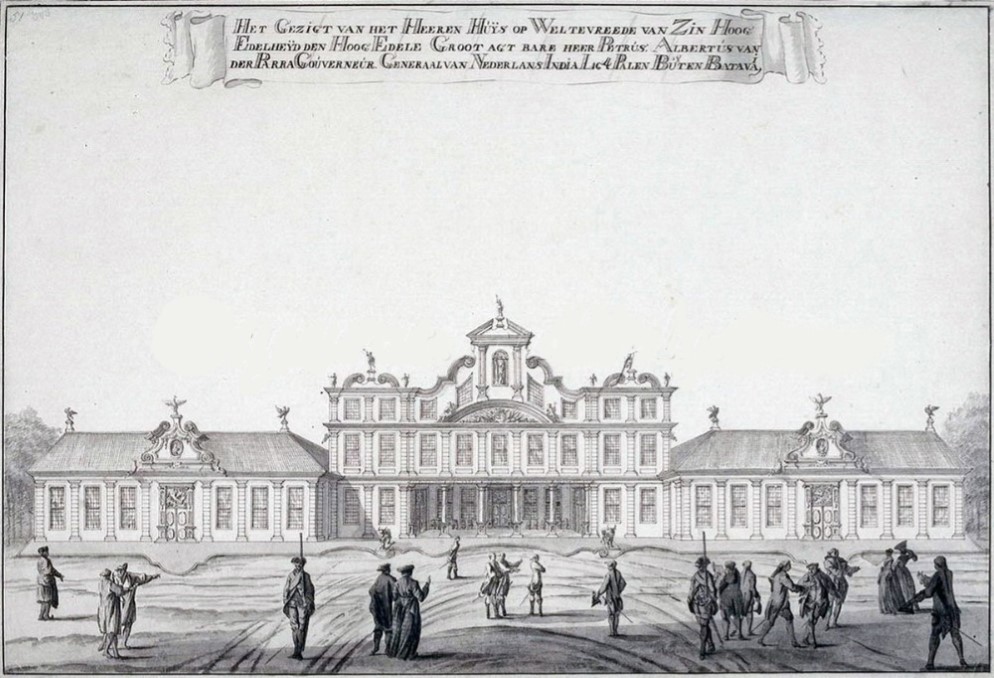
"Weltevreden" country house built by governor general Jacob Mossel in Batavia about 1761.

“Weltevreden” country house built by governor general Jacob Mossel in Batavia (Jakarta) about 1761.

In an entry in Reverend Bentley’s diary, at the death of one of Besssell’s sons we read “his father ‘was a native of Germany, and for the course of Twenty-two years was a resident of Padang, and other places on the Western Coast of Sumatra, in which time he held many posts of the greatest rank and responsibility in those colonies. He died at his country seat in Beverly, Mass., 21st Aug., 1810, 55 years, and was buried in Salem.’

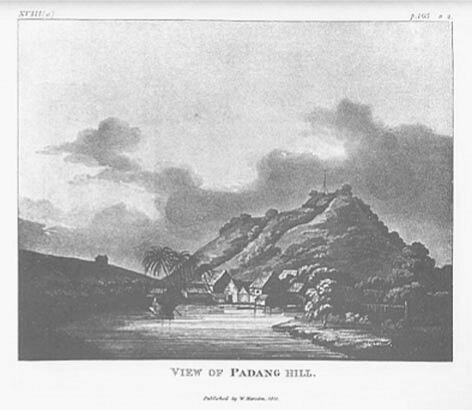
Padang

Entrance to the Padang River.

So the life story related by Reverend Bentley is one of a very wealthy man who kept to himself. One interesting item in this entry is the fact that he owned a farm in Londonderry, NH., which gives a clue as to why his son might have been drawn to Windham, for the site of his “camp.” I have seen the deeds for the Londonderry property where he purchased the farm of Robert Archibald, December 9, 1809 for Two Hundred Dollars. Through another deed we learn that the Londonderry property was sold after his death. In the deed of February 24, 1814, signed by his executor, Joseph White Jr., the farm was sold back to Robert Archibald for six hundred dollars. We also learn on this deed that Mr. Bessell’s full name was Francis Lewis Alexander Bessell, Esq.

Much of the following information about Franz Bessell comes from the book, Death of an Empire. The first mention of Bessell is the following: In Calcutta, Joseph White Jr. had negotiated for a fortune in cotton textiles, and then, after dropping down to Batavia to acquire first-quality sugar, he had met Franz Bessell, the Prussia-born agent of the Dutch East India Company for both Java and Sumatra. Bessell, a man who had been out in the islands too long, had recognized in White the very fellow to whom he might entrust his most prized possessions. No super cargo of Salem had ever brought home boys from his travels, but Joseph White Jr. stepped onto White’s wharf holding the hands of little Charles and Mathias Bessell, who came complete with large trust funds. Joseph’s adoptive parents helped the young bachelor in his new role as father, but they themselves had not finished with their own family.” This was in 1805.

bessell-bativia-2

In 1806, Stephen White was employed as a super cargo on the Mary & Eliza, which was owned by his adoptive father. His older brother John White was the Captain. After trading in India, he began his homeward trip, but not before stopping in Batavia, to pick up two additional passengers, “Franz Bessell, fifty-two, and his third son Frederick, looking forward to a reunion with his two Salem brothers.”

“In 1811, on adjoining lots, overlooking the town Common, Stephen and Joseph Jr. put up splendid three-story brick mansions…” and it was here that the Bessell boys were raised. In May of 1813, Joseph White Jr. one of the richest men in Salem, died suddenly and “his passing was treated as a public calamity.”

So why do I suppose that Franz Bessel had gone native and taken up with a Sumatran woman with whom he had three sons? First, the description of him as having “been out in the islands too long.” Second, the fact that Morrison describes “Bissell” as being a “Sumatran or Malay.” While this could indicate that the children were full blooded natives adopted by Bessell, this is contradicted by the fact that everywhere they are described as Francis Bessell’s sons. Also, it is noted in several places how “Americanized and civilized” the boys had become. While we only have Morrison’s solid description of F.L. Bissell as being Sumatran, (or half Sumatran,) every indication is that they were Francis Bessell’s sons from a relationship with a native woman on Sumatra. After all, he was in Java and Sumatra for over 22 years and it would only have been natural that he would have taken up with a woman there. Next week, the Bessell brothers in America.


Windham Life and Times – October 14, 2016

Frederick Bessell

sumatra-1

PART TWO: SALEM MASSACHUSETTS AND THE PEPPER TRADE WITH SUMATRA

“It was to the ‘rich East,’ indeed, that Salem owed its brief but dazzling period of commercial glory. In the two decades following the American Revolution, Salem’s sailing ships returned from China and East India (as Americans then called India, Indochina and the Malay Archipelago) brimming with tea and spices, silks and porcelain, ivory and gold dust. “Boston was the Spain, Salem the Portugal, in the race for Oriental opulence,” wrote historian Samuel Eliot Morison in 1921. Salem’s hugely profitable trade with the Orient transformed this hardscrabble New England seaport into a global powerhouse and, by the early 1800s, the wealthiest city per capita in the United States.” Read more: http://www.smithsonianmag.com/history/salem-sets-sail-2682502/#ygqOlWtuEoq8jH0k.99 Doug Stewart, 2004

“The origins of Salem’s multi-million dollar pepper trade with Sumatra are somewhat mysterious. Although the intrepid ship captains of Salem had long undergone lengthy and hazardous voyages to the East, the trade with Sumatra seems to have begun with Captain Jonathan Carnes who discovered an island teeming with pepper that could be bought directly form the suppliers without the charges of Dutch middlemen.”

In 1795, Jonathan Peele, a wealthy distiller of Salem, purchased and altered a large schooner called the Rajah, fitting her out for a long voyage to procure a cargo of pepper. The command was given to Captain Carnes. The Rajah was armed with four iron guns, and she carried a crew of ten men. This voyage was to last eighteen months. After arriving in Padang Sumatra, he procured intelligence that he would find large quantities of pepper to the north. “Without chart or guide of any kind, he made his way among numerous coral reefs, of which navigators have much dread even at present day, as far as the port of Analaboo, touching also at Soo-Soo, where he succeeded in procuring a large portion of his cargo.” With his vessel gone so long, Mr. Peele began to grow anxious over his investment in the ship. “But one fine morning, October 15, 1799, a vessel entered the harbor, with colors flying, and as rusty as a coal barge. The people hurried to the wharves, and great curiosity was manifested to learn what part of the eastern world Captain Carnes had been so successful in loading his vessel in so short a time with pepper. The cargo had been purchased of the natives for a few boxes of trinkets and hardware of comparatively little value, and was sold in Salem for thirty-seven cents a pound. The long absence of Captain Carnes was owing to the necessity of remaining in port until a second crop of pepper had ripened and had been gathered. There had never been so much pepper brought in one vessel to the United States. It is worthy of remark also, that at this time  period a vessel of 150 tons was deemed large enough to bring the whole crop raised on the west coast of Sumatra. The cargo was sold at a profit of seven hundred percent.”  Salem Vessels and Their Voyages: A History of the Pepper Trade with the Island of Sumatra.

sumatra-2

     “Carnes managed to keep the source of his cargo secret from the other Salem ship-masters for one more voyage on the Rajah before it was discovered. Needless to Say, the other ship owner and masters in Salem were eager to get in on the action.” “Pepper was exceedingly valuable, as both a spice and a preservative, but the Dutch and the British had forfeited most of their Atjeh trade through futile efforts at conquest. Salem men were recognized as a different breed of ‘white devil,’ and Salem’s merchants took full advantage to corner the American pepper market while also shipping to Europe and the Caribbean. They insisted that their ship-masters show respect to the rajahs and exercise great restraint if provoked. Living up to their ideals, they found themselves winning friends and growing rich.” “A typical Salem ship was “loaded with valuable cargoes: on typical merchantman of three hundred tons burthen might carry away goods worth $50,000, or tens of millions of dollars in today’s prices.” “The pepper ports known to the Salem merchants…are located in what is now known as the Aceh Province. In the years between 1799 and 1846, 179 ships sailed between Salem and Sumatra, with even more landing their cargoes in other American or European ports…” Death of and Empire, The Rise and Murderous Fall of Salem, America’s Richest City. Robert Booth

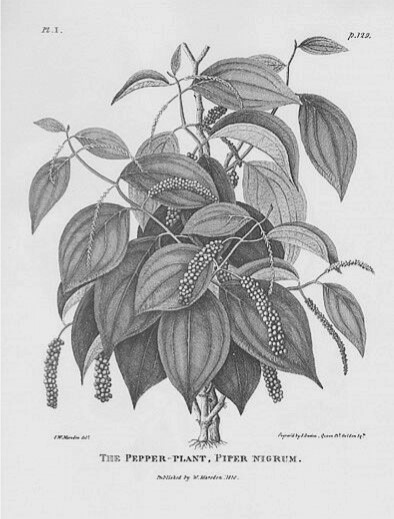
“The pepper trade was extremely dangerous. The island was surrounded by treacherous reefs and the natives of the island were often hostile and extremely eager to captures American ships, killing crew members and plundering their cargo while ships lay in port. It could be days before a ships holds were full, exacerbating the risk of midnight raids by pirates. The actual trading of pepper occurred on dry land—the captain and a couple of crew members would go ashore with scales (Hopefully leaving the ship adequately guarded) to weigh the pepper and negotiate prices, which could change during the transaction, based on supply, the local authorities whim, or whether another ship happened to arrive in port and offered a higher price. As the pepper trade went on, captains were sometime captured while trading onshore and held for ransom. In the eyes of the Salem captains, however, the rewards outweighed the risks.” To the Farthest Points of the Rich East: Salem and the Sumatra Pepper Trade. Massachusetts Historical Society August 2012

pepper

“The Salem Captains found that adopting the ways of the natives helped with trade and lowered the amount of violence. Captain “Nichols moved easily among the natives, picking up their language and adopting their mode of dress, in the tropical heat: a turban, a short, open jacket, and striped silk cutoffs, with a kris, or dagger, and a short sword tucked in the waistband. He respected their reputation for violence and never spent a night onshore…In showing respect to the locals by dressing in their attire and learning some of their language and speeding time with them, Captain Nichols won a trading advantage. ‘Nothing pleased the natives more than to find me ready to conform to their customs. I often walked arm-in-arm with their leading men, went into their huts to light my cigars, and, offering them some. Would sit down and smoke with them.”

Friendship, improbably, would permanently mark the relations between Christian Salem and Muslim Sumatra, good partners across the waters separating a sophisticated Western capital and a scattering of bamboo villages. For all of their daunting reputation, the Atjehnese would not cause problems for the ships and sailors of Salem; and trade along the Pepper Coast would be preserved in unbroken peace over the course of hundreds of voyages and many millions of dollars in profits.” Death of and Empire, The Rise and Murderous Fall of Salem, America’s Richest City. Robert Booth

Next week:  Franz Bessell goes native.


Windham Life and Times – October 7, 2016

Frederick Bessell

PART I: MORRISON’S ACCOUNT OF F.L. BISSELL IN WINDHAM

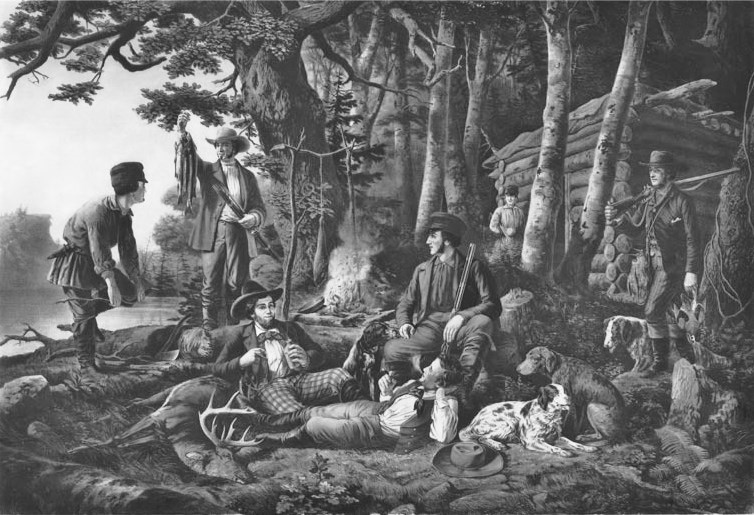
Louis Maurer (German-born Amercan artist, 1832-1932) published by N. Currier,  Camping Out Some of the Right Sort.

Louis Maurer (German-born American artist, 1832-1932) published by N. Currier,  Camping Out Some of the Right Sort. 1852. Bessell’s Camp in Windham was founded thirty years earlier.

I have always been intrigued by the account of  Bissell’s Camp which was located in Windham. It was described as weird and a little wild, and out of place in Windham’s history. I never really could understand how F.L. Bissell ended up in Windham and where he went to after he left. Actually, Frederick Bessell’s story is quite fascinating and is tied to the incredible wealth created by the maritime trade of Salem, Massachusetts, in the early 19th century.  Salem was America’s richest city at the time and the city’s merchant fleets had made many families there as rich as the Buffets or Gates of our time. While I have tracked down more information about Frederick Bessell, we will probably never know what induced him and Major Dudley to set up camp in the woods of Windham. So let’s begin with the retelling of Morrison’s description of Bissell’s Camp.

“At the age of eighteen or nineteen, F.L. Bissell came to Windham, in the month of May, 1823. He was a Malay or East Indian, a native of the isle of Sumatra, and came to this country in early life. He had a good English education, and was heir to a large estate, which was in the hands of a trustee or guardian, whose name was White of Salem, Mass. When he came to Windham he was accompanied by a man by the name of Major Dudley, a teacher of military tactics. They selected a spot and built a camp of pine boughs, with a stone fireplace. This camp was founded on a rock, which was but a little higher than the ground around it. It was soon supplied with all kinds of the best liquors, and with such food as was suitable for camp life.

“The next movement was the purchase of guns, pistols, swords, dirks, etc., also fishing gear and several dogs, all of which were of the most costly kind. Thus equipped, he with his friends, Major Dudley, and two or three others, were ready for fishing at Mitchell’s Pond, and for hunting wild game through the woods on each side of the brook that runs easterly from Mitchell’s Pond. They went into it with a keen relish, and from that time forward the yelping of hounds and the crack of the gun made music for the whole neighborhood. The novelty of the place and the odor of rum induced a great many people to visit Bissell’s camp.”

“Bissell evidently did not intend stopping long when he went there, but the attractions of the place drew so much company that he though it best to stay, and change in some measure what appeared to be a savage course of life, and take steps toward civilization. Therefore, the brush camp was torn down, and a log house built in its place. The house contained two rooms and a hall across the west end of the building; the inside of the house was finished in the most elaborate manner, the walls frescoed with pictures of East-Indian scenes, but the outside left in the worst condition possible. A stable was next built, then horses and carriages were bought, quite a number of each; in fact, he used money as though it were not worth having. In proof of this an incident will be related. He with another took a ride through the adjoining town of Salem; passing a farm-house, he saw a flock of geese, and having his shot-gun with him, he raised it and fired into their midst; killing and wounding several. He then ordered his driver to stop, and having found the owner of the geese, stated to him, what he had done, and asked what he must pay for the shot. The sum, (Not a small one,) was quickly named, and quickly paid by the sportsman, who then went on his way rejoicing.”

“Bissell was very fortunate in locating his camp, for the woodland which extended westward from his camp, on both sides of the brook to Mitchell’s Pond, was formerly the greatest place for game that could be found. It was the home to owls, hawks, crows, and pigeons, also of foxes, raccoons, woodchucks, mink and squirrels.”

Thus passed the first year of his camp life. He afterwards made additions to his house and stables, erected a large summer house, prepared an artificial pond, and stocked it with gold and silver fish. And so he went on for three or four years, till the money that he thought was lying back for his benefit was exhausted, or withheld from his use by his guardian or trustee. In the mean time he had contracted many debts, and his creditors were not slow in attaching his goods when the proper time came. They by due process of law took possession of all his personal estate. His financial embarrassment was the cause of his immediate departure from the place. He left these parts, and his subsequent history is unknown to the writer.”

“F.L. Bissell was a good penmen, and he embellished his writing very much by using (apparently) gold-dust instead of black sand, as a blotting material.”

“After Bissell’s departure, the premises was used, several years, as a kind of hotel, which was principally patronized by the thousands that were attracted by it romantic situation, and who were generally too thirsty to go away without seeing the inside of one particular room, where intoxicants were dealt out.”

“The first keeper of this hotel was a man by the name of Robinson, the next was Daniel Hunt, and the third was one Ferguson, neither of whom remained more than two or three years.

All the glory and attractions of ‘Bissell’s Camp’ passed rapidly away, after the hasty retreat of its founder. The buildings passed into the hands of one who was a manufacture of choice lace, which was then a remunerative business…The factory was torn down; the log camp was demolished about 1865. The lattice-made well-house still exists; the artificial pond is still there; and there are other ruinous evidences to remind the visitor of the places where buildings stood. But ‘the pomp and circumstances’ of its early state are gone forever.”

“Having closed the account of our common schools, mention will be made of a military school which but few of the present residents of Windham ever heard of. Among the companions of that wild, strange, eccentric man, F.L. Bissell, founder of ‘Bissell’s Camp,’ was Major Dudley, reported to have been an officer in the 1812-15 war. He came to town in May 1823, and was here several years. He was well versed in military tactics. He established a military school for the soldiers of the town, which was well patronized by those that loved the military profession.”

Next week: The connection between Salem Massachusetts and Sumatra.


Windham Life and Times – September 16, 2016

100 YEARS AGO IN WINDHAM

FAIRVIEW TABLET UNVEILED, LABOR DAY 1916

fair-1

WINDHAM. AUGUST 23.—On the afternoon of Labor Day there will be unveiled with public exercises at Fairview on Cobbett’s North Shore, a tablet commemorating the fact that the pond took its name from Rev. Thomas Cobbet, of Ipswich, Mass., who in 1662 received a grant of 500 acres on its shores. A historical sketch will be read, dealing with Mr. Cobbet, his grant, and other matters of history.

WINDHAM, SEPTEMBER 6.—On the afternoon of Labor Daya company of 80 or more gathered at Fairview on Cobbett’s North Shore for the exercises connected with the unveiling of a memorial tablet. There was singing, in which Raymond Kay, of New York, and L. Willard Park, of Boston, assisted, prayer by Rev. A.L. Dunton, remarks by L.W. Smith, representing the Haverhill, Mass. Historical Society, and a lengthy historical address by William S. Harris, dealing with Rev. Thomas Cobbet, his grant of land, names of the pond, and other matters of local history. Kendall Parker Abbott, the five year old son of the Fairview household, performed the act of unveiling the tablet, and Miss Eleanor K. Abbott read the inscription thereon, which is as follows:

COBBETT’S POND So called, but with various spellings, Since 1723. Named for Rev. Thomas Cobbet, Puritan minister of Lynn and Ipswich, Mass., Who received from the General Court of Mass., A grant of 500 acres on its north shore in 1662. “There Windham Range, in flowery vest, Was seen in robes of green, While Cobbet’s Pond, from east to west, Spread her bright waves between. ROBERT DINSMOOR. 1811.”

fair-2


Windham Life and Times – September 2, 1016

Brookside Farm

Circa. 1904-1946

brookside

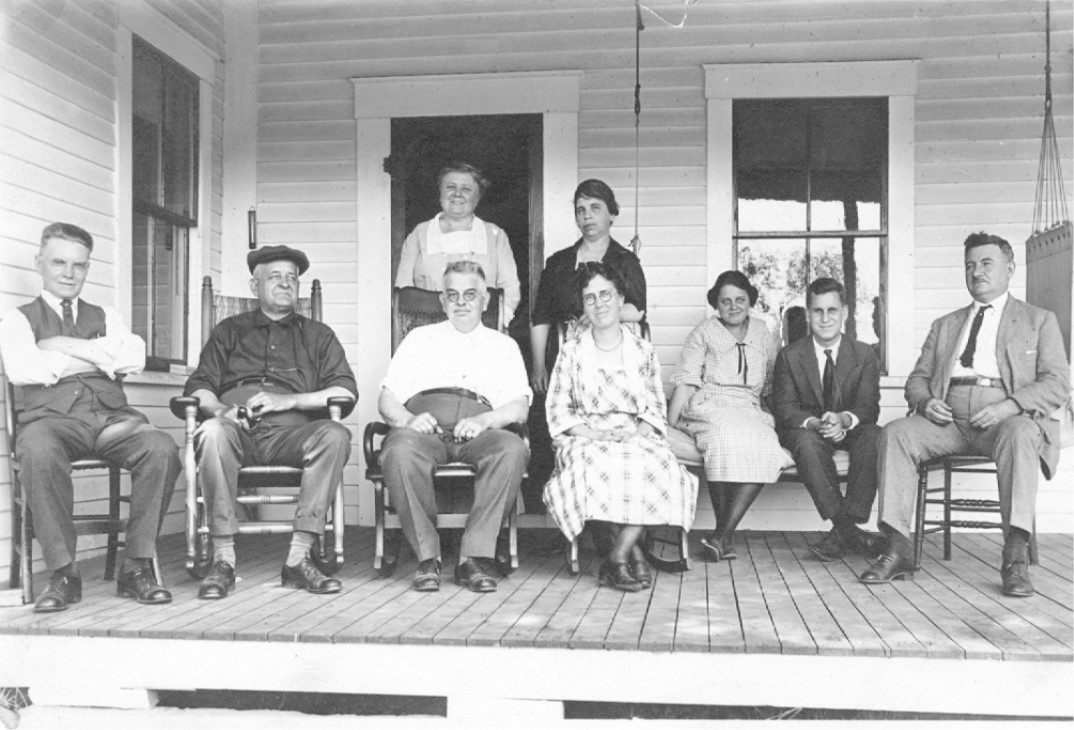
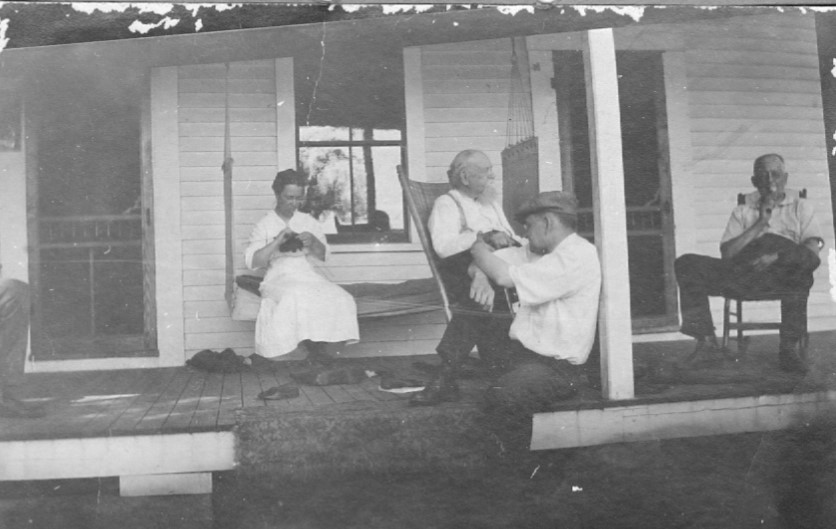
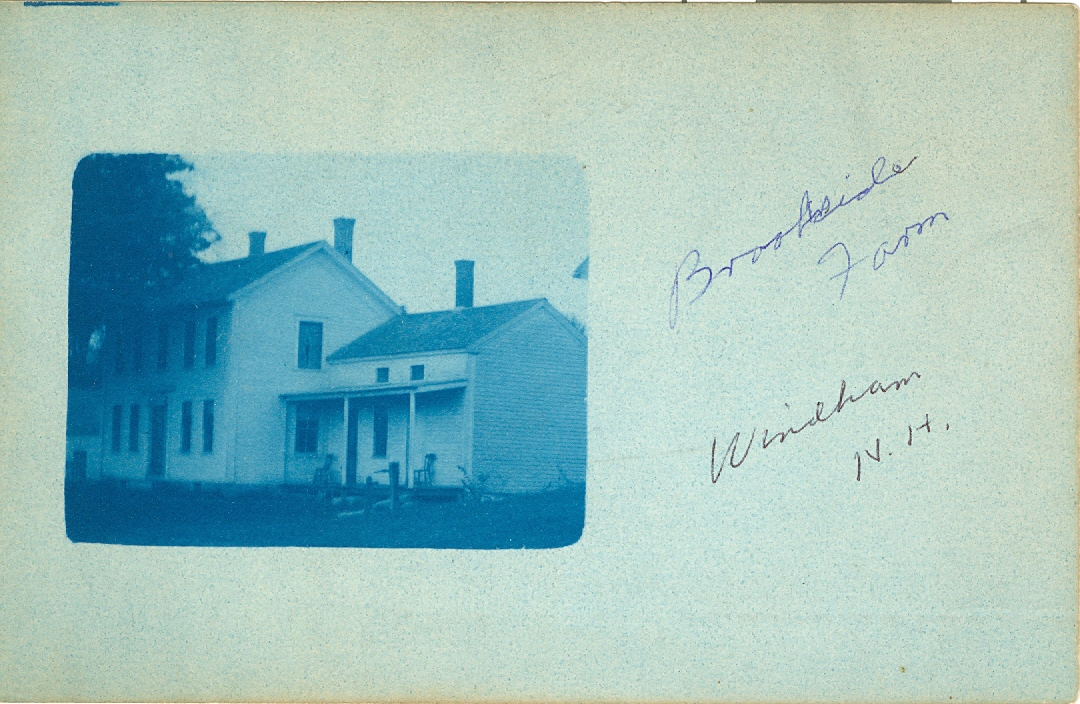
     A very nice couple stopped by to see me, in order to ask about a farm in Windham that their family once owned. They allowed me to make copies of their photographs so I could try to determine the location of the farm.  The “Brookside” sign over the door and noted on a photograph solved the mystery. This is a beautiful photograph of what people now know as the “Fellows” house, which once stood at the corner of North Lowell Road and Route 111, and was torn down a few years ago. Sadly, I misplaced the notes I took about the photographs. I am not sure whether the people in the photographs are Lang Family or the Knowlton Family. Walter and Carolyn Lang bought the property from George Seavey in 1904 for 3,200 dollars. The property was left to their heirs, Walter W. Lang , Elmer Lang and George Lang of Boston, John Lang of Saugus and Harold Lang of Pittsburg, PA. Perley G. and H. Elizabeth Knowlton purchased the property from them  in 1936, subsequently selling to the Fellows in 1946. One of the photographs in the group is a cyanotype (blue) and all the Cyanotype photographs in Windham that I’ve seen were taken about 1910. So my best guess is that the folks in the photographs are the Langs.  What is certain is that these people really enjoyed that porch, overlooking their rolling fields and Collins Brook.


Windham Life and Times – August 26, 2016

Cemetery on the Plain – 1910


scan0769

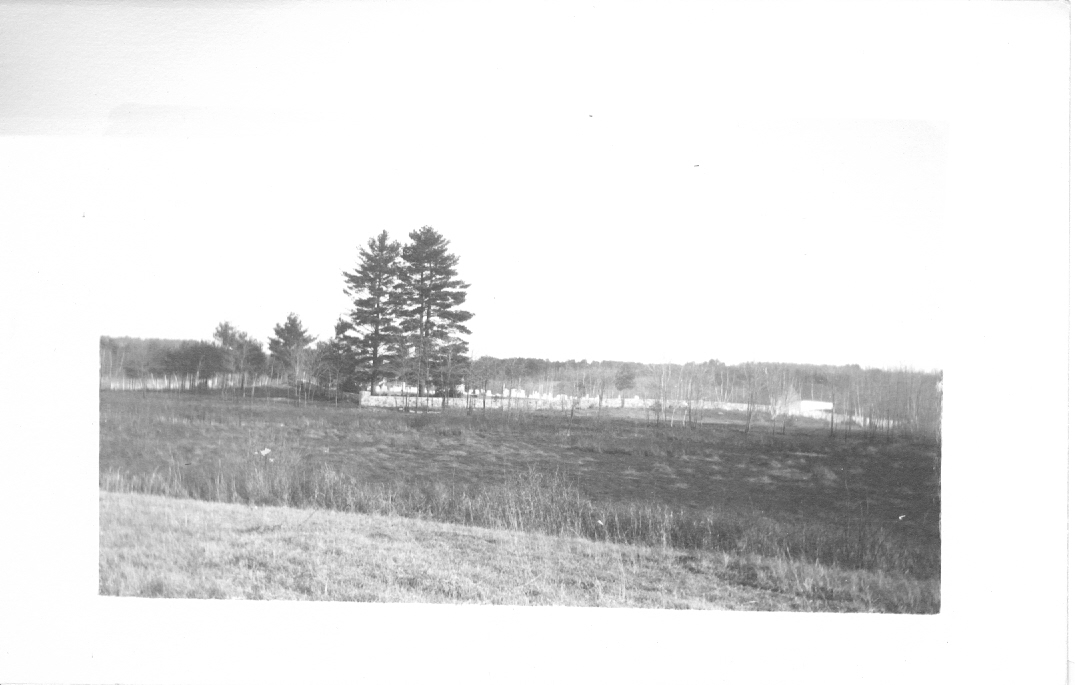
This is an interesting view of the Cemetery on the Plain taken about 1910. It took me a minute to place it. The photograph was taken from Lowell Road, near where Wayne Holm lives today. What is so amazing is the lack of trees. Collins Brook marsh is in the foreground and Garaphelia Park is to the right in front of the stone wall. It’s an interesting site for a cemetery but was most probably chosen because the sandy soil allowed for easy digging of the graves.


Windham Life and Times – August 19, 2016

Letter From Windham, New Hampshire to Bellevue, Kentucky

silas-1

Jerimiah Morrison was born in Windham NH on April 20, 1795. According to L.A. Morrison, “He succeeded his father on the homestead, where he always lived. He was a person of good judgement….He was among the earliest to espouse the anti-slavery cause, and at a time when it was not popular.”  He died of heart disease, in Windham, on November 24, 1862.

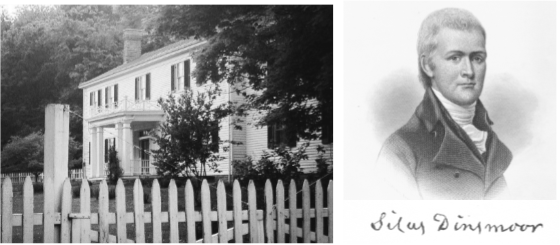
Silas Dinsmoor fitted for college at Williams Academy, in Windham and went on to graduate from Dartmouth College, in the class of 1787. He was appointed by President George Washington to be the U.S. agent to the Cherokee Indians in 1795. After serving in various capacities for the federal government, he moved to Bellevue, Kentucky, near Cincinnati, to where this letter is addressed. He died and is buried on the “Dinsmore Homestead,” which was owned by his nephew James.

silas-2

Above: The James Dinsmore Homestead, in Kentucky, where Silas Dinsmoor is buried. It is a museum today.

Silas Dinsmoor

Bellevue, Boone County Kentucky

Windham, January 15th 1842

Dear Sir,

It becomes my painful duty to communicate to you the sad intelligence of the death of your Cousin John Dinsmoor. You have been apprised of the death of his wife. Since which he has boarded in a respectable family in the neighborhood; his health continued pretty good until September last. Since which time, he’s declined. About a week before his death, he was seized with influenza attended with lung fever which terminated his earthly existence on Tuesday the 11th January, at three o’clock P.M. His suffering had been very severe for several days but was very much relieved the last three days he lived and hopes were… by his physician and friends up to the moment of his death that his health might be partially restored and he enjoy comfortable health for some time. Providence saw best that it should be otherwise. He died suddenly without any apparent alteration to the very moment of his death and without a moan or struggle. Thus our friends pass away one after another. This aged uncle is the last member of that ancient family in this place excepting Mary park who still survives and is not enjoying good health— I have written this at a request of his, signified to me, before his decease.  And I have written with more freedom and greater pleasure from my personal knowledge of you as a friend of my parents. Although you may have forgotten me and most of your younger friends in this place, yet be assured that you are still held in respectful remembrance by many here. And although we may not hope to see you here again yet we would be very glad to receive a letter from you once in a while. We would be gratified to here from brother John’s family those of them in your region. James & Silas I believe are in your neighborhood— I will now introduce myself as a son of Samuel Morrison and Margaret Dinsmoor and say that I would be very much gratified to receive a letter from you. Direct to your obedient servant Jeremiah Morrison.

John Dinsmoor's house in Windham is still standing on Range Road

John Dinsmoor’s house in Windham is still standing on Range Road

The John Dinsmoor in the letter, was born in Windham in 1761. He married Isabella Hemphill in 1791.  He settled on the north part of his father’s farm where he was a blacksmith. Morrison says, “He was industrious and built himself a good house and barn, as well as blacksmith’s shop. But his farm was poor; and whether the shop took up so much of his time as to spoil his farming, or the latter occupation so engaged him as to ruin his business as a smith, or whether the intrinsic poverty of soil is enough to account for the fact that, it is certain that he failed at both occupations and about 1827, was obliged to sell his place. He then moved to the farm of Isaac Thom in Windham Range; this place is now (1882) occupied and owned by his grandson, Joseph W. Dinsmoor. Having profited from past experience, or owing to more productive soil, although he had passed the prime of life, he was successful at his new work, and soon became the owner of the farm. He was a man of decided convictions and unyielding opinions. Late in life, when perhaps his disposition had somewhat soured by his reverses of fortune, he was inclined to be morose and to look on the dark side of the picture. His wife was happily of the opposite turn of mind. Always genial and companionable, making the best of everything, by pleasantly agreeing with her husband in his sharp and often very just criticisms of men and things, he owed it to her that the thought was but momentary, which with opposition would have become chronic…His son John, their only child in the State, resided near him, and was drowned in Cobbett’s Pond in November of 1834. Thus they were left childless, as it were, in their old age. In January 1840, his wife, with whom he had lived in most endearing companionship died of paralysis. She had retired to rest at night, in her usual good health, but in the night her husband awoke and found she had lost the power of speech. And it never returned. Her death was a great shock to him, and broke up his home. He passed the remainder of his days in the family of his neighbor, Ebenezer T. Abbott, one of a family whose name is a synonym for humanities that cheer and relieve distress.” His other two sons, Nathaniel and William had removed to New York. Silas Dinsmoor died, July 17, 1847.