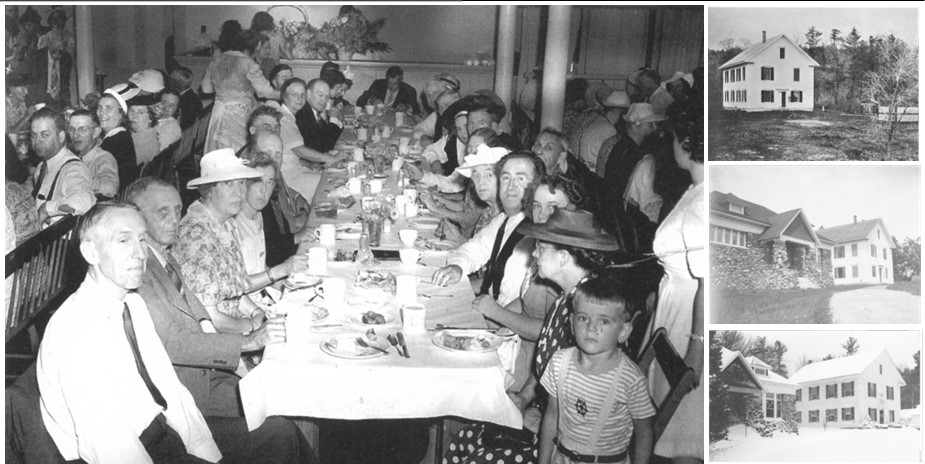
There was a time when the Lower Hall, at the Windham Town Hall. was used for social gatherings rather than town office space. This historic building is in need of repair and there may be a proposed warrant article in this years town budget. Before the advent of auditoriums at the Windham schools, all local events and activities took place at the Town Hall. The photograph above was taken in during the 200th Celebration of the founding of Windham in 1942. Over 400 people enjoyed a chicken dinner in the Lower Hall. This tradition of Town Hall events went back into the nineteenth century. The Derry News article covered an event in the lower hall from February 18, 1881 relating that the Annual Festival took place there: “The Annual Festival was held this year in the lower hall, on Wednesday and Friday evenings, of last week, and was a most enjoyable occasion, and a complete success, netting the Society about $130. The attendance on the first evening was not far from two hundred and fifty, the second night about one hundred. Wednesday even persons were present from all the adjoining towns, and thirty or more from Lowell, Mass. Confectionary, ice cream and button hole bouquets, were for sale, also fancy articles. A beautiful supper was served in the lower hall.” The Grange used to hold their meeting in the Upper Hall and the room that is now a kitchen, was at one time, the location of the Nesmith Library.
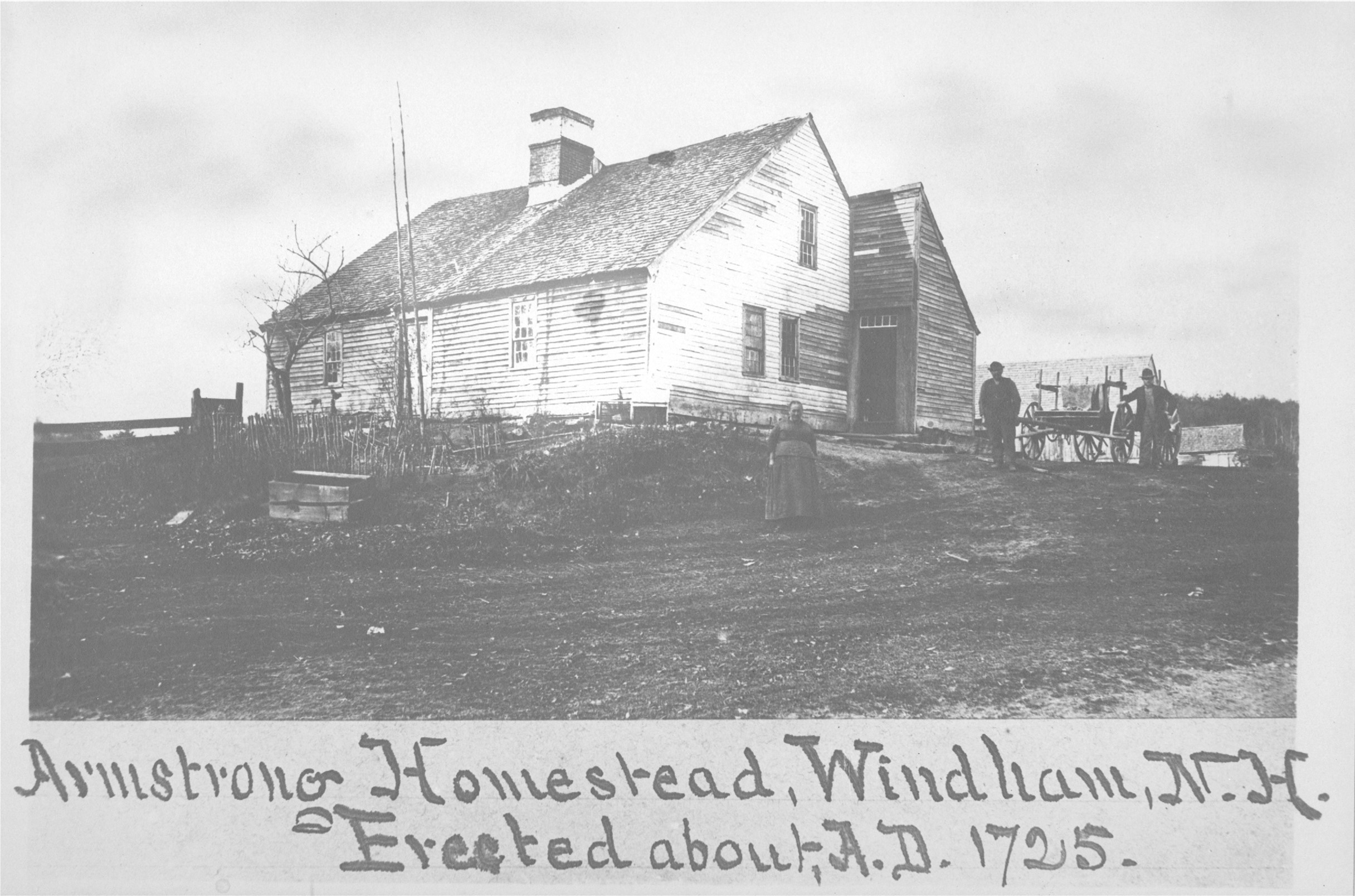
The original Armstrong Homestead is still standing today on Londonderry Road.
The 300th+ Anniversary of Settling in Windham
The Armstrong Family has been in Windham since 1722
The Armstrongs have always liked to boast that they got to “Windham” before the Dinsmores, which just might be true. However, the old records are also just a little murky.
The Armstrong family sailed to America from Northern, Ireland as part of the great 1718 Ulster migration. They followed the Rev. James McGregor and with other families went to Maine. Three Armstrong brothers, with wives, were on the ships. “We know certainly that several brothers named Armstrong landed on Richmond Isle near Falmouth, the old name for Portland and Cape Elizabeth, and founded families. James Armstrong and Mary his wife brought with them an infant son Thomas. John Armstrong and his wife brought an infant son James. Both children were born in Ireland in 1717.”
Robert Armstrong was also one of the party who landed in Falmouth, but he went to Portsmouth, New Hampshire and then to Londonderry…“The core of the company that settled Londonderry, New Hampshire, in April 1719, consisted of eighteen men with their families,—namely Robert Armstrong, Rev. James McGregor, James McKeen, etc. etc.” According to L.A. Morrison, “Robert Armstrong was one of the original proprietors of Londonderry, (*which comprised Windham, Derry, Londonderry and parts of Manchester), on June 21, 1722. There was a ‘home lot and 2nd division’ laid out to him, Dec. 21, 1722, and in the charter of the town it was provided, ‘That the Proprietors of each share shall build a dwelling-house within three years and settle a family therein.’ The fact that he owned this land after the three years would imply the conditions had been met.”
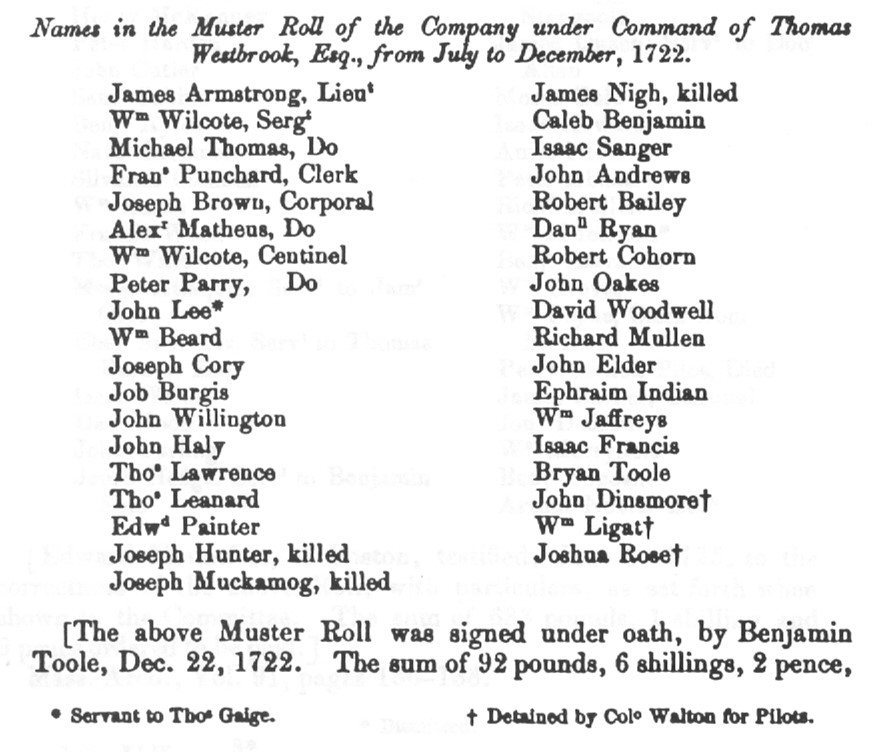
” Interestingly, James Armstrong (Windham Robert’s brother) had been made a Lieutenant by July of 1722, in the Company under the command of Col. Thomas Westbrook. John Dinsmoor, was also in this company from July to December 1722, having been conscripted as a guide after he had been captured by Indians earlier that year. So old Ulster friends, John Dinsmoor and James Armstrong served together in this military company in Maine.
“Whom Robert Armstrong married, or when he died is not known. He is undoubtedly the ancestor of the Armstrongs in Windham. Tradition says that the emigrant ancestor, of Scotch blood, emigrated from Northern Ireland, bringing two children with him. One died on the passage, which he buried in ‘the deep, deep sea.’ He often alluded to this painful experience as the greatest grief of his life. This could not have been John Armstrong, as he was born in 1713; came to America when a boy, and his oldest child was born in Windham; Sept 8, 1738. It must have been Charter Robert Armstrong, the proprietor, who was here with the first settlers in 1722, who lost his child on the passage, leaving an only son, who was John, of Windham, 9 years of age in 1722, If stronger evidence is needed, it is found in the fact that Charter Robert Armstrong’s Christian name has cropped out in successive generations, and is now honorably born by a living representative in Windham”
Robert’s son was Deacon John Armstrong who was a weaver. He was born in 1713 near Londonderry, Ireland and emigrated when young. He lived on the Armstrong “homestead” which is still standing on Londonderry Road, settling there previous to 1738. The current house was built about 1762. He was a Selectman and a moderator. He was a “trustworthy and respected” citizen and active in the Presbyterian church. He had eight children including David, who was born June 11, 1747. He succeeded his father on the family homestead. He signed the Association Test in 1776, was a surveyor and constable. He married Elizabeth Hemphill, January 8, 1775. They had twelve children. She died January 2, 1839 and he died June 21, 1836.”
The Armstrong Homestead in the Range was originally owned by Alexander Park, whose daughter Alice married Robert Armstrong in 1803.
“Robert was born on April 6, 1779. He married July 28, 1803, Alice, daughter of Alexander and Sarah (Maxwell) Park. As there were no sons in the family he became a son to Mr. Park, and resided on the farm with his wife’s parents in Windham Range. She died there November 10, 1830; he died there August 21, 1849. (This is the Armstrong farm that is now the Common Man.) This was one of the old “Range” farms that were laid out between Cobbett’s Pond and Canobie Lake which had water frontage on both.
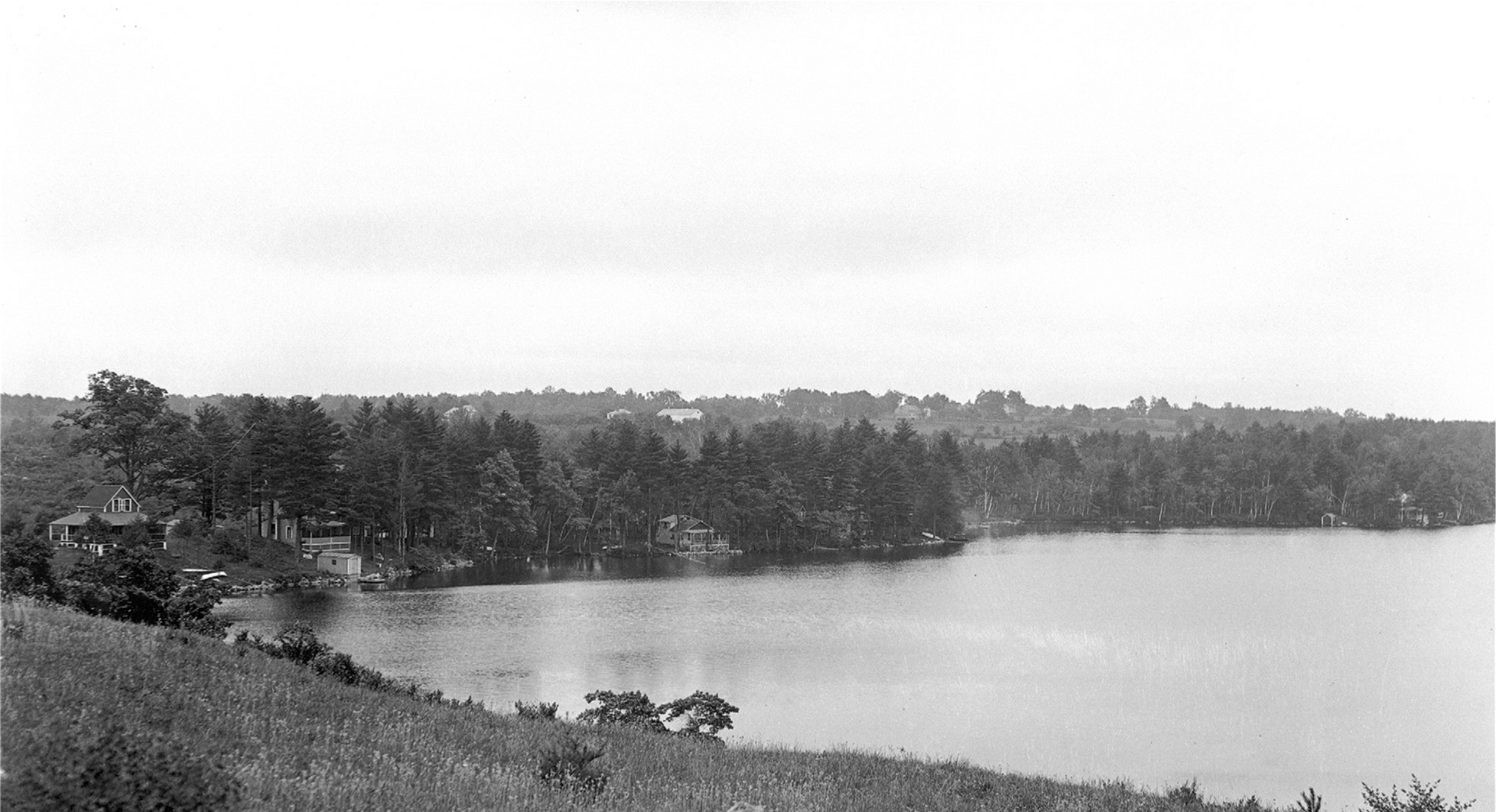
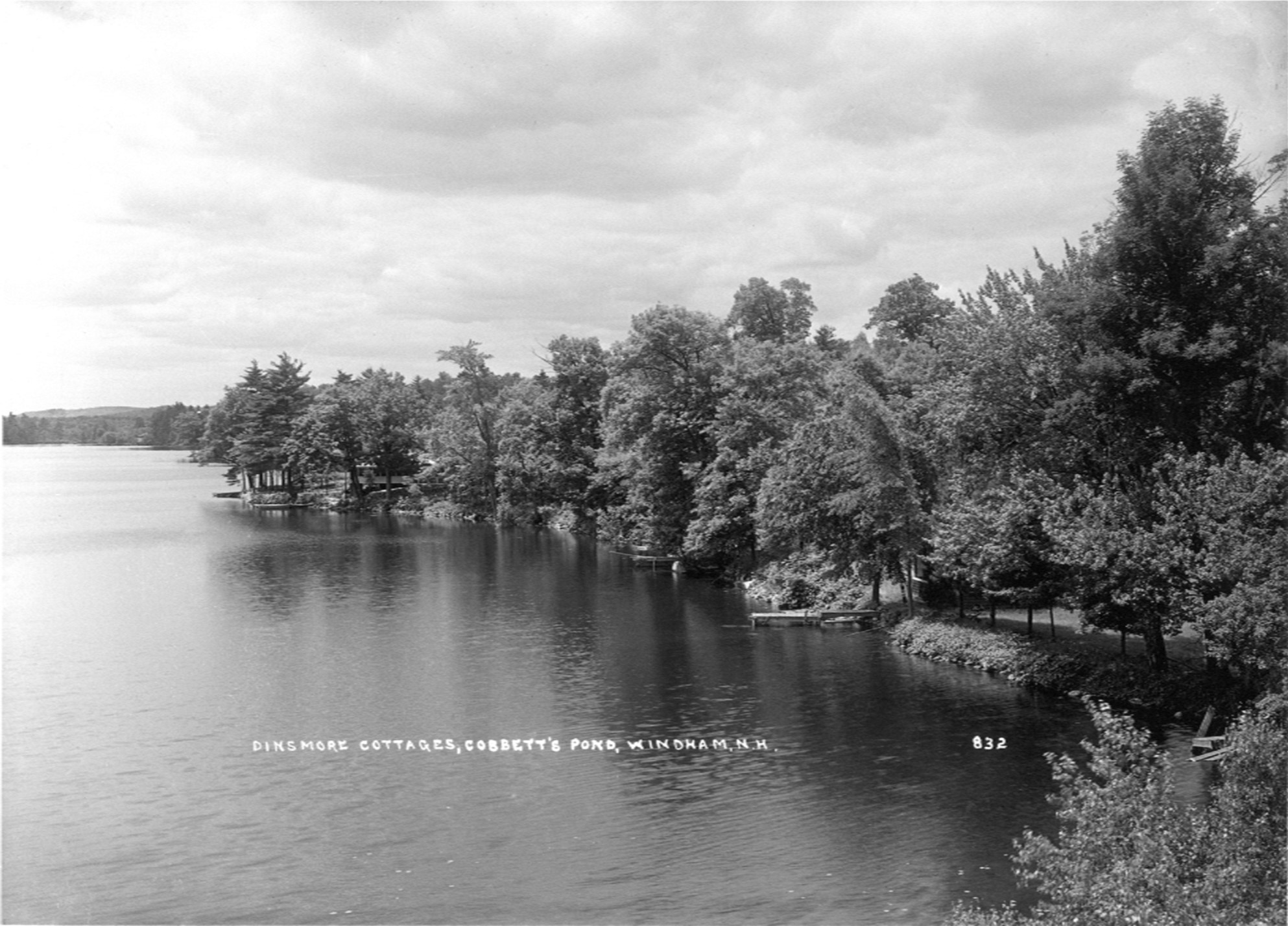
A photograph of the Armstrong farm frontage on Cobbett’s Pond taken form the neighboring property.
His son Robert was born in February 21, 1812 and succeeded his father on the original homestead of the Park family. He married Mary B, Emerson. “A farm not naturally abundant has been made to yield abundant harvests…” They had four children including George F. Armstrong who succeeded his father on the farm.
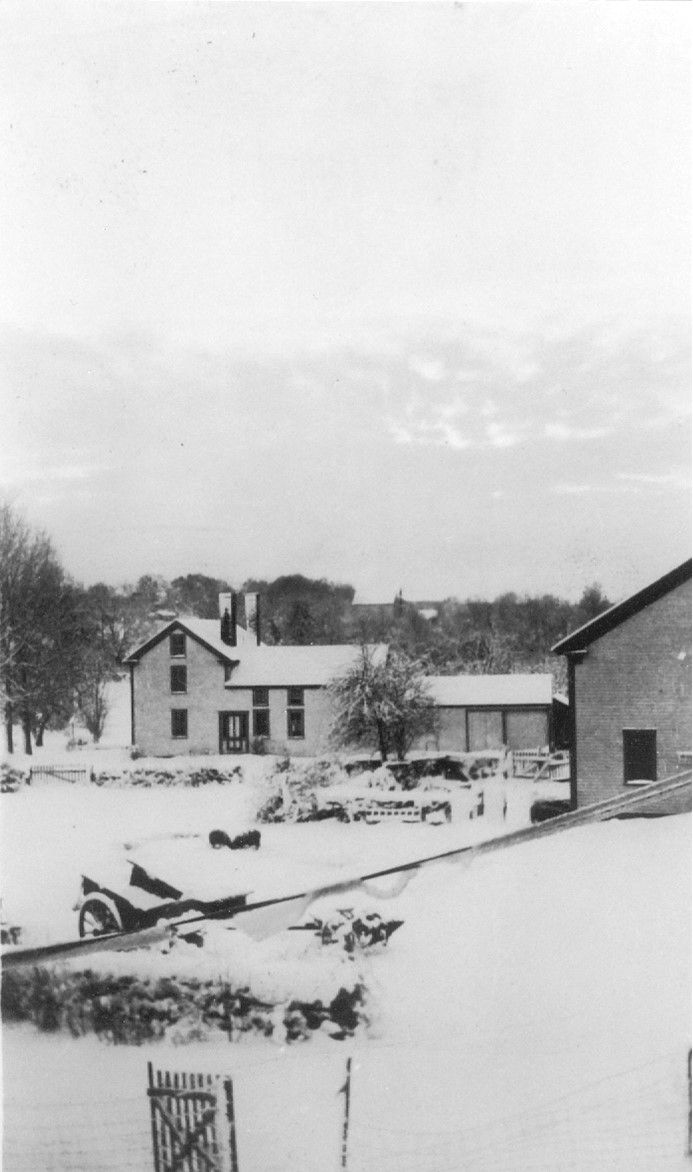
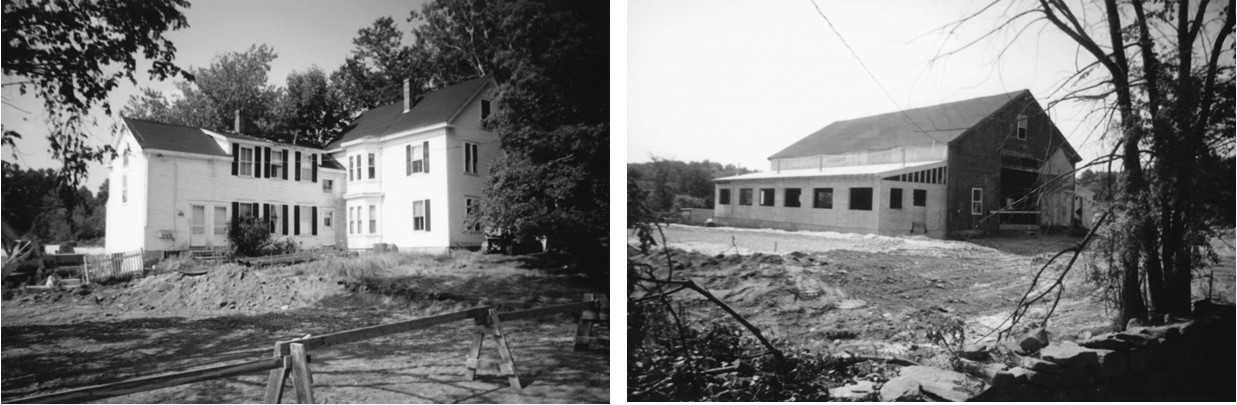
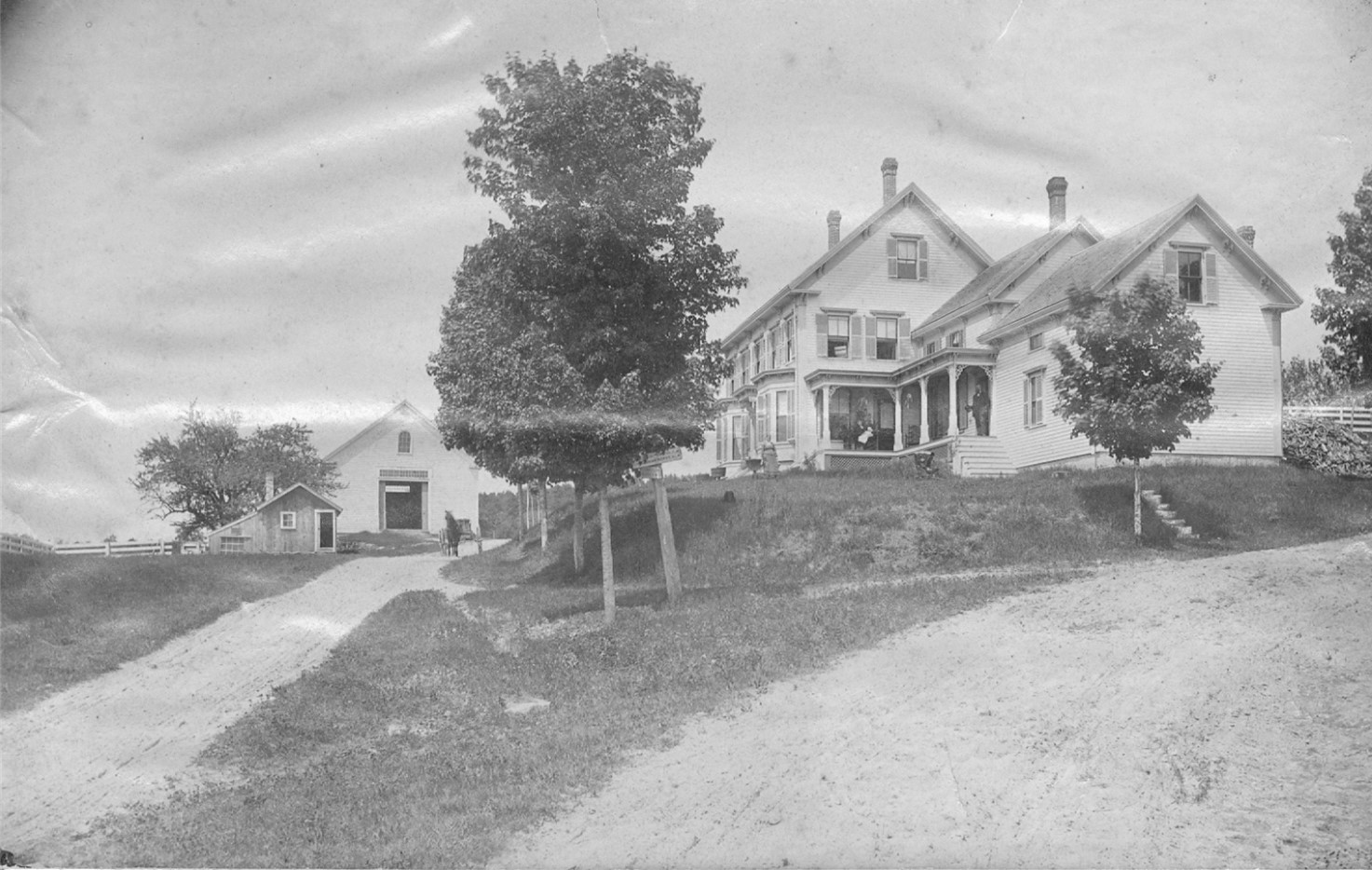
The Victorian era home built by George F. Armstrong.These photographs were taken when Alex Ray was converting the barn into the Common Man Restaurant. The thing I remember most about that barn is the night the race-horse Drill-Rod was born, and my mom and I stopped by to see him… right there about where the first floor window is located.
According to Rural Oasis, George F. Armstrong built the newer (white) Victorian home on the property and his sisters then occupied the original homestead followed later by Maurice Armstrong from 1926 through 1945. George and Dorothy Armstrong occupied the homestead until 1957 when it was sold to the Foden family. The Armstrongs developed camp lots on their farm on the shore of Cobbett’s Pond and on Canobie Lake along what is now West Shore Road.
Maurice’s sons, George and Robert lived in Windham and operated businesses here. Bob ran an excavating business and developed a section of Woodvue Road on Canobie Lake. George and his sons operated a well drilling company for many years and also had race-horses. They were harness racing horses and George’s son Alan was often the driver of the sulky. I sill remember riding in the back of the bronze Chevy wagon, Dot at the wheel, nobody wearing seat belts. I also remember the night we were visiting at George’s home on Range Road, when a car driven by one of his sons went flaming by, at what seemed at the time, to be over 100 miles and hour (and possibly on its side, but my memory is foggy).
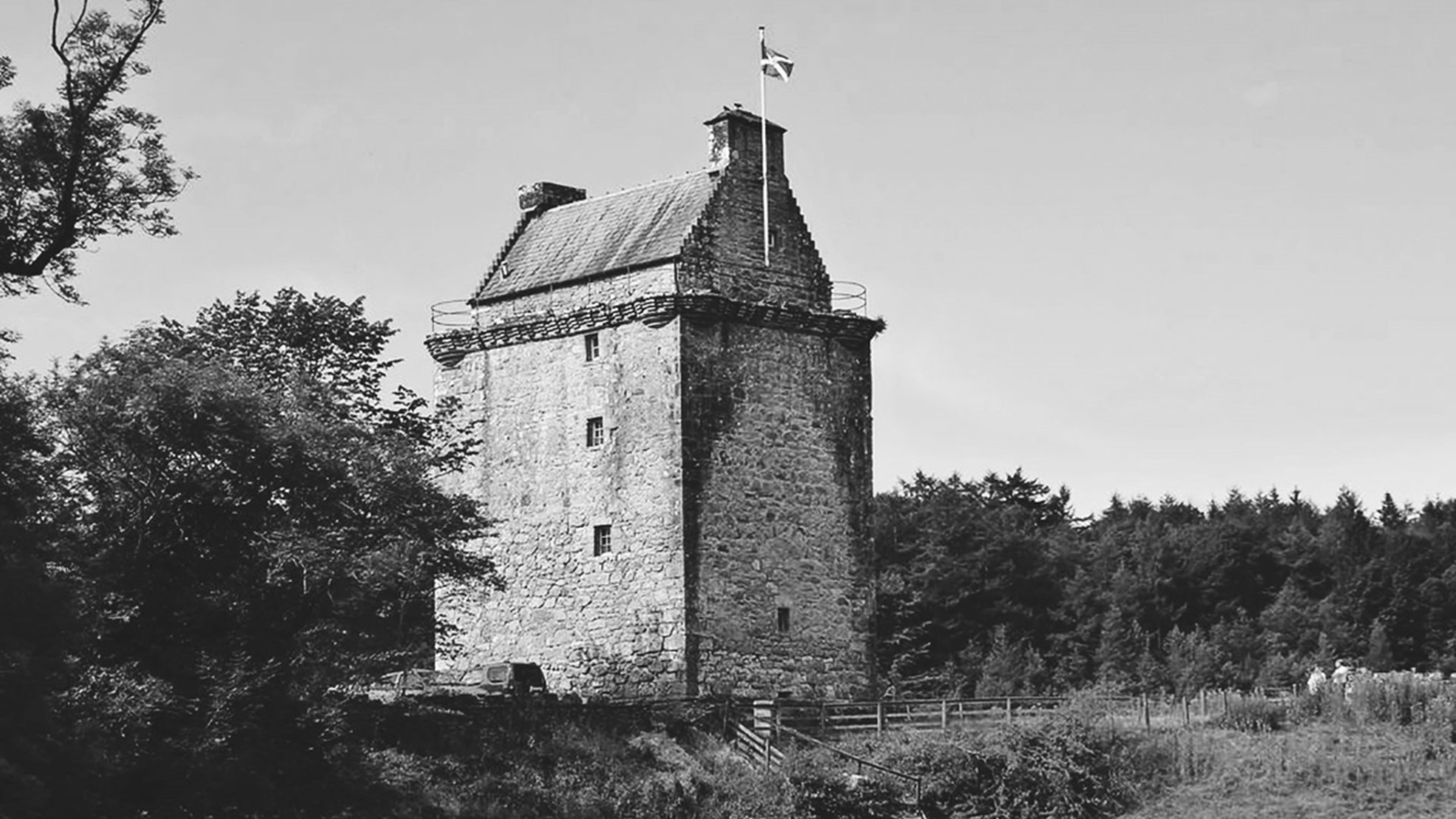
Gilnockie Tower home to the Armstrong clan on the Scottish Borders.
The Armstrong family are descended from the fierce, Scottish border clan, whose fortress was Gilnockie Tower that is located between Canonbie and Langholm on the River Esk. Originally known as Hollows Tower, it was built in 1520 by Johnnie Armstrong, who was the famous Scottish outlaw or “reiver,’ who raided across the border in England.
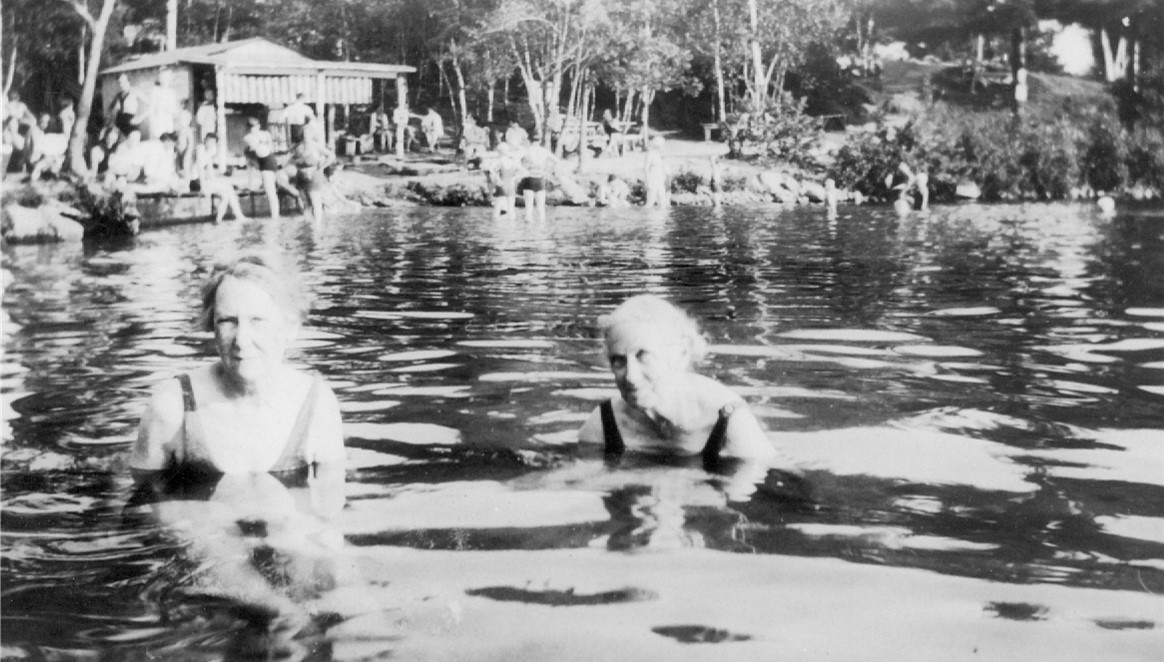
Armstrong Beach was operated by the family many years. My grandparents leased the concession stand one summer. It was one of five, public bathing beaches on the pond. According to Rural Oasis, “At one time this brook was the boundary between Dunkan and Armstrong Beaches and their was a dispute between the properties. “When Bill Ayer, owner of John Dinsmore’s farm on Indian Rock Road, sold his lake property in he 1930’s to George Dunkley of Salem for a public beach the question of correct boundaries arose. Dunkley’s deed read to the brook. Maurice Armstrong owner of the already established Armstrong Beach, claimed the line was several feet to the west of the brook. A bitter dispute, followed by legal actions with many witnesses, proved the brook was the legal boundary. Like the Hatfields and McCoys, George Dunkley and Maurice Armstrong harbored bitter feelings for the rest of their lives.” Apparently, long after, dead fish would go flying across the brook onto the opposite properties in a subtle war of attrition.
George Dunkley sold Dunkan Beach to Jeannette and Bob Comtois in 1966. They improved the property and in the spring of 1971 they decided to sell the property. George Dinsmore and George Armstrong who were good friends, decided to buy Dunkan Beach and combine it with Armstrong Beach and formed Castle View, Inc. In 1974, due to other business pressure George Dinsmore sold his share.
I worked at Dunkan Beach during the several summers that my father was involved in the operation. It was a very interesting place on a weekend afternoon. Parking was always packed on sunny days, 5 dollars on Sunday, and it was all cash. We used to sell hundreds of vinyl blow up rafts each day which would often return with tears when they popped. “Sorry no refunds.”
One day the place was packed and there was a near riot over an accusation of a rape having occurred on the raft. After things cooled down the two families involved were drinking beer together in the afternoon sun. Another day, somebody called in that a bomb had been planted in the pavilion. We called the Windham chief of police to the scene. Old Willis Low arrived, pipe billowing smoke, and he said to my father; “George, if we announce over the loud speaker that there is a bomb, there will be a stampede out of here, and people are sure to be hurt or even die. So my advice to you is that we forget about the whole thing and see what happens.” Nothing happened!
One day there was a couple hitting it pretty hot and heavy, laying on a blanket on the beach. So the decision was made to send out George Armstrong to get things under control. He stood there, stammering, “Miss! Sir! We don’t allow this on the beach!” “It is a family beach.” They totally ignored him and kept at it. George slunk away and we all had a good laugh.
The clientele changed and the era of public bathing beaches came to an end. The Armstrong family decided to build a function hall on the property which they have successfully operated for a number of years. The Armstrongs still own and operate Castleton on Cobbett’s Pond. I was thinking of having an open bar at my wake, I wonder if Castleton would host it? They could prop me up in a corner and my friends and relatives could toast my trip into the netherworld. I’m only slightly kidding!
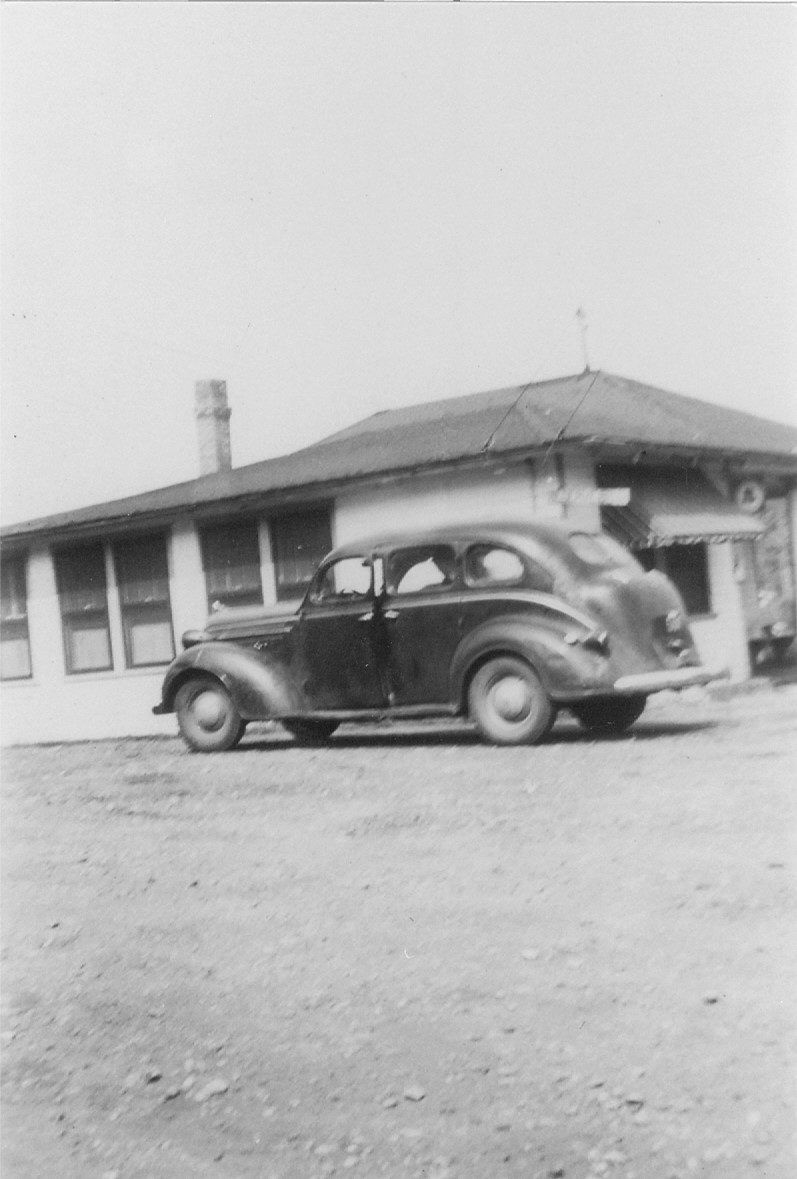
Maurice Armstrong’s car at the “Robin’s Nest” on Route 28 in Windham.
“The Great Race.”
The Robin’s Nest was the local drinking establishment favored by Windham folks. People would meet there to have a beer and swap stories. So you know how when you’re drinking with your buddies, things can sometimes get out of hand? For example, I have heard recently how two local real estate developers, at a local bar, almost came to fist-a-cuffs over who was worth the most.
Anyway, George Dinsmore Sr. and Maurice Armstrong were having drinks at the Robin’s Nest. Somehow, the subject of which one of them could run faster came up in conversation. Everyone in the bar joined in the debate, egging the contestants on. Soon the dispute became heated, no doubt lit by the drinks. It was decided that the only way to settle the matter was for the whole crowd at the bar to go outside and conduct a race on the busy, state highway, Route 28. Wagers were made, the two forlorn and “slightly” inebriated runners were lined up and a race course designated. Bam! Off they went. Imagine what the motorists on Route 28 must have thought! I really don’t know who won, if anybody, but I know the Armstrongs are bound to claim it was Maurice…who won.
When I was a kid, I used to sit enraptured listening to my dad and George Armstrong talking at my house. They would be smoking and drinking beer, hatching plots, talking business deals, gossiping and laughing…I remember the laughter the most! Keeping the pipe lit was always a challenge…but good friends…I’ll never forget them together.
Top: A view from the John H. Dinsmore farm. Near this spot, haying one hot summer day, young Samuel Dinsmore, told his father William, he didn’t want to be a farmer, but wanted to go to Dartmouth college instead. He eventually became governor of New Hampshire.
The Dinsmore Family has been in Windham since 1723.
300 years is a very long time for one family to call a place home. Most people move on, looking for better opportunities, or just different scenery. John Dinsmore came to America as part of the Ulster migration of 1718. In the winter of 1719, he left his fellow Scots-Irish companions, and used his skills as a stone mason to find work building foundations, fireplaces and in construction of Forts for the proprietors in Maine. He was captured by Indians near the fort at St. George, Maine. When warfare between the British, and Indians began in 1722, he abandoned his house in Maine and rejoined his friends from Northern Ireland here. At the town meeting on March 5, 1723, it was agreed to grant him 60 acres in a section of then Londonderry NH, which is now Windham. He built a stone house on the property and was joined by his wife and children; Robert Dinsmoor and Elizabeth Hopkins. John Dinsmoor, or “Daddy” as he was known to fellow townspeople, lived to the age of 99 and died in 1741. The foundations of the farm still exists.
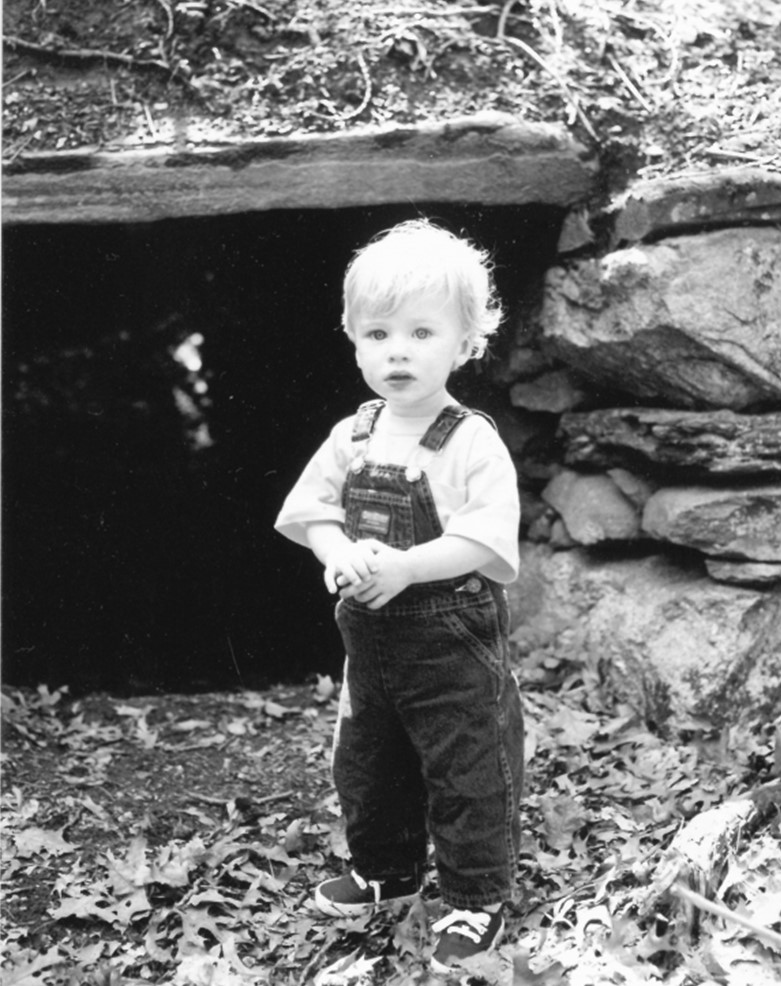
Matt Dinsmore at the ruins of the Dinsmoor-Hopkins Farm near the old Nashua & Rochester railroad line. The foundations of the house and barn are still located on the property and there is an apple tree that blooms in the woodlands.
Robert Dinsmoor, also a stone mason, was born in 1692 and died in 1751 in Windham. He was one of Windham’s first three Selectmen and was instrumental in the establishment of the town in 1742. After the town was founded, the Dinsmoor family was granted several thousand acres of land including the peaks of Jenny’s Hill and Dinsmoor Hill, where Searles Castle is located today, running to the shore of Cobbett’s Pond. Portions of this land are still owned by my parents today.
Robert’s son William was born in Windham on May 9, 1731. When his father’s farm was divided, the “Jenny’s Hill” place so called, consisting of 1,400 acres came to him by the drawing of lots. He married Elizabeth McKeen and built a house and barn on the south side of Jenny’s Hill and planted an orchard. He and his wife had 12 children. He died in 1811.
The Poets Farewell to the Muses
Robert Dinsmoor, The Rustic Bard
Andover’s Steeples there were seen,
While o’er the vast expanse between,
I did with wonder gaze;
There as it were beneath my feet,
I viewed my father’s pleasant seat—
My joy in younger days.
There Windham Range in flowery vest,
Was seen in robes of green,
While Cobbett’s Pond from east to west,
Spread her bright waves between.
Cows lowing, cocks crowing,
While frogs on Cobbett’s shore,
Lay croaking and mocking
The bull’s tremendous roar…
…Farewell sweet scenes of rural life,
My faithful friends and loving wife,
But transient blessing all…
Robert Dinsmoor was born on October 7, 1757 and died March 16, 1836. He was widely known as the “Rustic Bard,” which was the name under which he submitted his poetry to local papers. He fought in the Revolutionary War at the Battle of Bunker Hill. “He was a most genial companion, very fond of society…and maintained a large correspondence.” His first wife was his “beloved” Mary “Polly” Park who died giving birth to their twelfth child. On New Years Eve 1801 he married his second wife Mary (Davidson) Anderson.
Robert Park Dinsmoor was born in 1797 and lived on the farm formerly owned by his father on Jenny’s Hill. He married Sally Gregg. They had ten children together and he died August 28, 1861 and she died March 15, 1877.
John H. Dinsmore, my great grandfather, was born on June 3, 1840 and he occupied the farm owned by his father and grandfather. He married Adrianna Black, the daughter of Gardner and Nancy Black. He erected a new house and barn on his property in 1877 and demolished the old family home. Gardner Road in Windham is named for Adrianna’s father.
Adrianna Black Dinsmore standing in front of my grandfather’s stone house on Indian Rock Road. George Dinsmore Sr. with his daughter Dorothy and George and Edith Dinsmore.
My grandfather, George Dinsmore almost escaped the clutches of Windham. He moved to Wyoming with his new wife, Edith Johnson, but they eventually returned to Windham where he built a beautiful stone home with his own hands, overlooking Cobbett’s Pond.
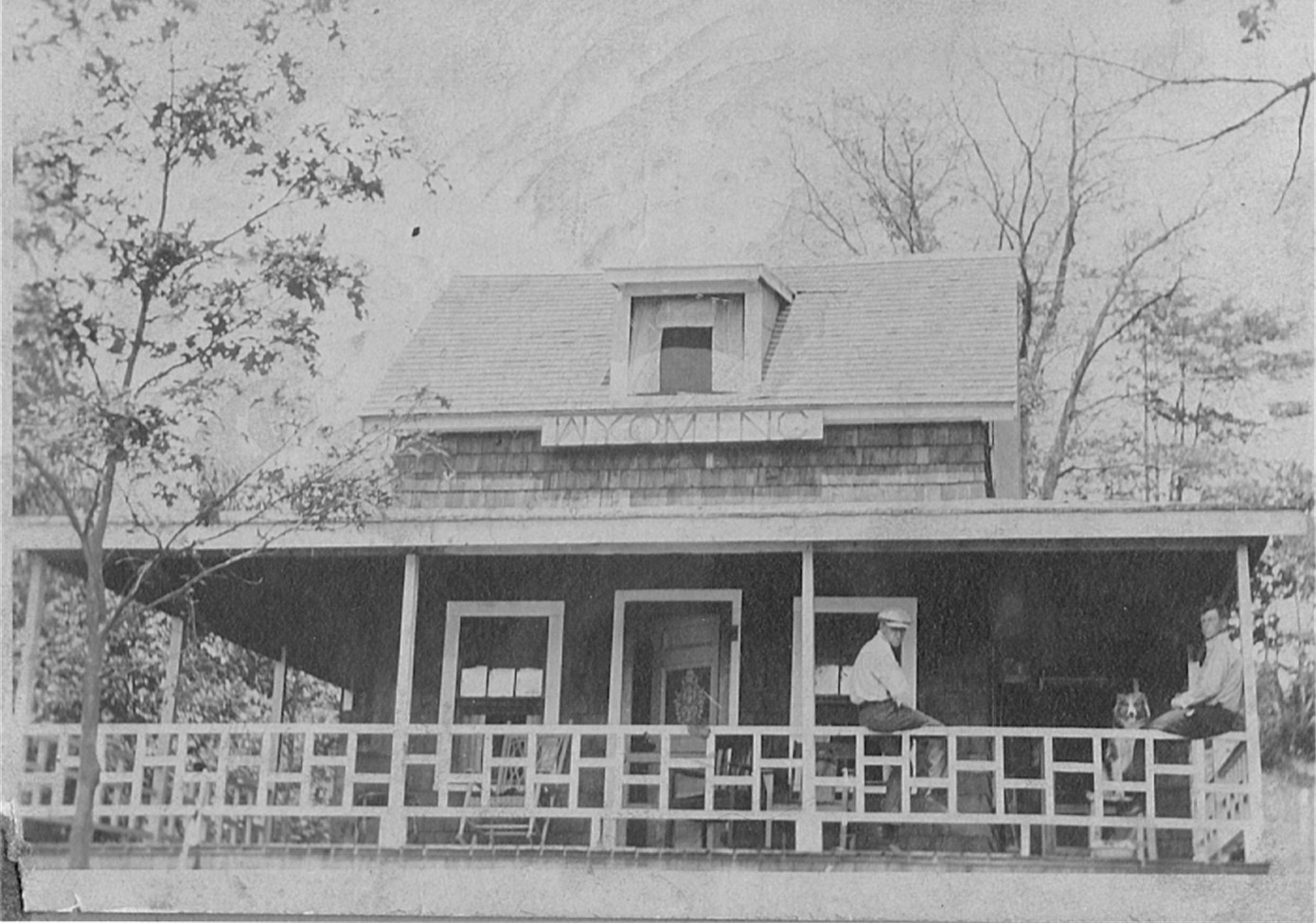
The “Wyoming” a camp on Cobbett’s Pond owned by George Dinsmore Sr. and named in honor of the place that always lived large in his heart. It is said that he once shot a whisky bottle out of the hand of a resident that lived across the pond from this very porch.
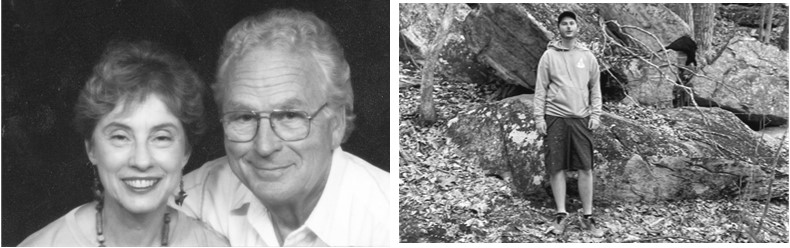
George and Edith Dinsmore had three children (John, Dorothy, and George) including my dad George Dinsmore Jr (Jigger). My father was in construction, assisted by his wife Marion (Mackenzie) who he met because her family had a camp on Cobbett’s Pond. Their companies built many homes and commercial buildings in Salem and Windham. My father was a selectmen for two terms in the late sixties and served on the planning board. They are now 91 years old and have been married for over seventy years.
The tall tales of George Dinsmore Sr. were well known around Windham. He normally would light upon somebody new to town and begin his story. He often told tales of his grandmother, Sally (Gregg) Dinsmore. The one I remember from childhood is this one:
How Cobbett’s Pond Came to Be
My grandmother was a hardworking woman, and her pride and joy were her watermelons which always won awards for their size at the country fair. She grew her watermelons on the side of the hill on her farm overlooking the broad valley below. One summer, she decided to use a secret formula to make the melons grow large, fat and juicy. And the watermelons grew. And grew. AND GREW SOME MORE! Soon they were so big, they were taller than my grandmother and she became alarmed they would roll down the hill and be ruined. So she devised a plan. She had her husband build large wooden braces to hold the giant melons in place. One day grandmother was out hoeing weeds in her watermelon patch and she accidently hit one of the braces. Well, that was a huge mistake and the giant watermelons, shining in the bright sun, began to roll down the hill toward the valley below. Well grandmother went ass over teakettle, rolling down the hill along side the giant watermelons. When the watermelons hit the valley below, they literally exploded filling it with water. Poor grandmother would have drowned too, if she had not been able to latch onto one of the giant seeds and paddle herself to shore. And that my friends is how Cobbett’s Pond came into being!
George and Marion Dinsmore and their grandson Isaac Dinsmore
So why did I decide to stay in Windham? Tradition I guess, but there is more to it than that. Windham was also a great place to start a family, a business and it’s also a great location just 30 or so miles from Boston. And when I was able to purchase an acre and a half of land and a cottage overlooking Cobbett’s Pond for $155,000, in 1985, it was a done deal. I will always be grateful to Sue (Binns) Alosky for helping me find my place on Cobbett’s and for introducing me to my wife, Kristie; her cousin. Every day, I find a reason to be happy that I live in Windham, overlooking the lake and Dinsmoor Hill and knowing my son Isaac now lives in town as well. Maybe, 300 years, isn’t that long of a time after all!
The following is from L.A. Morrion’s introduction to the second edition of Robert Dinsmoor, The Rustic Bard’s poetry. It verifies the early records of Londonderry that John Dinsmoor arrived here in 1723.
Maine, where there was an English fort, and while engaged in building a house for himself was taken captive by a band of Indians and carried away a prisoner. I have not been able to find any historic account of his settlement, or attempt to settle at that place, save that given by the Rustic Bard in the first edition of his poems, and I give it as the family tradition thus authenticated by his own pen : “The Indians had appeared quite friendly to him while so engaged in preparing himself a house, often visited him, and called him and themselves in their broken English ‘ all one brother,’ till one day they surrounded his unfinished cabin, with a war- whoop said, ‘ no longer one brother, you go Canada/ and he went with them, and was kept with them three months. The chief’s name was John, and his prisoner was made his body servant. One day when the chief was called away to a council of war, the prisoner was accused by two squaws of having been seen on a point of land near the shore in conference with some Englishmen, and although the edge of the St. George’s River, at the elbow, and a blockhouse at a short distance, having a large area between, enclosed by palisades and capable of receiving 250 men.” In Eaton’s Annals of Warren, Me., published years ago, is the following: “In 1719-20 two strong block- houses were erected, and the old trade house, which was situated directly in front of the spot, where the residence of the late General Knox now stands, was remodeled, being made a sort of fort.” The site of General Knox’s mansion was occupied in 1898 by the station of the Knox and Lincoln railway, at Thomaston, Me It was at Thomaston, Me , that Fort St. George stood. It was there that John Dinsmoor landed when he came to America. It was there he built his house, and while shingling it was captured by the Indians. The chief was still absent, he was condemned to be burned. He was bound to a tree, the fatal pile of wood made around him and that instant to be fired, when providentially the chief returned and commanded the execution delayed till he could enquire into the truth of the charge, alleging, if true, their tracks could be seen, as the ground there was sandy. The charge was soon proved to be false, and he, was reprieved. The last three days he was with them they traveled almost night and day, a great part of the time on k a dog trot,’ carrying their canoes with them. When they had a river to cross, as soon as the chief was in the boat it was the prisoner’s duty to push off and jump in after, and having just performed that duty at a certain river, the chief who had resolved to set him at liberty forbade him. He pleaded for liberty to step in, but the chief said, ‘ you much honest man John, you walk Boston.’ He replied, ‘ the Indians will kill me.’ The chief then told him how and where he could find a cave in a rock where he must lie three days and in that time the Indians would all be past. He gave him some bears’ grease and nuts, saying, ‘ Indians and French have all this land, you walk Boston John, then take English canoe, walk your own country. You much honest man John.’ He then took his solitary way and found the rock as he had been told. When he had lain there three days and nights, and seen the Indians, tribe after tribe, pass, till they had all gone, he arose from his cave and thought he must die of hunger, but by chance, or rather by Providence, he found some cranberries which supported him till he arrived at Fort George. From thence he got a passage to Boston, and from there he visited his old friends and countrymen in Nutfield. They had all been acquainted with him in Ireland. For the respect they had for the man, and perhaps moved by the narration of his perils and sufferings, the proprietors of Londonderry made him a gift of one hundred acres of land, and confirmed it by deed to him and his heirs forever. He was a mason by trade and built himself a stone house.” This appears to have been in 1723. After that he sent to Ireland for his wife and children, but they did not reach him in his new home till 1730. Neither tradition nor family records had handed down to the Rustic Bard, the Christian or sir-name of his maternal great-grandmother, and so far as my enquiry in the family extends, which comprehended every family of lineal descent up to 1883, I was not able to find the name, till during the current year the untiring research of Hon. Leonard Allison Morrison found that honest John had verified the appellation given him by the Indian chief, by his last will and testament, made Oct. 6, 1736, proven Jan. 4, 1736-7, now in the Probate Records Office of Rockingham County at Exeter, N. H., (as every honest man should, by providing for his widow) had answered our enquiry by calling her Hannah. John and Hannah had two children who came to this country, a son and daughter. The son Robert had married in Ireland Margaret Orr, and his sister Elizabeth married John Hopkins, and the wife and daughter with her family went to live in the stone house built by the husband and father on the land given him by the proprietors, and it is well authenticated that they continued to live as one family till the death of John the father, and that thereafter his widow, Hannah, lived till her death with the daughter Elizabeth, which facts go to show that the Bard was not warranted in his conclusion that the wife of John who came to this country was a second one, that had blessed him, for, genealogy rarely shows daughters falling in love with step- mothers. Robert Dinsmoor, the grandfather of the Rustic Bard, was evidently no ordinary man. We find him reaching the Londonderry Colonists in 1730, from whom he obtained title to a large tract of valuable land in the original town of Londonderry, which was near the tract deeded by the Colonists to his father, on which he built himself a residence, and which has been owned and occupied as a home- stead by his descendants till the present day. His eldest son, John, married the daughter of James McKeen, who, as chief man among the Colonists, came from Ireland in 1718, selected the Londonderry tract of land for settlement, then called Nut- field, and his daughter Elizabeth married James McKeen, Jr. Upon the organization of the town of Windham, under grant of charter from the provincial government of New Hampshire, this Robert Dinsmoor was named as Chairman of the three commissioners therein appointed to organize the town in 1742. His son William, born May 9, 1731, was the father of Robert, the Rustic Bard. He married Elizabeth Cochran, granddaughter of the same Justice McKeen, and settled on a part of his paternal acres which, then a primeval forest of oak and pine trees, awaited the axe of the pioneer man, whose strong arm should level the forest and compel a hard reluctant soil to yield the fruits necessary to support a christianized civilization. By lot, the father, Robert, divided his lands between his three sons, who lived to manhood. John, the eldest, drew that part which extended northerly toward Londonderry. Robert, Jr., drew the homestead, which occupied a commanding view of the country east and south, and in later years has been honored by a view of the once-renowned Boston and Concord Turnpike, and in still later years by the Lawrence and Manchester Railroad, and has had that rare attraction which has held spellbound to it the family name from generation to generation, known and honored for the intelligence and Christian vir- tues of its occupants that has made the spot a beacon light to the passing ages. The younger son, William, the father of the Rustic Bard, drew by the same cast that portion of the domain which embraced “Jenny’s hill,” a mound of sixty acres or more from which can be seen the Monadnock in New Hampshire and the Wachusett in Massachusetts. The land extended and embraced, in part, that charming lake, now surrounded by its beautiful farms and wood-capped hills, two and one-half miles long by one-half mile wide, and called ” Cob- bet’s pond ” from the fact that the colonial government in Massachusetts, which never owned a foot of land near it, granted it with five hundred acres of land to a minister by that name, Rev. Thomas Cobbet, in Ipswich, Essex County in Massachusetts, and thereby shows how unfortunate it is to get a bad name when young. But the very air of that place seems to have been poetic, as I find in the History of Windham a beautiful and touching tribute of affection to the memory of his deceased brother by the Bard’s father, found in a letter to his sister, that has escaped the ravages of the tooth of time by the thoughtful care of the historian and is given a place here as a meed of honor :
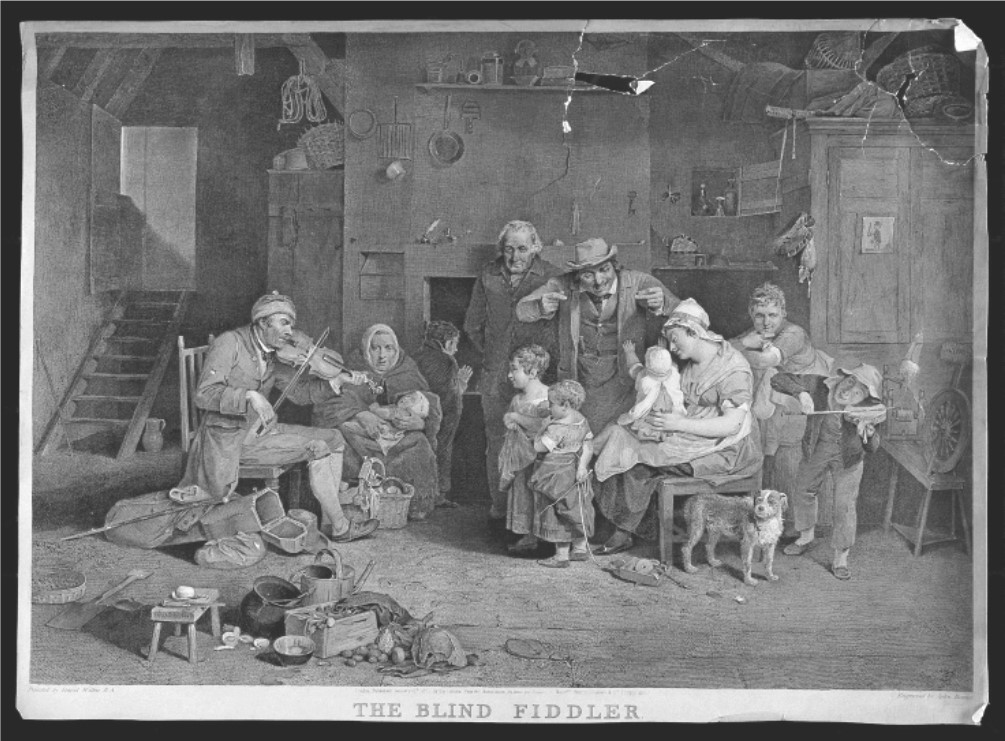
A blind man plays the fiddle to a family audience. Coloured engraving by J. Burnet after D. Wilkie, 1806. Credit: Wellcome Collection. CC BY.
Reverend MacGregor’s Fiddle
Scots-Irish Influence on American Music
E.H. Derby in his address to the Londonderry Celebration of 1869 says, “..and, if tradition may be trusted, even their clergy introduced musical instruments into New Hampshire. I do not refer to the ear-piercing fife alone, or the spirit-stirring drum, whose ‘toot’ so engrossed the ear that Matthew Clark, when presiding over the Session, that he could do no business,— I allude to a stringed instrument of music. The pastor of whom the tale is told had served as a chaplain in the army, and while in camp had learned to play the violin. He brought one to America — doubtless at the bottom of his chest — and in his log cabin, in the dreary winter nights, found solace in the music. But, late one night, an elder heard the ‘linked sweetness drawn out,’ and peeping through the crevice in the cabin, liked the elders who watched Susanna, decried his pastor in the very act of drawing the bow, and reported him to the session; and the elders decreed that he should ‘hang up the fiddle and bow’ for three successive Sundays, in front of the pulpit. And this, I presume, was the first display of stringed instruments of music in New Hampshire. Derry must not, therefore, be forgotten at the great Musical Festival, for which Mr. Gilmore is rearing a structure that reminds of the Coliseum.”
Well if fiddle playing was frowned upon by the early elders of Nutfield, it soon took on a prominence within the community. In Old Portraits and Modern Sketches, 1850, John Greenleaf Whittier reports the following about the fairs held in early Londonderry. “Their moral acclimation in Ireland had not been without its effect upon their character. Side by side with a Presbyterian as austere as that of John Knox, had grown up something of the wild Milesian humor, love of convivial excitement and merry-making, Their long prayers and fierce zeal in behalf of orthodox tenants, only served, in the eyes of their Puritan neighbors, to make more glaring still the scandal of their marked social irregularities. It became a common saying in the region round about, that, ‘the Derry Presbyterians would never give up a pint of doctrine or a pint of rum.’ …Ere long the celebrated Derry Fair was established in imitation of those with which they had been familiar in Ireland. Thither annually came all manners of horse-jockeys and peddlers, gentlemen and beggars, fortune-tellers, wrestlers, dancers and fiddlers, gay young farmers and buxom maidens. Strong drink abounded… A wild, frolicking, drinking, fiddling, courting, horse-racing, riotous merry-making— a sort of Protestant carnival, relaxing the grimness of Puritanism for leagues around.” The Scots-Irish seem to be characterized by an uneasy dichotomy, the side by side need for both religious revival and the “hooting and hollering” of a jolly good time!
The same Scots-Irish people who settled in Nutfield were also the dominant cultural force in the settlement of the Appalachian Mountain areas of Virginia, West Virginia, Kentucky, Tennessee and North Carolina. And these Scots-Irish settlers certainly brought the fiddle with them and used it plenty, in the mountains and valleys where American country music had its roots. There is a great New York Times best seller, called Wayfaring Strangers, written by Fiona Ritchie and Doug Orr, with a forward by Dolly Parton, that traces this “musical voyage” from Scotland and Ulster to Appalachia. These settlers, “brought with them a wealth of traditional ballads and tunes from the British Isles and Ireland, a carrying stream that merged with the sounds and songs of English, German, Welsh, African American, French, and Cherokee origin.”
I’m just a poor wayfaring stranger
Traveling through this world below
There is no sickness, no toil, nor danger
In that bright land to which I go
I’m going there to see my Father
And all my loved ones who’ve gone on
I’m just going over Jordan
I’m just going over home
I know dark clouds will gather ’round me
I know my way is hard and steep
But beauteous fields arise before me
Where God’s redeemed, their vigils keep
I’m going there to see my Mother
She said she’d meet me when I come
So, I’m just going over Jordan
I’m just going over home
I’m just going over Jordan
I’m just going over home
Getting back to Pastor MacGregor and his fiddle, Wayfaring Strangers in explaining the origin of the Scottish fiddle states, “Throughout the long history of migrations from Scottish Lowlands and Highlands, the fiddle was the ideal traveling companion, whether for sailors, journeymen, merchants, or emigrants. It was portable, adaptable to new playing styles, the instrument of choice for dances, and perfect both for soloists and playing partners. So it is not surprising that the fiddle eventually followed the Scottish emigration trail all the way to the southern Appalachians. Beginning in the seventeenth century, it took its place as the most popular dance instrument on both sides of the Atlantic. Hanover County, Virginia, hosted the first fiddling contest of colonial times in 1736, held on November 30 in honor of the holiday of St. Andrew, patron saint of Scotland.” In Scotland “…the music of the classical violin was the initial attraction, folk-style fiddle playing soon followed. These adaptions of the instrument were no doubt related to the widespread interest in dancing at community gatherings, weddings, funerals, and local festivals and fairs, as well as the ballrooms and drawing rooms of the landed gentry…”
“…The company followed a trail from Haverhill about fifteen miles through the woods.” (But did they come by land? Not according the John Greenleaf Whittier who was intimately acquainted with the Scots-Irish in southern New Hampshire. In his book, Old Portraits and Modern Sketches Whittier describes the pioneer’s journey as follows: “In the early part of the eighteenth century, a considerable number of Presbyterians of Scotch descent, from the north of Ireland, emigrated to the new world. In the spring of 1719, the inhabitants of Haverhill, on the Merrimack, saw them passing up the river in several canoes, one of which unfortunately upset in the rapids above the village. The following fragment of a ballad celebrating this event, has been handed down to the present time, and may serve to show the feelings even then of the old English settlers toward the Irish emigrants:
‘They began to scream and bawl,
As out they tumbled one and all,
And, if the Devil had spread his net,
He could have made a glorious haul!’
“The new comers proceeded up the river, and landing opposite the Uncanoonuc Hills, on the present site of Manchester, proceeded inland to Beaver Pond. Charmed by the appearance of the country, they resolved here to terminate their wanderings. Under a venerable oak on the margin of the lake, they knelt down with their minister, Jamie McGregor, and laid, in prayer and thanksgiving, the foundation of their settlement. In a few years they had cleared large fields, built substantial stone and frame dwellings, and a large and commodious meeting-house; wealth had accumulated around them, and they had every where the reputation of a shrewd and thriving community. They were the first in New England to cultivate the potato, which their neighbors for a long time regarded as a pernicious root, altogether unfit for a Christian stomach. Every lover of that invaluable esculent has reason to remember with gratitude the settlers of Londonderry.”
It’s probably true that both the trails and river provided access for the Scotch-Irish to their new settlement in southern New Hampshire. If they truly did take the river in April it would have been roaring with spring snow melt.
Rev. MacMurphy continues, “The men and boys, perhaps no women or small children as they were to stay with their friends a month while preparations were being made to shelter them; sixteen men, their pastor and the boys, trailing up from Haverhill through the woods, with a few packs on horses, a few oxen and cows, and other live stock. What could they bring? Axes and hammers, saws, iron bars and shovels, hoes and plows, seed corn, potatoes, onions and beans, some garden seeds, some provisions, flour, meal, tea and molasses, pots and kettles, tins and dishes, knives, forks and spoons, their clothing, etc. (Also, undoubtably, rum.) And then where should they unpack? They came to a little west running brook, in a sheltered valley, and decided to camp down there. The horses and cattle were soon staked to good low land grass. By the aid of steel and flint and tinder and dry wood a fine warm fire was kindled and the pots and kettles hung above and necessary arrangements quickly made to prepare supper in the open field. With axes, rude shelters were provided under which men and boys could sleep at night. The number that listened to that sermon on Sunday might have been seventy-five persons, perhaps even a hundred or more, for note that the pastor had six boys and sixteen other men with one exception are quite certain to have had average families for those years.”
The names of the sixteen should be of interest, they may be found in several places: In the Town Records, in Parker’s Centenary Sermon, in Book of Nutfield, and on the map of the Double Range. These sixteen or seventeen men selected their homes on both sides of this little brook and located their huts with reference to frontage on the brook and land a mile long stretching away north and south, but only 30 perches in width; bringing their families near together.” (The rod or perch or pole is a surveyor’s tool and unit of length exactly equal to 5 1⁄2 yards…)
In a month’s time the woman folks were anxious to join the menfolk and come to Nutfield and by that time sufficient accommodations had been erected of hewn timbers, split shingles, and stone chimneys with open fireplaces to make a cheerful place to live in. Rude furniture, tables and chairs, benches and bedsteads, cut and fashioned from the living forest gave an impression of comparative comfort. This colony had not been on the premises a month before they called a meeting and were duly organized. They ordered the construction of a mill dam and saw mill and in six months they had a saw mill in operation on Beaver Brook less than a mile away from their cozy valley, and in less than two years they had a gristmill there and a second saw mill on Aiken brook. So the log shanties began to be replaced and supplemented with framed houses with real boards, clapboards, and shingles. Of course a church was built the first year of Nutfield and just about where the First Church now stands. Four months had brought more families and in September of 1719, they voted twenty more homesteads to the first new comers, to that number who should make immediate settlement in Nutfield. By the time the territory had been surveyed and laid out in ranges and homesteads of sixty acres the number of inhabitants had increased to that degree that the first so called Schedule named one hundred and five heads of families to receive allotments of homesteads; and others rewarded for services rendered the colony, up to the number of homestead rights of 122 1/2.”
“The Wheelwright Deed, given to Nutfield Colony as an Indian title to the ten miles square territory was not signed until October 29, 1719, and consequently the surveying and settling of bounds to the homesteads did not progress much in the first six months of occupation. The colonists working together cleared a few acres of forest around their camps at West Running Brook, with difficulty plowed among the stumps and in common raised and harvested their first crops and thus originated the name ‘common field’ as applied to a section well known to this day. The winter was not particularly severe, their mill was kept running, the timber around prospective houses and homes felled and drawn to the mill yard. In March of 1720 the homesteads were surveyed, laid out, butted and bounded, as we find in the Town Records and may trace on the map drawn for the purpose by the writer of this address and published in sections in Willey’s Book of Nutfield, with the provision that all rights to use these maps are reserved by the original draftsman.”
A June Snowstorm Brings Christmas to the Summit. Among the Clouds, July 13, 1905.
Part 2 – June Christmas
Summit House Opens: “The formal opening of every hotel is an important date in its calendar, and often the management endeavor to introduce some special attraction for the pleasure of those guests first to arrive. Mount Washington – always zealous of its individuality, this season outdid itself.”
“The Summit House was ‘opened,’ Monday, June 26th. The morning was rainy and dense clouds obscured the slightest vision of the outside world. There was wisdom in this arrangement, for it was not the scenery but the completeness of the hotel that was to be made manifest that day. The thermometer, which registered 46 in the morning, having heard a student waiter reciting “What is so rare as a day in June” was not forgetful of its part of the program and toward noon settled slowly to 38, and at 4 o’clock gave a decided novelty by sinking below the freezing point. Immediately the torrents of rain became a driving snow storm, and throughout the night and Tuesday and until late Wednesday (6/29) Mount Washington was in the clutches of a winter tempest, at time the roaring of the wind and the beating of ice and hail against the summit House was almost deafening. But within all was good cheer and comfort. “Dolly” the boiler was never more faithful, and steam whizzed through the pipes assuredly and without cessation, while the huge coal stores performed nobly the extra service required of them. But those were days to be remembered, and the few guests who braved the mountain will not soon forget their experiences. After all, it is not the weather that decides the amount of pleasure to be had in a visit to Mount Washington. ‘For the dissatisfied man all life is unsatisfactory, and for one that is contented the world is full of comforts, and for the cheerful man even the easterly wind is musical in the window crevices.’ ”
—Among the Clouds – Thu, Jul 13, 1905
“A June Christmas Tree: ‘On Wednesday evening, June 28th, the Summit House colony indulged in festivities unique in the history of Mount Washington. The platforms that morning covered with snow and the whole cone of the mountain glistening with frost work and ice suggested midwinter rather than a rare June day. Someone remarked that ‘it would be proper to observe Christmas.’ The idea was a popular one and immediately following breakfast preparations were continued throughout the day for an unusual festival. The manager of the hotel, Miss Mattie A. Clarke, ordered a fir tree brought up from the Base, which through the kindness of the Mount Pleasant House was later made attractive by many festoons of pop corn. Then came the search for gifts. There were about thirty-five employees of the Summit House and Mount Washington Railway to be remembered. Trunks, boxes, even coat pockets were divested of their treasures and by nightfall the tree was overloaded with offerings. Nearly 150 presents were ready for distribution. What they may have lacked in value was made up in quantity. About 8 o’clock the parlor doors were opened. Mr. John Tice presided at the piano and a merry company was soon seated. Hardly had an exchange of greetings been made when Mount Washington’s Santa Claus, Mr. Ed Colter, costumed in a style to make St. Nick himself envious appeared on the scene to the delight of everyone save Leon (the Summit dog), whose association with the genial gentleman had heretofore been confined to an almanac interpretation of seasons. Among the Clouds at this date not having commended an issue, one of the staff presented the initial number of a possible evening addition for midwinter circulation “Among the Snow Flakes.” Next Santa ably assisted by Mark Lee, distributed the presents, a description of which would be impossible. Then followed an excellent musical program, including solos by Mr. Chandler and Mr. Horan, and a chorus selected from the company. While the storm was furious, and together with the freezing temperature made all without wild and terrible, this little Summit House party – warm and comfortable, were living the sentiment of Dr. Van Dyke ‘and best of all along the way is friendship and mirth.’ ” —Among the Clouds July 13, 1905
Remember, we’re looking for a photograph of Mattie Clark for Tim Lewis. Does anyone know of one?
A BOLT-HOLE WHERE THE CHIEF COULD KICK BACK AND RELAX.
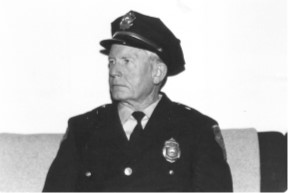
Willis Low was first appointed to the police force before 1941. In the early days, there was no police station so, “most of the police strategy was discussed at the homes of whichever officer was in charge of the particular case. Most of the time it was either the chief’s house or the Zins kitchen. Here would be laid the plans for speed traps, searching a home or camp for stolen goods, etc., but especially careful plans would be made for raids on stills…”
“Most police calls were received by Willis Low with his mother, Mrs. Ethel Low, taking calls and relaying the messages to the other men on duty. This was all done by telephone. You can imagine the interest the neighbors took in town affairs when they heard a cop’s number ringing. All of them were on party lines and one was a sixteen party line with all sixteen rings heard in each home. After Willis married, he of course moved all his police records to his new home on Nashua Road and that is still considered Police Headquarters (1975). His wife took over the answering service and is still on the job although the volume of calls has increased so much there is now a hookup to the police building behind the fire station.”
Willis Low remained the chief into the 1970’s and experienced the tremendous growth in calls after the construction of Interstate 93. As you can imagine, there were times when the chief wanted to escape from all of the demands of the job, which as noted above followed him home. He wanted a place where nobody could find him. Rock Pond is very isolated and really hard to find, unless you know it’s there. He bought the Harry Simpson cottage and updated it into a modern, comfortable summer home. This is the place where he could kick back and relax out of the public view.
The Harry Simpson Cottage (1929) was remodeled by Willis Low.
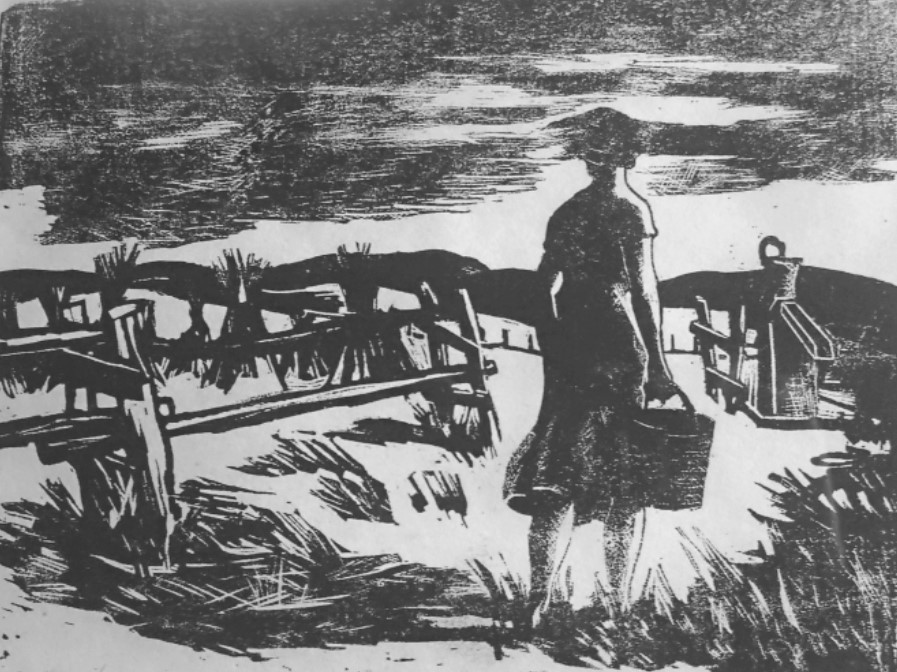
“In the print, Red showed his 19 year old bride walking through the fields in need of water for the strawberry plants. Life so naturally blended with the practical needs of family, that, over time, the gardens expanded, livestock increased, a new farm was bought, and five children were born. Her sole indulgence were flowers, wild and cultivated, where she found beauty after hours of toiling.” On their fiftieth wedding anniversary, Dad nicely summed up their life together when he gently said, ‘Could Not Be Better”. With a wide smile
We know from Ed Devlin’s own words that “he was never quite satisfied with life in the big city saying ‘I’m a country boy at heart.’ He also was quoted as saying, “New York is just not my bag. It’s too fast a pace for me, the city’s too impersonal.” “And when his friend, George Lloyd called him to help paint the mural for Hamilton Smith Hall, at the University of New Hampshire, Devlin grabbed the offer. ‘It was a good excuse to get out of New York…I liked New Hampshire so much I decided to stay.’ ” This was in 1939-40 and the project was a massive mural.
“Artist George Lloyd was on a mission to find a ‘real’ farmer. It was the spring of 1939, and, having been commissioned to paint a mural about agriculture that would cover one entire wall inside Hamilton Smith Hall, he wanted to be sure he could depict a New Hampshire farmer accurately. With UNH agriculture professors as his guide, he soon found his models out in the fields, piecing together a way of life in the aftermath of the Great Depression—much the way he was doing, himself. Lloyd was one of the unemployed artists who had been hired under the auspices of the Federal Art Project branch of the Work Projects Administration, a national program created by U.S. President Franklin D. Roosevelt to provide productive work to some 8.5 million citizens in lieu of unemployment benefits. Coordinated by Manchester artist Omer T. Lassonde, at the time one of the country’s most influential modernist painters. The UNH project included three massive murals, eight feet high and 40 feet wide, in the three main rooms of UNH’s then-library. Lloyd’s ‘agriculture’ mural was to grace the reserve room.” UNH Today. According to the artist’s wife, “this is a mural on farming in New Hampshire, It deals with the four seasons of the year—Spring, Summer, Fall and Winter; and with the four main social institutions around which the farming community is centered—the Home, Town Meeting, School and Church…” UNH Today
“In order to stay in rural New Hampshire, Devlin had to give up his art career. ‘Back in the 40’s there was very little interest in New Hampshire for this sort of thing or with artwork in general. People didn’t have the money to get interested in it.’ He met his wife, Pearl, a native of New Hampshire, and settled down in Nottingham, working a small dairy farm. When their family grew with five children, they bought 100 acres plus in Windham NH.” “He was a farmer for 30 years before he could devote himself to his ‘real work.’ ” “His former art training has given him an artist’s eye for craftsmanship, but he credits farming experience for much of his pottery design. ‘The one thing I have strived for is that a piece not only have a shape, but that shape to have a vitality to it…to live and have appeal,’ he said, ‘It’s a sensitivity of form. My close association with nature, after 30 years of farming helped to develop it’ ”
“But Ed Devlin went back to art work as suddenly as he had left it. Remembering his work with Dedham Pottery where he painted decorations, he remembered an old hankering to learn the potter’s trade.”
“ ‘My daughter was studying pottery at the University of New Hampshire. It restimulated an interest that was in the back of my head,’ he said. ‘I worked with it between farm activities and the more I got into it, the more it interested me.’ ‘As the years went by. This (Windham) was no longer a farming community. We finally got rid of the cows, then I put all my time into pottery.’ ”
PART ONE: “WHAT DO YOU MEAN, YOU DON’T WANT TO BE A DOCTOR ?!”
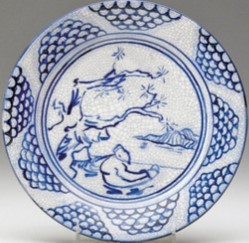
The plate shown above is described by the auction house as, “Dedham pottery crackleware, very rare plate painted by Ned Devlin, Asian inspired scene, 1934. Indigo Registered stamp, artist signature and date. Estimated at between $1,250 and $1,750.” (2008 auction)
Edward Devlin was born in 1912, a Boston native, he grew up in a comfortable home. His father had as they say, “pulled himself up by the bootstraps” and through hard work and determination had become a dentist. It was presumed in the Devlin household that owing to all the advantages given them, that all of the boys would enter the professions, preferably becoming doctors. We can only imagine the conversation, when Edward announced to his father, that he wanted to attend art school. That being said, his father must have recognized that he had “shown artistic inclinations from an early age.” Edward went on to “graduate from the School of the Museum of Fine Arts in Boston where he received a scholarship for painting in 1929.” He also attended Massachusetts Art Institute and studied sculpture at the Copley Society.
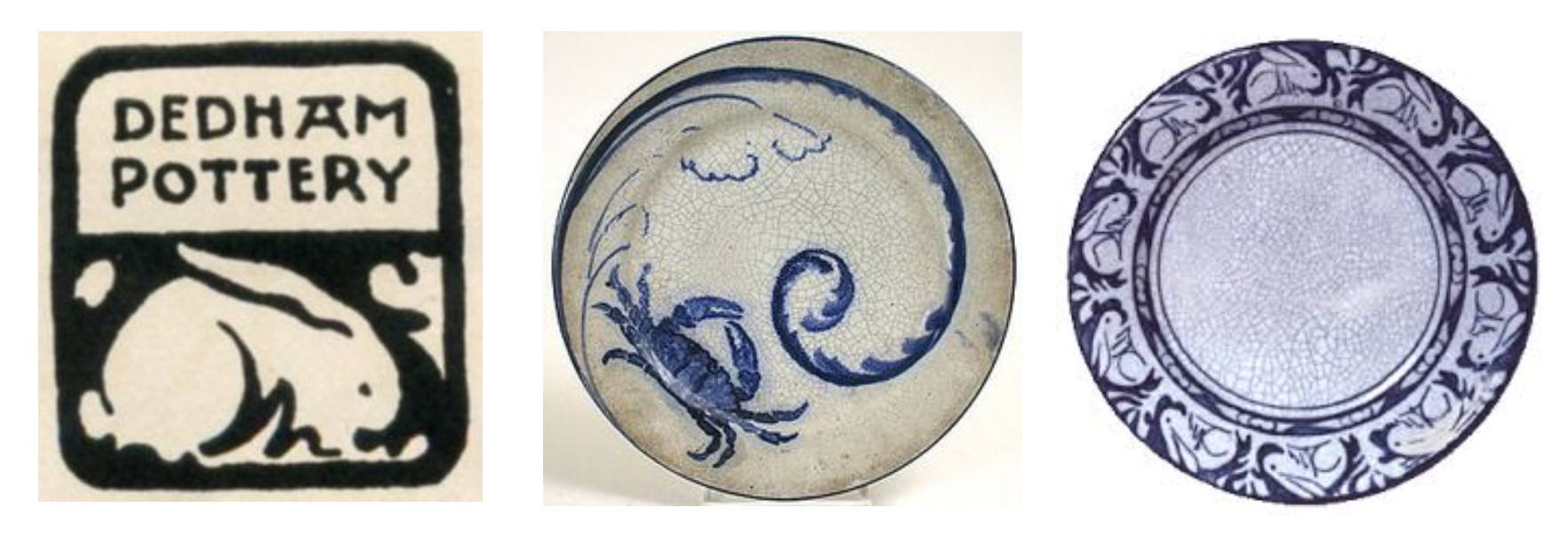
Ed began his career in the 1930’s as a decorator at the Dedham Pottery in Dedham, Massachusetts. When he worked for Dedham, he signed his work as Ned Devlin. While there he created Chinese landscape designs among other motifs. Dedham had been founded by a fifth generation Scottish potter named Hugh Robertson, and operated from 1896 through 1943. It was known for its high-fire stoneware characterized by a controlled and very fine crackle glaze with thick cobalt border designs. A Yankee Magazine article says of Dedham that, “This homage to the raw beauty of nature was never more apparent than during the Arts & Crafts movement. Its back-to-nature aesthetic rejected the industrialization of the late 19th century and embraced a return to the simplicity of handmade goods. American artists heard this call of the wild and, so inspired, produced some of the finest decorative pieces ever made in this country. Beautiful ceramics were one of the movement’s greatest legacies, and among the most popular wares was Dedham pottery, made right here in New England. You likely already know Dedham pottery: that simple tableware with the bluish-gray crackle glaze and cobalt-blue border of flora and fauna. The charming patterns repeat in a right-facing (or, occasionally, left-facing) rotation. It’s reminiscent of Chinese export porcelain, but with a whimsical edge. Both modern and traditional in its appeal, Dedham pottery’s most recognizable border design, the crouching ‘Dedham Rabbit,’ doubles as the image for the company logo.” All of the designs were painted by hand by the artists at Dedham.
The ubiquitous Dedham pottery rabbit plate and other Dedham pottery items.
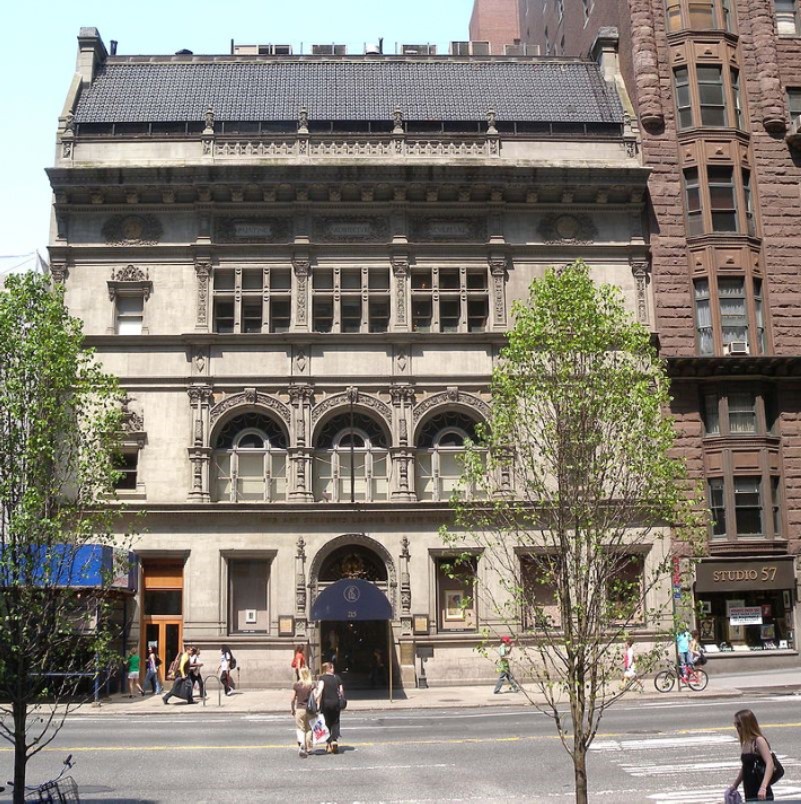
The Art Student League building in New York City. Notable Alumnae include Mark Rothko, Roy Lichtenstein, Georgia O’Keefe and Jackson Pollock.
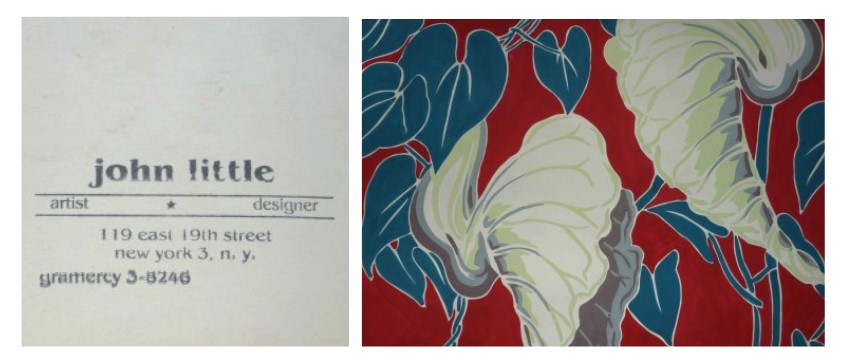
After working at Dedham, Ed decided to head for New York City. While there, he was a member of the Arts Students League. Another member of the league, at the same time, was John Little, who studied there under Georg Grosz (a famous German expressionist painter who emigrated to America in the 1930’s,) and Hans Hoffman. Little was according to the New York Times, “an abstract expressionist artist who founded a New York company that made fabrics and wallpapers with designs inspired by abstract impressionism.” “In 1921, Mr. Little founded the fabrics-wallpaper company, which he called the John Little Studio. By the mid-1930’s the concern was attracting wide praise for fabrics that combined high-quality designs with affordable prices.” Little went on later to paint with his friend and neighbor, Jackson Pollock. Edward Devlin designed fabrics and wallpaper at John Little Studios, during the 1930’s, at the highpoint of the company.
Fabric Designed at The John Little Studios. Date Unknown.
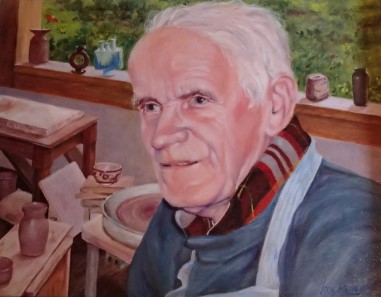
When you think of artists associated with Windham, you might think of the impressionist painter Mary Braddish Titcomb or the western artist, Howard Everett Smith, both of whom grew up in town, but became noted for their art elsewhere. Well, there was another artist, who moved to Windham in the 1940’s, who was a designer, painter and potter, who became very well known in art circles in New Hampshire and beyond.
Over the years, learning about Windham’s history, his name kept coming up in conversation, but I knew very little about him. Of course, I knew his wife Pearl, personally, from my trips to the Nesmith Library as a child. Then one day, I was given a piece of pottery, that bore the imprint of Ed Devlin on the base. The vase had belonged to long time Windham, Chief of Police, Willis Low. Little did I know at the time, that the potter and the chief were close friends, as you might have expected them to be in a small town, like Windham was, during their lifetimes. Back then, the rhythm of life was a bit slower and more humane. Willis will always be remembered for the way he handled the kids who went astray, working in his unique way to put them back on the straight and narrow, without all the fuss and hysteria often seen with juveniles today. And it’s Willis Low’s vase that renewed my curiosity about Ed Devlin.
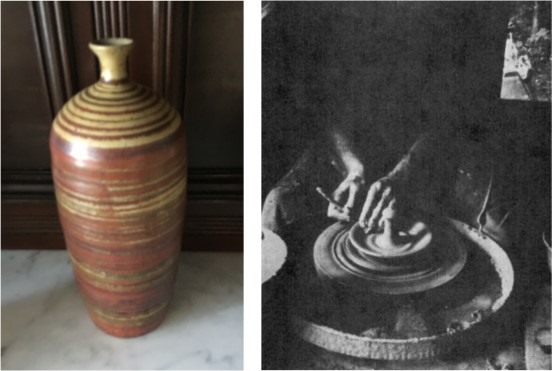
Low’s vase is pictured below. It is a beautiful form, with warm hues of rich, deep russet and brown on a natural speckled background. Well, now I had a piece of the man’s pottery, but still didn’t know anything about him. Finally, determined to tell his story, I called his family to find out more about him and his career as an artist.
The Devlin family, especially Mary, was very gracious to me in providing the detailed information I was seeking about her dad and his craft. I really enjoyed finally hearing his story, about his life in the arts, and his life in Windham. I hope that over the next few weeks, I will be able to do justice to a man I only know through those that loved him, newspaper accounts and by the art he created.







 Windham NH History