
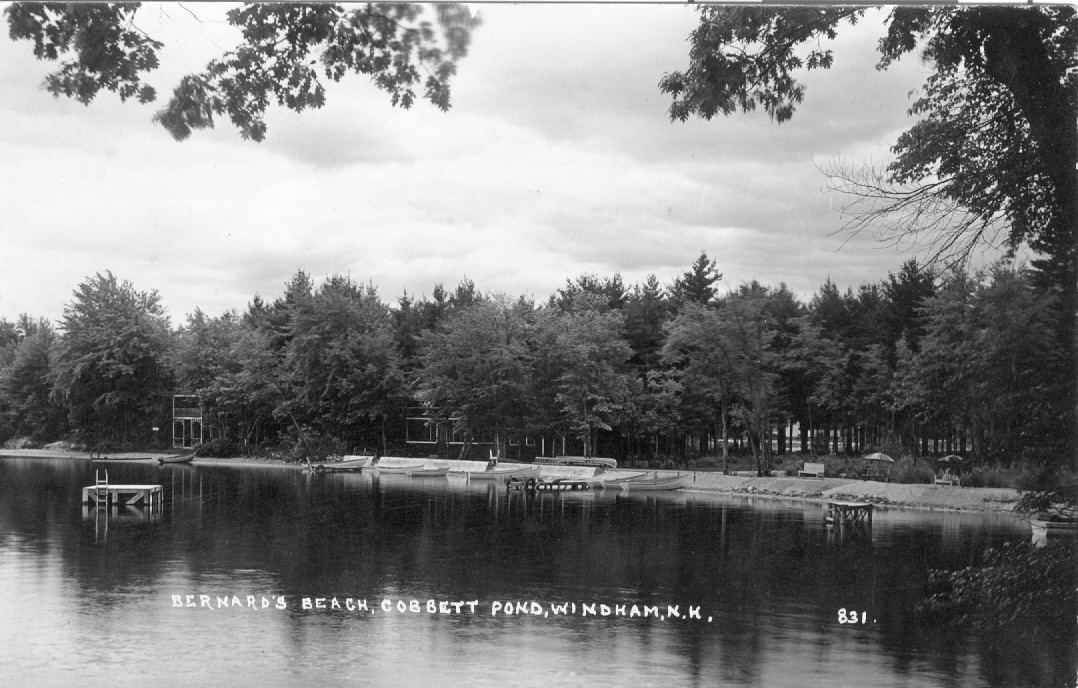
 This postcard shows Bernard’s Beach on Cobbett’s Pond in Windham NH. It is commonly known as “Pine Terrace” today. Originally, this area was called Morrison Cove as referenced by William Harris on his early map of Cobbett’s Pond.
Uncategorized
Windham Life and Times – July 24, 2015
The Mackenzie Property and the Boy Scout Log Cabin
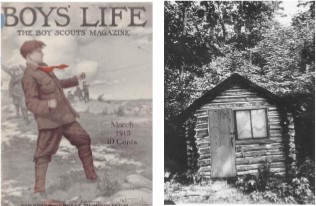
Boys Life Magazine from 1915 with Article About Howard Upham’s Log Cabin
WINDHAM, July 6.— “Howard Upham, boy scout of Troop 36 of Dorchester, Mass., tells in Boys’ Life, the Boy Scout’s Magazine, the story of ‘How I Built My Log Cabin,’ and there is a cute little picture of this cute little cabin with its stone chimney, which stands at the rear of the Upham cottage on Cobbett’s. Howard claims the entire cost, not counting labor, was under fifteen dollars.”
After reading this, I remembered that my grandparents, Lorimer and Della Mackenzie had purchased land on North Shore Road, on Cobbett’s Pond, from the Uphams. My great-father owned the lot next door. At some point, prior to the purchase of the land, the Upham cottage had burned to the ground. I always remember talk of the log cabin that was on the property, which my grandparents used for several years before they built their summer cottage. The property is now owned by my aunt and uncle Phil and Beverly Meuse.
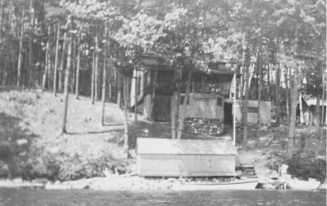
Upham’s Cottage Before in Burned on North Shore Road
Well it appears that the log cabin was Howard Upham’s Boy Scout project. At the time, scouts were building log cabins all over the country. The piece in Boy’s Life reads: “It was my desire, in the first place to build a log cabin which would accommodate two or more fellows. Having carefully figured out the size desired, I cleared a piece of ground twelve by fourteen feet, located near the shore of a lake. Dead pines and oaks standing in the nearby woods afforded the necessary material for the cabin. I began building the cabin so late in the summer, and so near school time, that I got only as far as laying the foundation, which was of oak timber. I selected an oak foundation for the reason of greater durability.”
“The pine logs for the walls of the cabin were hauled during the winter months, when the snow was on the ground. They were cut into fourteen foot lengths, averaging six inches in diameter, and then notched near the ends, so they would fit snugly into each other. The gathering and notching of the logs and fitting up the side walls I did that winter. The following spring the roof was put on. This was done by nailing boards over the logs of the roof, and then tacking over the boards a good grade of roofing paper. “
“Then came the building of the fireplace, which consisted of rough field stone. It took some time to get the stones properly fitted and cemented into place, but finally, after a week of masonry work, a good chimney and large fireplace were completed. A mixture of Portland cement and coarse sand were used to fill up the cracks between the logs. I figured that cement made a better substitute than the moss that is commonly used. Last of all the windows and door were carefully fitted in, while inside a floor of pine boards was laid upon oak timbers… The total expense for building the entire cabin came under fifteen dollars.”
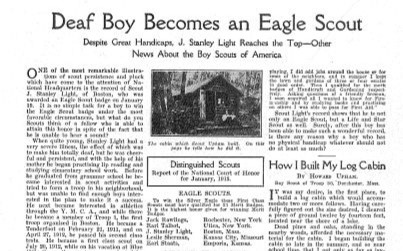
Article in Boy’s Life
Windham Life and Times – July 16, 2015
A Tribute to the “Common” Day Lily

Well, they’re here again, and I really can’t go another year without giving a big shout out to the magnificent orange glow that appears in July and always makes me smile, even on the busiest of summer days. You can spot them virtually everywhere; blooms held high, along the roads, beside stone walls, reaching out along the lake shore or in front of a great old antique home. These aren’t the stuck up high-breds with there fantastic pallets, ruffled edges and giant blossoms. No these are the dependable, sturdy, gritty, ancient, and beloved Tawny Day lily (H.fulva).
Day-lilies arrived in Europe from China, Japan, Korea and Eastern Siberia, during the 16th century, and by the 17th century had crossed the Atlantic to North America. It is also supposed that America sea-captains involved with the Asian trade brought them home with them. Hemerocallis is Greek and roughly translates at “beautiful for a day. “Crude homesteads being carved out of the forests in the America were beautified by transplants from the Old Country and Asia. They were the carefree choice of pioneers who had no time to spend fussing with ornamentals. The appeal of the daylily with its vigor and rock hardiness, along with its ease in propagating, made it the perfect perennial. The plant also multiplies well and is seldom bothered by insects or disease and spread into large clumps.” Best of all, you can dig some out of the clump and they easily grow in their new locations. They are without question the “easy” of the flower world but just because their easy, doesn’t mean they’re not beautiful.

Of the dozen plus Hemerocallis wild species, two were definite favorites: the Tawny Daylily (H.fulva) and the Lemon Day lily (H.lilasphodelus). Both were treasured possessions at the turn of this century. Many escaped from abandoned homesteads and old cemeteries, naturalizing themselves with ease and are seen by some as weeds or an “invasive” threat. They grow in both full sun and in shaded areas happily opening in the morning, each blossom lasting for a day.
The writer of the “River Bliss” blog captures their nature, “Daylilies take full advantage of their day in the sun by remaining in bloom for the duration, whereas delicate chicory flowers close around mid-day when the sun is most intense. I stopped in my tracks to listen to the advice the day-blooming flowers offered about making the most of a brief existence. They said:
Quick! Dry your eyes!
There’s so much living to do.
Get to it!
The day is young,
and the day is short.
Wake up and engage it.
Don’t waste a moment
Wallowing in longing or regret.
You have this one day to work with
the material of Here and Now
So make the most of it.
“How interesting that the Chinese name for the daylily, xuan-cao, can be translated as “forget-worry herb” or “the plant of forgetfulness” because it was believed to alleviate worries by causing one to forget. When I stopped to connect with the essence of the day-lilies, I forgot mine!”

So join me for the next few days and enjoy the humble yet noble Tawny Day-lilies, as they freely bloom for your sole enjoyment. Each bloom, shining brightly in crimson orange, for just one day. Day-lilies are also a reminder that it is approaching mid-summer and that its time to enjoy what’s left of New England’s fleeting warmth while it lasts.
Windham Life and Times – July 9, 2015
100 Years Ago in Windham
WS Harris in the Exeter Newsletter
Disaster as Searles Tax Windfall Ends | Tragic Drowning in Cobbett’s Pond
WINDHAM, JULY 2, 1915— “The family of John J. Smullen of Dorchester, Mass., are spending the summer vacation in Mrs. Blake’s house. Mrs. Ella Prescott and granddaughter Ella E. Cogger, are moving this week to their new home at Salem Depot, and the purchasers of the Prescott place, Miss Bertha E. Griffin and Mrs. Blanche G. North, of Somerville, Mass., are moving in for the summer.”
“Writs of “extent” levying on the property of the selectman and if necessary other citizens of the town have been served through Sheriff Spinney for the unpaid state tax of $11,000 and county tax of $8,000 due for the year 1914. It will come hard for the town to pay these large sums, but the longer it is fought the more there will be to pay (here is the background from a previous article.) APRIL 13, 1915— The town in special meeting today voted to pay 25 cents per hour for fighting forest fires, to authorize the treasurer to hire money as needed, and to authorize the selectmen to sell the stone crusher. Relative to state and county taxes it was voted that the Selectmen pay the state treasurer the $1,464 which the town claims is the rightful amount due the state, and to adjourn for four weeks until counsel for the town are able to report on the advisability of the state’s claim of $11,000.
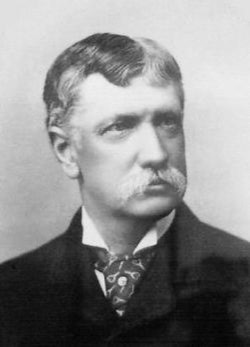 I am guessing that this tax dispute had something to do with the Searles property assessment when the castle was his personal residence. MARCH 19, 1915—The inventory of the town as compared with the that year before indicates that the bottom has dropped out of something, the total valuation standing at $732,389, as compared to over six and half millions in April 1913.” The explanation is found in Rural Oasis; “In 1913 Searles was taxed (by the town of Windham) on his money at interest, that is for his liquid assets. This proved to be a windfall for the town because much of his wealth was in cash. The result was that the tax rate dropped to about 55 cents per $1,000 valuation. The town fathers’ reaction was: how can we spend all that money? With the approval of the voters the selectmen decided on a road building program. A steam roller and stone crusher were purchased and construction began at the Windham Depot to appoint three hundred yards south of Londonderry Road and on a portion of Kendall Pond Road north of Old Mill Road. However, the project was ill fated for two main reasons: first the attitude of the construction crew was geared more towards play than work. As one longtime resident explains, baseball was so popular that when the crew felt they needed practice they would do just that, practice, regardless of their work. Secondly, and more importantly was Searles erratic behavior. Upset by the huge tax assessment in 1914 he packed and established residency in New York, which he maintained until his death in 1920. This move left Windham facing a large state assessment with no way of paying it: $25,000 of gold notes were issued and the man whose departure had caused the trouble proceeded to buy half the amount. In addition he purchased the stone crusher for $2,500 while Hudson purchased the steam roller.” And herein lies the lesson for all state and local governments: Taxing the rich to bail out the government will only work if you cut off their feet. The rich are free to move from town to town and state to state when the tax burden placed on them become unbearable. This was the lesson that Windham learned the hard way in 1915.
“One of the saddest of drowning accidents occurred in Cobbett’s Pond Friday noon, June 25, when Roydon S. Pierce, of Dorchester, Mass., sixteen years of age, lost his life by the overturning of a canoe. Only the day before, young Pierce had come with his cousin, Edmund G. Wilson, to the Wilson cottage, to spend a week or two. While paddling about the pond alone, in some way he fell into the water, and although a good swimmer and not far from shore he was unable to reach the shore or canoe and sank in about twelve feet of water. His friends, Edmund Wilson, James and Howard Upham, hearing his cries for help, put off from shore with all possible speed and, diving, brought the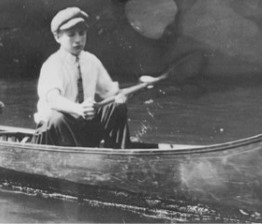 body to the surface and to shore at Haseltine’s point. They, with the help of others worked for nearly and hour in unavailing attempts of resuscitation, until the arrival of Dr. E.A. Wade, of Salem Depot, who pronounced the case hopeless. Later in the day the medical referee, Dr. L.G. Dearborn, of Derry, with an undertaker, came and took charge of the body. Royden was the second of three sons of Mr. and Mrs. Charles Pierce, residing at 114 Rosseter Street, Dorchester, and was in his seventeenth year. He would have graduated from the Dorchester High School next year. A slight acquaintance was sufficient to reveal his exceptionally bright and winning personality. He was an attendant at the Harvard Congregational Church of Dorchester, where funeral services were held on Sunday afternoon. A pocket edition of the Book of Proverbs was found floating on the water where Royden sank, which it is thought he had been reading. The loss of this promising young life in so sudden and sad manner, with assistance in sight but too far away to be availing until too late, has cast gloom over the whole North Shore colony and all who knew the young man. The hope of immorality is the only thing that gives meaning to this present existence and unlocks its mysteries.” W.H.S. It is rather ironic that he was reading Proverbs when he stumbled out of the canoe into the water since one section reads as follows:
“My son, do not let wisdom and understanding out of your sight, preserve sound judgement and discretion; they will be life for you, an ornament to grace your neck. Then you will lie down in safety, and your foot will not stumble. When you lie down, you will not be afraid; when you lie down, your sleep will be sweet. Have no fear of sudden disaster or of the ruin that overtakes the wicked, for the Lord will be at your side and will keep your foot from being snared.” Proverbs 3: 21-26
Windham Life and Times – July 2, 2015
Canonbie, Canobie, Cannobie
How the Ethos of the Border Clans and Reivers Impacted America
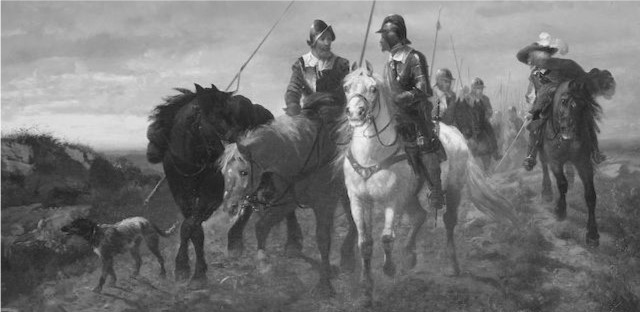
The Border Reivers Spirit of Independence
So you may be wondering what in the world does the history of the border clans and reivers have to do with the history of both Windham and America. The border clans and families moved from the “debatable lands,” first to Northern Ireland and then to America. Many came to this area of New Hampshire. Independence Day, might just be a good time to appreciate how much the Scots-Irish influenced the ethos of America. It all comes down to this; the border Scotch held honor above all, loyalty to family above all, and had an ingrained sense of individualism that made them rebel against centralized authority. The men of the borders prized their independence above all things, including the inconvenient laws issued by the “mere kings” of Scotland and England. For the most part they became small “d” democrats supporting the rebellion against King George III and backing presidents like Andrew Jackson who fought the power of the eastern elites.
“In many ways, their culture became American culture. The Scots-Irish (sometimes called the Scotch-Irish) are all around you, even though you probably don’t know it. They are a force that shapes our culture, more in the abstract power of emotion than through the argumentative force of law. In their insistent individualism, they are not likely to put an ethnic label on themselves when they debate societal issues. Some of them don’t even know their ethnic label, and some who do don’t particularly care. They don’t go for group-identity politics any more than they like to join a union. Two hundred years ago the mountains built a fierce and uncomplaining self-reliance into an already hardened people. To them, joining a group and putting themselves at the mercy of someone else’s collective judgment makes as much sense as letting the government take their guns. And nobody is going to get their guns. Quote from “Born Fighting: How the Scots-Irish Shaped America” written by James Webb.
Many fought for the South, but most gained no advantage from slavery and were not a part of the planter class, yet they fought tenaciously for “states rights.” Many more fought for the North. The hero of World War One, Alvin York was a pacifist from the hills of Tennessee, of Scotch-Irish and English extraction. And of course, the hero of the race to the moon, Neil Armstrong, was a direct descendant of the independent spirited reiver clans. It really is sad, that this county is so ignorant of its history, and that American public opinion is so easily swayed by the persuaders. The border reivers and the Scots-Irish immigrants would be appalled if they could see the strong hand that now rules America from above and the dependence on the government that personifies so many American lives. Happy Fourth of July.

Neil Armstrong on the Moon.
Windham Life and Times – June 25, 2015
Canonbie, Canobie, and Cannobie
Johnnie Armstrong
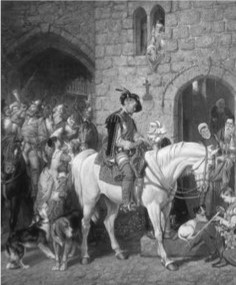
Johnnie Armstrong Meets the King
Johnnie Armstrong of Ginockie was a powerful leader who ruled a vast area along the Scottish Border. He is perhaps one of the best known figures among the Border reivers. A stirring ballad was written about him soon after his death and he was further romanticized in the nineteenth century writings of Sir Walter Scott.
Johnnie became very rich and powerful and could put 3000 horsemen in the field. Very little is known of his early life but it was rumored that he made a fortune while at sea then returned to the Esk River Valley and became a powerful leader.
Armstrong became known as “Black Jok” because he specialized in blackmail or black rent. “It was said that there was not one English place of prominence between his home at Hollows Tower, known as Gilnockie and east Newcatles which did not pay protection money to Black Jok.” The “rent” was paid to insure they would be protected from raids by both Armstrong and other Border reivers. Armstrong operated for some years under the protection of Robert, the 5th Lord Maxwell who was the Scottish West March Warden. The six Marches consisted of three on the Scottish side of the border and three on the English. The Marches were established by Scotland and England to supervise the unruly border areas. Maxwell, was one of Scotland’s great feudal barons. He was in a long lasting feud with the Johnstone Clan. Maxwell had engaged the Armstrongs as extra troops the fight the Johnstones. He subsequently owed the Armstrongs protection. Although responsible for keeping the reivers under control, Maxwell “looked the other way” as the Armstrongs and their allies, the Nixons, Elliots and Crosiers went about their reiving. Black Jok burnt Netherby in Cumberland in 1527, in return for which William Dacre, 3rd Baron Dacre burnt him out at Canonbie in 1528; and Gavin Dunbar, the Archbishop of Glasgow as well as Chancellor of Scotland, intervened with an excommunication for Armstrong. In a way the power and wealth of Armstrong was an embarrassment for the young King James V. Maxwell began to fear the power of Johnnie Armstrong and his lack of loyalty. Henry VIII was putting diplomatic pressure on James V to put an end to the lawlessness that was rampant in the Borders region. At the time there was a truce of sorts between England and Scotland and Black Jok and other reivers flouted the peace with their lucrative harassment of the English Border. James V wanted to subjugate the power of the Scottish Border clans. James V moved south to the Scottish Borders in June 1530 intent on proving to the Border clans that it was he who ruled in Scotland, including the Borders. He first executed other reiving clan leaders and then headed south to deal with Armstrong. It is said that James V tricked Armstrong into meeting him at Carlenrig. Some sources say that a “loving letter” was sent inviting him to hunt with the king. Whatever the case, a shrewd Johnnie Armstrong would never have agreed to meet the king without a guarantee of safe conduct.
According to the “Ballad,” Armstrong made a great show, dressed in his finery as would have befitted any court and accompanied by an entourage of about twenty-four Lairds and retainers, including Elliots, Littles and Irvines. Perhaps the confusion over the actual numbers hanged with Armstrong, twenty-four, thirty-six or fifty, stems whether or not the retainers were also hanged. Johnnie Armstrong sported a hat from which hung nine gold and silver tassels, and but for the sword of honor and a crown, he could have been King. When it became clear that he was to be hanged John Armstrong declared himself a subject of James his liege and stated he had only raided the English. The most famous lines, oft quoted by Sir Walter Scott, were uttered by Armstrong, when the extent of the King’s duplicity was revealed:
“To seek hot water beneath cold ice
Surely it is a great folly
I have asked grace at a graceless face,
But there is none for my men and me.”
He is also reputed to have said, “Had I known, Sire, that you would take my life this day, I should have stayed away and kept the Border in spite of King Henry and you, both. For I know that Henry Tudor would be a blithe man this day to know that John Armstrong was condemned to die. Which proves who lacks in judgement, does it not?” Nevertheless, all was in vain as he and his men were led to the trees around Carlenrig and hanged from the back of their mounts.
Legend has it that the trees at Carlenrig, where Armstrong and his followers were hanged, withered and died, and none have grown there since.”
In the aftermath of the hanging, Robert, Lord Maxwell, who came to fear Armstrong’s burgeoning power benefited from Armstrong’s death. On 8th July 1530, three days after the death, Maxwell received into his hands all the property that had belonged to Johnnie Armstrong.
Being the reivers that they were, you can be sure that the Armstrongs had their revenge. Twelve years later, in 1542, James V was to die, some say of a broken heart, following the rout of the Scottish army at the Battle of Solway Moss which took place eight days after the birth of his daughter, Mary, Queen of Scots. Some of the Armstrongs joined the English army in dealing a mortal blow to the Scots as they vainly tried to cross the river Esk at Longtown. It was the Armstrongs who picked off the remnants of the Scots army as they fled in panic north through Liddesdale.
.
Windham Life and Times – June 18, 2015
Canobie, Canonbie, Cannobie
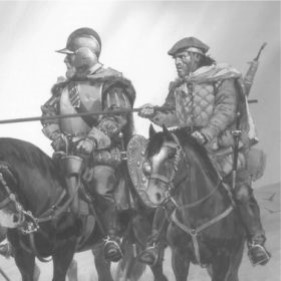
A Border Reiver with Steel Bonnet
Part 4: What’s a Reiver
What’s a reiver? You might know that “The Reivers” is a novel written by William Faulkner. The Border Reivers were gangs of horsemen who lived in or around the “Debatable Land” on the disputed border between England and Scotland. They were basically land pirates, who raided within a days ride of their homes, from around 1300 to 1600. They also held family ties and honor in high esteem. Reivers stole cattle, sheep and horses, and were even known to hire themselves out as mercenaries. They also blackmailed landowners.
“The word blackmail has no connection at all with the postal system. In the 16th and part of the 17th centuries, the area along the border between England and Scotland was not usually protected by the officials on either side. Landholders were beset not only by outlaws but also by their own chieftains, who told them that in return for payment they would not be raided. In Scotland mail means “payment, rent, tax,” and at that time payment or rent was by custom referred to as “silver” or “white” when paid in coins. Because the robbers usually required payment in cattle or grain rather than money, their payment came to be called ‘black” mail.’ ”
“The Bands of Reivers were organized according to families and clans – rivalry and feuding between border families gave rise to raiding. Various rules and rights were observed by the clans and allowed by the ruling classes, including the ‘Hot Trod’ custom which basically said taking revenge was permitted as long as you were quick (within six days) and loud and obvious about it. Leaving it longer meant seeking official sanction for any action.”
McDonald says, “From the thirteenth to the sixteenth centuries, outlaws and ‘border lords’ reigned supreme on the contentious frontier between England and Scotland. Feud and terror, raid and reprisal, were the ordinary stuff of life—and a way of survival. Power was held by the notorious border reivers; clan-loyal raiders, freebooters, plunderers, and rustlers who robbed, murdered, and wreaked havoc. These ‘steel bonnets’ (named for their helmets), both fierce and fanciful, were the last opponents of the rule of law before the Acts of Union of 1701.
The fact of the matter is that the clans along the borders were more than just outlaws. Fierce wars were fought over this border territory and because of this there was rivalry between the kings of Scotland and England for the loyalty of the people who lived here. Since there was no official, functioning government or oversight, there developed a system of justice and rules based on loyalty to the family name.
You also have to see the reivers in their historical context. The monarchy in both England and Scotland were held and taken by force of arms. Its always interesting to me that government theft, terror and violence is sanctioned as legitimate by historians but individual force is not. Why do the national governments get a pass for the horrid crimes they commit? Henry the VIII was the ruler of England during much of this period. (1491-1547) He used political violence and war as governmental policy. His subjects who did not agree with his religious beliefs, (which put all religious authority into his hands rather than to the independence of the church) both Catholic and Protestant, were killed, often by being burned alive on the stake. He cut off the head of his wife so he could marry another, and political enemies were often beheaded, drawn and quartered or murdered. Throughout England, Henry the VIII basically stole all the wealth of the Catholic church and appropriated it to the monarchy. As you will remember, the priory at Canonbie was raised to the ground and all of it wealth robbed by the monarchy. So you have to be careful being too judgmental in the 15th and 16th century, especially of people who asserted their own rights and freedom, and who put the support and defense of their families above all else. After all, it was a time of might makes right, and where men fought for honor.
Leonard Morrison, an able advocate of the border Scots and the Windham families says, “In the belt of country in the southern part of Scotland, near the border of England, and now embraced by the counties of Dumfries and Roxburgh, once dwelt some of the most renowned of the Scottish Lowland clans, among whom were the clans Johnston, Elliot, Douglass, Maxwell, Chisholm, and Armstrong.”
“Of the clan Armstrong this article will speak. It was one of the most noted, most numerous, and most powerful of the Lowland clans. This section of country the Armstrongs occupied, being near the English border, was called the ‘Debatable Land,’ and though in Scotland, it was subject to the claims of England, and was often overrun by armies of each kingdom, and sometimes stripped and despoiled by both. By very necessities of their condition, and the troubled circumstances in which they were placed by the lawlessness of the age, they were forced to resort to expedients not justifiable in a more enlightened era. Like the neighboring clans, they followed:
“The simple Plan,
That they should take, who had the power,
And they should keep, who can.”
Two great books are in print about the Reivers. The Reivers by Alistair Moffat and The Steel Bonnets by George Fraser.
Windham Life and Times – June 11, 2015
Canobie, Canonbie, Cannobie
Part 2: Lochinvar

Lochinvar and “fair” Ellen
“Lochinvar” is a ballad with eight six-line stanzas. It tells the story of a Scottish knight, “young Lochinvar,” who is described as faithful and true but who arrives at the wedding of his romantic interest to steal her away for his own. Of course, our interest in the poem is that it is set in and around Canonbie Scotland. The brave knight swims across the River Esk, which runs though Canonbie.
Netherby Hall is a real place. “For four centuries the Graham family nurtured and developed Netherby and its estates. Theirs is a tale of ‘rogues to riches’, steeped in the history of the Borders with its notorious Reivers and a unique part of the country that went by the forbidding name of the Debatable Land.” It appears the Netherby Grahams descended from nobility but sometime before 1492, the King of Scots, probably James III, got fed up of Lang Will’s business practices. “He was well known for his Reiver ways of extracting rents, mails, for land he did own but he went too far when he stole lands from the Earl of Morton. Put to the horn… he was eventually forced to flee with his family to the Debateable Land.” It was a British badlands of sorts, an area where any person who was out with the law could be killed without any redress on the killer,” a place for the Grahams to find refuge. “As such it was home to some of the most notorious Border Reivers, the Grahams among them. Lang Will’s family prospered. By the 1540s, made up of at least six sons, they had half a dozen peel towers and the eldest son, Richard, owned Netherby. Lang Will’s rent collecting business… raised vast amounts of money, 100,000 merks according to one source. They were allies of the Armstrongs and linked by marriage to the Johnstones…”

Netherby Hall and Coop House
O, Young Lochinvar is come out of the west;
Through all the wide border his steed was the best;
And save his good broad-sword he weapon had none;
He rode all unarmed, and he rode all alone.
So faithful in love, and so dauntless in war,
There never was knight like the young Lochinvar.
He staid not for brake, and he stopped not for stone;
He swam the Eske river, where ford there was none;
But, ere he alighted at Netherby gate,
The bride had consented, the gallant came late:
For a laggard in love, and a dastard in war,
Was to wed the fair Ellen of brave Lochinvar.
So boldly he entered the Netherby Hall,
‘Mong bridesmen, and kinsmen, and brothers, and all;
Then spoke the bride’s father, his hand on his sword,
( For the poor craven bridegroom said never a word, )
“O come ye in peace here, or come ye in war,
Or to dance at our bridal, young Lord Lochinvar?”
“I long wooed your daughter, my suit you denied —
Love swells like the Solway, but ebbs like its tide —
And now I am come, with this lost love of mine,
To lead but one measure, drink one cup of wine;
There are maidens in Scotland more lovely by far,
That would gladly be bride to the young Lochinvar.”
The bride kissed the goblet — the knight took it up;
He quaffed off the wine, and he threw down the cup.
She looked down to blush, and she looked up to sigh,
With a smile on her lips, and a tear in her eye.
He took her soft hand, ere her mother could bar —
“Now, tread we a measure ! ” said young Lochinvar.
So stately his form, and so lovely her face,
That never a hall such a galliard did grace;
While her mother did fret and her father did fume,
And the bridegroom stood dangling his bonnet and plume;
And the bride-maidens whispered, ” ‘T were better by far
To have matched our fair cousin with young Lochinvar. ”
One touch to her hand and one word in her ear,
When they reached the hall door, and the charger stood near
So light to the croup the fair lady he swung,
So light to the saddle before her he sprung !
“She is won ! we are gone, over bank, bush, and scaur;
They’ll have fleet steeds that follow,” quoth young Lochinvar
There was mounting ‘mong Græmes of the Netherby clan;
Forsters, Fenwicks, and Musgraves, they rode and they ran
There was racing and chasing on Cannobie Lea,
But the lost bride of Netherby ne’er did they see.
So daring in love, and so dauntless in war,
Have ye e’er heard of gallant like young Lochinvar

Cannobie Lea on River Esk
Windham Life and Times – June 4, 2015
Canobie, Canonbie, Cannobie
Part 2: Sir Walter Scot and Border Ballards
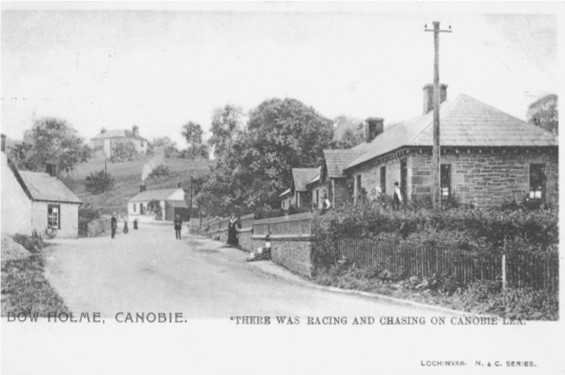
Canobie, Scotland
Sir Walter Scott was one of the most influential writers, in the English language, during the nineteenth century. Today, most, including myself, know very little about the life and work of this writer. He is responsible for one of the most vivid lines from my childhood, one that is indelibly seared into my conscience. It is two lines from the epic poem Marmion written in 1808, which are one of the most quoted excerpts from Scottish poetry which is derived from Canto VI, XVII :
Oh, what a tangled web we weave
When first we practice to deceive!
Another quote that I’ve heard often but didn’t ever know where it came is, “Blood is thicker than water,” which comes from Guy Mannering, Ch. 37 (1815). Then there is this choice saying from, The Heart of Midlothian’, Ch. 8 (1818). Revenge is the sweetest morsel to the mouth, that ever was cooked in hell. And then this from The Talisman, Ch. 24 (1825). A miss is as good as a mile.

Sir Walter Scott
Most important to us here is the fact that the Scott’s were an old Scottish borders family. “Scott spent his childhood years in Edinburgh, with occasional extended visits to his grandfather Robert Scott’s farm in Tweeddale in the Borders, where he became versed in his family’s history, and in Borders culture in general.” (BBC) As a boy, youth and young man, Scott was fascinated by the oral traditions of the Scottish Borders. He was an obsessive collector of stories, and developed an innovative method of recording what he heard at the feet of local story-tellers using carvings on twigs, to avoid the disapproval of those who believed that such stories were neither for writing down nor for printing.” (Wiki) “He attended the famed Edinburgh High School, and then followed in his father’s wake by taking a law degree at Edinburgh University, being called to the Bar in 1792. At 25 he began writing, first translating works from German then moving on to poetry.
In 1797 he married the daughter of a French refugee, Charlotte Carpenter, with whom he had four children. Five years later, he published a three-volume set of collected Scottish ballads, The Minstrelsy of the Scottish Borders. This was an early indicator of his interest in Scotland and history from a literary standpoint.” (BBC)
“Scott was a poet, novelist, ballad-collector, critic and man of letters, but is probably most renowned as the founder of the genre of the historical novel, involving tales of gallantry, romance and chivalry. In 1802-03, Scott’s first major work, Minstrelsy Of The Scottish Border appeared. As a poet Scott rose into fame with the publication of The Lady of the Lake (1810), Rokeby (1813), and The Lord of the Isles (1815). With their romantic, often sublime, depictions of landscape, they fuelled the taste for the ‘picturesque’ and encouraged the trend for the inclusion of Scotland in the ‘Grand Tour,’ the cultural European tour that enticed much of the travel-minded gentry in the 18th and 19th centuries.” (BBC)
His novels and poetry are still read, and many of his works remain classics of both English-language literature and of Scottish literature. Famous titles include Rob Roy, The Lady of the Lake, Waverley, The Heart of Midlothian and The Bride of Lammermoor. Scott’s novel Ivanhoe was required reading in many American high schools into the 1950’s.
Next week we will return to our main interest, which resides in the epic poem Marmion, in which are found the lines about the hero Lochinvar. The setting for this poem is the borders of Scotland near Canonbie.
Windham Life and Times – May 28, 2015
Canonbie, Canobie, Cannobie

Pictured above is Gilnockie Tower, located 2.3 miles north of Canonbie Scotland, built by Johnnie Armstrong, around 1520. The Lochinvar, made his escape through Cannobie in Sir Walter Scott’s poem
Part 1: My Apologies to Leonard Morrison
I’ve written about how the name “Canobie” Lake came to be, several times in this column, and I’ve always assumed the Leonard Morrison made a mistake with the spelling. In fact, this town in the borders lands of Scotland is now known as Canonbie, however, I’ve recently discovered that this was not always the case. I found an old postcard on which it said that the view was of Canobie, Scotland. This prompted me to do some research to see if there was more than one “Canobie.” This is what I discovered:
Canonbie is a small village in Dumfriesshire within the District Council Region of Dumfries and Galloway in south west Scotland, six miles south of Langholm and two miles north of the Anglo-Scottish border. It is on the A7 road from Carlisle to Edinburgh, and the River Esk flows through it. There are frequent references in older documents to it as Canobie. (Miller, Hugh (1871). Leading Articles on Various Subjects. p. 245.) So there it is, our beloved and accurate, Windham historian, Leonard Morrison, did not make a mistake. Canonbie was known as Canobie in the 19th century, when, the Boston & Maine Railway station was built and Policy Pond was renamed. So Mr. Morrison, I apologize for not trusting in you.
Canonbie Parish had an Austin (Augustinian) priory at Hallgreen, dating back to about 1165. The priory was destroyed during the reign of Henry VIII after the Battle of Solway Moss in 1542. A grassy mound in a field near the present day church is believed to be the only remnant of the ruins. “The priory is important in that it is the source of the name Canobie. CANOBIE, or CANONBIE, a parish, in the county of Dumfries. An ancient priory here is supposed to have given the name to this place, Canobie being probably derived from the Saxon Bie, or By, signifying “a station,” and thus interpreting the word “the residence of the canons.”
Remains of a Roman signal station can be found on rising ground near the old Gilnockie station; and ruins of famous mediaeval strongholds are at Hollows and Harelaw; remains of other mediaeval strengths are at Mumbyhirst, Auchenrivock, Hallgreen, Woodhouselees, and Stark.
Over the coming weeks, you’ll know the whole story of Canobie. You’ll hear how this town on the Scottish borders was immortalized in a poem by Sir Walter Scott, “There was racing and chasing on Cannobie Lee,” and you’ll learn about the exploits of Johnnie Armstrong, the laird of Gilnockie. There really is much more to the name Canobie, than you’ve ever imagined and is it a very appropriate name for the beautiful lake shared by Windham and Salem.
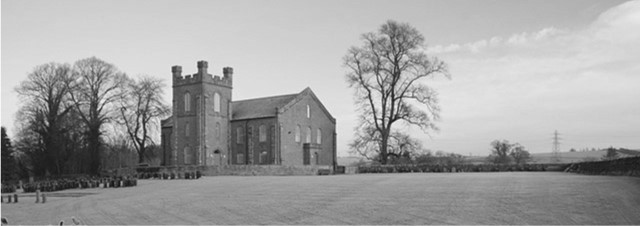
The Canonbie church was built around 1820, near the site of the original priory from which Canonbie took its name.
 Windham NH History