Back to School

My grandfather, George Dinsmore Sr., on the far left, next to the teacher at the brick school house in Windham NH.

My grandfather, George Dinsmore Sr., on the far left, next to the teacher at the brick school house in Windham NH.

The Brook’s Children in 1901 or 2 on Cobbett’s Pond. Photograph of Harold Brooks.
Summer’s nearly over now:
Apples blush, heavy, on bending branches;
Heatbugs rasp and saw
Through goldenrod endless afternoons.
Later crickets clatter,
Stitching warm darkness with thin strings of sound.
In the bushes a hundred fireflies
Flitter and fade, pointing the night
With silent white flashes…
…Long shadows in the afternoon;
Peaches yellow in mellow sunshine;
Squash brilliant and bumpy on market stalls;
And the occasional early pumpkin.
Evenings are cooler, nights longer;
Summer’s almost over now. W.H.M
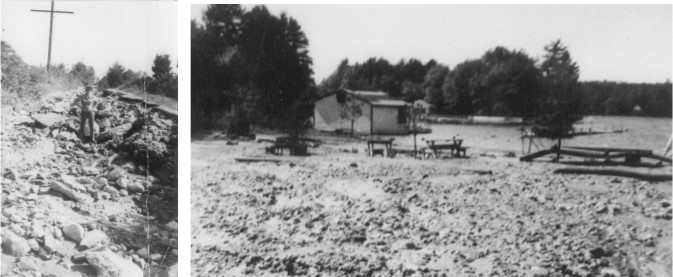
It is really strange how quiet the Atlantic and Caribbean have been recently during hurricane season. There is no question that weather goes through phases of activity and inactivity. These photographs show the damage at Bella Vista Beach after a hurricane that hit New England in the 1950’s. Hurricane season lasts from June 1st through November 30th so there is still plenty of time for storms to form and make landfall.
In a recent Washington Post article by Angela Fritz, about the quiet hurricane season , she says that, “…what’s interesting is that the area that we look to for the development of the strongest hurricanes — the main development region just north of the equator in the Atlantic Ocean — has been very, very quiet. Not a single storm has formed in this area so far this year. Nothing has even hinted at it. The lazy summer comes as no surprise to seasonal hurricane forecasters who all predicted a relatively inactive season before it began June 1. NOAA’s forecast in late May called for a 70 percent chance of a below-average season, with six to 11 named storms, three to six of which could become hurricanes, and up to two major hurricanes. It was the highest probability of a below-average season that NOAA had ever forecast.
High Wind Shear: “Wind shear is one of those things that can make or break a season. Even if everything else is working against hurricane formation — cooler than average ocean temperatures, few low-pressure waves — low wind shear could be the thing that tips the scales. El Nino’s most direct impact on the Atlantic hurricane season is increased wind shear. Such is the case this year, which has been exhibiting record-breaking wind shear…Klotzbach found that just in the Caribbean, wind shear has reached record levels since the beginning of the satellite era, nearly double what it was in the epic El Nino year of 1997.”
Cooler than Average Ocean Temperatures: “Sea surface temperatures are the most straightforward way to determine if conditions in an ocean basin are conducive for hurricane development. At the very core of necessary conditions for hurricanes is warm ocean waters — generally 82 degrees or warmer — that serve as fuel for the storms to grow. So far this season, surface temperature in the tropical Atlantic has been running three to four degrees cooler than average, and the actual magnitude of the temperature is only marginally conducive to support hurricane formation, particularly in the main development region east of the Caribbean. Sea surface temperature is actually warmer in the Gulf of Mexico and off the east coast of Florida. Klotzbach says the month of June in the main development region was the second-coldest on record since 1900, relative to the rest of the tropics.” That’s funny, since the earth is experiencing catastrophic global warming.
High Pressure and Sinking Air: “Something that is closely related to the abnormally cool ocean temperatures is the pressure pattern between the Atlantic and the East Pacific. The East Pacific has been boiling over with record warm ocean water, fueling a record hurricane season there. That has led to a lot of hot, rising air west of Mexico and sinking air — or high pressure — over the Atlantic. If there’s a place that storms are unlikely to form, it’s in a region of high pressure and sinking air, over an abnormally cool surface, and forecasts are calling for a continuation of this pattern into the fall .”
Lots of Dust From the Sahara in Africa: “The final nail in the hurricane season thus far is the copious amounts of dust blowing west off the coast of Africa. It helps that there hasn’t been much rain in the region (say, in the form of a tropical storm) to rinse the dust out of the atmosphere. In general, Saharan dust over the Atlantic is not in itself sufficient to totally destroy a season, but it does serve as the dry, sandy icing on the anti-hurricane cake.”

“Originally built by J.P. Hughes in 1849 who sold it to Horace Berry in 1910. Horace Berry died and left the property to his wife Margaret J. Berry who sold it to Herbert E. Russell in 1919. Russell sold it to George Butterfield in 1921 who resided on the property until he sold it in 1943.” Rural Oasis. Since George Butterfield is noted on the postcard the photograph must have been taken after 1921.

Haying on the Johnson Farm in Windham NH
Windham, August 10: Some farmers claim to have finished their haying, but how that feat was accomplished remains a mystery.” W.S.H.

Haying on the Wilson Farm on the Windham/Derry Line
“…He spoke of the grass and flowers and trees,
Of the singing birds and the humming bees;
Then talked of the haying, and wondered whether
The cloud in the west would bring foul weather…”
From “Maud Muller” John Greenleaf Whittier

Haying on the Markewich Farm in West Windham
“Yes, long shadows go out
from the bales; and yes, the soul
must part from the body:
what else could it do?
The men sprawl near the baler,
too tired to leave the field.
They talk and smoke,
and the tips of their cigarettes
blaze like small roses
in the night air…”
(It arrived and settled among them before they were aware.)
The moon comes
to count the bales,
and the dispossessed–
Whip-poor-will, Whip-poor-will
–sings from the dusty stubble.
These things happen.
the soul’s bliss
and suffering are bound together
like the grasses.
The last, sweet exhalations
of timothy and vetch
go out with the song of the bird;
the ravaged field
grows wet with dew.
“Twilight: After Haying” Jane Kenyon

Haying -Everyone Helps
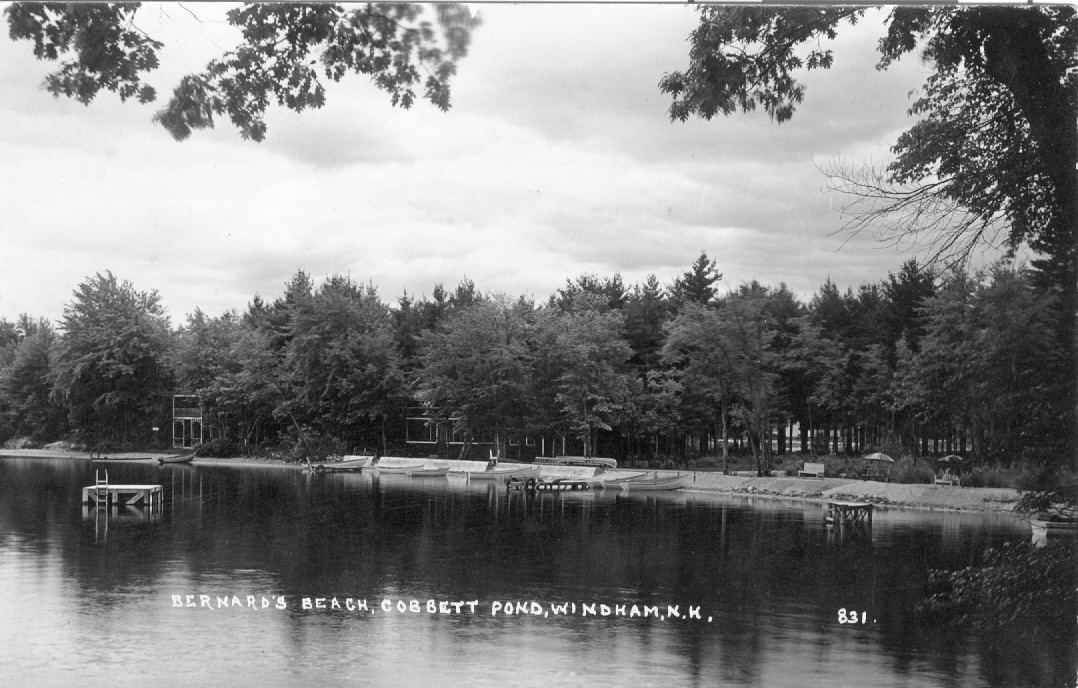 This postcard shows Bernard’s Beach on Cobbett’s Pond in Windham NH. It is commonly known as “Pine Terrace” today. Originally, this area was called Morrison Cove as referenced by William Harris on his early map of Cobbett’s Pond.
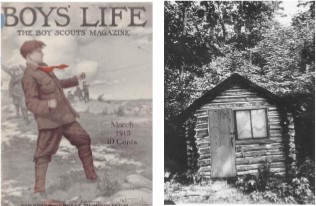
Boys Life Magazine from 1915 with Article About Howard Upham’s Log Cabin
WINDHAM, July 6.— “Howard Upham, boy scout of Troop 36 of Dorchester, Mass., tells in Boys’ Life, the Boy Scout’s Magazine, the story of ‘How I Built My Log Cabin,’ and there is a cute little picture of this cute little cabin with its stone chimney, which stands at the rear of the Upham cottage on Cobbett’s. Howard claims the entire cost, not counting labor, was under fifteen dollars.”
After reading this, I remembered that my grandparents, Lorimer and Della Mackenzie had purchased land on North Shore Road, on Cobbett’s Pond, from the Uphams. My great-father owned the lot next door. At some point, prior to the purchase of the land, the Upham cottage had burned to the ground. I always remember talk of the log cabin that was on the property, which my grandparents used for several years before they built their summer cottage. The property is now owned by my aunt and uncle Phil and Beverly Meuse.
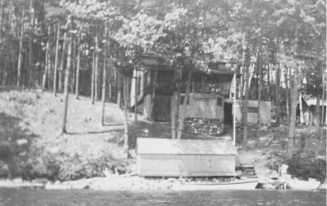
Upham’s Cottage Before in Burned on North Shore Road
Well it appears that the log cabin was Howard Upham’s Boy Scout project. At the time, scouts were building log cabins all over the country. The piece in Boy’s Life reads: “It was my desire, in the first place to build a log cabin which would accommodate two or more fellows. Having carefully figured out the size desired, I cleared a piece of ground twelve by fourteen feet, located near the shore of a lake. Dead pines and oaks standing in the nearby woods afforded the necessary material for the cabin. I began building the cabin so late in the summer, and so near school time, that I got only as far as laying the foundation, which was of oak timber. I selected an oak foundation for the reason of greater durability.”
“The pine logs for the walls of the cabin were hauled during the winter months, when the snow was on the ground. They were cut into fourteen foot lengths, averaging six inches in diameter, and then notched near the ends, so they would fit snugly into each other. The gathering and notching of the logs and fitting up the side walls I did that winter. The following spring the roof was put on. This was done by nailing boards over the logs of the roof, and then tacking over the boards a good grade of roofing paper. “
“Then came the building of the fireplace, which consisted of rough field stone. It took some time to get the stones properly fitted and cemented into place, but finally, after a week of masonry work, a good chimney and large fireplace were completed. A mixture of Portland cement and coarse sand were used to fill up the cracks between the logs. I figured that cement made a better substitute than the moss that is commonly used. Last of all the windows and door were carefully fitted in, while inside a floor of pine boards was laid upon oak timbers… The total expense for building the entire cabin came under fifteen dollars.”
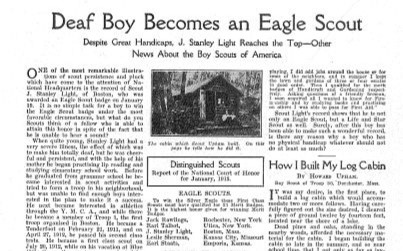
Article in Boy’s Life

Well, they’re here again, and I really can’t go another year without giving a big shout out to the magnificent orange glow that appears in July and always makes me smile, even on the busiest of summer days. You can spot them virtually everywhere; blooms held high, along the roads, beside stone walls, reaching out along the lake shore or in front of a great old antique home. These aren’t the stuck up high-breds with there fantastic pallets, ruffled edges and giant blossoms. No these are the dependable, sturdy, gritty, ancient, and beloved Tawny Day lily (H.fulva).
Day-lilies arrived in Europe from China, Japan, Korea and Eastern Siberia, during the 16th century, and by the 17th century had crossed the Atlantic to North America. It is also supposed that America sea-captains involved with the Asian trade brought them home with them. Hemerocallis is Greek and roughly translates at “beautiful for a day. “Crude homesteads being carved out of the forests in the America were beautified by transplants from the Old Country and Asia. They were the carefree choice of pioneers who had no time to spend fussing with ornamentals. The appeal of the daylily with its vigor and rock hardiness, along with its ease in propagating, made it the perfect perennial. The plant also multiplies well and is seldom bothered by insects or disease and spread into large clumps.” Best of all, you can dig some out of the clump and they easily grow in their new locations. They are without question the “easy” of the flower world but just because their easy, doesn’t mean they’re not beautiful.

Of the dozen plus Hemerocallis wild species, two were definite favorites: the Tawny Daylily (H.fulva) and the Lemon Day lily (H.lilasphodelus). Both were treasured possessions at the turn of this century. Many escaped from abandoned homesteads and old cemeteries, naturalizing themselves with ease and are seen by some as weeds or an “invasive” threat. They grow in both full sun and in shaded areas happily opening in the morning, each blossom lasting for a day.
The writer of the “River Bliss” blog captures their nature, “Daylilies take full advantage of their day in the sun by remaining in bloom for the duration, whereas delicate chicory flowers close around mid-day when the sun is most intense. I stopped in my tracks to listen to the advice the day-blooming flowers offered about making the most of a brief existence. They said:
Quick! Dry your eyes!
There’s so much living to do.
Get to it!
The day is young,
and the day is short.
Wake up and engage it.
Don’t waste a moment
Wallowing in longing or regret.
You have this one day to work with
the material of Here and Now
So make the most of it.
“How interesting that the Chinese name for the daylily, xuan-cao, can be translated as “forget-worry herb” or “the plant of forgetfulness” because it was believed to alleviate worries by causing one to forget. When I stopped to connect with the essence of the day-lilies, I forgot mine!”

So join me for the next few days and enjoy the humble yet noble Tawny Day-lilies, as they freely bloom for your sole enjoyment. Each bloom, shining brightly in crimson orange, for just one day. Day-lilies are also a reminder that it is approaching mid-summer and that its time to enjoy what’s left of New England’s fleeting warmth while it lasts.
WINDHAM, JULY 2, 1915— “The family of John J. Smullen of Dorchester, Mass., are spending the summer vacation in Mrs. Blake’s house. Mrs. Ella Prescott and granddaughter Ella E. Cogger, are moving this week to their new home at Salem Depot, and the purchasers of the Prescott place, Miss Bertha E. Griffin and Mrs. Blanche G. North, of Somerville, Mass., are moving in for the summer.”
“Writs of “extent” levying on the property of the selectman and if necessary other citizens of the town have been served through Sheriff Spinney for the unpaid state tax of $11,000 and county tax of $8,000 due for the year 1914. It will come hard for the town to pay these large sums, but the longer it is fought the more there will be to pay (here is the background from a previous article.) APRIL 13, 1915— The town in special meeting today voted to pay 25 cents per hour for fighting forest fires, to authorize the treasurer to hire money as needed, and to authorize the selectmen to sell the stone crusher. Relative to state and county taxes it was voted that the Selectmen pay the state treasurer the $1,464 which the town claims is the rightful amount due the state, and to adjourn for four weeks until counsel for the town are able to report on the advisability of the state’s claim of $11,000.
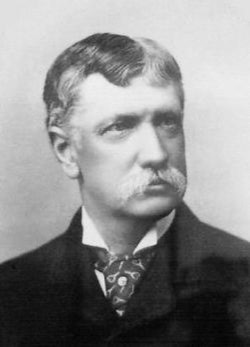 I am guessing that this tax dispute had something to do with the Searles property assessment when the castle was his personal residence. MARCH 19, 1915—The inventory of the town as compared with the that year before indicates that the bottom has dropped out of something, the total valuation standing at $732,389, as compared to over six and half millions in April 1913.” The explanation is found in Rural Oasis; “In 1913 Searles was taxed (by the town of Windham) on his money at interest, that is for his liquid assets. This proved to be a windfall for the town because much of his wealth was in cash. The result was that the tax rate dropped to about 55 cents per $1,000 valuation. The town fathers’ reaction was: how can we spend all that money? With the approval of the voters the selectmen decided on a road building program. A steam roller and stone crusher were purchased and construction began at the Windham Depot to appoint three hundred yards south of Londonderry Road and on a portion of Kendall Pond Road north of Old Mill Road. However, the project was ill fated for two main reasons: first the attitude of the construction crew was geared more towards play than work. As one longtime resident explains, baseball was so popular that when the crew felt they needed practice they would do just that, practice, regardless of their work. Secondly, and more importantly was Searles erratic behavior. Upset by the huge tax assessment in 1914 he packed and established residency in New York, which he maintained until his death in 1920. This move left Windham facing a large state assessment with no way of paying it: $25,000 of gold notes were issued and the man whose departure had caused the trouble proceeded to buy half the amount. In addition he purchased the stone crusher for $2,500 while Hudson purchased the steam roller.” And herein lies the lesson for all state and local governments: Taxing the rich to bail out the government will only work if you cut off their feet. The rich are free to move from town to town and state to state when the tax burden placed on them become unbearable. This was the lesson that Windham learned the hard way in 1915.
“One of the saddest of drowning accidents occurred in Cobbett’s Pond Friday noon, June 25, when Roydon S. Pierce, of Dorchester, Mass., sixteen years of age, lost his life by the overturning of a canoe. Only the day before, young Pierce had come with his cousin, Edmund G. Wilson, to the Wilson cottage, to spend a week or two. While paddling about the pond alone, in some way he fell into the water, and although a good swimmer and not far from shore he was unable to reach the shore or canoe and sank in about twelve feet of water. His friends, Edmund Wilson, James and Howard Upham, hearing his cries for help, put off from shore with all possible speed and, diving, brought the body to the surface and to shore at Haseltine’s point. They, with the help of others worked for nearly and hour in unavailing attempts of resuscitation, until the arrival of Dr. E.A. Wade, of Salem Depot, who pronounced the case hopeless. Later in the day the medical referee, Dr. L.G. Dearborn, of Derry, with an undertaker, came and took charge of the body. Royden was the second of three sons of Mr. and Mrs. Charles Pierce, residing at 114 Rosseter Street, Dorchester, and was in his seventeenth year. He would have graduated from the Dorchester High School next year. A slight acquaintance was sufficient to reveal his exceptionally bright and winning personality. He was an attendant at the Harvard Congregational Church of Dorchester, where funeral services were held on Sunday afternoon. A pocket edition of the Book of Proverbs was found floating on the water where Royden sank, which it is thought he had been reading. The loss of this promising young life in so sudden and sad manner, with assistance in sight but too far away to be availing until too late, has cast gloom over the whole North Shore colony and all who knew the young man. The hope of immorality is the only thing that gives meaning to this present existence and unlocks its mysteries.” W.H.S. It is rather ironic that he was reading Proverbs when he stumbled out of the canoe into the water since one section reads as follows:
“My son, do not let wisdom and understanding out of your sight, preserve sound judgement and discretion; they will be life for you, an ornament to grace your neck. Then you will lie down in safety, and your foot will not stumble. When you lie down, you will not be afraid; when you lie down, your sleep will be sweet. Have no fear of sudden disaster or of the ruin that overtakes the wicked, for the Lord will be at your side and will keep your foot from being snared.” Proverbs 3: 21-26
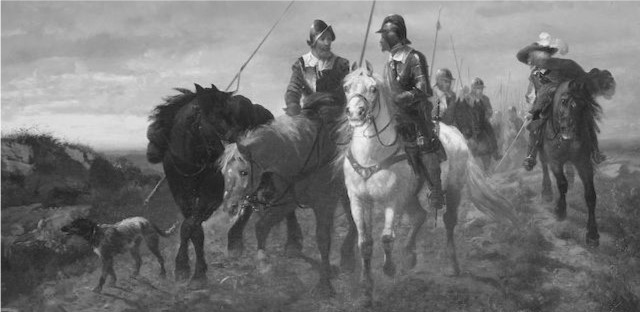
The Border Reivers Spirit of Independence
So you may be wondering what in the world does the history of the border clans and reivers have to do with the history of both Windham and America. The border clans and families moved from the “debatable lands,” first to Northern Ireland and then to America. Many came to this area of New Hampshire. Independence Day, might just be a good time to appreciate how much the Scots-Irish influenced the ethos of America. It all comes down to this; the border Scotch held honor above all, loyalty to family above all, and had an ingrained sense of individualism that made them rebel against centralized authority. The men of the borders prized their independence above all things, including the inconvenient laws issued by the “mere kings” of Scotland and England. For the most part they became small “d” democrats supporting the rebellion against King George III and backing presidents like Andrew Jackson who fought the power of the eastern elites.
“In many ways, their culture became American culture. The Scots-Irish (sometimes called the Scotch-Irish) are all around you, even though you probably don’t know it. They are a force that shapes our culture, more in the abstract power of emotion than through the argumentative force of law. In their insistent individualism, they are not likely to put an ethnic label on themselves when they debate societal issues. Some of them don’t even know their ethnic label, and some who do don’t particularly care. They don’t go for group-identity politics any more than they like to join a union. Two hundred years ago the mountains built a fierce and uncomplaining self-reliance into an already hardened people. To them, joining a group and putting themselves at the mercy of someone else’s collective judgment makes as much sense as letting the government take their guns. And nobody is going to get their guns. Quote from “Born Fighting: How the Scots-Irish Shaped America” written by James Webb.
Many fought for the South, but most gained no advantage from slavery and were not a part of the planter class, yet they fought tenaciously for “states rights.” Many more fought for the North. The hero of World War One, Alvin York was a pacifist from the hills of Tennessee, of Scotch-Irish and English extraction. And of course, the hero of the race to the moon, Neil Armstrong, was a direct descendant of the independent spirited reiver clans. It really is sad, that this county is so ignorant of its history, and that American public opinion is so easily swayed by the persuaders. The border reivers and the Scots-Irish immigrants would be appalled if they could see the strong hand that now rules America from above and the dependence on the government that personifies so many American lives. Happy Fourth of July.

Neil Armstrong on the Moon.
 Windham NH History