Windham Life and Times – June 25, 2015

Canonbie, Canobie, and Cannobie

Johnnie Armstrong
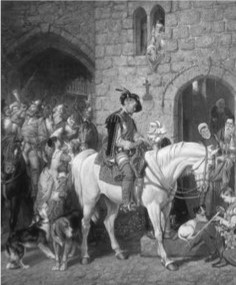
Johnnie Armstrong Meets the King

Johnnie Armstrong Meets the King

Johnnie Armstrong of Ginockie was a powerful leader who ruled a vast area along the Scottish Border. He is perhaps one of the best known figures among the Border reivers. A stirring ballad was written about him soon after his death and he was further romanticized in the nineteenth century writings of Sir Walter Scott.

Johnnie became very rich and powerful and could put 3000 horsemen in the field. Very little is known of his early life but it was rumored that he made a fortune while at sea then returned to the Esk River Valley and became a powerful leader.

Armstrong became known as “Black Jok” because he specialized in blackmail or black rent. “It was said that there was not one English place of prominence between his home at Hollows Tower, known as Gilnockie and east Newcatles which did not pay protection money to Black Jok.” The “rent” was paid to insure they would be protected from raids by both Armstrong and other Border reivers. Armstrong operated for some years under the protection of Robert, the 5th Lord Maxwell who was the Scottish West March Warden. The six Marches consisted of three on the Scottish side of the border and three on the English. The Marches were established by Scotland and England to supervise the unruly border areas. Maxwell, was one of Scotland’s great feudal barons. He was in a long lasting feud with the Johnstone Clan. Maxwell had engaged the Armstrongs as extra troops the fight the Johnstones. He subsequently owed the Armstrongs protection. Although responsible for keeping the reivers under control, Maxwell “looked the other way” as the Armstrongs and their allies, the Nixons, Elliots and Crosiers went about their reiving. Black Jok burnt Netherby in Cumberland in 1527, in return for which William Dacre, 3rd Baron Dacre burnt him out at Canonbie in 1528; and Gavin Dunbar, the Archbishop of Glasgow as well as Chancellor of Scotland, intervened with an excommunication for Armstrong. In a way the power and wealth of Armstrong was an embarrassment for the young King James V. Maxwell began to fear the power of Johnnie Armstrong and his lack of loyalty. Henry VIII was putting diplomatic pressure on James V to put an end to the lawlessness that was rampant in the Borders region. At the time there was a truce of sorts between England and Scotland and Black Jok and other reivers flouted the peace with their lucrative harassment of the English Border. James V wanted to subjugate the power of the Scottish Border clans. James V moved south to the Scottish Borders in June 1530 intent on proving to the Border clans that it was he who ruled in Scotland, including the Borders. He first executed other reiving clan leaders and then headed south to deal with Armstrong. It is said that James V tricked Armstrong into meeting him at Carlenrig. Some sources say that a “loving letter” was sent inviting him to hunt with the king. Whatever the case, a shrewd Johnnie Armstrong would never have agreed to meet the king without a guarantee of safe conduct.

According to the “Ballad,” Armstrong made a great show, dressed in his finery as would have befitted any court and accompanied by an entourage of about twenty-four Lairds and retainers, including Elliots, Littles and Irvines. Perhaps the confusion over the actual numbers hanged with Armstrong, twenty-four, thirty-six or fifty, stems whether or not the retainers were also hanged. Johnnie Armstrong sported a hat from which hung nine gold and silver tassels, and but for the sword of honor and a crown, he could have been King. When it became clear that he was to be hanged John Armstrong declared himself a subject of James his liege and stated he had only raided the English. The most famous lines, oft quoted by Sir Walter Scott, were uttered by Armstrong, when the extent of the King’s duplicity was revealed:

“To seek hot water beneath cold ice
Surely it is a great folly
I have asked grace at a graceless face,
But there is none for my men and me.”

He is also reputed to have said, “Had I known, Sire, that you would take my life this day, I should have stayed away and kept the Border in spite of King Henry and you, both. For I know that Henry Tudor would be a blithe man this day to know that John Armstrong was condemned to die. Which proves who lacks in judgement, does it not?” Nevertheless, all was in vain as he and his men were led to the trees around Carlenrig and hanged from the back of their mounts.

Legend has it that the trees at Carlenrig, where Armstrong and his followers were hanged, withered and died, and none have grown there since.”
In the aftermath of the hanging, Robert, Lord Maxwell, who came to fear Armstrong’s burgeoning power benefited from Armstrong’s death. On 8th July 1530, three days after the death, Maxwell received into his hands all the property that had belonged to Johnnie Armstrong.

Being the reivers that they were, you can be sure that the Armstrongs had their revenge. Twelve years later, in 1542, James V was to die, some say of a broken heart, following the rout of the Scottish army at the Battle of Solway Moss which took place eight days after the birth of his daughter, Mary, Queen of Scots. Some of the Armstrongs joined the English army in dealing a mortal blow to the Scots as they vainly tried to cross the river Esk at Longtown. It was the Armstrongs who picked off the remnants of the Scots army as they fled in panic north through Liddesdale.

.
Windham Life and Times – June 18, 2015

Canobie, Canonbie, Cannobie

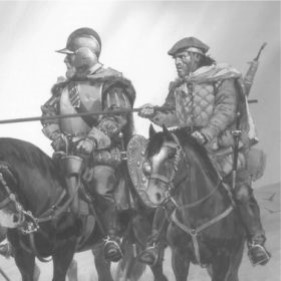
A Border Reiver with Steel Bonnet

A Border Reiver with Steel Bonnet

Part 4: What’s a Reiver

What’s a reiver? You might know that “The Reivers” is a novel written by William Faulkner. The Border Reivers were gangs of horsemen who lived in or around the “Debatable Land” on the disputed border between England and Scotland. They were basically land pirates, who raided within a days ride of their homes, from around 1300 to 1600. They also held family ties and honor in high esteem. Reivers stole cattle, sheep and horses, and were even known to hire themselves out as mercenaries. They also blackmailed landowners.

“The word blackmail has no connection at all with the postal system. In the 16th and part of the 17th centuries, the area along the border between England and Scotland was not usually protected by the officials on either side. Landholders were beset not only by outlaws but also by their own chieftains, who told them that in return for payment they would not be raided. In Scotland mail means “payment, rent, tax,” and at that time payment or rent was by custom referred to as “silver” or “white” when paid in coins. Because the robbers usually required payment in cattle or grain rather than money, their payment came to be called ‘black” mail.’ ”

“The Bands of Reivers were organized according to families and clans – rivalry and feuding between border families gave rise to raiding. Various rules and rights were observed by the clans and allowed by the ruling classes, including the ‘Hot Trod’ custom which basically said taking revenge was permitted as long as you were quick (within six days) and loud and obvious about it. Leaving it longer meant seeking official sanction for any action.”

McDonald says, “From the thirteenth to the sixteenth centuries, outlaws and ‘border lords’ reigned supreme on the contentious frontier between England and Scotland. Feud and terror, raid and reprisal, were the ordinary stuff of life—and a way of survival. Power was held by the notorious border reivers; clan-loyal raiders, freebooters, plunderers, and rustlers who robbed, murdered, and wreaked havoc. These ‘steel bonnets’ (named for their helmets), both fierce and fanciful, were the last opponents of the rule of law before the Acts of Union of 1701.
The fact of the matter is that the clans along the borders were more than just outlaws. Fierce wars were fought over this border territory and because of this there was rivalry between the kings of Scotland and England for the loyalty of the people who lived here. Since there was no official, functioning government or oversight, there developed a system of justice and rules based on loyalty to the family name.

You also have to see the reivers in their historical context. The monarchy in both England and Scotland were held and taken by force of arms. Its always interesting to me that government theft, terror and violence is sanctioned as legitimate by historians but individual force is not. Why do the national governments get a pass for the horrid crimes they commit? Henry the VIII was the ruler of England during much of this period. (1491-1547) He used political violence and war as governmental policy. His subjects who did not agree with his religious beliefs, (which put all religious authority into his hands rather than to the independence of the church) both Catholic and Protestant, were killed, often by being burned alive on the stake. He cut off the head of his wife so he could marry another, and political enemies were often beheaded, drawn and quartered or murdered. Throughout England, Henry the VIII basically stole all the wealth of the Catholic church and appropriated it to the monarchy. As you will remember, the priory at Canonbie was raised to the ground and all of it wealth robbed by the monarchy. So you have to be careful being too judgmental in the 15th and 16th century, especially of people who asserted their own rights and freedom, and who put the support and defense of their families above all else. After all, it was a time of might makes right, and where men fought for honor.

Leonard Morrison, an able advocate of the border Scots and the Windham families says, “In the belt of country in the southern part of Scotland, near the border of England, and now embraced by the counties of Dumfries and Roxburgh, once dwelt some of the most renowned of the Scottish Lowland clans, among whom were the clans Johnston, Elliot, Douglass, Maxwell, Chisholm, and Armstrong.”

“Of the clan Armstrong this article will speak. It was one of the most noted, most numerous, and most powerful of the Lowland clans. This section of country the Armstrongs occupied, being near the English border, was called the ‘Debatable Land,’ and though in Scotland, it was subject to the claims of England, and was often overrun by armies of each kingdom, and sometimes stripped and despoiled by both. By very necessities of their condition, and the troubled circumstances in which they were placed by the lawlessness of the age, they were forced to resort to expedients not justifiable in a more enlightened era. Like the neighboring clans, they followed:

“The simple Plan,
That they should take, who had the power,
And they should keep, who can.”

Two great books are in print about the Reivers. The Reivers by Alistair Moffat and The Steel Bonnets by George Fraser.

Windham Life and Times – June 11, 2015

Canobie, Canonbie, Cannobie

Part 2: Lochinvar

Lochinvar and "fair" Ellen

Lochinvar and “fair” Ellen

“Lochinvar” is a ballad with eight six-line stanzas. It tells the story of a Scottish knight, “young Lochinvar,” who is described as faithful and true but who arrives at the wedding of his romantic interest to steal her away for his own. Of course, our interest in the poem is that it is set in and around Canonbie Scotland. The brave knight swims across the River Esk, which runs though Canonbie.

Netherby Hall is a real place. “For four centuries the Graham family nurtured and developed Netherby and  its estates. Theirs is a tale of ‘rogues to riches’, steeped in the history of the Borders with its notorious Reivers and a unique part of the country that went by the forbidding name of the Debatable Land.” It appears the Netherby Grahams descended from nobility but sometime before 1492, the King of Scots, probably James III, got fed up of Lang Will’s business practices. “He was well known for his Reiver ways of extracting rents, mails, for land he did own but he went too far when he stole lands from the Earl of Morton. Put to the horn… he was eventually forced to flee with his family to the Debateable Land.” It was a British badlands of sorts, an area where any person who was out with the law could be killed without any redress on the killer,” a place for the Grahams to find refuge. “As such it was home to some of the most notorious Border Reivers, the Grahams among them. Lang Will’s family prospered. By the 1540s, made up of at least six sons,  they had half a dozen peel towers and the  eldest son, Richard, owned Netherby.  Lang Will’s rent collecting business… raised vast amounts of money, 100,000 merks according to one source. They were allies of the Armstrongs and linked by marriage to the Johnstones…”

Netherby Hall and Coop House

Netherby Hall and Coop House

O, Young Lochinvar is come out of the west;
Through all the wide border his steed was the best;
And save his good broad-sword he weapon had none;
He rode all unarmed, and he rode all alone.
So faithful in love, and so dauntless in war,
There never was knight like the young Lochinvar.

He staid not for brake, and he stopped not for stone;
He swam the Eske river, where ford there was none;
But, ere he alighted at Netherby gate,
The bride had consented, the gallant came late:
For a laggard in love, and a dastard in war,
Was to wed the fair Ellen of brave Lochinvar.

So boldly he entered the Netherby Hall,
‘Mong bridesmen, and kinsmen, and brothers, and all;
Then spoke the bride’s father, his hand on his sword,
( For the poor craven bridegroom said never a word, )
“O come ye in peace here, or come ye in war,
Or to dance at our bridal, young Lord Lochinvar?”
 
“I long wooed your daughter, my suit you denied —
Love swells like the Solway, but ebbs like its tide —
And now I am come, with this lost love of mine,
To lead but one measure, drink one cup of wine;
There are maidens in Scotland more lovely by far,
That would gladly be bride to the young Lochinvar.”
 
The bride kissed the goblet — the knight took it up;
He quaffed off the wine, and he threw down the cup.
She looked down to blush, and she looked up to sigh,
With a smile on her lips, and a tear in her eye.
He took her soft hand, ere her mother could bar —
“Now, tread we a measure ! ”    said young Lochinvar.

So stately his form, and so lovely her face,
That never a hall such a galliard did grace;
While her mother did fret and her father did fume,
And the bridegroom stood dangling his bonnet and plume;
And the bride-maidens whispered,  ” ‘T were better by far
To have matched our fair cousin with young Lochinvar. ”
 
One touch to her hand and one word in her ear,
When they reached the hall door, and the charger stood near
So light to the croup the fair lady he swung,
So light to the saddle before her he sprung !
“She is won !     we are gone, over bank, bush, and scaur;
They’ll have fleet steeds that follow,” quoth young Lochinvar
 
There was mounting  ‘mong Græmes of the Netherby clan;
Forsters, Fenwicks, and Musgraves, they rode and they ran
There was racing and chasing on Cannobie Lea,
But the lost bride of Netherby ne’er did they see.
So daring in love, and so dauntless in war,
Have ye e’er heard of gallant like young Lochinvar

Cannobie Lea on River Esk

Cannobie Lea on River Esk

Windham Life and Times – June 4, 2015

Canobie, Canonbie, Cannobie

Part 2: Sir Walter Scot and Border Ballards

Canobie, Scotland

Canobie, Scotland

Sir Walter Scott was one of the most influential writers, in the English language, during the nineteenth century. Today, most, including myself, know very little about the life and work of this writer. He is responsible for one of the most vivid lines from my childhood, one that is indelibly seared into my conscience. It is two lines from the epic poem Marmion written in 1808, which are one of the most quoted excerpts from Scottish poetry which is derived from Canto VI, XVII :

Oh, what a tangled web we weave
When first we practice to deceive!

Another quote that I’ve heard often but didn’t ever know where it came is, “Blood is thicker than water,” which comes from Guy Mannering, Ch. 37 (1815). Then there is this choice saying from, The Heart of Midlothian’, Ch. 8 (1818). Revenge is the sweetest morsel to the mouth, that ever was cooked in hell. And then this from The Talisman, Ch. 24 (1825). A miss is as good as a mile.

Sir Walter Scott

Sir Walter Scott

Most important to us here is the fact that the Scott’s were an old Scottish borders family. “Scott spent his childhood years in Edinburgh, with occasional extended visits to his grandfather Robert Scott’s farm in Tweeddale in the Borders, where he became versed in his family’s history, and in Borders culture in general.” (BBC) As a boy, youth and young man, Scott was fascinated by the oral traditions of the Scottish Borders. He was an obsessive collector of stories, and developed an innovative method of recording what he heard at the feet of local story-tellers using carvings on twigs, to avoid the disapproval of those who believed that such stories were neither for writing down nor for printing.” (Wiki) “He attended the famed Edinburgh High School, and then followed in his father’s wake by taking a law degree at Edinburgh University, being called to the Bar in 1792. At 25 he began writing, first translating works from German then moving on to poetry.

In 1797 he married the daughter of a French refugee, Charlotte Carpenter, with whom he had four children. Five years later, he published a three-volume set of collected Scottish ballads, The Minstrelsy of the Scottish Borders. This was an early indicator of his interest in Scotland and history from a literary standpoint.” (BBC)
“Scott was a poet, novelist, ballad-collector, critic and man of letters, but is probably most renowned as the founder of the genre of the historical novel, involving tales of gallantry, romance and chivalry. In 1802-03, Scott’s first major work, Minstrelsy Of The Scottish Border appeared. As a poet Scott rose into fame with the publication of The Lady of the Lake (1810), Rokeby (1813), and The Lord of the Isles (1815). With their romantic, often sublime, depictions of landscape, they fuelled the taste for the ‘picturesque’ and encouraged the trend for the inclusion of Scotland in the ‘Grand Tour,’ the cultural European tour that enticed much of the travel-minded gentry in the 18th and 19th centuries.” (BBC)

His novels and poetry are still read, and many of his works remain classics of both English-language literature and of Scottish literature. Famous titles include Rob Roy, The Lady of the Lake, Waverley, The Heart of Midlothian and The Bride of Lammermoor. Scott’s novel Ivanhoe was required reading in many American high schools into the 1950’s.

Next week we will return to our main interest, which resides in the epic poem Marmion, in which are found the lines about the hero Lochinvar. The setting for this poem is the borders of Scotland near Canonbie.


Windham Life and Times – May 28, 2015

Canonbie, Canobie, Cannobie

Pictured above in Gilnockie Tower, located 2.3 miles north of Canonbie Scotland, built by Johnnie Armstrong, around 1520. The Lochinvar, made his escape through Cannobie in Sir Walter Scott’s poem

Pictured above is Gilnockie Tower, located 2.3 miles north of Canonbie Scotland, built by Johnnie Armstrong, around 1520. The Lochinvar, made his escape through Cannobie in Sir Walter Scott’s poem

Part 1: My Apologies to Leonard Morrison

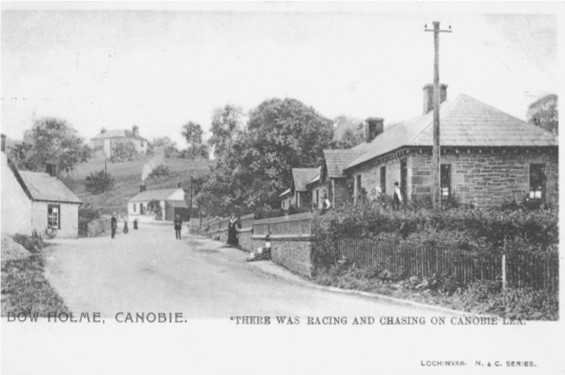
I’ve written about how the name “Canobie” Lake came to be, several times in this column, and I’ve always assumed the Leonard Morrison made a mistake with the spelling. In fact, this town in the borders lands of Scotland is now known as Canonbie, however, I’ve recently discovered that this was not always the case. I found an old postcard on which it said that the view was of Canobie, Scotland. This prompted me to do some research to see if there was more than one “Canobie.” This is what I discovered:

Canonbie is a small village in Dumfriesshire within the District Council Region of Dumfries and Galloway in south west Scotland, six miles south of Langholm and two miles north of the Anglo-Scottish border. It is on the A7 road from Carlisle to Edinburgh, and the River Esk flows through it. There are frequent references in older documents to it as Canobie. (Miller, Hugh (1871). Leading Articles on Various Subjects. p. 245.) So there it is, our beloved and accurate, Windham historian, Leonard Morrison, did not make a mistake. Canonbie was known as Canobie in the 19th century, when, the Boston & Maine Railway station was built and Policy Pond was renamed. So Mr. Morrison, I apologize for not trusting in you.

Canonbie Parish had an Austin (Augustinian) priory at Hallgreen, dating back to about 1165. The priory was destroyed during the reign of Henry VIII after the Battle of Solway Moss in 1542. A grassy mound in a field near the present day church is believed to be the only remnant of the ruins. “The priory is important in that it is the source of the name Canobie. CANOBIE, or CANONBIE, a parish, in the county of Dumfries. An ancient priory here is supposed to have given the name to this place, Canobie being probably derived from the Saxon Bie, or By, signifying “a station,” and thus interpreting the word “the residence of the canons.”

Remains of a Roman signal station can be found on rising ground near the old Gilnockie station; and ruins of famous mediaeval strongholds are at Hollows and Harelaw; remains of other mediaeval strengths are at Mumbyhirst, Auchenrivock, Hallgreen, Woodhouselees, and Stark.

Over the coming weeks, you’ll know the whole story of Canobie. You’ll hear how this town on the Scottish borders was immortalized in a poem by Sir Walter Scott, “There was racing and chasing on Cannobie Lee,” and you’ll learn about the exploits of Johnnie Armstrong, the laird of Gilnockie. There really is much more to the name Canobie, than you’ve ever imagined and is it a very appropriate name for the beautiful lake shared by Windham and Salem.

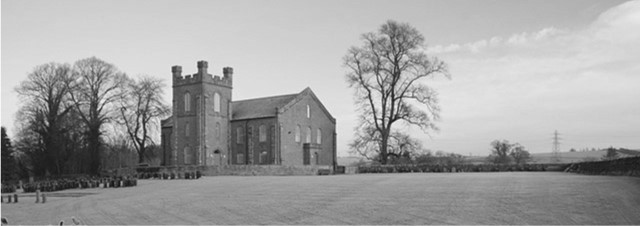
The Canonbie church was built around 1820, near the site of the original priory from which Canonbie took its name.

The Canonbie church was built around 1820, near the site of the original priory from which Canonbie took its name.

Windham Life and Times – May 22, 2015

Indian Meadows

An Indian Settlement

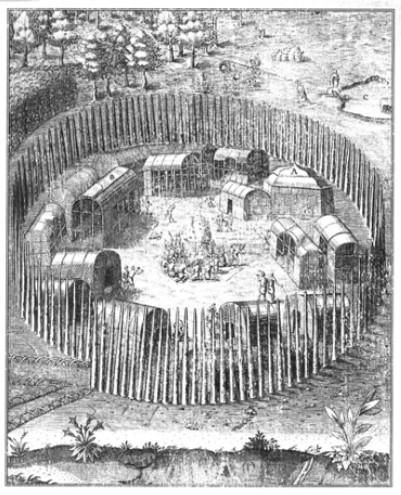
An Indian Settlement

At right, is a late 17th century representation of an East Coast Algonquian village. A description of the semi-abandoned Pigwacket village made in 1703 by an English scouting party led by Major Winthrop Hilton states: “When we came to the fort, we found about an acre of ground, taken in with timber [palisaded], set in the ground in a circular form with ports [gates], and about one hundred wigwams therein; but had been deserted about six weekes, as we judged by the opening of their barnes [storage pits] where their corn was lodged.”  The bark-covered wigwams or longhouses in this view are typical of Abenaki dwellings used in this region.  By tradition, “Pigwacket” is said to mean “at the cleared place.”

One of the interesting items found in Joseph Howe’s Historical Sketch of the Town of Methuen, was the references to “Indian meadows.” In 1642, a large area along the Merrimack River, into southern New Hampshire, was purchased from the Native Americans. In the deed is states that, “We, Passaquo and Saggahew, with ye consent of Passaconnaway: have sold unto ye inhabitants of Pentuckett all ye lands we have in Pentuckett…in consideration of ye same three pounds & ten shillings.” Before the Europeans came, this area was heavily populated by Native Americans.
From the Bethel, Maine historical society we learn that, “…the Abenaki, an eastern Algonquian sub-group, maintained their historic homeland over an area stretching from the Iroquoian tribal lands in southern Québec to the northern Massachusetts border and from the Passamaquoddy territory in eastern Maine to the shore of Lake Champlain in western Vermont.  Translated as “people of the Dawnland” or “eastern people,” the Abenaki were composed of numerous bands of Native Americans historically identified by the names of the river valleys, or principal villages, in which they lived at the time of European contact.”

“Data is lacking for a reliable estimate of Abenaki populations before 1600, but it is reasonable to state that in that year several thousand individuals inhabited the White Mountain region of Maine and New Hampshire, with a total population in New England as a whole of well over 100,000 native people.  Interrelated through marriage, and sharing a common dialect, the Abenaki participated in an annual cycle of migration that took them southward to seashore camps for the summer, northward to deep woods hunting camps in the winter, and back to their riverside villages for late fall feasting and spring fishing and planting.”

“By the middle of the 17th century, the traditional Indian way of life in this region was undergoing drastic change.  An attitude of friendly curiosity turned to distrust and hostility as the native population watched their numbers rapidly dwindle due to virulent epidemics introduced by Europeans.  Indian intertribal relationships disintegrated due to the burgeoning fur trade and the introduction of firearms.  The demand for furs, especially, strained the native economy by using up time previously spent in search of large game for food and skins; the fur trade also made natives much more aware of the importance of territorial boundaries, a concept foreign to the Abenaki before European notions of private land use and ownership were imposed on the region.  The intermingling of cultures was further strained by the effects of the liquor trade, a significant component in English and French efforts to maintain Abenaki allegiances as the century wore on.”

Now, with that brief synopsis of Native American history in New England, we return to Indian meadows. It seems that in the early settlement of Haverhill, the most desirable tracts, was land that had been cleared by the Indians. Howe states, “….It is said that the uplands at the time were mostly covered by a heavy growth of timber, except and occasional spot burned over by fires set by the Indians. The meadows were, many of them, cleared and covered with a tall and dense growth of grass. The Indians were accustomed to burn the grass in the fall, that they might more easily capture the deer resorting to them to feed on the young grass in the spring. These meadows appear to have been much sought after by the early settlers, who obtained from them he principle subsistence for their cattle. They cut and stacked the hay in summer and in the winter drew it home on sleds. An early writer says of Haverhill: ‘keeping of cattle…encourages them to spend their days in those remote parts… being an overwhelming desire in most men after meadow land.’ ”

Native Americans were not the “live in harmony with the land” types we’ve been lead to believe. “The most significant type of environmental change brought about by Pre-Columbian human activity was the modification of vegetation. … Vegetation was primarily altered by the clearing of forest and by intentional burning. Natural fires certainly occurred but varied in frequency and strength in different habitats. Anthropogenic fires, for which there is ample documentation, tended to be more frequent but weaker, with a different seasonality than natural fires, and thus had a different type of influence on vegetation. The result of clearing and burning was, in many regions, the conversion of forest to grassland, savanna, scrub, open woodland, and forest with grassy openings.”(William M. Denevan) In Windham, the “Range” between Cobbett’s Pond and Canobie Lake was once a large, Indian settlement, which was abandoned. This may have been one of the “remote parts” of Haverhill that attracted first English and then Scotch-Irish settlers.

Windham Life and Times – May 15, 2015

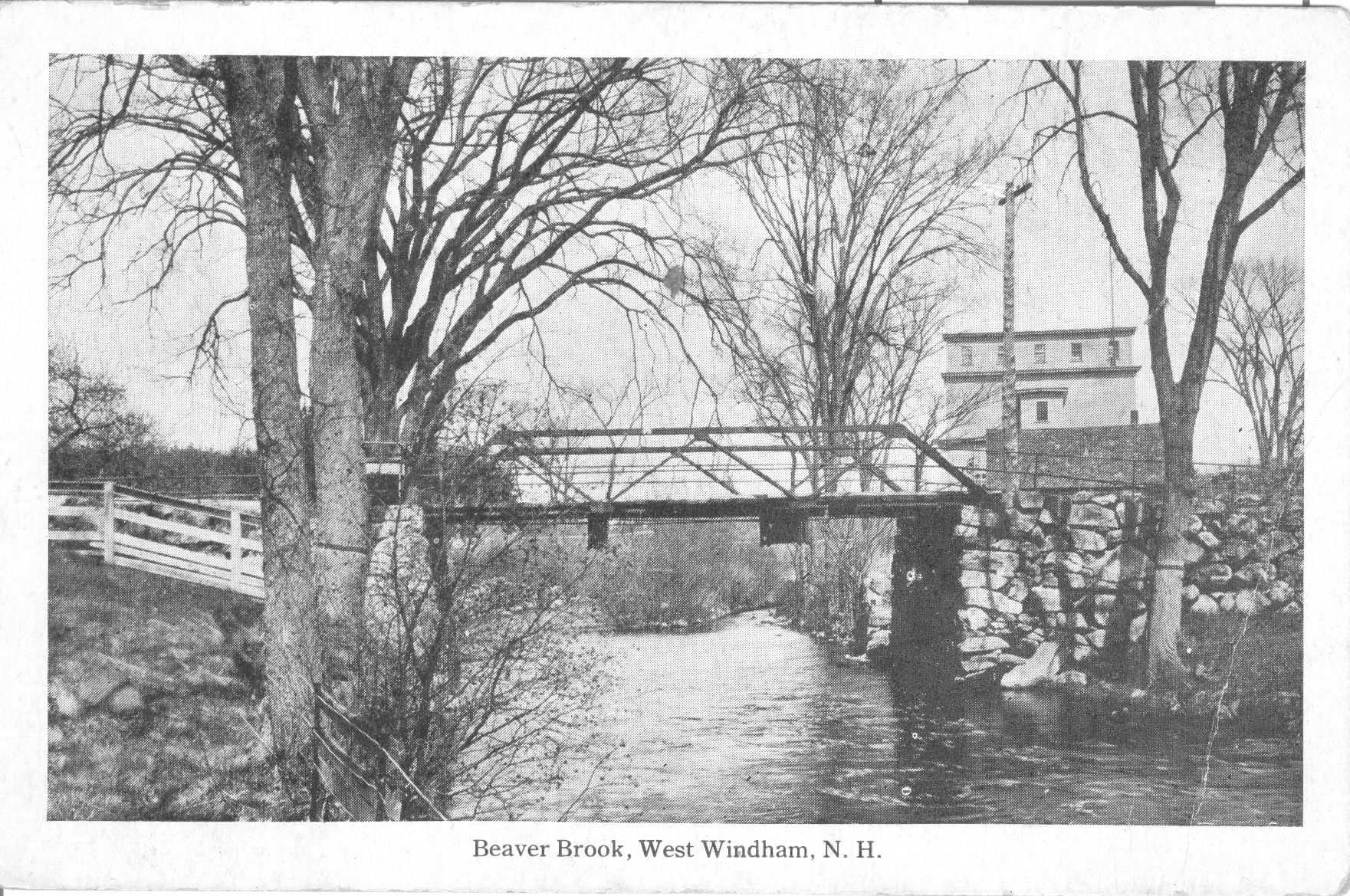
Bridges Across Beaver Brook in Windham

scan0631

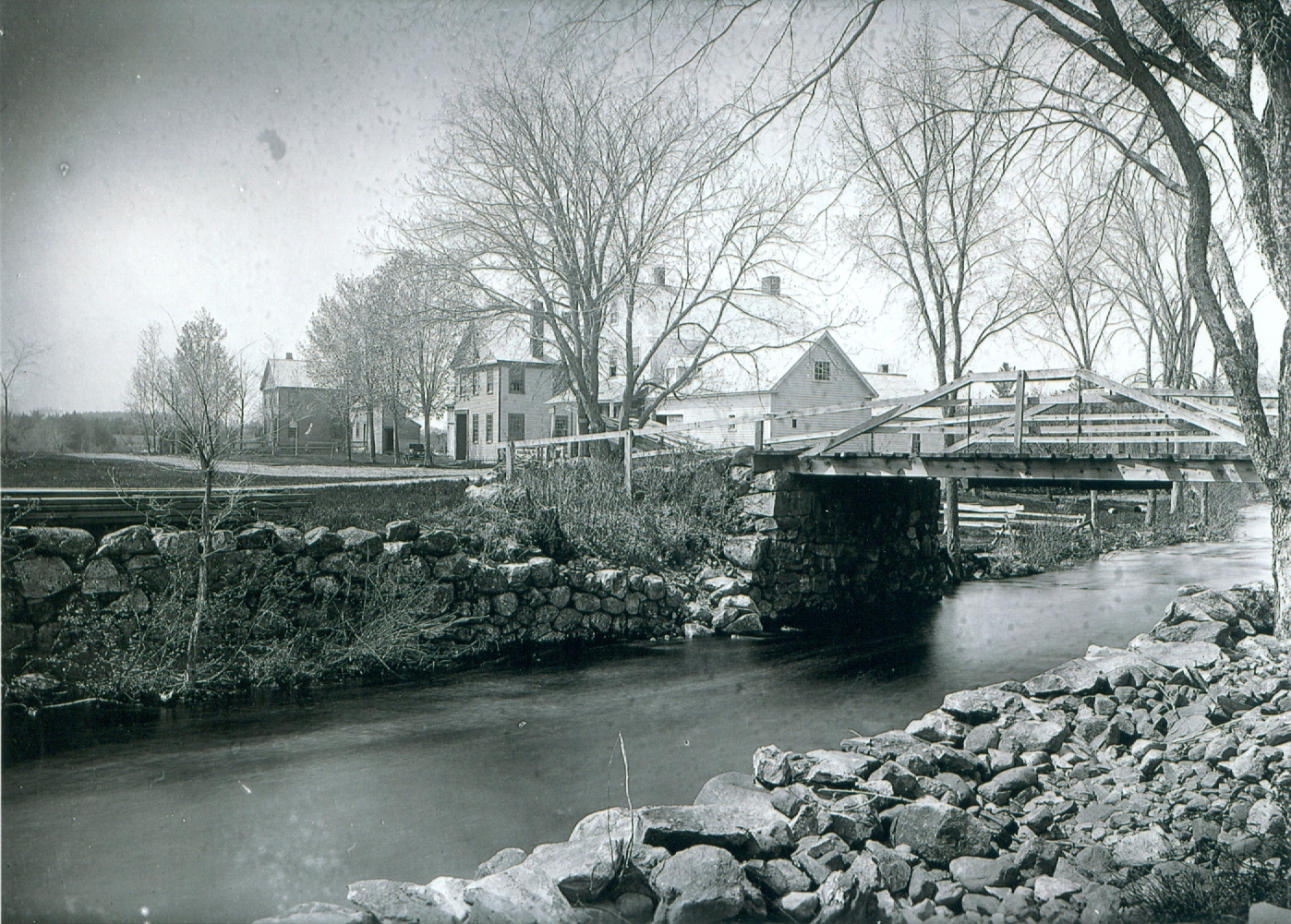
Early Bridge across Beaver brook. Image Courtesy of Society for the Preservation of New England Antiquities

There are three major crossing points in Windham across Beaver Brook. The Mammoth Road bridge crossing is shown in the two photographs above. The brook also happens to be the town line between Windham and Londonderry. Mammoth Road was a toll highway, built in 1831, that ran from Hooksett to Lowell. On the left the old wooden span has been replaced with a metal bridge. The second crossing, again on the border between Windham and Londonderry was at Kendall Mills. This bridge stood in front of the dam that created Kendall Pond. The two photographs at the bottom show this crossing. The third bridge is located on Bridle Bridge Road. This road, before it was bypassed, was once the main route to Nashua and again was at the border between Windham and Hudson.

New metal bridge at the same location on Mammoth Road

New metal bridge at the same location on Mammoth Road

Windham Life and Times – April 30, 2015

Shadow Lake

“HITTY TITTY POND”

Shadow Lake sits on the border of Salem and Windham NH

Shadow Lake sits on the border of Salem and Windham NH

I just came across this postcard of Shadow Lake and it reminded me that this beautiful pond often gets forgotten, even though it is located in both Windham and Salem. In fact, this view is mostly of the Windham shore. According to Gilbert’s History of Salem, “The name given is in accordance with the spelling employed for more than one hundred years, having derived from the name by which the Indians designated this really charming lake. It has lately been corrupted into ‘Hitatit’ and ‘Hit-Tit,’ without any reasonable justification so far as we can ascertain. More recently the name Shadow Lake has been applied to it, but the old name still holds sway…. (1907)

“It lies in a wooded hollow among high hills of the northwest part of town, at the angle with the Windham line. The highway follows the east shore for the entire length of the pond, affording one of the most beautiful drives in Salem (Old Route 111). Summer visitors have recently erected several cottages in the groves along the lakeside.”

“In years gone by, when the lake filled the entire valley and extended far beyond its present limits, the stream from the westward flowed through the lake near what then was its center; but as the waters receded, the higher part of the bed, toward the south, was the first to be left above the surface, this bringing the south end of the of the lake (or that shore nearer toward Canobie station), nearer and nearer to the entrance of the brook. It must be understood that this brook, then as now, flowed through the lake. Then a still farther recession of waters left the brook entirely outside the lake on the south, in the channel it had been wearing through so many years. Some of the oldest residents today, remember when this was the condition. But this barrier between brook and the lake was gradually worn away by the severe freshets of successive springs and they once more joined their waters. As is well known, the brook now just cuts the south end of the lake, then with augmentation there received, hurries eastward to join its sister streams.”

Shadow-2

This became the old Route 111 in Salem NH

I’m just curious of the proof that it was an Indian name. I’m wondering why the original name would devolve from “Satchwell’s Pond” in the Haverhill Proprietors book back to an Indian name? Salem was laid out and settled in the 1650’s by residents of Haverhill MA. Theophilus Satchwell was a surveyor and early settler. According to Gilbert, “We recognize the name of one of the most prominent men of Haverhill, Theophilus Satchwell…While on his journeys through the forests beyond the Spicket he came upon a fair sheet of water hidden among the hills, which up to this time had been unknown to settlers. It received the name Satchwell’s Pond; but shortly after the land was laid out, and men became familiar with that part of town, it was found that there was another name. The Indians called it Hitty Titty; at least this is the spelling given by the settlers. The name Satchwell’s does not appear again…” Let’s see, a hidden pond takes on the exact name of a popular English hide and seek game. I know, I know, it’s an Indian name. In Fact, Canobie Lake went from Haverhill Pond to Polis’ pond (later Policy) which is an Indian name.

HITTY-TITTY

Hitty-titty in-doors,
Hitty-titty out;
You touch Hitty-titty,
And Hitty-titty will bite you.

     “These lines are said by children when one of them has hid herself. They then run away, and the one who is bitten (caught) becomes Hitty-titty, and hides in her turn.”

     The name of the pond was officially changed in March of 1913. “That the name of Hit Tit or Hitty Titty pond in the towns of Salem and Windham is hereby changed to, and the same shall be hereafter known and called Shadow Lake.” Approved March 14, 1913. Of course, you can understand the desire for a name change. Can you imagining the rollicking conversation on the porch of the summer cottages, that were built on the lake, late on a Sunday afternoon, after a beer or two, about why the lake was named Hitty Titty.

Windham Life and Times – April 23, 2015

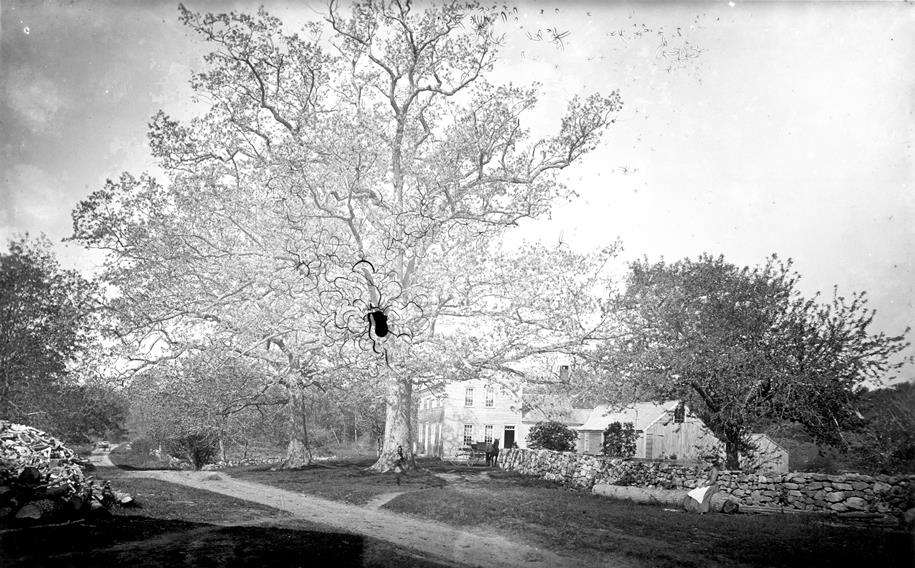
THE PARK OAKS

The Oaks at the Park Homestead, Windham NH. Baldwin Coolidge Photograph Courtesy of SPENA

The Oaks at the Park Homestead, Windham NH. Baldwin Coolidge Photograph Courtesy of SPNEA

100 YEARS AGO IN WINDHAM | W.S. HARRIS REPORTING

Windham April 23, 1915: “One of the two gigantic white oaks at the Park homestead on the Range died last year, and has been sawed down and reduced to firewood. Where cut it was a mere shell, over five feet across. About 1740, or 175 years ago, when Elder Robert Park cleared the farm and established a home where now his great grandchildren live, he left standing a row of three white oaks of the original forest. One of these long since disappeared, and now a single survivor stands, like Whittier’s ‘Wood Giant’ in ‘the loneliness of greatness,’ an object of veneration to every beholder and perhaps the only living object in all the township whose origin antedates the arrival of the pale-faced settler.”

g
‘What marvel that in simpler days
Of the worlds early childhood,
Men crowned with garlands, gifts and praise,
Such monarchs of the wildwood! ’

The last oak has long since disappeared. The home is still standing as of April 2015, next to Naults Honda.

Windham Life and Times – April 16, 2015

Club Miramar

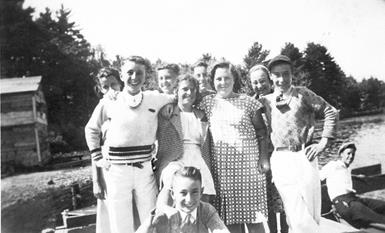
I.H.P. Cobbett's Pond, 1935

I.H.P. Cobbett’s Pond, 1935

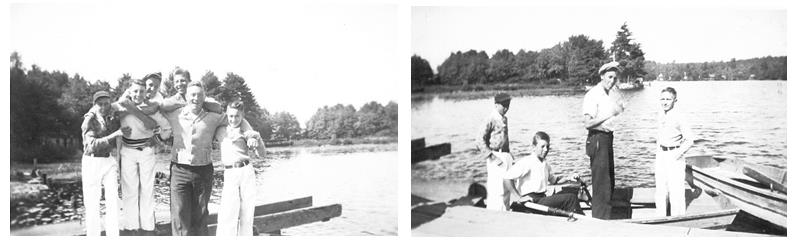
I recently acquired these old photographs which were taken on Cobbett’s Pond in 1935. Unfortunately, the people in the photographs have not been identified. The photographs were definitely taken at or near Bella Vista Beach. Bella Vista was a speak-easy for a time, but by the 1935 prohibition would have been over? Club “Mariana” is mentioned in “rural Oasis” and was a night-club/speakeasy owned by Rene Dubois. Could it have really been called Club Mirimar or Club Miramar? In 1935, the Bella Vista property was owned by Cecil and Ethel Banan. Do you know these people? E-mail and tell me what you know.

I.H.P. Cobbett’s 1935. Cobbett's Pond Club Mirimar 1935

I.H.P. Cobbett’s 1935. Cobbett’s Pond Club Mirimar 1935

Club Mirimar. Andrew 1935

Club Mirimar. Andrew 1935