Windham Life and Times – October 2, 2015

World War I Rages in Europe

Wilson Keeps Us Out of War...Until After the Election.

Wilson Keeps Us Out of War…Until After the Election.

100 Years Ago in Windham – W.S. Harris

“WINDHAM, September 28, 1915. — “Some say patriotism is dead in America. It is time that patriotism was replaced by something immeasurably higher—the brotherhood of man—taught by the Prophet of Nazareth some two thousand years ago, but forgotten by most of his followers in this “progressive” age. It is patriotism that is causing this horrible war which is bringing the nations of Europe to the verge of irresponsible ruin, the crime of the ages, with no possible good results in sight after a year’s continuance. Let patriotism die if in its place could come some hope of the ages—peace of earth, good will toward all men.” Will Harris

World War One was the bloodiest of wars, that destroyed the best and brightest of Europe. It is so hard for people who are caught up in the moment to assess the potential gains and losses of a conflict, and whether they are truly worth the cost of life and property. In April of 1915, the Germans used poison gas for the first time at the second battle of Ypres. The French had used non-lethal tear gas earlier. The Germans release of chlorine gas in its first successful use caused over 6,000 French casualties. Its use constituted a war crime violating the 1899 Hague Declaration Concerning Asphyxiating Gases and the 1907 Hague Convention on Land Warfare, which prohibited the use of “poison or poisoned weapons” in warfare. Later more deadly mustard gas would be deployed. In August, the Battle of Loos saw over 59,000 British casualties. (Wikipedia) Let that sink in, that was in just one battle of the war. You can see why most people in America in 1915, like Will Harris, wanted nothing to do with the war. During the campaign of 1916 Wilson would run as a peace candidate who promised to keep America out of the war. Of course, he would break his promise in 1917. The total number of military and civilian casualties in World War I was over 38 million: over 17 million deaths and 20 million wounded, ranking it among the deadliest conflicts in human history. The total number of deaths includes about 11 million military personnel and about 7 million civilians. It also can be argued, that World War One was the proximate cause of the Second World War that followed.

The world today has many similarities to what was taking place prior to World War I. The British Empire controlled vast colonies across the globe which made it the most prosperous nation on earth, but one that was in decline. During the 19th century, Britain dominated a uni-polar world. Germany, Japan, America and other nations as well, had expansionist ambitions that threatened British domination. Fast forward to today. Since the fall of the Soviet Union, The American Empire has dominated global trade and dictated the direction and leadership of independent countries across the globe, feeling free to deploy troops, depose leaders, and to wage proxy wars, even as we are in decline. This uni-polar world was laid out in the Wolfowitz Doctrine, an unofficial name given to the initial version of the Defense Planning Guidance for the 1994–99 fiscal years, authored by Under Secretary of Defense for Policy Paul Wolfowitz and his deputy Scooter Libby. Not intended for public release, it was leaked to the New York Times on March 7, 1992, and sparked a public controversy about U.S. foreign and defense policy. The document was widely criticized as imperialist as the document outlined a policy of unilateralism and pre-emptive military action to suppress potential threats from other nations and prevent any other nation from rising to superpower status. This outlook puts us in the same familiar territory as Britain was in before World War I, only this time, the United States is facing the rising power of China and the reassertion of Russian might. The tinderbox is not the Balkans but rather the Middle East. China and Russia flexing their muscles in Syria can only be seen as a total foreign policy disaster for the United States, (even though we created much of the mess in the first place,) and this Sunni-Shia, Christian, Jewish religious conflict runs the risk of embroiling us all in a third world war. And all of this is happening as America’s might flails impotently across the globe like a rudderless juggernaut, all moral authority lost in a frenzy of self indulgence, pretense and sense of entitlement. Pray for peace, prepare for war; that was America 100 years Ago, are we also on the precipice?

Today, there are the Muslim, Christian and Jewish beliefs in a cataclysmic end time battle. The Christians prophecy speaks of the Battle of Armageddon, which is supposed to take place in a vast plain in the Middle East. “…and they go out to the kings of the whole world, to gather them for the battle on the great day of God Almighty.” “And the four angels who had been kept ready for this very hour and day and month and year were released to kill a third of mankind.  The number of the mounted troops was two hundred million…” Revelation 9 14-16. I remember the prophecy books of the sixties, which proclaimed that Russia, China, Iran (Persia) and their allies would fight against Israel. Revelation 16″12 says that in the end times “The sixth angel poured out his bowl on the great river Euphrates, and its water was dried up to prepare the way for the kings from the East.” Who are these kings of the East?

In Islamic eschatology as found in the Hadith, the area of Dabiq is mentioned as a place of some of the events of the Muslim Malahim (which would equate to the Christian apocalypse, or Armageddon). Abu Hurayrah, companion to the Prophet, reported in his Hadith that God’s Messenger, the Prophet, said: The Last Hour would not come until the Romans land at al-A’maq or in Dabiq. An army consisting of the best (soldiers) of the people of the earth at that time will come from Medina (to counteract them). Scholars and hadith commentators suggest that the words Romans refers to Christians. The Islamic State believes Dabiq (in Syria) is where an epic and decisive battle will take place where Muslims will defeat Christian forces of the west and usher in the end of the world. Dabiq is the official online magazine of the Islamic State. (Wikipedia)

Then there is that troubling End Time verse in Revelation about the destruction of the “Whore of Babylon.”  “Through whom all of the merchants of the earth have become fabulously enriched.” Now who could St John have been talking about? In an instant her destruction is come… with fire…time to go get the marshmallows!

Windham Life and Times – September 25, 2015

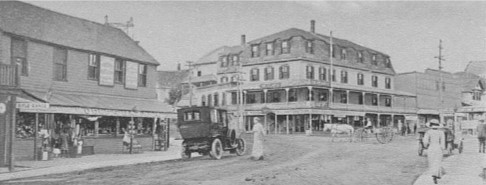
100 Years Ago In Windham – Armstrong Store

Armstrong Store Windham Junction NH

Armstrong Store Windham Junction NH

“WINDHAM, September 28. — “To our ‘steady diet’ of peaches and cream there was added on last nights tea table strawberries and cream, —strawberries of the Everbearing variety, fresh from the garden of N.W. Garland.
July, October, and March weather, all in less than two weeks. How the apples, peaches and dead limbs did rattle down from the trees in the great blow of Sunday and Monday. And how the tall pines did sway over the little cabin perched among the rocks, where we spent Sunday night.

The new pupils at Pinkerton Academy from here are Helen Worledge, Marguerite Alley and Viola Jackson. Samuel Ballou who lived with his sister, Mrs. George Seavey, at the Depot, died there Sunday, age 70. He was a native of Derry. Mrs. Caleb Clark is another sister.

A train pulls into Windham Junction with Armstrong Store at top left.

A train pulls into Windham Junction with Armstrong Store at top left.

Eugene C. True, of Derry, has bought of Eugene W. Armstrong the store property and business at the Depot which the latter has conducted for a few years past. It is the stand formerly for a long period occupied by the late Edwin N. Stickney. Mr. True has been employed for some years in the furniture store of L.H. Pillsbury & Son, in Derry, and is highly spoken of by those who know him.

Windham Life and Times – September 24, 2015

100 Years Ago in Windham – W.S. Harris

View from the rock outcroppings known variously as the “lookout” and the “crow’s nest.”

View from the rock outcroppings known variously as the “lookout” and the “crow’s nest.”

“WINDHAM, September 14— A tablet has been obtained to be attached to one of the great boulders at Fairview on Cobbett’s North Shore. The tablet measures 18 x 24 inches and in cast in ’White bronze,’ a metallic composition of pleasing gray color, made by the Monumental bronze company of Bridgeport, Conn. The inscription reads as follows:

COBBETT’S POND
So called, but with various spellings,
Since 1723.
Named from Rev. Thomas Cobbet,
Puritan minister of Lynn and Ipswich, Mass.
Who received from the General Court of Mass.
A grant of 500 acres on its north shore
In 1662.

There Windham Range in Flowry vest,
Was seen in robes of green.
While Cobbet’s Pond from east to west,
Spread her bright waves between.
-Robert Dinsmoor, 1811.

rocks-2

As it is so late in the season, the tablet will probably not be set in place until next spring, when it is hoped to dedicate is with appropriate exercises.”  W.S.H.

Margaret and Tootsie at Fairview Rocks (From William Brooks Logbooks)

Margaret and Tootsie at Fairview Rocks (From William Brooks Logbooks)

rocks-3

Windham Life and Times – September 17, 2015

100 Years Ago in Windham- W.S. Harris

“WINDHAM, September 14.— Frank Smith, who had worked several years past for G.W. Johnson and previously for other farmers on the Range, died suddenly Saturday, perhaps from the effects of drinking too much ice water during the hot days of last week. He complained of being unwell Saturday noon, and about four o’clock he was found lying on the hay in the barn with life extinct. He had a married son living in Andover, Mass., and the burial was there.”

York, Maine 1915

York, Maine 1915

“William C. Landis, of Lakeport, spoke at the church here Sunday evening, recounting in an interesting way some of his experiences as a missionary of the American Sunday School Union. He showed the need for such work in the rural sections of New Hampshire and some of the encouraging results. In the afternoon he had been at Canobie Lake helping reorganize the Sunday School at the Searles Chapel.”

“Mrs. Worledge and children are at home after their summer at Hampton Beach. The Worledge and Cochran families had a pleasant auto trip to York Beach on Friday.”

Miss Clyde's Dahlias

Miss Clyde’s Dahlias

“Miss M. Esther Clyde, sister of our postmaster, living half mile from Windham Depot in Derry, has a truly wonderful display of dahlias, having over one hundred distinct varieties.” (It must have been the cow manure that made them grow so tall. I have never seen dahlias growing at such a height as in the photograph at right.)
“Henry Earl Gilson, one of our bright boys, and son of Henry Y. Gilson. Goes tomorrow to Durham to enter the State College. He was graduated from Pinkerton last June.”

The Gilson Place, Windham, NH

The Gilson Place, Windham, NH

“From Salem Depot one can go to Lawrence by train, trolley, or jitney bus. From Windham Depot a passenger wishing to be taken to the Center, a distance of less than three miles over a good road, interviewed an owner of an auto who lived near. He wanted $1.50 for the job. He didn’t get the job.”

Windham Life and Times – September 10, 2015

100 Years Ago in Windham NH – W.S. Harris in the Exeter Newsletter

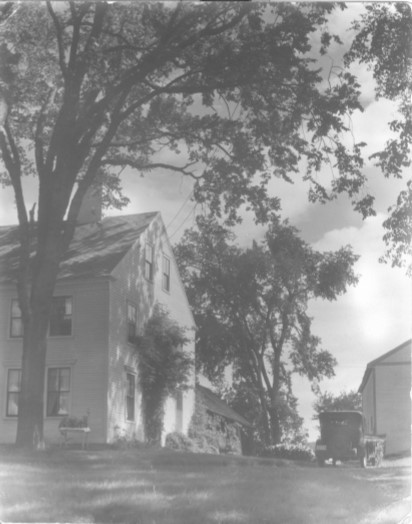
The Nesmith Homestead Windham NH during the period of this article.

The Nesmith Homestead Windham NH during the period of this article. Still standing on North Lowell Road

WINDHAM, September 7.— Mr. & Mrs. Horace Berry, as usual, attended the annual forestry meetings in the White Mountains, held this year at the Profile House.
James Upham has returned to his father’s cottage here, after serving through July and August as information clerk at the Profile House. He visited the summit of Mount Washington recently and found in the ashes of the Tip-Top House a spoon and fork which he values as souvenirs.

Mrs. Elizabeth C. (Smith) Nesmith, widow of Jacob Alpheus Nesmith passed her 84th birthday on September 3. She is one of our most esteemed and deserving old ladies, always having a genial smile and hearty handclasp for her friends. Flowers and other simple gifts helped to make the day a pleasant one. Her only son Arthur Nesmith, with his wife, lives in the other part of the house and tills the ancestral acres.
The three “Armstrong sisters” crossed Cobbett’s Pond one fine afternoon of last week to visit friends on the North Shore. This trip was a special delight to Miss Mary, who has been a partial invalid since 1877, and in all the years since, although living near the pond, has not been upon its waters. Passionately fond of nature, the beauties of the day and locality were deeply enjoyed by her.

The fiftieth wedding anniversary of Mr. and Mrs. Caleb B. Clark was fittingly and pleasantly observed on Monday afternoon by a reception at their home in the Depot district. Relatives and friends to the number of about sixty attended, giving evidence of their regard for this worthy couple. Among those present were Mr. and Mrs. Frank J. Demeritt, of Houston, Texas; Mr. and Mrs. Otis Clark of Schenectady N.Y., and others from West Medford, Haverhill, Mass., Derry and elsewhere. The fact that the observance fell upon Labor Day doubtless prevented some from attending. The house was decorated with golden rod and with choice flowers sent by friends. The customary refreshments were served. Letters from friends not present were read by Mrs., A.L. Dunton, and a presentation was made by Rev. Mr. Dunton of goodly sums in gold, contributed by many friends of Mr. and Mrs. Clark in town. Other valuable gifts were received.

Caleb Clark was born in this town March 6, 1841, and has always lived here. He is a substantial farmer and highly respected citizen, one faithful to every trust and duty. Besides holding minor offices, he has served the town as Selectman seven years, 1887-90 and 1912-14. For many years he has been among the most constant members and attendants of the Presbyterian Church at the Center, of which he was made a ruling elder in 1899. Elder Clark is descended from Samuel Clark, who with his brother George settled in Windham when it was a wilderness, coming from Londonderry, where their father, James Clark, was an early settler and elder of the church. His wife, whom he married September 6, 1865, was Nancy Ballou of Derry, a descendant of Rev. James MacGregor, the first minister in Londonderry. They have three children….” W.S.H.

Windham Life and Times – August 27, 2015

Summer’s Almost Over Now…

The Brook's Children in 1901-2 on Cobbett's Pond. Photograph of Harold Brooks.

The Brook’s Children in 1901 or 2 on Cobbett’s Pond. Photograph of Harold Brooks.

Summer’s nearly over now:
Apples blush, heavy, on bending branches;
Heatbugs rasp and saw
Through goldenrod endless afternoons.

Later crickets clatter,
Stitching warm darkness with thin strings of sound.

In the bushes a hundred fireflies
Flitter and fade, pointing the night
With silent white flashes…

…Long shadows in the afternoon;
Peaches yellow in mellow sunshine;
Squash brilliant and bumpy on market stalls;
And the occasional early pumpkin.

Evenings are cooler, nights longer;
Summer’s almost over now. W.H.M

Windham Life & Times – August 20, 2015

Where Have All the Hurricanes Gone?

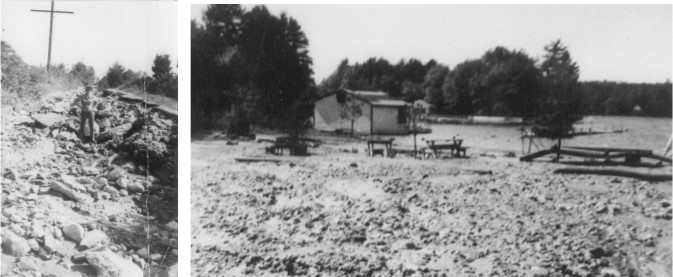
bella vista huricane

It is really strange how quiet the Atlantic and Caribbean have been recently during hurricane season. There is no question that weather goes through phases of activity and inactivity. These photographs show the damage at Bella Vista Beach after a hurricane that hit New England in the 1950’s. Hurricane season lasts from June 1st through November 30th so there is still plenty of time for storms to form and make landfall.

In a recent Washington Post article by Angela Fritz, about the quiet hurricane season , she says that, “…what’s interesting is that the area that we look to for the development of the strongest hurricanes — the main development region just north of the equator in the Atlantic Ocean — has been very, very quiet. Not a single storm has formed in this area so far this year. Nothing has even hinted at it. The lazy summer comes as no surprise to seasonal hurricane forecasters who all predicted a relatively inactive season before it began June 1. NOAA’s forecast in late May called for a 70 percent chance of a below-average season, with six to 11 named storms, three to six of which could become hurricanes, and up to two major hurricanes. It was the highest probability of a below-average season that NOAA had ever forecast.

High Wind Shear: “Wind shear is one of those things that can make or break a season. Even if everything else is working against hurricane formation — cooler than average ocean temperatures, few low-pressure waves — low wind shear could be the thing that tips the scales.  El Nino’s most direct impact on the Atlantic hurricane season is increased wind shear. Such is the case this year, which has been exhibiting record-breaking wind shear…Klotzbach found that just in the Caribbean, wind shear has reached record levels since the beginning of the satellite era, nearly double what it was in the epic El Nino year of 1997.”

Cooler than Average Ocean Temperatures: “Sea surface temperatures are the most straightforward way to determine if conditions in an ocean basin are conducive for hurricane development. At the very core of necessary conditions for hurricanes is warm ocean waters — generally 82 degrees or warmer — that serve as fuel for the storms to grow. So far this season, surface temperature in the tropical Atlantic has been running three to four degrees cooler than average, and the actual magnitude of the temperature is only marginally conducive to support hurricane formation, particularly in the main development region east of the Caribbean. Sea surface temperature is actually warmer in the Gulf of Mexico and off the east coast of Florida. Klotzbach says the month of June in the main development region was the second-coldest on record since 1900, relative to the rest of the tropics.” That’s funny, since the earth is experiencing catastrophic global warming.

High Pressure and Sinking Air: “Something that is closely related to the abnormally cool ocean temperatures is the pressure pattern between the Atlantic and the East Pacific. The East Pacific has been boiling over with record warm ocean water, fueling a record hurricane season there. That has led to a lot of hot, rising air west of Mexico and sinking air — or high pressure — over the Atlantic. If there’s a place that storms are unlikely to form, it’s in a region of high pressure and sinking air, over an abnormally cool surface, and forecasts are calling for a continuation of this pattern into the fall .”
Lots of Dust From the Sahara in Africa: “The final nail in the hurricane season thus far is the copious amounts of dust blowing west off the coast of Africa. It helps that there hasn’t been much rain in the region (say, in the form of a tropical storm) to rinse the dust out of the atmosphere. In general, Saharan dust over the Atlantic is not in itself sufficient to totally destroy a season, but it does serve as the dry, sandy icing on the anti-hurricane cake.”

Windham Life and Times – August 13, 2015

The Pines, West Windham NH

Pines

“Originally built by J.P. Hughes in 1849 who sold it to Horace Berry in 1910. Horace Berry died and left the property to his wife Margaret J. Berry who sold it to Herbert E. Russell in 1919. Russell sold it to George Butterfield in 1921 who resided on the property until he sold it in 1943.”  Rural Oasis.  Since George Butterfield is noted on the postcard the photograph must have been taken after 1921.

Windham Life and Times – August 7, 2015

100 Years Ago in Windham – W.S. Harris – Haying

Haying on the Johnson Farm in Windham NH

Haying on the Johnson Farm in Windham NH

Windham, August 10: Some farmers claim to have finished their haying, but how that feat was accomplished remains a mystery.” W.S.H.

Haying on the Wilson Farm on the Windham/Derry Line

Haying on the Wilson Farm on the Windham/Derry Line

“…He spoke of the grass and flowers and trees,
Of the singing birds and the humming bees;
Then talked of the haying, and wondered whether
The cloud in the west would bring foul weather…”
From “Maud Muller” John Greenleaf Whittier

Haying on the Markewich Farm in West Windham

Haying on the Markewich Farm in West Windham

“Yes, long shadows go out
from the bales; and yes, the soul
must part from the body:
what else could it do?
The men sprawl near the baler,
too tired to leave the field.
They talk and smoke,
and the tips of their cigarettes
blaze like small roses
in the night air…”
(It arrived and settled among them before they were aware.)
The moon comes
to count the bales,
and the dispossessed–
Whip-poor-will, Whip-poor-will
–sings from the dusty stubble.
These things happen.
the soul’s bliss
and suffering are bound together
like the grasses.
The last, sweet exhalations
of timothy and vetch
go out with the song of the bird;
the ravaged field
grows wet with dew.
“Twilight: After Haying” Jane Kenyon

Haying -Everyone Helps

Haying -Everyone Helps